
Google Shopping Ads in Dubai (2026): Real AED CPCs and Merchant Center Setup
Shopping ads take 76% of retail search ad clicks and one in five apparel listings carries a disapproval. Real AED Shopping CPCs for Dubai, Merchant Center setup and the UAE feed rules.
- PUBLISHED
- 13 OCT 2026
- READ TIME
- 12 MIN
- AUTHOR
- AQUARIUS · DUBAI
- UNIT
- REV 2026.09
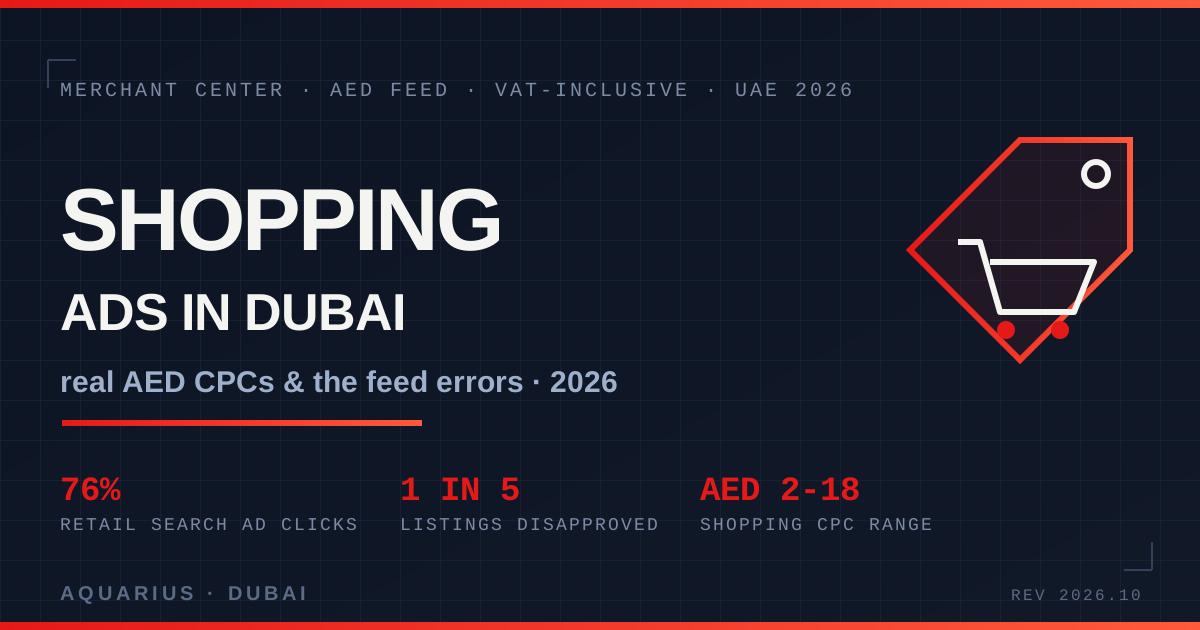
Short answer: Google Shopping ads in Dubai cost roughly AED 2–18 per click depending on category — about AED 5 average in fashion and AED 8 in jewellery and gold — which is consistently cheaper than the AED 5–18 you pay for the same traffic through Search text ads. Shopping formats take an estimated 76% of all retail search ad clicks, so for a UAE store with a real product catalogue this is not an optional channel. The catch is the feed: price and availability mismatches are the single most common disapproval reason, and in a typical apparel catalogue about one in five Shopping listings is carrying an active disapproval right now.
Key takeaways
- The UAE ecommerce market is US$12.30 billion in 2026, heading for US$21.01 billion by 2031 at an 11.29% CAGR, with 11.04 million online shoppers and over 45,000 active ecommerce stores.
- Amazon.ae, Noon and Carrefour UAE together hold 45–50% of UAE ecommerce GMV, charging 5–15% and 7–15% category commission. Shopping ads are how a direct store buys that shelf space back without paying commission on every order.
- Average CPC on Shopping and Performance Max rose about 15% between June 2025 and June 2026. Dubai targeting runs 30–50% above Abu Dhabi and 50–70% above Sharjah and Ajman for the same query.
- UAE law requires displayed prices to be VAT-inclusive everywhere a price appears. Get this wrong between feed and landing page and Google disapproves the product — the compliance rule and the ad platform rule happen to agree.
- Merchants who did not update their feed practices saw disapproval rates rise an average of 18% in Q1 2026 as Google tightened product data requirements.
Why the shelf matters more than the shopfront in the UAE
The numbers behind UAE online retail are no longer speculative. The market is valued at US$12.30 billion in 2026 and forecast to reach US$21.01 billion by 2031. There are 11.04 million online shoppers, internet penetration sits near 99% across 11.3 million users, and roughly 80% of payments are made digitally. In Dubai specifically, wholesale and retail trade produced AED 50.9 billion of real gross value added in Q1 2026 alone — about 22% of the emirate’s GDP.
Here is the part most Dubai store owners get wrong. They think their competition is other websites. It is not. Amazon.ae, Noon and Carrefour UAE control 45–50% of GMV between them, and when a shopper in Jumeirah searches a product name, the top of the page is a product grid — images, prices, store names — not ten blue links. If your catalogue is not in that grid, the marketplace listing of your own product is, and you are paying 5–15% commission for the privilege. We ran those economics in detail in our guide to selling on Noon and Amazon versus your own store.
Shopping ads are the cheapest route onto that shelf because the format does a different job to a text ad. Global data puts average Shopping CPC near US$0.66 against US$1.16 for ecommerce search clicks, and vendors measuring UAE accounts report roughly a 30% higher conversion rate than equivalent text ads — unsurprising, because the shopper has already seen the product and the price before clicking.
What Google Shopping actually costs in Dubai in 2026
Real AED ranges, from UAE account benchmarks published this year rather than global averages converted at the peg.
| Category / format | AED CPC range (2026) | Typical average | Note |
|---|---|---|---|
| Fashion and apparel — Shopping | AED 2–10 | ~AED 5 | Highest competition, lowest barrier to entry |
| Jewellery and gold — Shopping | AED 3–18 | ~AED 8 | High ticket, worth the CPC on margin |
| Performance Max (blended, all assets) | AED 2–12 | — | Blends Shopping, Display, YouTube and Discover inventory |
| Ecommerce (non-electronics) — Search text ads | AED 5–18 | — | The comparison that makes Shopping look cheap |
| Display remarketing | AED 0.50–4 | — | Cart abandoners, not cold prospecting |
| Ecommerce CPA (mid-ticket order) | AED 60–180 | — | Judge the channel on this, not on CPC |
Three multipliers nobody warns you about. Geography: Dubai targeting costs 30–50% more than Abu Dhabi and 50–70% more than Sharjah or Ajman for an identical query, which is an argument for emirate-level campaign splits rather than one UAE campaign. Season: peak windows — Ramadan, December to January, GITEX and back-to-school — push CPCs 40–60% above off-season. Trend: Shopping and Performance Max CPC climbed about 15% year on year to June 2026, so a 2024 budget model is already out of date. Our broader Google Ads cost in Dubai breakdown covers the Search side of the same account.
Practical floor: AED 50–100 a day is enough to gather usable data on a narrow catalogue; competitive categories need AED 200–500 a day before the bidding algorithms have anything to learn from. There is no official Google minimum, but there is a statistical one — smart bidding wants 30–50 conversions in 30 days before it stabilises.
Merchant Center for a UAE store: five things that are different here
Merchant Center is the same product worldwide. The compliance surface is not.
- AED as primary currency, United Arab Emirates as country of sale. Feeds priced in USD for a .ae store are a reliable way to lose the click to a competitor whose price the shopper can actually read.
- VAT-inclusive prices, by law and by policy. Consumer protection runs on Federal Law No. 15 of 2020, amended by Federal Decree-Law No. 5 of 2023, with detail in Cabinet Resolution No. 66 of 2023: the price the customer will actually pay, including 5% VAT, must be shown wherever a price appears — not revealed at checkout. UAE VAT legislation says the same about advertised prices. Google independently disapproves products when feed price and landing-page price disagree. One mistake, two separate penalties.
- Business verification against your trade licence. You will need licence details and a website URL that matches your verified domain exactly, including the www or non-www form, plus phone or postcard verification. Account and domain verification takes minutes; budget 3–5 business days for the initial product review once the feed is up.
- Arabic is a second feed, not a translation toggle. Arabic titles and descriptions perform materially better across the GCC, and the right implementation is a separate Arabic-language feed with human-written titles. Machine-translated titles pasted into a feed read as spam to shoppers and get ignored by Google’s matching. Same discipline as our Arabic and RTL localisation guide.
- Shipping and returns must be real. UAE shoppers filter hard on delivery speed, and configured shipping that does not match what your checkout quotes is both a disapproval risk and a conversion killer.
The feed errors that quietly kill Dubai catalogues
Disapprovals do not announce themselves. A disapproved product simply stops appearing, and it never shows up in your ad reporting as a loss — it shows up as missing impressions you did not know you should have had. The ranked causes, from 2026 analyses:
- Price and availability mismatch — the number one cause. Google crawls your landing page and compares. A promo applied in the cart but not in the feed, or an out-of-stock flag that syncs nightly instead of hourly, is enough. One documented case wiped 40% of a merchant’s SKUs on the day a six-week promotion launched.
- Missing or invalid GTINs — the second most common data cause. Branded resale products need them. Dubai distributors reselling imported stock are the most exposed, because the GTIN sits in a supplier sheet nobody mapped into the catalogue.
- Image policy violations. Apparel requires a white background; promotional overlays and watermarks are rejected across categories.
- Titles written for the brand, not the buyer. “Signature Collection Piece 04” has no search demand. Brand plus product type plus key attributes does.
Scale of the problem: roughly one in five listings in a typical apparel catalogue carries an active disapproval, and merchants who did not adapt to 2026’s tightened requirements saw disapprovals rise about 18% in Q1 2026. Analysis from FeedArmy attributes only about 10% of disapprovals to Google itself — the remaining 90% trace back to the merchant’s own site or data. That is actually good news, because it means almost all of it is fixable without an appeal.
The 2026 shift: your feed is now the storefront AI reads
This is the structural change worth budgeting for. Google’s generative surfaces — AI Mode, Gemini shopping answers and the new agentic checkout flows — draw on the same product graph that Merchant Center feeds. An AI agent assembling a recommendation never sees your design, your photography direction or your brand film. It sees attributes. Products with thin or inconsistent data get filtered out of the reasoning before the shopper ever sees a shortlist.
At Google Marketing Live in May 2026, Google added six conversational attributes to Merchant Center: question_and_answer, document_link, related_product, item_group_title, variant_option and popularity_rank. They are optional and do not affect approval — which is exactly why most Dubai catalogues have not filled them in, and exactly why filling them in is currently cheap advantage. Alongside the established product_highlight and product_detail fields, they are the raw material for conversational shopping answers. The priority order has not changed, though: accurate real-time price and availability first, then specific titles, then identifiers, category and images.
Two more 2026 developments to plan around. On 20 April 2026, sponsored tiles were documented appearing inside the Shopping tab’s free-listing grid — a space that had been purely organic since 2020 — so a store can hold its impression count and still lose sessions. And free listings stay worth claiming despite tiny click share: in one apparel brand’s April 2026 data, free Merchant listings drove under 1% of Search Console clicks but organic Shopping sessions produced about 77% more revenue per session than regular organic search. Google’s own line is that retailers running free listings and ads together see roughly twice the views and 50% more visits. Run both — the feed is the same asset. The agent-facing side of this is covered in our piece on AI shopping agents and your Dubai store, and the on-site half in schema markup for Dubai websites.
What setup and management cost in Dubai
Our AED ranges, excluding ad spend.
| Scope | What you get | AED (2026) | Timeline |
|---|---|---|---|
| Merchant Center foundation | Account and domain verification, trade-licence business verification, primary AED feed, shipping and returns config, policy pass | AED 4,500–9,000 | 1–2 weeks |
| Feed optimisation | Title and attribute rewrite, GTIN mapping, google_product_category and product_type taxonomy, image policy fixes, supplemental feeds | AED 8,000–18,000 | 2–3 weeks |
| Bilingual AR/EN feed | Human-written Arabic titles and descriptions, separate Arabic feed, RTL landing-page parity | AED 9,000–22,000 | 2–4 weeks |
| Campaign build and tracking | Shopping plus Performance Max structure, emirate splits, GA4 and server-side conversion tracking, value-based bidding | AED 12,000–28,000 | 2–4 weeks |
| Feed automation (ERP or POS to Google) | Hourly price and stock sync from your ERP, POS or Shopify to Merchant Center, disapproval alerting, AI Mode attributes populated from product data | AED 15,000–45,000 | 4–8 weeks |
| Monthly management | Bid and budget management, feed health monitoring, disapproval triage, promo and seasonality calendar, reporting | AED 3,500–12,000/month or 10–15% of spend | Ongoing |
One VAT note founders miss: Google invoices UAE advertisers from a non-resident entity, so the 5% VAT is accounted for by you under the reverse-charge mechanism in your own return rather than charged on the invoice. Budget it as a real cost, because it is one.
The arithmetic that decides this
Take a Dubai fashion store doing AED 400,000 a month online. Route AED 100,000 of that through a marketplace at 10% commission and the channel costs AED 10,000 that month — and every month after, forever, with the customer relationship owned by the marketplace. Drive the same AED 100,000 through Shopping ads at an AED 5 average CPC, a 2% conversion rate and an AED 350 average order: that is 286 orders needing about 14,300 clicks, or roughly AED 71,500. Worse — and that is the honest answer at those assumptions. Flip one variable and it inverts: at a 3.5% conversion rate on an optimised product page the same revenue costs about AED 40,800, and at an AED 600 average order it drops under AED 24,000. Shopping ads reward high average order value and good product pages; marketplaces reward neither. That is the real decision, and it is a spreadsheet, not an opinion. If your product pages are the weak link, the fix is upstream — see ecommerce website cost in Dubai and Shopify versus custom ecommerce.
How Aquarius does it
We start with a feed audit, not a campaign. Every SKU gets checked for price and availability parity against the live landing page, GTIN coverage, image policy and title search demand — because spending on a catalogue where one in five products is disapproved is just funding your competitors’ impression share. Then we automate the sync so price and stock update hourly from whatever system owns the truth, populate the AI Mode attributes while they are still optional, and only then build campaigns, split by emirate so Dubai CPCs do not eat a budget Sharjah could have spent better. Fixed-scope pricing in AED, your Merchant Center and Google Ads accounts stay in your own name, and the feed logic is handed over documented. Our pricing page shows how we scope fixed-price work.
FAQ
How much do Google Shopping ads cost in Dubai?
Expect AED 2–10 per click in fashion and apparel (around AED 5 average) and AED 3–18 in jewellery and gold (around AED 8). Blended Performance Max runs AED 2–12. A mid-ticket ecommerce acquisition lands around AED 60–180. Dubai targeting costs 30–50% more than Abu Dhabi and 50–70% more than Sharjah or Ajman for the same query, and peak seasons add another 40–60%.
Do I need a UAE trade licence to use Google Merchant Center?
You need a verifiable business to complete Merchant Center business verification, and for a UAE store that means your trade licence details plus a domain that matches your verified website exactly. You also need your pricing and tax display to be locally compliant — VAT-inclusive at every price touchpoint — before the catalogue will survive review.
Why are my products disapproved in Merchant Center?
Most commonly a price or availability mismatch between your feed and your landing page, then missing or invalid GTINs on branded products, then image policy violations such as a non-white apparel background or a promotional overlay. Only around 10% of disapprovals are attributable to Google itself; the rest trace to merchant data or the website, which means they are fixable without an appeal.
Should I run Shopping ads or sell on Noon and Amazon?
Run both, but know what each costs. Marketplace commission is 5–15% on Amazon and 7–15% on Noon of every order, forever, and the customer belongs to the platform. Shopping ads cost per click regardless of outcome, so they win when your average order value and conversion rate are healthy. Roughly 42% of UAE online shoppers buy from both marketplaces and direct brand sites, so direct is not a niche.
Do I need a separate Arabic product feed for the UAE?
If you want the Arabic-language half of the market, yes. Arabic titles and descriptions perform measurably better across the GCC, and a separate Arabic feed with human-written copy is the correct implementation. Machine-translated titles dumped into the primary feed hurt both matching and trust.
How long before Shopping ads produce results in Dubai?
Product review takes 3–5 business days after the feed is submitted. Expect two to four weeks of data collection at AED 50–100 a day on a narrow catalogue, or AED 200–500 a day in competitive categories, before bidding stabilises around 30–50 conversions per 30 days. Feed quality, not budget, decides where that curve plateaus.
Figures checked on 13 October 2026: Mordor Intelligence UAE ecommerce market size and 2031 forecast; UAE online shopper, internet penetration and active-store counts from 2026 UAE ecommerce statistics compilations; Dubai Statistics Centre wholesale and retail GVA for Q1 2026; published 2026 UAE Google Ads CPC benchmarks by industry and emirate; Google Merchant Center Help on supported currencies and countries; Productsup and FeedArmy 2026 analyses of disapproval causes and rates; PPC Land reporting on the Merchant Center AI Mode attributes announced at Google Marketing Live in May 2026 and on free listings; Brodie Clark’s 20 April 2026 documentation of sponsored tiles in the Shopping tab grid; UAE Federal Law No. 15 of 2020 as amended by Federal Decree-Law No. 5 of 2023 with Cabinet Resolution No. 66 of 2023, and UAE VAT legislation on advertised prices. AED/USD converted at the fixed 3.6725 peg.
Want to know whether your catalogue would survive a Merchant Center review? Send us your product feed URL — we will come back with the disapprovals you are already carrying and what the fix costs.