
Agentic Commerce in Dubai (2026): In-Chat Checkout Died, Agent-Ready Product Data Won
85% of UAE shoppers already use AI to shop, but only 32% trust an agent to pay. What Dubai stores must fix in 2026 now that ChatGPT checkout is gone - feeds, schema, crawler access and AED costs.
- PUBLISHED
- 30 SEPT 2026
- READ TIME
- 11 MIN
- AUTHOR
- AQUARIUS · DUBAI
- UNIT
- REV 2026.09
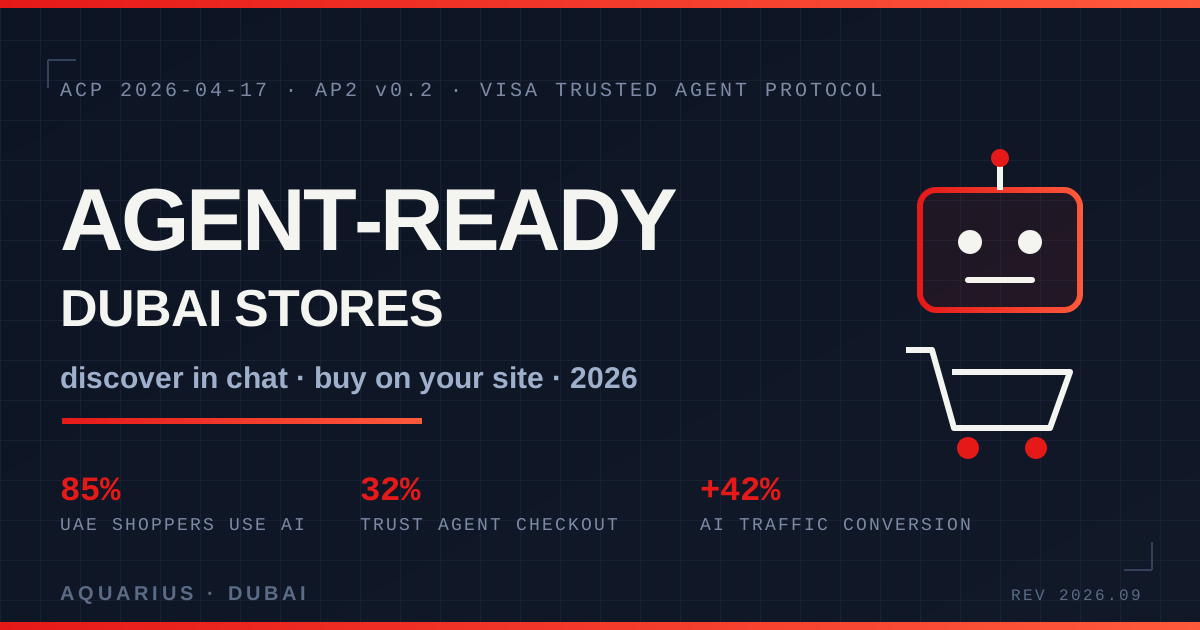
Short answer: AI shopping agents are already sending real buyers to UAE stores, but not the way the 2025 headlines promised. OpenAI retired ChatGPT Instant Checkout on 24 March 2026 after fewer than about 30 Shopify merchants ever went live, and repositioned ChatGPT around discovery - the shopper finds the product in the chat, then buys on your site. So the money in 2026 is not in agent checkout. It is in being the store an agent can read, price, stock-check and confidently recommend: a valid product feed, complete Product schema, open access for AI crawlers, and a checkout that does not break when an agent-referred human lands on it. Budget AED 6,000-45,000 depending on your platform.
The Dubai numbers that make this urgent
Agentic commerce reads like a Silicon Valley story until you look at Gulf adoption, which is running ahead of most of the world.
- 85% of UAE consumers have already used AI to help them shop, and 93% say AI tools make online shopping faster and easier - Visa’s Stay Secure Study 2026, fielded by Wakefield Research across 5,800 adults in 17 CEMEA markets in January-February 2026.
- They use it for the exact moments that decide a sale: checking reviews and ratings (60%), comparing prices (59%) and finding gift ideas (55%). And 60% say they typically discover new brands or retailers while shopping online.
- Only 32% would trust an AI agent to complete checkout on its own. That single number explains why in-chat checkout stalled and why discover-in-AI, buy-on-the-merchant-site is the model that survived.
- The supply side has already moved: 91% of UAE e-commerce companies use some form of AI across their platforms and 84% expect to use more over the next five years.
- The prize keeps growing. The UAE e-commerce market is estimated at USD 12.30 billion in 2026 and forecast to reach USD 21.01 billion by 2031 (11.29% CAGR), with Dubai taking roughly 60% of it and about 11.04 million people in the country shopping online.
Put those together and the gap is obvious. Nearly nine in ten shoppers in the Emirates are pointing an AI assistant at your category. Almost none of them will let it pay. Which means the winner is whoever gets recommended, not whoever gets integrated.
What actually happened to ChatGPT checkout
Here is the myth-bust most Dubai agencies are still selling wrong. Instant Checkout launched with Etsy on 29 September 2025 and a promise of a million Shopify merchants. Six months later, on 24 March 2026, OpenAI pulled the in-chat purchase flow. CNBC reported the core reasons: merchant adoption never arrived, the catalogue stayed thin, and item information was not always current.
Most Dubai businesses are preparing for the wrong thing. You do not need an agent checkout integration in 2026. You need product data an agent cannot get wrong.
The protocol layer did not die with the feature, which is the part worth understanding:
- Agentic Commerce Protocol (ACP) - the OpenAI and Stripe open standard - kept shipping. PayPal joined as a payment provider on 28 October 2025, Stripe released its Agentic Commerce Suite on 11 December 2025, and the stable spec cut is dated 2026-04-17.
- Google’s Agent Payments Protocol (AP2) launched in September 2025 with 60+ partners including Mastercard, American Express, PayPal, Coinbase and Salesforce. v0.2 landed on 28 April 2026, and Google donated the protocol to the FIDO Alliance for community governance.
- Visa’s Trusted Agent Protocol, introduced in October 2025 with more than ten partners, solves the merchant-side problem: telling a legitimate AI agent apart from a malicious bot using agent-specific cryptographic signatures.
And it has a UAE beachhead already. Visa is working with Aldar so customers in the UAE can use AI agents to pay repetitive charges such as real estate service fees. That is agentic payment landing in local property portfolios, not a distant US pilot.
What an AI agent actually needs from your store
Every one of these protocols - ACP, AP2, Trusted Agent Protocol - assumes the same foundation: machine-readable product data. An agent will not scrape your carousel and guess. Here is the practical 2026 checklist for a UAE store, in the order it pays off.
1. A validated product feed
OpenAI’s commerce documentation is explicit that merchants supply identifiers, descriptions, pricing, inventory, media and fulfillment options, with required fields existing specifically so price and availability display correctly. Accepted formats are CSV or JSON, and the onboarding pattern is an initial sample feed for validation followed by daily snapshots. If your Dubai store still edits prices by hand in the CMS, you do not have a feed - you have a liability.
2. Complete Product schema on every product page
Structured data is no longer an SEO nice-to-have; it is the fallback an agent uses when there is no feed, and the cross-check when there is. Ship Product, Offer with priceCurrency set to AED, availability, and AggregateRating or Review where the reviews are genuine, plus GTIN or MPN identifiers. Extracting facts from prose is slower and wronger for the agent, and every wrong extraction is a lost recommendation. See our guide on getting cited by AI search for the content side of the same problem.
3. Crawler access you have probably blocked by accident
This is the single most common failure we find on Dubai stores. A WAF rule, an aggressive bot-fight mode, or a copy-pasted robots.txt that blocks GPTBot will often also block OAI-SearchBot, the crawler behind ChatGPT’s search and shopping surfaces. Blocking a training crawler while allowing a search crawler is a deliberate two-line decision. Most stores make it by accident and quietly disappear from AI recommendations.
4. Delivery and price truth for the UAE
Agents compare. If your product page cannot answer whether an item reaches Sharjah tomorrow and what that costs, a competitor’s page can. Publish emirate-level delivery windows and charges, show prices in AED with 5% VAT handled explicitly, and keep stock accurate to the hour. Cash on delivery and BNPL still carry a large share of UAE baskets - see payment gateway options for Dubai stores - and an agent that cannot see a payment path it understands will route the shopper elsewhere.
5. Arabic that is real, not translated at runtime
Arabic product data is a ranking and recommendation asset in the Gulf. Machine-translated titles injected by a plugin at page load are not equivalent to a bilingual feed and proper right-to-left product pages.
| Protocol / standard | Who runs it | Status, September 2026 | What it needs from a Dubai merchant |
|---|---|---|---|
| ACP (Agentic Commerce Protocol) | OpenAI + Stripe | Stable spec 2026-04-17; in-chat checkout retired 24 Mar 2026 | Product feed (CSV/JSON), daily snapshots, OAI-SearchBot access |
| AP2 (Agent Payments Protocol) | Google, donated to FIDO Alliance | v0.2 on 28 Apr 2026; 60+ launch partners | Signed-mandate verification, agent detection at checkout |
| Trusted Agent Protocol | Visa | Live since Oct 2025; UAE deployment with Aldar | Verify agent signatures; stop blocking good agents as bots |
| Agent Pay | Mastercard | Card-network layer, piloting through 2026 | Tokenised agent credentials via your acquirer |
| Product schema | Schema.org | Prerequisite for all of the above | Complete Product and Offer JSON-LD in AED on every SKU |
Does agent traffic actually convert? Yes, and that flipped recently
For most of 2025 the honest answer was no. AI referrals were curious browsers. That reversed inside twelve months:
- Adobe found AI-referred traffic converting 42% better than non-AI traffic in March 2026 - a year after the same traffic converted 38% worse.
- Benchmarked across 73 stores, ChatGPT’s e-commerce conversion rate rose from 0.69% in September 2025 to 1.77% in September 2026, with other assistants combined moving from 0.34% to 1.38%.
- ChatGPT sent 88.1% of all AI-assistant visits to the e-commerce stores analysed in 2026 - so if you optimise for one surface first, that is the one.
- An earlier analysis of 94 stores found ChatGPT traffic converting at 1.81% against 1.39% for non-branded organic search.
Read that as a channel, not a novelty. A Dubai store doing AED 400,000 a month online with 3% of sessions arriving from AI assistants is already running a paid-search-sized channel it has never optimised, measured or protected.
What it costs to make a Dubai store agent-ready
These are our fixed AED bands, excluding 5% VAT. They are engineering scopes, not retainers.
| Scope | AED (one-off) | Typical timeline | Best for |
|---|---|---|---|
| Agent-readiness audit and fix list | 2,500 - 4,500 | 3-5 days | Any store wanting the gap list before spending |
| Product schema + crawler access + AED and VAT price truth | 6,000 - 14,000 | 1-2 weeks | Shopify, WooCommerce and most Dubai SME stores |
| Feed pipeline: generation, validation, daily snapshots, monitoring | 12,000 - 28,000 | 2-4 weeks | 500+ SKUs with frequent price or stock movement |
| Full programme: feed + bilingual data + agent detection at checkout + analytics | 28,000 - 45,000 | 4-7 weeks | Multi-emirate retailers and marketplaces |
For context, our standard build tiers start at AED 2,500 for a business site and AED 10,000 for a custom app - see pricing. Agent-readiness work usually attaches to a store you already own rather than triggering a rebuild.
The cost of doing nothing
Here is the conversion-side number that should decide your budget. If AI assistants send even 3% of your sessions and those sessions now convert 42% better than the rest of your traffic, then a store with a blocked crawler and a stale feed loses those orders silently. They never show up as a lost sale - only as a competitor’s recommendation. In a market forecast to grow from USD 12.30 billion to USD 21.01 billion by 2031, with 85% of shoppers already asking an AI first, the risk is not a failed integration. It is slow, invisible exclusion from the shortlist.
It works in your favour too. Because only 32% of UAE shoppers trust an agent to pay, the buyer almost always lands on your site to finish the job. That is a gift: you keep the customer relationship, the login, the loyalty data and the upsell - everything the retired in-chat checkout would have taken. You just have to be in the recommendation.
How Aquarius does it
We start with the audit, because roughly half the Dubai stores we look at are losing agent visibility to something that costs nothing to fix - a bot rule, a missing availability field, prices that disagree between the page and the feed. Then we build the feed as monitored infrastructure rather than a one-time export: validation on every snapshot, alerts when price and stock drift, and bilingual EN and AR product data. We instrument AI referral traffic separately in analytics so you can see the channel instead of arguing about it. Fixed scope, fixed AED price, and you own the code and the feed endpoint - the same handover terms we apply to every build.
If you want to know where you stand before spending anything, send us your store URL and we will run the agent-readiness check and send back the gap list.
FAQ
Can a Dubai store still get sales through ChatGPT after Instant Checkout was retired?
Yes, and that is now the main path. OpenAI retired the in-chat purchase flow on 24 March 2026 and repositioned ChatGPT around discovery, with checkout happening on the merchant’s own site. Shoppers find the product in the chat and land on your product page to buy, which makes product data quality and page speed the job - not a checkout integration.
Do I need to join OpenAI’s merchant programme?
Not in order to be discovered. Organic visibility in ChatGPT shopping surfaces depends on crawler access and clean structured data. Submitting a product feed gives OpenAI authoritative price and availability, which reduces the chance of your products being shown wrongly or skipped - the exact failure mode cited when the checkout feature was pulled.
Is my robots.txt blocking AI shopping agents?
Very possibly. Many UAE stores block GPTBot to prevent model training and unintentionally block or throttle OAI-SearchBot too, alongside CDN bot-management rules that treat agents as scrapers. Those are separate decisions and should be made separately. Visa’s Trusted Agent Protocol exists precisely because merchants cannot currently tell a good agent from a bad bot.
Does any of this help with Google?
Yes. Complete Product schema, accurate AED pricing with VAT, real stock status and emirate-level delivery data are the same inputs Google Shopping surfaces and AI-generated answers use. Agent-readiness is mostly structured-data and data-hygiene work, so it pays twice.
How long before AI agents pay for things in the UAE?
The rails are being laid now - AP2 v0.2 in April 2026 and its donation to the FIDO Alliance, Visa’s Trusted Agent Protocol in production with Aldar in the UAE, Mastercard Agent Pay piloting through 2026. Consumer trust is the brake, not the technology: only 32% of UAE shoppers would let an agent complete checkout today. Build for discovery now and the payment layer becomes a small integration later instead of a rebuild.
Sources: Visa Stay Secure Study 2026 (Wakefield Research, January to February 2026, 5,800 adults across 17 CEMEA markets); CNBC, 20 March 2026; OpenAI commerce developer documentation; Google AP2 release notes and FIDO Alliance announcement; Visa Trusted Agent Protocol; Mordor Intelligence UAE e-commerce market report; Adobe Analytics, March 2026; Khaleej Times, 2026. Prices exclude 5% VAT and are current as of 30 September 2026.