Schema Markup for Dubai Websites (2026): What Still Earns Rich Results
Google stopped showing FAQ rich results on 7 May 2026 and retired seven more types in 2025. The JSON-LD that still pays for UAE sites, and the AED cost.
- PUBLISHED
- 13 OCT 2026
- READ TIME
- 10 MIN
- AUTHOR
- AQUARIUS · DUBAI
- UNIT
- REV 2026.09
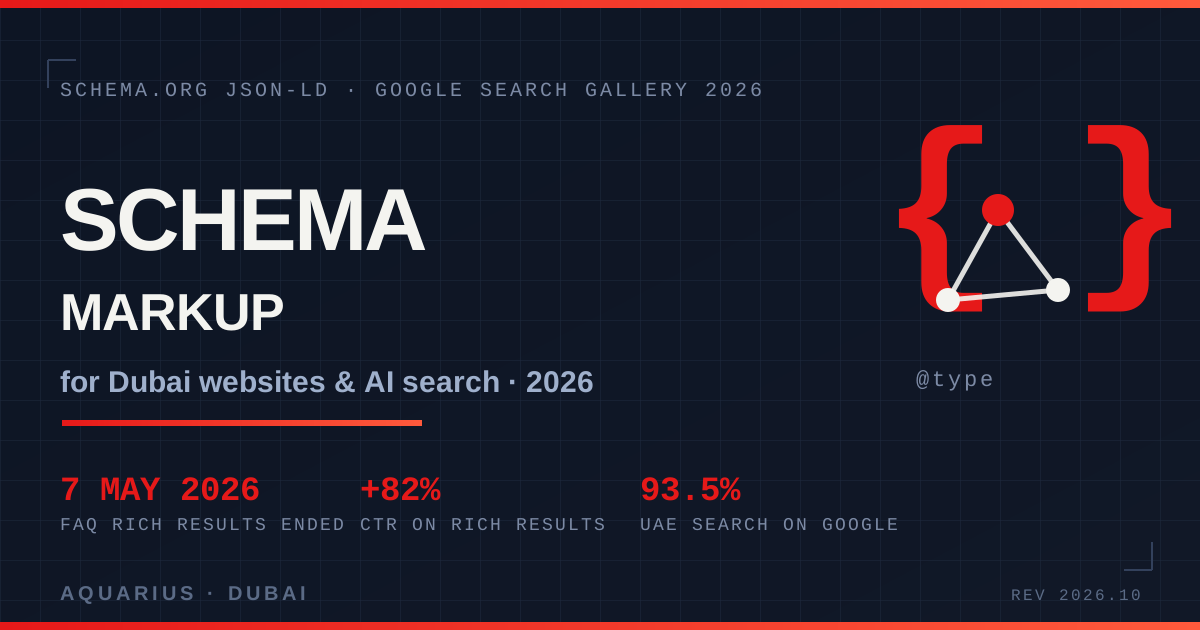
Short answer: schema markup still pays in 2026, but not the way most Dubai agencies sold it. Google stopped showing FAQ rich results on 7 May 2026 and retired seven more structured data types on 12 June 2025, so the FAQ blocks bolted onto half the websites in Dubai now earn nothing visual. What still earns real estate is a small set of types — Organization, LocalBusiness, Product, Review snippet, Breadcrumb, Event, JobPosting, Video — plus accurate entity markup that AI Mode and AI Overviews use when they verify a claim.
Key takeaways
- Google’s own case studies: Nestlé saw 82% higher CTR on pages shown as rich results, Rotten Tomatoes 25% higher CTR, Food Network 35% more visits after marking up 80% of pages.
- 93.47% of UAE searches ran on Google in September 2026 (StatCounter), across roughly 11.4 million internet users at about 99% penetration.
- FAQ rich results ended 7 May 2026; Search Console FAQ reporting went in June 2026 and API support in August 2026. The markup is still valid — it just buys comprehension, not pixels.
- Google says structured data is not required for AI Overviews or AI Mode. It is still the cheapest way to make your entity unambiguous when an answer engine checks a fact.
- Budget AED 1,500–4,000 for a clean one-time implementation on a small Dubai site and AED 6,000–18,000 for a templated ecommerce or multi-branch build.
Why this matters more in the UAE than almost anywhere
The UAE is a near-saturated search market. DataReportal’s 2026 figures put internet users at about 11.4 million — roughly 99% of the population, up 3.5% year on year, and StatCounter had Google at 93.47% of UAE search in September 2026 with Bing a distant 3.96%. On mobile, Google’s share runs higher still.
Two things follow. First, there is no second channel to hide in: if your listing loses a star rating or an AED price to a competitor, you lose the click on the only search engine that matters here. Second, the UAE is an early-adopter market for AI answers — UAE respondents report 58% AI adoption, second only to India at 59%, Google’s AI Mode passed 1 billion monthly users in May 2026, and AI Overviews now appear on roughly 43% of searches. Your markup is read by both systems, and most Dubai sites are still feeding them a decade-old mess.
The myth-bust: your FAQ schema is no longer doing what you think
This is where most Dubai businesses get it wrong. FAQPage markup was the single most over-deployed schema type in the region because it once produced an accordion under your result and pushed competitors down the page. That ended.
Google’s documentation now carries the notice: as of 7 May 2026, FAQ rich results no longer appear in Google Search. The retirement was flagged in a changelog a year earlier. The FAQ search appearance, the rich result report and Rich Results Test support were dropped in June 2026, and Search Console API support in August 2026.
It was not the first cut. HowTo rich results went in 2023, and on 12 June 2025 Google retired seven more types in one announcement: Book Actions, Course Info, Claim Review, Estimated Salary, Learning Video, Special Announcement and Vehicle Listing. Reporting for those disappeared on 8 September 2025, BigQuery appearance fields started returning NULL on 1 October 2025, and PracticeProblem followed in January 2026.
Two corrections to the panic doing the rounds in Dubai marketing groups. Retired markup is ignored, not penalised — you do not need an emergency sprint to strip it out. And FAQPage is still a valid Schema.org type that Google continues to parse for page understanding, so well-written Q&A content can still win featured snippets and People Also Ask placements. What died is the guaranteed visual, not the content strategy.
What still earns rich results in 2026
Google’s search gallery lists roughly 25 live feature types. These are the ones that actually move clicks for UAE businesses, with the realistic win for each.
| Schema type | What you get in the SERP | Who needs it in Dubai |
|---|---|---|
| Organization | Logo, address, contact and social profiles in knowledge panels | Every business — the entity foundation |
| LocalBusiness | Hours, ratings, directions and booking actions | Clinics, salons, restaurants, showrooms, multi-branch retail |
| Product + Offer | Price in AED, availability, shipping and returns | Any UAE ecommerce store or merchant feed |
| Review snippet / AggregateRating | Star ratings against your result | Service businesses with genuine first-party reviews |
| Breadcrumb | A readable site path instead of a raw URL | Everyone with more than two levels of navigation |
| Event | Dates, venue, ticket links | Exhibitions, conferences, venues, ticketing platforms |
| JobPosting | Inclusion in Google’s job experience | Recruiters, free zone employers, anyone hiring at scale |
| Video (VideoObject) | Thumbnails, key moments, video tab presence | Property tours, course providers, product demos |
| Article / ProfilePage | Author and publisher attribution signals | Publishers, consultancies, anyone building E-E-A-T |
| FAQPage | No rich result since 7 May 2026 — comprehension only | Keep it; stop counting on it |
The UAE-specific details that break implementations
- Addresses. UAE addresses rarely have a street number that validates cleanly. Use
addressLocality: "Dubai",addressRegion: "Dubai",addressCountry: "AE", and put the building, street and community intostreetAddressas one honest line. OmitpostalCoderather than inventing one. - Prices. Use
priceCurrency: "AED", and if you display VAT-inclusive pricing to UAE consumers, make the marked-up price match the price on screen. A mismatch is a manual-action risk, not a clever trick. - Arabic pages. Mark up both language versions with
inLanguageand matchinghreflang, and keep the same entity@idacross both so you are one organisation, not two. - Multi-branch. One
LocalBusinessnode per physical branch, each with its own URL and@id, all linked to the parentOrganizationviaparentOrganization. Dubai, Abu Dhabi and Sharjah crammed into one node is the most common thing we fix. - Trust signals. Real DED or free zone trade licence details, DHA or SIRA permit numbers where they apply, and a
sameAslist pointing at your verified Google Business Profile and real social accounts.
Scale check for the ecommerce side: UAE ecommerce reached roughly AED 45.1 billion (US$12.3bn) in 2026, up from about AED 17.6 billion in 2020, with apparel and footwear alone at AED 11.4 billion in 2025. Around 85% of UAE consumers say they have used AI to help them shop and 67% used mobile for their last retail purchase. Product markup is the difference between appearing with a price and appearing as a blue link next to one.
Schema and AI search: the honest version
Plenty of Dubai pitches claim schema gets you into AI Overviews. Google’s stated position is the opposite: structured data is not required for generative AI features and there is no special markup for them. Googlers have also told Search Central Live audiences that GEO and AEO do not need separate frameworks — it is still SEO.
What is defensible: AI systems resolve entities and check claims while they assemble an answer, and clean markup that matches your visible page is the cheapest, least ambiguous way to state who you are, where you operate, what you charge and who vouches for you. It will not manufacture authority you do not have. If AI visibility is the goal, pair it with the content work — see our guides on what AI Overviews changed for UAE businesses and how to get cited by AI search.
How to implement it without breaking anything
- Use JSON-LD, not microdata. It is Google’s recommended format and it keeps markup out of your HTML templates.
- Ship one graph per page. A single
<script type="application/ld+json">with an@grapharray beats five plugins each emitting a competing Organization node. - Give every entity a stable
@id(for examplehttps://example.ae/#organization) and reference it everywhere instead of repeating the data. - Only mark up what is visible. Invisible ratings, fabricated review counts and prices that differ from the page are the fastest route to a structured data manual action.
- Validate twice. Google’s Rich Results Test for eligibility, the Schema Markup Validator for syntax, then watch the Search Console enhancement reports for two to four weeks.
- Template it. Markup generated from your CMS or product data stays correct when content changes. Hand-pasted JSON-LD rots within a quarter.
What schema markup costs in Dubai in 2026
Pricing in this market ranges from a AED 500 plugin toggle to five-figure retainers. Here is what the work genuinely takes, at our rates.
| Scope | What is included | AED (2026) |
|---|---|---|
| Audit only | Full crawl, retired-type cleanup plan, validation report, priority list | AED 1,200–2,500 |
| Small business site (up to ~20 pages) | Organization, LocalBusiness, Breadcrumb, Article, service pages | AED 1,500–4,000 |
| Multi-branch or bilingual site | Per-branch nodes, Arabic and English graphs, hreflang alignment | AED 4,000–9,000 |
| Ecommerce (templated) | Product, Offer, AED pricing, availability, shipping, review snippets | AED 6,000–18,000 |
| Ongoing monitoring | Monthly validation, Search Console watch, deprecation tracking | AED 600–1,800/month |
Judge that against the upside Google itself publishes: 82% higher CTR on rich-result pages (Nestlé), 25% higher (Rotten Tomatoes), 35% more visits (Food Network), and Rakuten’s 1.5x longer time on page with 3.6x higher interaction. On a Dubai site already earning 3,000 organic clicks a month, even a 15% CTR lift is 450 extra visits a month — paid back inside the first month against a AED 3,000 one-off at almost any UAE service margin.
How Aquarius does it
We template markup from your actual data so it cannot drift from the page, strip the retired types instead of leaving dead FAQ and HowTo blocks behind, keep one entity graph across your Arabic and English pages, and hand over the Search Console reports with a plain-English note on what to watch. No invented ratings, no markup for things your site does not show. If an implementation we ship fails Google’s Rich Results Test for an eligible type, we fix it free. See transparent pricing, or read how we approach SEO for Dubai businesses.
FAQ
Should I remove FAQ schema from my Dubai website now?
No. Google ignores retired markup rather than penalising it, and it still parses FAQPage to understand your page. Remove it only if it is bloating page weight or duplicating other nodes. Do stop reporting FAQ rich results as a KPI — they stopped appearing on 7 May 2026 and Search Console reporting ended in June 2026.
Does schema markup improve my rankings?
Not directly. Structured data is not a ranking factor. It changes how your result is displayed, which changes click-through rate, and it helps search and AI systems understand your entity. The ranking gain, when it comes, is downstream of the extra clicks and clearer relevance.
Which schema types matter most for a Dubai service business?
Organization and LocalBusiness first, with a correct UAE address, real hours and sameAs links to your verified Google Business Profile. Then Breadcrumb, your service or product pages, and Review snippet only if you have genuine first-party reviews on the page.
Can I just use a WordPress plugin?
For a simple brochure site, yes — one plugin configured once beats nothing. Problems start when two or three SEO plugins each emit their own Organization and WebSite nodes, or when an ecommerce theme outputs prices without priceCurrency: "AED". If your Rich Results Test shows duplicate or conflicting entities, that is the plugin stack, not Google.
Will structured data get me cited in ChatGPT or AI Overviews?
It helps machines identify you correctly; it does not buy citations. Google is explicit that no special schema is needed for AI features. Treat markup as hygiene and spend the rest of the budget on content that answers real UAE questions with real numbers.
Figures checked on 13 October 2026: Google Search Central structured data documentation and changelog (FAQ rich results ended 7 May 2026; seven types retired 12 June 2025), Google’s published structured data case studies, StatCounter UAE search engine share for September 2026, DataReportal Digital 2026 UAE, and 2026 UAE ecommerce market reporting. USD figures converted at the fixed 3.6725 AED/USD peg.
Want to know exactly which types your site is eligible for, and which dead markup is still sitting in your templates? Send us the URL and we will come back with the audit, not a sales deck.