
Visitor Management and Access Control Software in Dubai (2026): AED Costs and the Biometric Consent Trap
Dubai offices run at 94% occupancy and the lobby is the bottleneck. Real AED costs to build visitor management and access control software, plus the PDPL biometric consent rule most buildings break.
- PUBLISHED
- 13 OCT 2026
- READ TIME
- 12 MIN
- AUTHOR
- AQUARIUS · DUBAI
- UNIT
- REV 2026.09
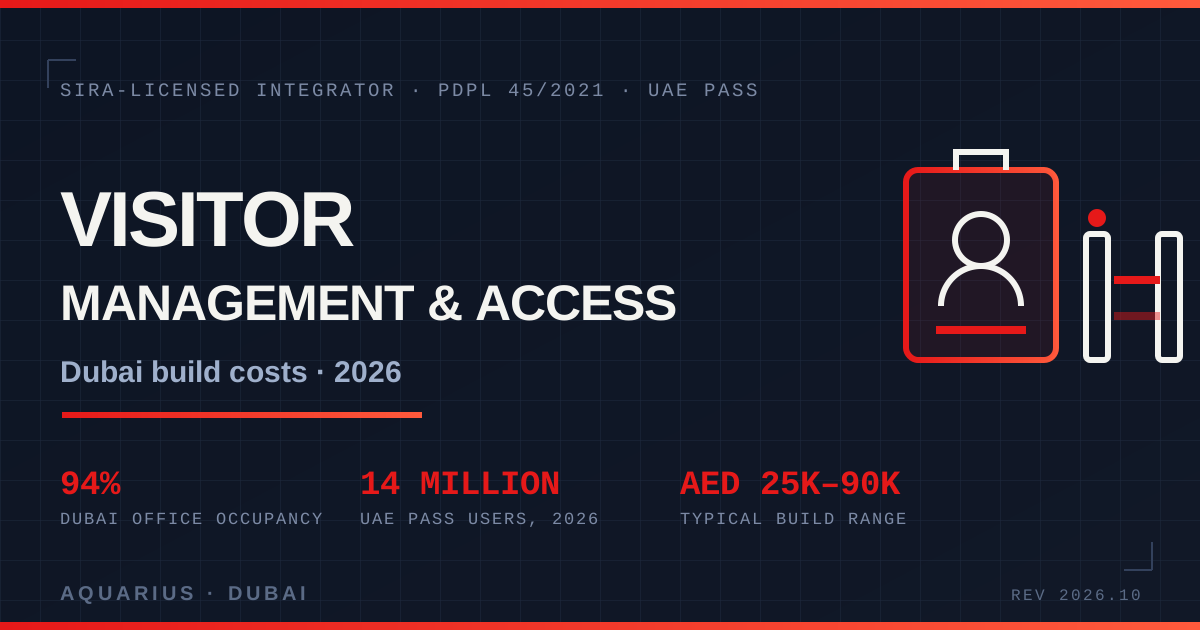
Short answer: a visitor management and access control system in Dubai costs AED 25,000–90,000 to build for a single building — pre-registration, Emirates ID or UAE PASS identity capture, host notification, badge printing and a live evacuation list — rising to AED 90,000–250,000 for a multi-tower portfolio with turnstile and access-controller integration, contractor permit-to-work and tenant self-service. The expensive mistake is not the hardware. It is capturing a face or a fingerprint without the explicit consent the UAE Personal Data Protection Law requires for biometric data.
Key takeaways
- Dubai office occupancy sits near 94%, with prime rents up 16% year-on-year in Q2 2026 and Grade B rents up 31.5%. Buildings are full, so lobbies are the bottleneck.
- DIFC alone ended 2025 with 8,844 active registered companies and a 50,200-strong workforce, up 9% in twelve months. DMCC passed 26,000 member companies. That is the daily visitor load your reception desk absorbs.
- UAE PASS crossed 14 million users in 2026 with over 600 million logins across 15,000+ services — so verified visitor pre-registration no longer needs a passport photocopy.
- Biometric data is sensitive personal data under Federal Decree-Law No. 45 of 2021. Face or fingerprint capture needs explicit, provable consent and an alternative route for anyone who refuses.
- The global visitor management software market is worth about US$2.39 billion in 2026 and growing at a 12.05% CAGR. Dubai is buying it faster than most, mainly because landlords are selling it as a tenant amenity.
Why the lobby became a problem in 2026
Dubai did not plan a visitor-management crisis. It just ran out of office space. CBRE puts Dubai office occupancy around 94% with prime rents up 16% year-on-year in Q2 2026, while JLL recorded Grade B rents up 31.5% as occupiers took whatever they could find. DIFC, TECOM and DMCC are pre-leasing space before it completes.
Full buildings mean more people per floor plate, more hot-desking, more co-working, and far more strangers arriving at 9:30am. DIFC closed 2025 with 8,844 active registered companies and a workforce of 50,200, up 9% in a year; it added 2,525 new companies, a 39% increase. DMCC crossed 26,000 member companies after registering 2,300 in 2025. Across the emirate there are more than 215,000 active business licences. Every one of those entities has clients, couriers, auditors, candidates and maintenance contractors walking through a door that somebody has to control.
Here is what most Dubai buildings get wrong. They treat visitor management as a reception upgrade — an iPad on a stand that prints a sticker. It is not. It is the only system that can answer the three questions that actually matter: who is inside the building right now, what were they allowed to do, and can you prove both six months later when an insurer, an auditor or the police ask.
What a Dubai-grade system actually has to do
Strip away the vendor demos and a serious deployment covers six jobs. Most off-the-shelf tablet apps cover two.
- Pre-registration and invite. The host books the visitor, the visitor gets a WhatsApp or email pass with a QR code, parking guidance and the building rules. Walk-ins become the exception rather than the design.
- Identity capture that is legal here. Emirates ID scan, passport MRZ read for visitors without one, or a UAE PASS verified identity. With 14 million UAE PASS users and 600 million logins, pre-verification is realistic for the majority of UAE-resident visitors. See our UAE PASS integration guide for how the handshake works.
- Access provisioning, not just a badge. The visitor record should push a temporary credential into the access controller — a QR at the speed gate, a temporary card, or a mobile credential valid for three hours on floors 14 and 15 only, and dead afterwards.
- Contractor and permit-to-work control. No entry until insurance, SIRA or trade certification and a signed method statement are on file and unexpired. This is where facility managers find the real return.
- Live mustering. A fire alarm should produce a current list of everyone on site, by floor, on a phone at the assembly point. A sticker printer cannot do this; a system that knows who tapped in and never tapped out can.
- Tenant self-service and reporting. In a multi-tenant tower each company manages its own visitors, sees its own logs, and never sees another tenant’s. That isolation is a data-protection requirement, not a feature.
Pair this with CAFM for work orders, queue management if you run a service counter, and guard patrol software for the manned side of security.
The biometric consent trap
This is the part that quietly creates liability. Under Federal Decree-Law No. 45 of 2021, in force since 2 January 2022, biometric data — a facial image used to identify someone, a fingerprint template — is sensitive personal data. Processing it requires explicit consent that the controller must be able to prove, obtained in a clear, specific and accessible way before capture.
What we see in Dubai lobbies instead: a face-recognition terminal at the turnstile with a one-line sign, no consent record tied to the individual, no retention limit, no deletion schedule, and no non-biometric alternative for a visitor who declines. A tick box buried in a kiosk flow that you cannot produce as evidence per person is not consent you can rely on.
Three practical rules we build in by default:
- Always ship a non-biometric path. A QR code or temporary card must work for anyone who refuses a face scan, with no friction penalty. Otherwise the consent is not freely given.
- Store the template, not the photograph — and put a clock on it. Visitor biometrics should expire with the visit. Thirty days is a defensible default for the audit log; the raw image rarely needs to survive the day.
- Log consent as data, not as paper. Timestamp, the version of the notice shown, the language it was shown in, and the choice made — retrievable per visitor.
Worth knowing: as of October 2026 the PDPL Executive Regulations have still not been published in the Official Gazette, which is exactly why some Dubai operators have convinced themselves the law is theoretical. The Decree-Law itself is in force, and the consent obligations in it apply today. Our UAE PDPL compliance checklist covers the wider obligations.
One more Dubai-specific rule: if your visitor system touches CCTV, the surveillance side falls under SIRA, and the cameras and recorders must be designed, installed and commissioned by a SIRA-licensed integrator. Integrator guidance published through 2026 points to higher camera resolution, longer retention for high-risk premises and hardened recorder networks. A self-installed NVR invalidates compliance regardless of how good the hardware is — so the software project and the security contract have to be scoped together, not sequentially.
What it costs to build in Dubai, in AED
Software only. Turnstiles, readers, printers and cameras are a separate capital line and come from your security contractor.
| Scope | What you get | AED (one-off) | Timeline |
|---|---|---|---|
| Single-site visitor management | Pre-registration, QR invite, Emirates ID scan, host notification, badge print, visitor log, basic reports | AED 25,000–55,000 | 4–7 weeks |
| Compliance-grade single site | Above plus UAE PASS identity, consent ledger, retention automation, Arabic and English UI, live evacuation list | AED 55,000–90,000 | 7–11 weeks |
| Access control integration | Two-way link to controllers and speed gates, temporary credentials, floor-level permissions, anti-passback handling | AED 30,000–80,000 | 3–6 weeks on top |
| Contractor permit-to-work module | Document vault with expiry blocking, induction quiz, permit approval chain, SIRA and insurance certificate checks | AED 25,000–60,000 | 3–5 weeks |
| Multi-tower tenant portal | Tenant self-service, per-tenant data isolation, landlord analytics, white-label per building | AED 60,000–140,000 | 8–14 weeks |
| Hosting, support and compliance upkeep | UAE-region hosting, monitoring, access reviews, PDPL log hygiene, minor changes | AED 2,500–9,000/month | Ongoing |
Licensed SaaS alternatives typically land at AED 180–600 per site per month for a basic tier and climb steeply with locations and integrations — which is the right answer for one small office, and the wrong one for a landlord with nine towers who will pay that fee forever and still not own the tenant data. Our pricing page sets out how we scope the build side.
The arithmetic that decides build versus subscribe
Take a Dubai landlord with four buildings. A mid-tier SaaS deployment at AED 450 per site per month is AED 21,600 a year, or AED 108,000 over five years, before integration fees and before any tenant-specific customisation — and the visitor history lives in a vendor account. A custom portal at AED 90,000–140,000 plus AED 4,000 a month in hosting and support crosses over around year three and then keeps paying, with the data and the tenant relationship on your side of the line.
The faster return is usually operational. One receptionist per tower spending two hours a day on manual sign-in, ID photocopies and phone calls to hosts is roughly a quarter of a salaried role per building. Reclaim that across four towers and the software has paid for a chunk of itself in headcount efficiency before you price in a single avoided incident.
Then there is the cost of not doing it. The real exposure in Dubai is rarely a fine — it is an incident with no audit trail: a contractor on site with lapsed certification, an unlogged visitor in a tenant server room, an evacuation where the list is a paper book on a desk that is now on fire. Each of those becomes an insurance conversation in which the only question that matters is whether you can produce records.
How Aquarius does it
We start with a walkthrough of your actual lobby at 9am, not a feature list — where the queue forms, which door the couriers use, who holds the contractor files, and what your security contractor access controller will and will not expose over API. Then we scope the software against that, build it with the consent ledger and retention clocks in from day one, and test the evacuation list by actually running a drill. UAE-region hosting, Arabic and English from the first release, and the source code is yours. If a licensed product fits your building better than a build, we say so in the first meeting.
FAQ
How much does visitor management software cost in Dubai?
A single-site custom system runs AED 25,000–55,000, rising to AED 55,000–90,000 with UAE PASS identity, a consent ledger and live mustering. Access-control integration adds AED 30,000–80,000 and a multi-tower tenant portal AED 60,000–140,000. Licensed SaaS starts around AED 180–600 per site per month.
Is facial recognition legal for visitor check-in in the UAE?
Yes, with conditions. Biometric data is sensitive personal data under Federal Decree-Law No. 45 of 2021, so you need explicit, provable consent captured before the scan, a clear purpose and retention period, and a working non-biometric alternative for anyone who declines. A sign on the wall is not consent.
Do I need SIRA approval for a visitor management system?
The software itself is not a SIRA product, but the moment it is wired to CCTV or surveillance recording, the security system falls under SIRA rules in Dubai and must be installed and commissioned by a SIRA-licensed integrator. Scope the software build and the security contract together.
Can visitors check in with UAE PASS?
Yes, and for UAE residents it is the cleanest route — 14 million users and 600 million logins as of 2026 means most of your visitors already have it. You still need a passport or Emirates ID fallback for international visitors and for anyone who has not activated an account.
How long does a Dubai deployment take?
Four to seven weeks for a single-site build, seven to eleven weeks for a compliance-grade system with UAE PASS and mustering, and eight to fourteen weeks for a multi-tower tenant portal. The schedule risk is almost never the software — it is waiting on the access-control vendor API credentials and on turnstile commissioning.
Figures checked on 13 October 2026: CBRE UAE Real Estate Market Review Q2 2026 for Dubai office occupancy and prime rent growth; JLL Q2 2026 for Grade B rent growth; DIFC 2025 annual results for active company and workforce counts; DMCC 2025 results for member company numbers; Digital Dubai and TDRA for UAE PASS user, login and service figures; Mordor Intelligence for visitor management system market size and CAGR; UAE Federal Decree-Law No. 45 of 2021 and DLA Piper data protection tracking for PDPL status; published 2026 SIRA integrator guidance for CCTV scope. AED build ranges are Aquarius project pricing.
Running a Dubai building where the visitor book is still a paper ledger? Tell us how many doors and tenants you have — we will come back with a scoped build range and the three compliance gaps we would expect to find in your lobby today.