
Queue Management System Development Dubai 2026: Cost and Features
Queue management systems in Dubai cost AED 40,000-734,000 in 2026. Real AED tiers, the 8-minute walk-away point, RTA digital benchmarks and break-even math.
- PUBLISHED
- 30 SEPT 2026
- READ TIME
- 10 MIN
- AUTHOR
- AQUARIUS · DUBAI
- UNIT
- REV 2026.09
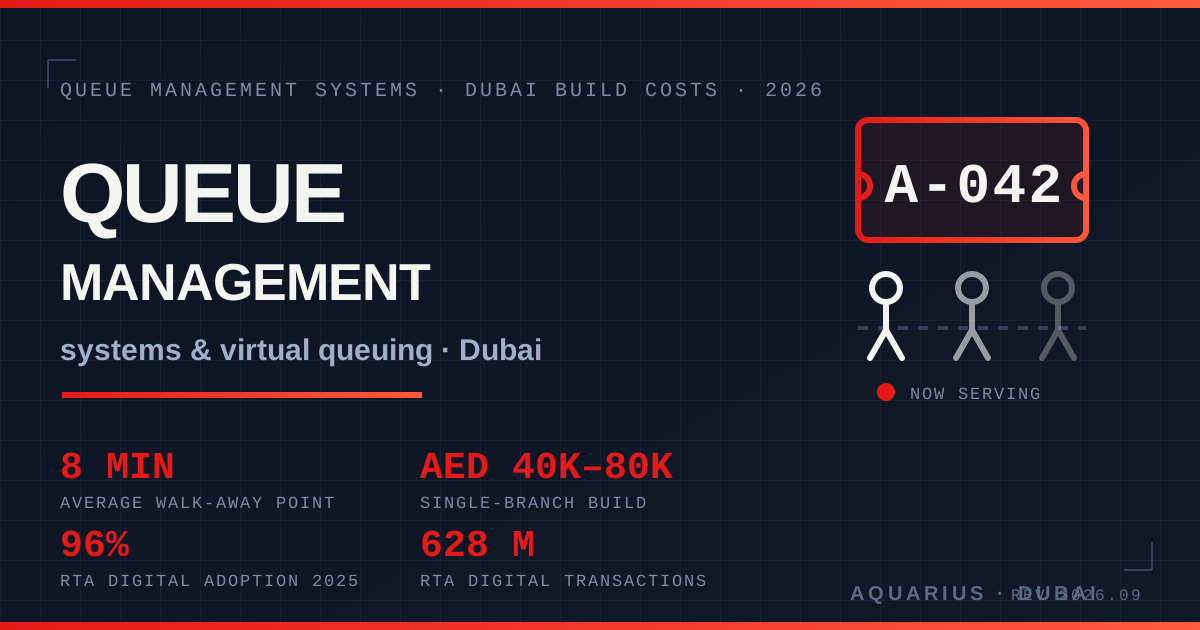
Short answer: a queue management system in Dubai costs about AED 40,000–80,000 for a single-branch virtual queue with mobile tickets and a live dashboard, AED 146,000–294,000 for a hardware package with self-service kiosks, token printers and counter displays, and AED 330,000–734,000 for an AI build that forecasts demand and routes customers across branches. The expensive mistake is buying the hardware first. Most Dubai walk-in traffic can be removed with an appointment link and a WhatsApp ticket before a single kiosk is installed. All figures exclude 5% VAT.
Key takeaways
- The average customer abandons a queue after 8 minutes, and 48% of retail bank customers will not wait past 10 minutes before walking out of a branch.
- Dubai’s RTA pushed 628 million transactions through digital channels in 2025 — a 96% digital adoption rate at a 98% customer happiness index. That is the local benchmark your branch is now judged against.
- A queue system does not shorten queues. Moving transactions out of the branch shortens queues; the queue system tells you which ones to move.
- Most Dubai businesses get this wrong: they spend AED 150,000+ on kiosks and screens to manage a queue that a booking link would have deleted.
Why Dubai raised the bar on waiting
Dubai residents have been trained by the government sector to expect almost no queue at all, and that expectation now lands on private clinics, banks, showrooms and service centres that never signed up for it.
The numbers behind that training are blunt. The Roads and Transport Authority reported more than 628 million transactions completed through digital channels in 2025, up 13% year on year, generating AED 5.3 billion in digital revenue — a 20.6% increase. Digital channel adoption hit 96% across 105 digital services delivered over six channels, and the average customer happiness index landed at 98%. RTA’s redeveloped Customer Happiness Centres now offer 97 services, up from 72, with in-centre transactions rising from 84,000 in 2024 to more than 100,000 in 2025.
Read those two figures together, because the ratio is the whole lesson: 628 million transactions digital, roughly 100,000 in person. The physical counter was not optimised. It was emptied, and what remained was the small share of work that genuinely needs a human.
The wider Dubai Paperless Strategy tells the same story in different units: 336 million printed pages removed, AED 1.3 billion saved and 14 million staff hours released across government departments, with 88 services in the DubaiNow app saving the average user 28 hours and 14 trips to a service centre a year. And the emirate has been instrumenting satisfaction since 2014 — the Happiness Meter reached 500+ touchpoints and over 6 million votes, publishing a city-wide happiness index that has sat in the 86–90% band.
What a queue actually costs you
Waiting is not a soft metric. It is measurable revenue leaving the building.
- The average walk-away point is 8 minutes of waiting.
- 48% of retail bank customers will wait a maximum of 10 minutes before leaving the branch.
- More than half of consumers abandon a line after 5 minutes with no visible progress.
- 39% of shoppers facing a wait switch to a competitor or abandon the purchase outright, and 32% abandon specifically because of the line.
- 86% name waiting as their single biggest in-store frustration.
- Tolerance is falling: only 75% of consumers will still wait 15 minutes, down from 81% in 2024.
- And the finding that pays for the whole project — consumers are nearly 5x more likely to accept a 30-minute wait when they are freed from standing in a physical line.
That last point is the design brief. You are not trying to make people wait less. You are trying to make waiting invisible — a ticket on a phone, a text at the right moment, and the freedom to sit in the coffee shop downstairs.
Who buys queue software in Dubai — and what they need
Dubai’s demand comes from four clusters, and they need genuinely different builds.
Healthcare
Dubai ended 2025 with about 5,800 licensed healthcare facilities, up from 5,340 in 2024 (+8%), including 55 hospitals, 126 general medical clinics, 70 dental clinics and 68 specialised clinics, staffed by more than 69,400 private-sector professionals. Each clinic runs several parallel queues — reception, insurance approval, doctor, lab, pharmacy — and the patient experiences the sum of all of them. AI-assisted flow management has been reported to cut service wait times by up to 60% in health provider deployments. If you are at the booking stage rather than the queue stage, start with our Dubai clinic booking system guide.
Banking, exchange houses and telecom
High transaction value, hard identity checks, and the strictest walk-away economics in the list. Appointment-first with a ranked virtual queue, plus counter-level analytics to staff the branch by hour.
Government-adjacent service centres
Typing centres, Amer and Tasheel-style service providers, PRO firms, insurance and visa desks. These need multi-service routing, Arabic-first interfaces and a happiness capture at the end of every ticket — the same pattern our PRO and visa compliance software guide covers.
Retail, automotive service and salons
Lower ticket value, higher volume, and the fastest abandonment. Here a virtual queue is often just an extension of a booking product — see our salon and spa booking app guide for the same mechanics applied to appointments.
The features that actually change the number
Ranked by measured impact, not by how they look in a vendor deck.
| Feature | What it does | Impact |
|---|---|---|
| Remote ticket (QR / WhatsApp / link) | Customer joins the queue before arriving or from the car park; no lobby crowding | Highest — converts a physical wait into an invisible one, where tolerance rises ~5x |
| Honest live ETA | Position plus a predicted minute range, recalculated as counters clear | High — removes the uncertainty that drives 8-minute abandonment |
| Appointment + walk-in blending | One queue engine handles booked slots and walk-ins with fair priority rules | High — kills the “I had an appointment” conflict at the desk |
| Service-based routing | Routes by service type and language, not first-come-first-served | High — a 2-minute renewal should never sit behind a 25-minute new application |
| Arabic + English, RTL-correct | Tickets, SMS, kiosk and displays in both languages | Mandatory in Dubai — see our Arabic RTL localisation guide |
| Staff and counter analytics | Wait time, service time, no-show rate and abandonment by hour, counter and agent | High — this is the data that reduces headcount cost, built like a proper BI dashboard |
| Happiness capture | A one-tap rating at ticket close, tied to the agent and wait time | Medium — matches the Dubai Happiness Meter convention customers already know |
| Digital signage displays | Now-serving screens, media playlists, prayer-time aware scheduling | Medium — useful, but it is a signage problem, not a queue problem |
| Self-service kiosk + printer | Physical token issuing for walk-ins without smartphones | Lowest per dirham — necessary for some audiences, never the starting point |
Two Dubai-specific additions that off-the-shelf international products handle badly: UAE Pass identity at check-in, which removes the ID-capture step entirely (our UAE Pass integration guide covers the flow), and PDPL-correct data handling for the Emirates IDs, phone numbers and health context a queue system inevitably collects — consent, retention limits and deletion, per the UAE PDPL compliance checklist.
What it costs in Dubai in 2026
Published Dubai and UAE market bands, plus what the same outcome costs as a custom build:
| Tier | Scope | Dubai cost | Timeline |
|---|---|---|---|
| Virtual queue, single branch | QR / WhatsApp ticketing, live ETA, staff console, basic dashboard, mobile notifications — no hardware | AED 40,000–80,000 | 4–7 weeks |
| Full system with hardware | Adds self-service kiosks, token printers, counter and main displays, signage, multi-counter routing | AED 146,000–294,000 | 8–14 weeks |
| AI-driven | Demand forecasting, dynamic staffing, predictive wait times, cross-branch load balancing, deep analytics | AED 330,000–734,000 | 14–24 weeks |
| Enterprise multi-branch | Dozens of locations, central command dashboard, CRM and core-system integration, SLA reporting, high availability | AED 918,000–1,469,000+ | 6–12 months |
Recurring cost is the line most proposals bury: budget roughly AED 1,200–4,500 a month for hosting, SMS and WhatsApp message fees and support, plus the usual 15–20% of build cost a year for maintenance — the same rule as our Dubai maintenance cost guide. Per-message costs matter more than people expect at queue volumes; our SMS and WhatsApp messaging cost breakdown has the current TDRA-compliant rates.
For context on scale, the global queue management market is sized at about USD 38.97 billion in 2025, rising to USD 43.67 billion in 2026 and USD 77.13 billion by 2031 — a 12.05% CAGR, with cloud and virtual queuing the fastest-growing slice. The direction of spend is away from lobby hardware and toward software.
The break-even math
Run it on abandonment, not on comfort. Take a Dubai clinic or showroom seeing 120 walk-ins a day, six days a week — roughly 3,100 a month. If even 8% abandon before being served (conservative against the 32% retail figure and the 8-minute walk-away point), that is 248 lost customers a month. At an AED 250 average transaction value, the leak is AED 62,000 a month.
An AED 60,000 virtual-queue build recovering just a quarter of that pays for itself in under four months and keeps paying. Add the staffing side: the Dubai Paperless Strategy released 14 million staff hours by removing paper steps; a queue engine that routes a 2-minute renewal away from a 25-minute application does the same thing at branch scale, and the analytics tell you exactly which hours are overstaffed.
The cost-of-inaction number is harsher than the build cost. Every month you defer, the leak repeats — and in a market where 96% of RTA transactions are already digital and consumer wait tolerance dropped from 81% to 75% in a single year, the queue you tolerate today will be less tolerated next year.
How Aquarius builds it
We start by measuring, not quoting. Two weeks of baseline data — arrivals by hour, service time by type, abandonment rate — usually shows that a third to a half of your walk-ins never needed a counter. We remove those with a booking link and a WhatsApp ticket first, then build the queue engine for what is genuinely left, and only spec kiosks and screens if the remaining audience actually needs them.
Builds are AI-assisted and fixed-scope, phased so you see the wait-time chart move before the next invoice: virtual queue and analytics in phase one, routing, appointments and Arabic RTL in phase two, hardware and AI forecasting last. Everything is PDPL-designed, integrates with your CRM or clinic system rather than replacing it, and ships with the code and repository in your own company name — see what a proper handover includes. Published rates are on our pricing page and the full build list is on services.
FAQ
How much does a queue management system cost in Dubai?
About AED 40,000–80,000 for a single-branch virtual queue with mobile ticketing and dashboards, AED 146,000–294,000 for a full system with kiosks, printers and displays, AED 330,000–734,000 for an AI-driven build with demand forecasting, and AED 918,000–1,469,000+ for enterprise multi-branch deployments. Add roughly AED 1,200–4,500 a month for hosting, messaging and support. All figures exclude 5% VAT.
How long will customers wait before leaving?
The average walk-away point is 8 minutes. Forty-eight per cent of retail bank customers will not wait beyond 10 minutes, more than half of consumers abandon after 5 minutes with no visible progress, and only 75% will still tolerate a 15-minute wait — down from 81% in 2024.
Do I need kiosks and token printers?
Usually not at the start. Remote ticketing by QR, WhatsApp or link delivers most of the measurable gain because consumers are roughly 5x more likely to accept a long wait when they are not standing in a physical line. Add kiosks later for walk-in segments that genuinely cannot use a phone.
Does it need to support Arabic?
Yes. Tickets, kiosk screens, now-serving displays and SMS all need correct Arabic with RTL layout, not a translated string dumped into a left-to-right template. In Dubai this is a baseline expectation, not a phase-two feature.
Is a queue management system subject to UAE PDPL?
Yes, if it stores personal data — and it almost always does: names, mobile numbers, Emirates ID references and, in clinics, health context. You need a lawful basis, a stated retention period, deletion on request and controls over who can see historical ticket data.
How long does it take to build?
Four to seven weeks for a single-branch virtual queue, 8–14 weeks with hardware, 14–24 weeks for AI forecasting and cross-branch routing, and six months or more for a large multi-branch rollout with core-system integrations.
Get a fixed AED quote
Tell us your branch count, daily walk-in volume and which services eat the most counter time, and we will send a fixed-scope AED quote with a phased plan and the abandonment math on your own numbers. Talk to Aquarius — Dubai-built, code in your name.