
Tailoring Shop Management Software in Dubai (2026): Measurements, WhatsApp Tracking, VAT Invoicing
Dubai lists 492 tailoring businesses and fit drives 53% of garment returns. Real 2026 AED costs for tailoring software: measurement profiles, WhatsApp order tracking, FTA VAT invoicing.
- PUBLISHED
- 24 OCT 2026
- READ TIME
- 11 MIN
- AUTHOR
- AQUARIUS · DUBAI
- UNIT
- REV 2026.09
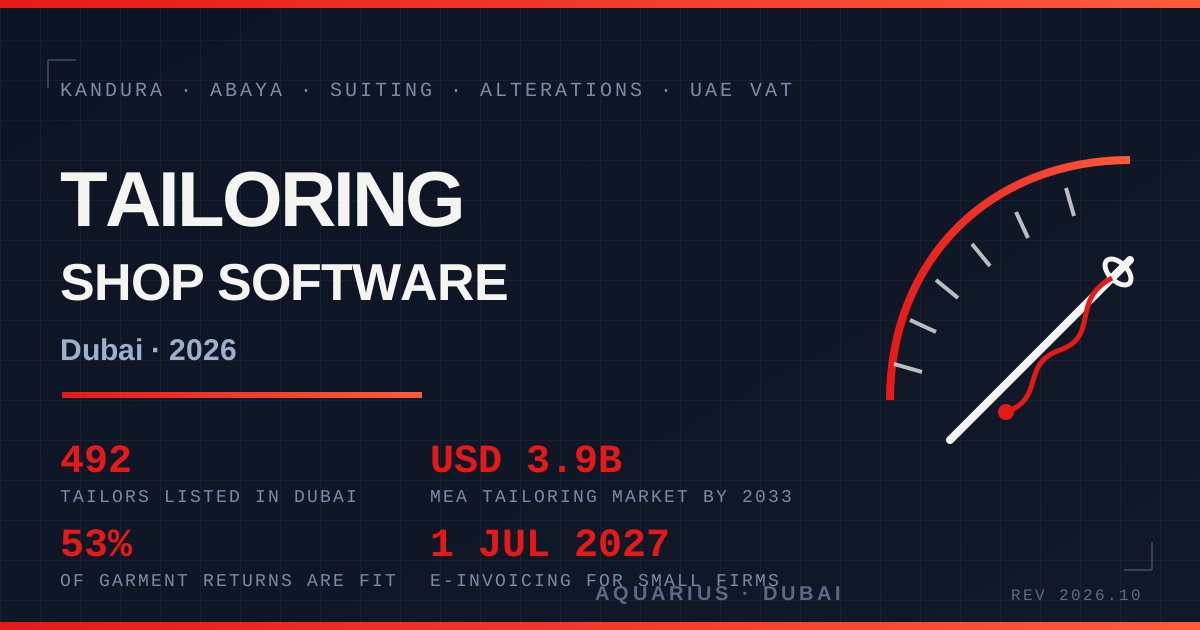
Short answer: tailoring shop software in Dubai is a measurement-first order system — a reusable customer measurement profile, a job card that tracks cutting, stitching, trial and delivery, a WhatsApp notification on every stage change, and an FTA-compliant VAT invoice at the counter. Off-the-shelf GCC products start at a few hundred dirhams a month per branch; a custom build for a multi-branch kandura or abaya house in Dubai runs AED 45,000 to AED 180,000. The deciding factor is not features — it is whether your measurement data, your fabric stock and your tax invoices live in one place or in three notebooks.
Three numbers every Dubai tailor should see first
- Dubai is one of the densest tailoring markets on earth: directory listings alone count 492 tailoring businesses in Dubai, concentrated in Satwa, Deira, Al Quoz and the malls — and trade commentary puts the share practising genuine bespoke at under 5%. Almost everyone is competing on turnaround and reliability, not on craft claims.
- The Middle East and Africa tailoring and alteration services market was worth about USD 2.6 billion in 2025 and is forecast to reach USD 3.9 billion by 2033, against a global market of roughly USD 10.3 billion in 2026. The UAE sits at the premium end of that curve: the UAE luxury fashion market moved from USD 1.3 billion in 2025 to USD 1.4 billion in 2026, and the Middle East and Africa held 46.2% of global abaya revenue in 2025, worth around USD 4.02 billion.
- Fit is the product. Across apparel generally, sizing problems drive more than 53% of all returns — and a 2025 review of AI fitting tools found average return-rate reductions of 36.5%, ranging from 28.5% to 55%, with conversion up 15–20%. In a tailoring shop the equivalent of a return is a free re-alteration: labour you already paid for, twice.
Put those together and the gap is obvious. A Dubai tailor takes 14 to 24 measurements by hand, writes them on a card or in a WhatsApp chat, quotes a date, and then absorbs every error personally — a mis-read collar, a lost fabric roll, a trial appointment nobody reminded the customer about. At AED 1,500–4,000 for a custom suit and AED 5,000–15,000 at the luxury bespoke end, one remake eats the margin on three orders.
Most Dubai tailoring shops think they have a staffing problem. They have a records problem. The measurement is the asset — and it is sitting in a notebook that leaves with the master tailor.
What tailoring shop software actually has to do in the UAE
Measurement profiles that survive staff turnover
The core table is not an order — it is a customer, with a named measurement set per garment type. A kandura needs length, chest, shoulder, sleeve, neck, cuff style and jubba detail; a two-piece suit needs a different twenty fields; an abaya needs its own. Good systems store multiple profiles per customer (own fit, son’s fit, 2023 fit versus today’s), timestamp every revision, and let the cutter see the last version used for a garment that fit well. That single feature is what turns a walk-in into a repeat account, because the second order needs no measuring session at all.
A job card that matches how the workshop actually runs
Dubai tailoring work moves through fixed stages: order taken, fabric issued, cut, stitched, finished, trial, alteration, delivered. Software that models those stages — with the responsible tailor named at each one and an actual due date — is the difference between a shop that can quote a reliable date and a shop that guesses. Add a per-tailor workload view and you stop promising Thursday to eleven customers whose garments are all queued behind the same stitcher.
Fabric and trim inventory in metres, not pieces
Fabric is money sitting on a shelf, and it depletes in fractions. Your system has to deduct metres per cut, track rolls by supplier and dye lot, flag low stock before Ramadan and Eid demand peaks, and separate customer-supplied cloth from shop stock — the single most common source of disputes in a Satwa tailoring shop. If you also sell ready pieces or accessories at the counter, that is a POS and inventory question too, covered in our note on POS and inventory software in Dubai.
WhatsApp, not phone calls
In the UAE, status updates belong on WhatsApp. Through the official WhatsApp Business API, Meta’s UAE rates as of 1 October 2026 are about AED 0.0576 per utility message (order confirmations, ready-for-trial, delivery reminders) and AED 0.2115 per marketing message, with the first 1,000 service messages per business number per month free. Note the October 2026 change: every message inside the 24-hour service window is now billed individually, including chatbot and agent replies. For a shop doing 400 orders a month with three notifications each, that is roughly AED 70 a month in message fees plus a BSP platform fee of AED 99–600. Full breakdown in our WhatsApp Business API cost guide for Dubai.
VAT invoicing that will still be legal in 2027
This is the part most shops underestimate. UAE VAT at 5% requires sequential, gap-free tax invoices with your TRN — and the UAE’s e-invoicing mandate is now dated. The voluntary pilot opened 1 July 2026; large businesses above AED 50 million revenue had to appoint an Accredited Service Provider by 30 October 2026 and go live 1 January 2027. Everyone below AED 50 million — which is essentially every tailoring shop in Dubai — must appoint an ASP by 31 March 2027 and issue structured e-invoices from 1 July 2027. Invoices move as PINT AE structured data through the Peppol network, not PDFs, with 51 mandatory fields on an electronic tax invoice. Any system you buy in 2026 should have a credible answer for that date. See UAE e-invoicing and ERP integration for the mechanics.
Arabic and English, both directions
Your counter staff may work in English, Hindi, Urdu or Tagalog; your customer receipt and SMS should read correctly in Arabic. That means genuine RTL support in the interface and on printed output, plus Arabic names stored and searched properly — not transliterated guesses that make the same customer appear four times.
Buy, subscribe or build: 2026 Dubai cost ranges
There are three honest routes, and the right one depends entirely on branch count and how unusual your workflow is.
| Route | Dubai cost (2026) | What you get | Right for |
|---|---|---|---|
| GCC tailoring SaaS TailorSync, Tailonix, Mazoonsoft and similar | Roughly AED 150–600 per branch / month, tiered; typically a 30-day free trial | Measurements, orders, alterations, fabric stock, FTA VAT invoices with QR, multi-branch roles, Arabic-first options | Single shop to five branches running a standard kandura / abaya / alterations workflow |
| Generic POS plus spreadsheets | AED 0–200 / month plus unpaid admin hours | Billing and basic stock — measurements and job stages live outside the system | Nobody, past about 40 orders a month. This is the status quo you are escaping |
| Custom web and mobile build | AED 45,000–180,000 one-off, plus hosting and support | Your exact stage flow, customer self-service order tracking, tailor payroll by piece rate, ecommerce or catalogue front end, API to accounting | Multi-branch houses, uniform and corporate contract suppliers, brands selling made-to-measure online |
| Add-on: photo measurement | AED 25,000–70,000 to integrate a third-party scan SDK | Two-photo smartphone capture as a first pass before human verification | Online made-to-measure and corporate uniform rollouts across many sites |
On that last row, be realistic about accuracy. Published comparisons put smartphone photo-measurement average error at roughly 5–6%, against manual tape measurement estimated at 80–85% accuracy in practice. That is good enough to pre-fill a profile, size a thousand-person uniform order, or filter obvious errors — not good enough to cut a bespoke jacket without a fitting. Use it to shorten the measuring session, never to replace it.
What changes in the shop within 90 days
The gains are boring and large. Measuring time on a repeat order drops to zero because the profile is already there. Trial no-shows fall because a WhatsApp reminder costs under six fils and goes out automatically. Fabric shrinkage becomes visible because every cut deducts metres against a roll. Delivery dates stop slipping because the queue is a screen, not a memory. And the records stay when a master tailor leaves — which, in a market with 492 competing shops, is the asset you are really protecting.
The commercial upside sits in the second order. A shop that can text a returning customer “same fit as your January kandura, ready Thursday” converts without a visit. That is the same mechanic that cuts fit-driven returns by an average of 36.5% in online apparel, applied to a workshop: fewer remakes, fewer free alterations, more capacity sold at full price. If you are also planning to sell online, the storefront side is covered in our guides to fashion ecommerce in Dubai and premium UAE product storefronts.
How Aquarius builds this
We start with one measuring session watched end to end, in your shop, in your words — because the field list a Satwa kandura specialist uses is not the list a Jumeirah suiting house uses, and no off-the-shelf form covers both. From there: a measurement schema per garment type, the workshop stage flow your tailors already follow, WhatsApp Business API notifications wired to stage changes, fabric stock in metres, and VAT invoicing built against the FTA sequential-numbering rules with a documented path to PINT AE e-invoicing before the 1 July 2027 deadline. Arabic and English from day one, not as a later translation pass.
Typical first phase is 5 to 8 weeks for a single-branch system, 10 to 14 weeks for multi-branch with customer order tracking. You own the source code, the database and the hosting account — the measurement history is your commercial asset, and it stays yours. Build ranges are on our pricing page and the engineering detail on services.
The cost of waiting is not the software fee. It is a remake on an AED 3,000 suit, a roll of fabric nobody can account for, and an e-invoicing deadline that arrives on 31 March 2027 whether or not your invoices are still hand-written.
FAQ
How much does tailoring shop software cost in Dubai in 2026?
Ready-made GCC tailoring platforms typically run AED 150–600 per branch per month on tiered plans, usually with a 30-day trial. A custom web and mobile system built around your own workflow costs AED 45,000–180,000 one-off depending on branch count, customer-facing order tracking and accounting integration, plus hosting and support. Adding a third-party photo-measurement SDK is a further AED 25,000–70,000.
Do I need e-invoicing for my Dubai tailoring shop?
Yes, on a known date. Businesses with annual revenue below AED 50 million must appoint an Accredited Service Provider by 31 March 2027 and issue structured e-invoices from 1 July 2027. Invoices travel as PINT AE structured data over Peppol, with 51 mandatory fields on an electronic tax invoice — not as PDFs or scans. Large businesses above AED 50 million were ahead of you: ASP by 30 October 2026, live 1 January 2027. Any system you buy now should state how it will connect to an ASP.
Can an app take measurements from a photo accurately enough for tailoring?
For pre-filling and for volume uniform orders, yes; for bespoke cutting, not alone. Comparative testing puts smartphone photo-measurement average error around 5–6%, while manual tape measurement in real conditions is estimated at 80–85% accuracy — which is why the serious deployments use a scan as the first pass and a human verification before cutting. Two-photo capture is the dominant enterprise model in 2026 precisely because it needs no hardware.
What does WhatsApp order tracking cost per month?
Meta’s UAE rates from 1 October 2026 are about AED 0.0576 per utility message and AED 0.2115 per marketing message, with the first 1,000 service messages per business number each month free. A shop sending three utility updates on 400 orders a month pays roughly AED 70 in Meta fees, plus a provider platform fee commonly between AED 99 and AED 600 a month. Since October 2026 each message in the 24-hour service window is billed separately, so automate templates rather than long chat threads.
Should I buy a GCC tailoring SaaS or build custom?
Buy if you run one to five branches on a conventional kandura, abaya or alterations workflow and the vendor’s VAT output satisfies your accountant — it is faster and cheaper, and the trial costs you nothing. Build if you supply corporate uniform contracts, pay tailors on piece rates, need customer-facing order tracking or a made-to-measure storefront, or run a stage flow that no vendor models. The expensive mistake is a half-migration: measurements in the software, job stages still on paper.
Is my customer measurement data regulated in the UAE?
Treat it as personal data. Body measurements, names and phone numbers fall squarely within UAE PDPL scope, so collect what you need, keep it in a system with per-user access rather than a shared WhatsApp account, and have a retention answer. See our UAE PDPL compliance checklist for the practical version.
If you are running a Dubai tailoring shop on measurement cards and a WhatsApp group, the first upgrade is smaller than you think. Send us your order volume and branch count and we will tell you free whether a GCC off-the-shelf platform covers you, or where a custom build pays for itself.