
Fashion Ecommerce in Dubai (2026): The 45% Return Rate Your Product Page Is Causing
UAE fashion ecommerce is a US$4.7bn market in 2026, and 35-45% of apparel orders come back - the highest in the GCC. Real AED build costs, the fit-data fixes that cut returns, and the Arabic label rule.
- PUBLISHED
- 02 OCT 2026
- READ TIME
- 11 MIN
- AUTHOR
- AQUARIUS · DUBAI
- UNIT
- REV 2026.09
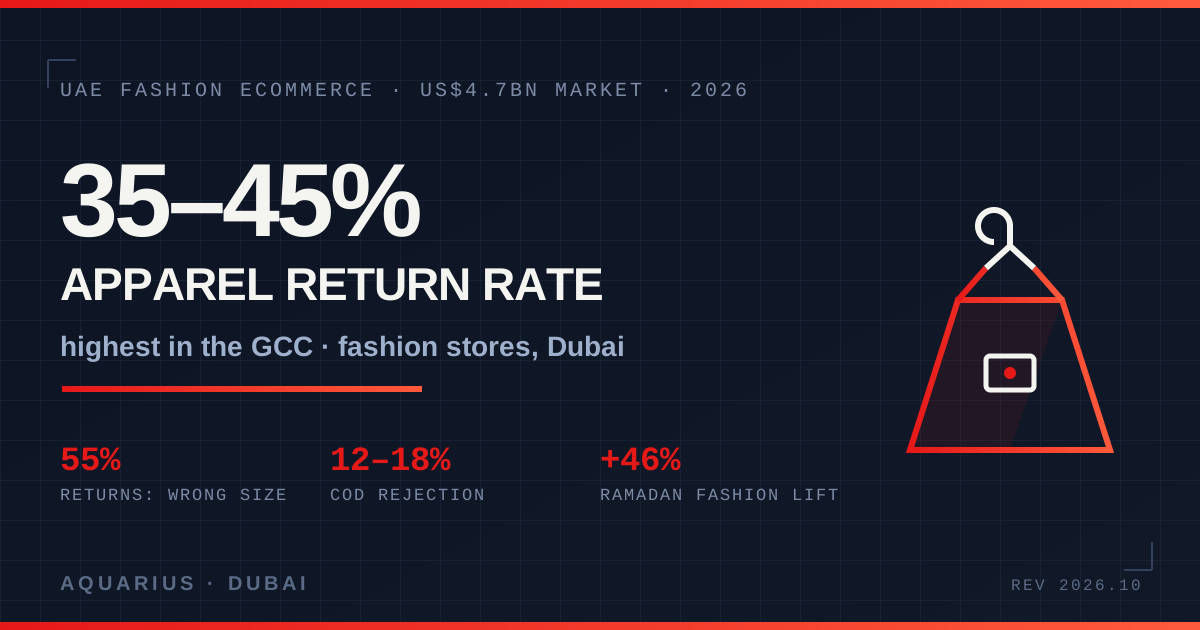
Short answer: UAE fashion ecommerce is a US$4.7 billion market in 2026 with about 6.1 million online fashion shoppers — and 35–45% of apparel orders come back, the highest return rate in the GCC. A production-grade Dubai fashion store costs AED 18,000–45,000 on Shopify, AED 45,000–110,000 for a bilingual custom build with a real fit system, and AED 110,000–280,000 headless. The returns are not a courier problem — 55% of them are “wrong size”, which is a product-page problem. All figures exclude 5% VAT.
Key takeaways
- Fashion is the single biggest slice of UAE ecommerce: around a 22% category share and roughly 38.7% of total ecommerce revenue, across about 8,000 fashion stores.
- UAE apparel returns run 35–45% versus 20–25% in the US and 15–20% in Southeast Asia. Reasons: wrong size 55%, item differs from photos 25%, changed mind 20%.
- That means roughly four in five returns are caused by missing information, not by logistics. Size guides, fit-specific photography and virtual try-on cut return rates by 8–12 percentage points.
- Every garment you sell needs a label in Arabic (or Arabic and English) carrying type, fibre content, size, brand, care and country of origin — and imported textiles need an ECAS certificate of conformity from MoIAT under Cabinet Resolution No. 54 of 2019.
- Your published returns policy is a legal document under Federal Decree-Law No. 15 of 2020 and its Executive Regulation, Cabinet Decision No. 66 of 2023 — with penalties reaching AED 2 million.
The Dubai fashion ecommerce market in 2026
Fashion is not a niche inside UAE ecommerce — it is the centre of it. The UAE fashion ecommerce market is valued at about US$4.7 billion in 2026 (roughly AED 17.2 billion at the pegged rate of US$1 = AED 3.6725), serving around 6.1 million shoppers at an average revenue per user near US$937. Set that against total UAE ecommerce of roughly US$12.3 billion in 2026 (about AED 45.1 billion), of which Dubai accounts for an estimated 60%, and the shape of the opportunity is clear: fashion carries about a 22% category share and contributes close to 38.7% of ecommerce revenue.
The competitive density is just as clear. There are roughly 8,000 online stores selling fashion into this market, and the online fashion segment is compounding at 15–18% a year. Modest wear is the engine underneath it: the GCC was the largest single geographic market for modest fashion in 2025 at US$51.2 billion, or 34.5% of global revenues, with abayas alone commanding a 42.3% share of that segment. UAE modest-fashion spend is estimated at US$23 billion.
And it is violently seasonal. Fashion purchases rise about 46% during Ramadan (cosmetics up to 64%), and regional modest-fashion retailers have reported Ramadan and Eid sales up close to 50% year on year. Ramadan 2027 is expected to begin around 8 February, which means the technical work for that peak — stock feeds, checkout capacity, Arabic creative, returns capacity — has to land in the last quarter of 2026.
Most Dubai fashion stores get this wrong: returns are a product-page defect
Here is the number that decides whether a Dubai fashion store is profitable: 35–45% of apparel orders are returned. That is the highest rate in the region — US apparel sits at 20–25%, Southeast Asia at 15–20%, and global apparel averages around 26%. On top of that, cash-on-delivery rejection for fashion runs 12–18%, and COD is still 25–30% of UAE transactions, so a meaningful share of your orders fail at the doorstep before a return is even logged.
The instinct is to treat this as a logistics line item and go hunting for a cheaper reverse-pickup rate. That is the wrong budget. Look at the stated reasons: wrong size 55%, item different from the photos 25%, changed my mind 20%. Eighty percent of your returns are caused by information your store failed to give the shopper before they paid. No courier contract fixes that. A better product page does — detailed size guides, fit-specific photography and virtual or AR try-on have been measured cutting return rates by 8–12 percentage points.
What that is worth, per 1,000 orders a month at an AED 350 average order value, using an all-in reverse cost of AED 32–48 per return (Dubai pickup is typically AED 22–30, plus inspection, re-bagging and relabelling):
| Return rate | Returns per 1,000 orders | Reverse-logistics cost (AED) | Refunded GMV (AED) |
|---|---|---|---|
| 45% (worst case, no fit data) | 450 | 14,400–21,600 | 157,500 |
| 40% (typical Dubai apparel store) | 400 | 12,800–19,200 | 140,000 |
| 35% (good size charts) | 350 | 11,200–16,800 | 122,500 |
| 28% (fit system + try-on + real photography) | 280 | 8,960–13,440 | 98,000 |
Going from 40% to 28% keeps roughly AED 42,000 of revenue per 1,000 orders every month — over AED 500,000 a year on that volume — and strips about AED 4,000–6,000 a month out of reverse logistics. It is the highest-ROI engineering work available to a fashion retailer in this market, and almost nobody budgets for it.
What a Dubai fashion store actually needs under the hood
A fashion catalogue is the hardest ecommerce data model in retail: one product, many colourways, many sizes, each a separate stock position, each photographed differently. The build decisions that matter here are not theme decisions.
1. A fit system, not a size chart image
A JPEG of a size table does nothing. What moves the return rate is structured fit data: per-garment measurements (not generic S/M/L), brand-specific size mapping, “runs small / true to size” signals derived from your own return reasons, and a recommender that uses what the shopper kept last time. Capture a return reason code on every refund — without it you are flying blind on the 55%.
2. Photography built to kill the “different from photos” 25%
Fixed shot protocol per SKU: front, back, detail, fabric macro, on-model with the model’s height and worn size stated, plus movement video. Fabric weight, stretch and opacity in text. This is a production cost, typically AED 120–450 per SKU in Dubai depending on model and set, and it pays back in the return rate.
3. Arabic that is actually right-to-left
Arabic is not a translation layer bolted onto a Latin theme — the whole layout mirrors, numerals and sizes need locale handling, and product copy needs a human. If you are planning a bilingual catalogue, our guide to Arabic website localisation and RTL in Dubai covers the traps.
4. Checkout matched to how the UAE pays
BNPL is around 14% of UAE ecommerce checkout, and in fashion it skews higher because basket sizes sit in the sweet spot. Tabby’s published merchant rates run roughly 4–7% of order value plus AED 1–2 per transaction; Tamara sits near 4–6%. Both negotiate once you cross meaningful monthly BNPL volume. Keep COD — it is still a quarter to a third of transactions — but price the 12–18% fashion rejection rate into it, and consider OTP confirmation before dispatch. The mechanics of that are in our last-mile and COD integration guide.
5. A self-service returns portal
Returns are your second-largest customer touchpoint. A portal that issues a label, books the pickup, captures the reason code and refunds on scan converts a refund into a repeat purchase — and gives you the dataset that drives item 1.
The compliance layer: Arabic labels and your returns policy
Two rules catch Dubai fashion sellers, and both are cheap to fix before launch and expensive after.
Labelling. Information and care labels on garments must be in Arabic, or Arabic and English, and must state the garment type, fibre composition, size, manufacturer or brand name, care instructions (symbols accepted) and country of origin; outer packaging needs the product name and unit count. The Gulf standard behind this is GSO 863. Textiles placed on the UAE market also fall under the Emirates Conformity Assessment Scheme per Cabinet Resolution No. 54 of 2019 — testing in an ISO/IEC 17025 accredited laboratory and a certificate of conformity from the Ministry of Industry and Advanced Technology. Private-label and dropship sellers get caught here most often, because the factory label was never built for this market.
Your returns policy is regulated. Consumer protection sits under Federal Decree-Law No. 15 of 2020, with the Executive Regulation in Cabinet Decision No. 66 of 2023, effective 14 October 2023. It requires ecommerce suppliers to state terms clearly and to show the return and refund policy before purchase, not buried in terms and conditions. For defective goods the supplier must repair, replace or refund at its own cost, and the regulation sets inspection periods of up to 15 days for foodstuffs and up to 30 days for other goods. Penalties under the law reach AED 2 million, and economic departments across the UAE logged more than 45,000 consumer complaints in 2026, with refund refusals near the top of the list. If you are still setting up, start with the Dubai ecommerce licence costs and the legal pages a UAE website needs.
Fashion ecommerce website cost in Dubai (2026)
Realistic build ranges, development only, excluding 5% VAT, platform fees and media spend:
| Build type | Cost (AED) | Timeline | What it covers |
|---|---|---|---|
| Shopify fashion store, 50–300 SKUs | 18,000–45,000 | 3–5 weeks | Themed storefront, variant model, Tabby/Tamara + COD, basic size guides |
| Bilingual custom Shopify build | 45,000–110,000 | 6–10 weeks | Arabic RTL, structured fit data, size recommender, returns portal, feeds |
| Headless custom store (Next.js + commerce API) | 110,000–280,000 | 10–16 weeks | Owned front end, OMS/WMS integration, try-on, loyalty, peak-ready infra |
| Multi-brand / GCC multi-country platform | 280,000–650,000+ | 4–7 months | Multi-store, multi-currency, KSA expansion, ERP and 3PL integrations |
The line items founders forget: product photography and 3D at AED 120–450 per SKU; building the structured size-and-fit dataset at AED 8,000–25,000; a self-service returns portal at AED 15,000–40,000; proper Arabic RTL at AED 12,000–35,000; and last-mile at roughly AED 17–30 per next-day Dubai delivery before reverse costs. Our published AED pricing and ecommerce development services show how we phase these.
How Aquarius builds fashion stores
- Fit data in sprint one. We model garment measurements, size mapping and return reason codes before anyone designs a product page, because that schema is what lowers the return rate.
- Return-rate instrumentation shipped with the store. Reason codes, per-SKU return dashboards and a size-recommender feedback loop from day one.
- Bilingual by default, with genuine RTL mirroring rather than a mirrored stylesheet.
- Payments and COD priced honestly, with BNPL fees modelled against your AOV before you sign a merchant agreement.
- Your code, your repos, your cloud. No vendor-held licences and no lock-in.
Risk reversal: we scope the fit-and-returns workstream as a fixed-price, standalone deliverable. If you take that schema and build the store elsewhere, it still works — and it still cuts your returns. Selling in an adjacent category? See how we approach perfume and oud ecommerce and gold and jewellery stores in Dubai.
FAQ
How much does a fashion ecommerce website cost in Dubai in 2026?
About AED 18,000–45,000 for a Shopify store with 50–300 SKUs, AED 45,000–110,000 for a bilingual custom build with structured fit data and a returns portal, and AED 110,000–280,000 for a headless custom store. Multi-brand or GCC multi-country platforms run AED 280,000–650,000 and up. Add AED 120–450 per SKU for photography. All excluding 5% VAT.
Why are fashion return rates so high in the UAE?
UAE apparel returns run 35–45%, against 20–25% in the US. The stated reasons are wrong size (55%), the item looking different from the photos (25%) and changed mind (20%) — so most of it is an information gap at the product page, worsened by a COD culture that lets shoppers order several sizes with no money at risk. COD rejection for fashion is 12–18% on its own.
Do my garment labels need to be in Arabic to sell online in the UAE?
Yes. Information and care labels must be in Arabic, or Arabic and English, showing garment type, fibre content, size, brand, care instructions and country of origin, per the GSO 863 textile labelling standard. Imported textiles also require ECAS conformity assessment and a certificate of conformity from MoIAT under Cabinet Resolution No. 54 of 2019.
What does UAE law require in my online returns policy?
Federal Decree-Law No. 15 of 2020 and its Executive Regulation, Cabinet Decision No. 66 of 2023 (effective 14 October 2023), require ecommerce suppliers to state terms clearly and display the return and refund policy before purchase. Defective goods must be repaired, replaced or refunded at the supplier’s cost, and inspection periods run up to 15 days for foodstuffs and 30 days for other goods. Penalties reach AED 2 million.
Should I offer Tabby or Tamara on a Dubai fashion store?
Offer BNPL — it is roughly 14% of UAE ecommerce checkout and fashion basket sizes suit it. Merchant rates are the thing to negotiate: published Tabby rates sit around 4–7% of order value plus AED 1–2 per transaction, Tamara around 4–6%. Model that against your gross margin before you enable it on every SKU, and keep COD alongside it because it is still a quarter to a third of UAE transactions.
When should I start building for Ramadan?
Ramadan 2027 is expected to begin around 8 February, and fashion sales lift about 46% in that window. Infrastructure, stock feeds, Arabic creative and extra returns capacity need to be live by December 2026 — peak is not the time to deploy.
Cut the return rate, keep the revenue
Send us your current return rate, your average order value and your top three return reasons, and we will come back with a fixed-price fit-and-returns scope plus an AED build estimate for the store around it. Start on our contact page or compare tiers on Aquarius pricing. In a market where 45% of apparel can come back, the product page is your margin.