On-Site Search for Dubai Ecommerce (2026): Arabic Relevance, Algolia vs Typesense vs OpenSearch, and Real AED Costs
Search users convert at 4.63% vs 2.77% for browsers, yet 56% of ecommerce sites fail search UX. Real 2026 AED costs for Algolia, Typesense and OpenSearch in the UAE, plus Arabic relevance fixes.
- PUBLISHED
- 24 OCT 2026
- READ TIME
- 12 MIN
- AUTHOR
- AQUARIUS · DUBAI
- UNIT
- REV 2026.09
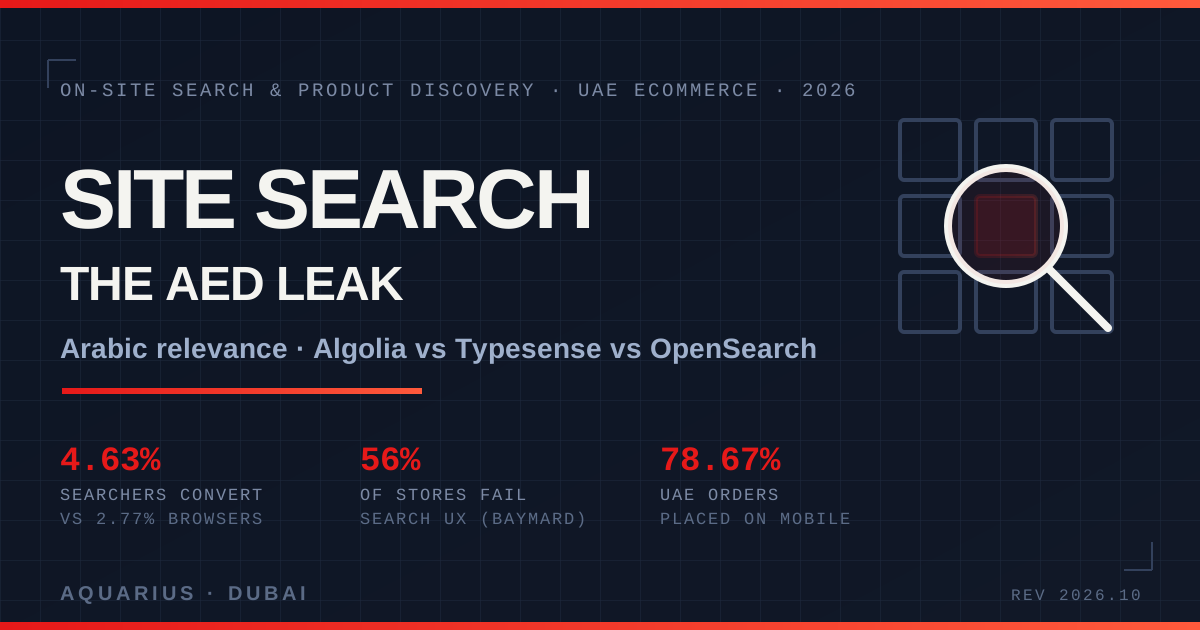
Short answer: shoppers who use your site search convert at 4.63% against 2.77% for shoppers who only browse — and yet Baymard’s 2026 benchmark finds 56% of ecommerce sites still fail to adequately support what users actually search for. In Dubai the gap is wider, because one search box has to answer an Arabic query, an Arabizi query and a misspelt English brand name against the same catalogue. Hosted search starts around AED 90 a month; a serious bilingual implementation is a AED 22,000 to AED 45,000 one-off.
Most Dubai stores get this exactly backwards. They spend on ads to buy the visit, spend again on conversion-rate optimisation of the product page, and leave the search box on whatever the platform shipped by default — literal keyword matching, no typo tolerance, no synonyms, no Arabic normalisation, no analytics. The highest-intent traffic on the site is the traffic that types. It gets the least engineering attention of anything in the funnel.
Three UAE numbers that make search a revenue channel, not a widget
The stakes are set by how the UAE actually shops in 2026.
- 11.04 million people in the UAE shop online — about 96% of the population — heading for roughly 12.9 million shoppers and 98% penetration by 2030. There is no untapped audience left to acquire; growth has to come from converting traffic you already pay for.
- Smartphones now carry 78.67% of UAE ecommerce orders, growing at a 16.24% CAGR. Separate Majid Al Futtaim and Visa research found 67% of UAE consumers used a phone in their most recent retail purchase and 37% completed the purchase on mobile — the highest rate recorded globally. On a phone there is no mega-menu and no left-hand facet rail. There is a search box.
- The market is worth roughly USD 12.30 billion in 2026, forecast to about USD 21.01 billion by 2031 at an 11.29% CAGR; EZDubai separately projects UAE ecommerce at AED 67.2 billion by 2030, a 9.9% CAGR. Every percentage point of search failure gets applied to a bigger base each year.
On a Dubai store, search is not a feature. It is the mobile navigation for 78% of your orders — and it is usually the only part of the funnel nobody owns.
What the 2026 Baymard benchmark says you are failing at
Baymard Institute’s search benchmark is the hardest data on this. The 2026 round covers more than 10,000 performance ratings across 170+ benchmarked sites and apps, and the headline is blunt: 56% fail to adequately support users’ search needs. Broken down, 46% of desktop sites, 58% of mobile sites and 64% of apps score mediocre or worse. Only four desktop sites and one mobile site rated perfect.
The useful part is which query types break. Exact-match searches mostly work. Everything a real customer types does not.
| Query type | Example on a Dubai store | Sites with issues |
|---|---|---|
| Non-product | return policy, delivery to Al Barsha, warranty | 66% |
| Abbreviation or symbol | 55 inch TV, AC, 6kg w/m | 54% |
| Compatibility | charger for iPhone 17 Pro | 44% |
| Use case | gifts for Eid, villa garden furniture | 43% |
| Feature | inverter AC 1.5 ton, SPF 50 | 39% |
| Symptom | hair fall, slow laptop | 37% |
| Product type | abaya, air fryer | 20% |
| Exact product | exact SKU or full product name | 12% |
Two operational metrics follow from that. Industry zero-result rates run 10% to 15% against a sane target of under 5%, and exit-after-search should sit under 25%. If you cannot report either number for last month, that is the first deliverable — not the search engine.
The Arabic problem that no plugin solves for you
This is where Dubai diverges from every generic guide, and where off-the-shelf search quietly fails. Arabic breaks the two assumptions English search engines are built on: one spelling per word, and suffix-based plurals.
Orthographic variation. Three character sets are routinely interchanged in typed Arabic — alef and its hamza forms, yeh versus alef maksura, and heh versus teh marbuta. Add optional diacritics and tatweel elongation and a single product name has four or five legitimate keyboard spellings. Without normalisation each one is a different token, and most of them return nothing.
Broken plurals. Arabic plurals frequently change the internal pattern of the word rather than appending a suffix, so the suffix-stripping stemmers that work for English simply miss. Lucene and Elasticsearch ship a native Arabic analyser; for catalogues carrying mixed dialects, root-based stemming of the ISRI type generally recalls better than the default.
Arabizi and code-switching. A real UAE query log contains Modern Standard Arabic, Gulf vocabulary, English product names in Latin script, and Arabizi — Arabic written in Latin letters and numerals. Arabizi has to be transliterated back into Arabic script before any Arabic analyser or language model can touch it. No major platform does that for you out of the box.
Platform support is thinner than the marketing suggests. Algolia’s own language table lists Arabic plural handling as basic, capped at 10,000 dictionary entries, with stop words supported and word segmentation marked not applicable. That is a starting point, not a solution — the synonym set, the Arabizi map and the dialect vocabulary are yours to build and maintain, the same discipline that makes Arabic and RTL localisation work rather than merely exist.
Algolia vs Typesense vs OpenSearch vs the plugins: real 2026 costs
List prices pulled on 24 October 2026, converted at USD 1 = AED 3.6725.
| Option | How it is billed | Entry cost |
|---|---|---|
| Algolia Grow | USD 0.50 per 1,000 search requests, USD 0.40 per 1,000 records | Free to 10,000 searches and 50,000 records; 10,000 searches and 100,000 records included |
| Algolia Grow Plus | USD 1.75 per 1,000 searches — adds AI ranking, AI synonyms, personalisation | 3.5x the keyword rate |
| Algolia Elevate | Annual contract, custom — NeuralSearch, 99.99% availability, SSO | Quote only |
| Typesense Cloud | Per hour by RAM, vCPU and region, plus about USD 0.09 per GB egress after 10 GB | About USD 115 to 230 a month for a 4–8 GB cluster; HA roughly triples the base rate |
| Meilisearch Cloud | Instance plus disk, or usage-based | From USD 20 a month; about USD 30 a month modelled at 100,000 documents and 50,000 searches |
| AWS OpenSearch (self-managed relevance) | Per instance hour in me-central-1 (UAE), plus storage | USD 0.2094 per hour for r6g.large — about USD 306 a month for two data nodes |
| Doofinder | Tiered by search requests | EUR 49 Basic (10,000 requests), EUR 149 Pro, EUR 349 Advanced |
| Searchanise | By catalogue size, unlimited queries | Free to 25 products, from USD 19 a month at 1,500 products |
| Klevu | Per module, by request volume | USD 649 site search (50,000 requests), plus USD 549 merchandising and USD 449 recommendations |
Put that on a real Dubai store. At 40,000 sessions a month with 40% of visitors searching three times each, you are near 48,000 search requests. On Algolia Grow that is 38 billable blocks of a thousand above the included 10,000 — about USD 19, call it AED 70 a month. Switch on the AI tier and the same traffic costs USD 66.50, about AED 245 a month. At ten times the traffic, Grow is roughly AED 880 a month and Grow Plus roughly AED 3,080. The monthly licence is almost never the expensive part. The relevance work is.
One more thing worth knowing before you promise anyone a Shopify-native build: Search & Discovery caps you at 25 filters, 1,000 filter groups, 100 displayed values per filter and 200 unique values per group — and filter values on a search results page are derived from only the first 1,000 results. For a 30,000-SKU catalogue with real attribute data, that ceiling arrives early.
The in-region latency trap
Two details decide whether your search feels local, and both get missed at procurement.
Algolia has a Dubai data centre, and you probably cannot use it as your primary. Algolia runs 16 regions across 47 data centres; the Middle East region — Dubai — is one of only two listed as DSN-only, alongside Europe (Netherlands). Distributed Search Network is a paid add-on on higher plans, so a default Dubai deployment on an entry plan is served from Europe or India, not from Dubai. Typesense Cloud, by contrast, lists UAE and Bahrain among its standard cluster regions.
Running your own cluster in the UAE carries a hard regional premium. Live AWS OpenSearch on-demand pricing for me-central-1 against us-east-1, pulled 24 October 2026:
| Instance | UAE (me-central-1) | US East | UAE premium |
|---|---|---|---|
| t3.small.search | USD 0.0429/hr | USD 0.0360/hr | +19% |
| m6g.large.search | USD 0.1602/hr | USD 0.1280/hr | +25% |
| r6g.large.search | USD 0.2094/hr | USD 0.1670/hr | +25% |
| r6g.xlarge.search | USD 0.4189/hr | USD 0.3350/hr | +25% |
So self-hosting in-region costs roughly a quarter more than the US figure every comparison blog quotes, before a single hour of relevance engineering. That is the trade: a hosted engine costs AED 70 to AED 3,000 a month and gives you no control over the analyser chain; a self-managed OpenSearch cluster from about AED 1,120 a month gives you full control of Arabic normalisation and custom stemming, and needs someone on the team who knows what an analyser is.
What it costs to build in Dubai, and what it returns
Implementation ranges we quote in Dubai, separate from the monthly licence:
| Scope | What you get | One-off (AED) |
|---|---|---|
| Hosted search, single language | Indexing, autocomplete, typo tolerance, synonyms, facets, search analytics dashboard | 9,000 – 18,000 |
| Bilingual EN/AR relevance | Arabic normalisation and stemming, Arabizi transliteration map, bilingual synonym sets, RTL results UI, zero-result redirects | 22,000 – 45,000 |
| Headless or hybrid semantic | Self-managed or vector-hybrid search, merchandising rules, personalised ranking, A/B tested ranking changes, query-log pipeline | 60,000 – 120,000 |
Now the cost of leaving it alone. Take 40,000 monthly sessions, 40% of them searching, and an average order value of AED 420. At the benchmark 4.63%, those 16,000 searching sessions produce about 741 orders. If the search box fails them and they convert at the 2.77% browse rate instead, you get about 443. The difference is roughly 298 orders, about AED 125,000 of revenue a month — modelled from the published benchmark rates rather than measured on your store, but it reframes a AED 45,000 project as a payback measured in days. It is also the one platform decision most Dubai founders defer until after launch.
How we do it at Aquarius: baseline your current zero-result and exit-after-search rates first, mine three months of real query logs before choosing an engine, build the Arabic and Arabizi synonym layer from your own catalogue vocabulary rather than a generic dictionary, then ship ranking changes behind measurement so every change is defensible. Engine selection comes last, because the engine is the cheap part. See pricing for how we scope it, or tell us your catalogue size and we will tell you which of the three tiers above you actually need.
Frequently asked questions
Is my platform’s built-in search good enough for a Dubai store?
For a catalogue under roughly 500 SKUs in one language, often yes. Beyond that, or the moment you publish an Arabic storefront, built-in search becomes the constraint: Shopify’s Search & Discovery caps at 25 filters and builds filter values from the first 1,000 results only, and no mainstream platform ships Arabic normalisation, Arabizi handling or a synonym workflow you can maintain.
How much should a UAE store budget per month for search?
A store at 40,000 sessions a month lands near AED 70 on Algolia Grow or AED 245 on the AI tier; a bigger store at ten times that traffic is AED 880 to AED 3,080. Self-managed OpenSearch in me-central-1 starts near AED 1,120 a month for two r6g.large data nodes. Budget the one-off relevance work separately — it is the larger number.
Which search engine has a UAE region?
Typesense Cloud lists UAE and Bahrain as standard cluster regions. Algolia has a Dubai data centre but lists the Middle East as DSN-only, meaning it serves as a distributed replica through a paid add-on rather than as your primary cluster. AWS OpenSearch runs in me-central-1 at roughly a 19% to 25% premium over US East.
What is a good zero-result rate?
Under 5%. Industry averages sit at 10% to 15%, so most stores are leaking about one search in eight. Fix it with synonyms, typo tolerance and Arabic normalisation first, then with a zero-result page that recommends rather than apologises.
Does fixing search help SEO or AI shopping agents?
Indirectly but materially. Clean query logs reveal the exact demand language to use in category copy and FAQs, and a structured, filterable catalogue is what AI shopping agents parse when they shortlist products on a customer’s behalf. A store an agent cannot search is a store an agent cannot recommend.
If you want to know what your own search box is costing you, send us the store URL and your monthly session count. We will pull the zero-result and exit-after-search baselines and tell you plainly whether this is a AED 9,000 fix or a AED 45,000 one.