
Shopping Mall App Development Dubai 2026: Wayfinding and Costs
The Dubai Mall drew 111 million visitors and Dubai booked AED 129bn of retail sales in half a year. What a mall app with wayfinding, live parking and a tenant portal really costs, in AED.
- PUBLISHED
- 13 OCT 2026
- READ TIME
- 12 MIN
- AUTHOR
- AQUARIUS · DUBAI
- UNIT
- REV 2026.09
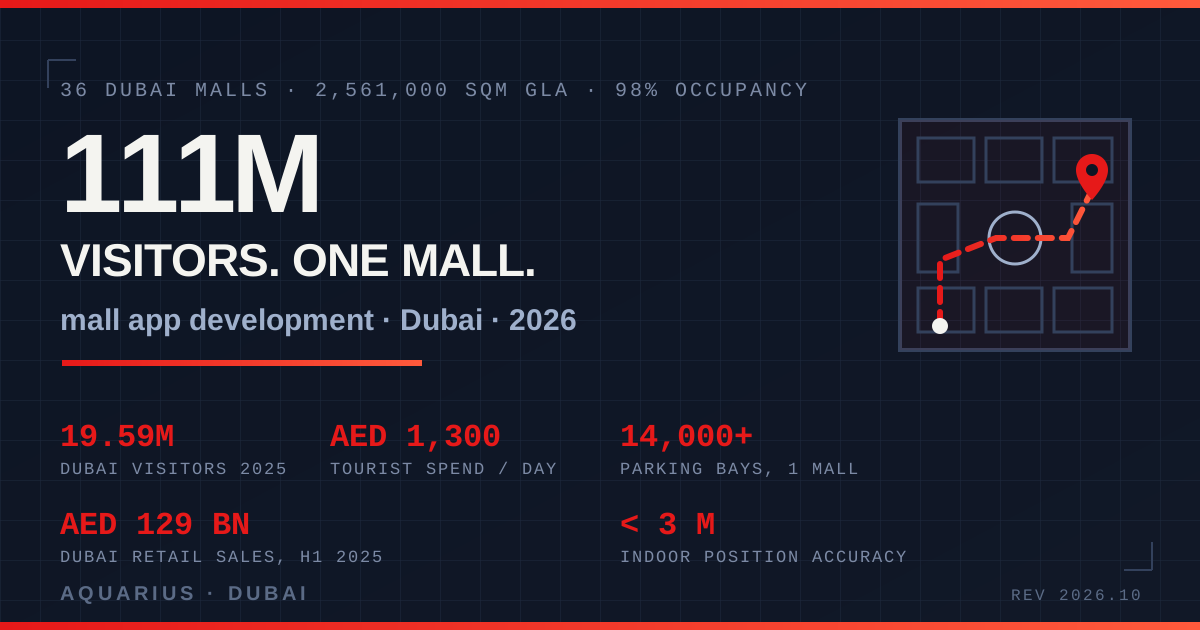
Short answer: a Dubai mall app earns its budget on four jobs — find the store, find the parking bay, find the offer, and prove the visit. A community-mall MVP (tenant directory, offers, push) runs AED 15,000-35,000; a regional-mall app with indoor wayfinding, live parking and a tenant portal lands at AED 180,000-450,000 in phases. The cheapest part is the map. The expensive part is the data plumbing behind it.
Dubai is the densest mall market on earth per resident, and almost every centre still measures its digital performance in app downloads rather than attributable visits. That is the gap worth building into.
The footfall is real. The measurement usually is not (awareness)
Start with the scale, because it changes what the software has to do.
The Dubai Mall drew more than 111 million visitors in 2024, up about 6% on the 105 million of 2023 and well clear of the 88 million recorded in 2022 — making it the most visited place on the planet for a second consecutive year. Across the emirate, Dubai’s mall network tracks 36 centres totalling roughly 2,561,000 sqm of gross leasable area, anchored by The Dubai Mall at about 502,000 sqm, Mall of the Emirates at roughly 233,000 sqm and Dubai Hills Mall at around 186,000 sqm.
The demand side matches. Dubai hosted 19.59 million international overnight visitors in 2025, up 5% and the highest annual total ever recorded, with December 2025 becoming the first single month above two million at 2.04 million arrivals. DET expects a further 5% rise across 2026. Those visitors spend: Dubai booked AED 129 billion in retail sales in H1 2025 alone, up 11% year on year, at an average tourist spend of about AED 1,300 per day.
Landlord economics have followed. Emaar’s malls, retail and commercial leasing segment posted AED 6.3 billion of revenue in 2025, up 13%, with EBITDA of AED 5.5 billion (up 17%) and average portfolio occupancy at 98%. Citywide retail vacancy improved to 4.7% in Q2 from 8.0% a year earlier, while average retail rents rose 6.4% year on year in Q1. And capital is piling in: Dubai retail property sales hit AED 3.8 billion in H1 2026, up 177%, across 850 transactions (up 56%) at an average ticket of AED 4.4 million.
Most Dubai mall operators get this wrong: they commission an app as a marketing brochure with a map in it. The asset that actually moves rent reviews and retail-media rate cards is the visit record — who came, which zone they walked, which offer they opened, which tenant they transacted with. Build the app around that record and the directory comes free.
One more number that decides your platform strategy: UAE smartphone penetration sits around 95-96%, Android holds roughly 81% of UAE mobile OS share against 18.8% for iOS, and over 70% of UAE e-commerce transactions are mobile. An iOS-only pilot covers the higher-spend segment and misses four fifths of the devices in the car park.
What a mall app actually has to do (consideration)
1. Indoor wayfinding — and the beacon myth
The reference implementation is next door. The Dubai Mall app ships turn-by-turn indoor navigation across 1,300+ stores, plus washroom and taxi-point lookup. The question operators ask first is always hardware.
Here is the arithmetic that kills most beacon proposals. Bluetooth beacon networks deliver 1-3 m accuracy but need roughly one beacon every 25-50 sqm. On a 200,000 sqm regional mall that is 4,000 to 8,000 beacons to buy, mount, map and re-battery on a rolling cycle. Apple’s Indoor Maps programme with an IMDF survey delivers sub-3 m positioning with zero installed hardware, riding the Wi-Fi infrastructure you already pay for — the catch being that it covers iPhone and iPad only. The sane 2026 build is IMDF-first for iOS, Wi-Fi and sensor-fusion positioning on Android, and beacons deployed only in a handful of high-value micro-zones where you want proximity triggers rather than blanket coverage.
2. Parking, which is the real retention feature
Nobody opens a mall app twice for a store directory. They open it because they cannot find the car. The Dubai Mall runs more than 14,000 bays across five car parks — Grand Parking at 2,571 spaces, Cinema Parking at 4,165 and Fashion Parking at 2,596, plus Zabeel and Fountain Views — with live availability and a plate-based Find My Car in the app. Replicating that means integrating the parking guidance system and ANPR feed, not writing a screen. If your tariff logic touches Salik or ParkIn, read our note on Salik, ParkIn and nol integration for Dubai apps before scoping.
3. Footfall analytics, inside PDPL limits
Stereo-depth and dual-lens counters above entrances separate inbound from outbound traffic at documented accuracy above 95%, logging totals by hour, day and zone. That is the compliant baseline. Where projects go wrong is demographics and faces: the UAE PDPL (Federal Decree-Law No. 45 of 2021) makes consent the default basis for processing personal data, so age-bracket or gender estimation needs explicit consent plus a data-protection impact assessment, and face recognition across anonymous public footfall is effectively unachievable in a mall concourse. Design for aggregate, anonymous counts with defined retention windows — our UAE PDPL checklist for websites and apps and the AI video analytics guide cover the control set.
4. Loyalty that survives contact with tenants
Scale benchmark: Majid Al Futtaim’s SHARE programme reached 10.3 million members in 2025, linked across more than 5,000 stores spanning malls, Carrefour, cinemas and leisure. You will not match that, and you do not need to — but it sets tenant expectations about receipt scanning, point accrual and offer redemption. Receipt-level data is also the only honest way to attribute a visit to a sale when tenant POS systems stay closed. See loyalty and rewards app development in Dubai for the mechanics.
5. The tenant portal nobody budgets for
This is the module that turns an app into an operating system: tenant onboarding, trading-hours and promotion submission, monthly sales certification, fit-out and maintenance requests, and a zone-level footfall dashboard the retailer can actually see. It is also where the retail-media money lives. The UAE retail media networks market generated USD 662.3 million in 2025 and is forecast to reach USD 1,301.6 million by 2033, while Middle East retail media is projected to hit USD 2,748 million by 2031 at a 14.8% CAGR. Globally, retail media is on track for about USD 196.7 billion in 2026, roughly 16% of all advertising spend. Without first-party visit and redemption data, you are selling sponsorship against footfall estimates. With it, you sell attributable reach.
What it costs in Dubai, in AED (decision)
Indoor-navigation builds globally price at USD 15,000-30,000 for small venues and USD 30,000-100,000 for mid-sized venues such as shopping malls — about AED 55,000-110,000 and AED 110,000-367,000 respectively. Dubai delivery with Arabic and RTL, local integrations and PDPL work lands in the same band. Scope it in phases and ship revenue-earning modules first:
| Module | What you get | Timeline | Cost (AED) |
|---|---|---|---|
| Phase 0 — Community mall MVP | Tenant directory, offers, events, push, EN/AR | 3-4 weeks | 15,000 - 35,000 |
| Phase 1 — Indoor wayfinding | IMDF survey, iOS positioning, Android sensor-fusion, turn-by-turn, accessibility routes | 8-12 weeks | 90,000 - 180,000 |
| Phase 2 — Parking | Live bay availability, zone guidance, plate-based Find My Car, tariff and validation logic | 6-10 weeks | 60,000 - 140,000 |
| Phase 3 — Loyalty and wallet | Receipt scanning, points engine, coupon redemption, Apple and Google Wallet passes | 8-12 weeks | 80,000 - 200,000 |
| Phase 4 — Tenant portal | Sales certification, promo submission, maintenance tickets, zone footfall dashboards | 6-10 weeks | 70,000 - 160,000 |
| Phase 5 — Retail media module | Ad inventory, campaign booking, screen scheduling, attribution reporting | 6-8 weeks | 60,000 - 150,000 |
| Run cost | Hosting, map upkeep, store-data changes, OS releases, support | Monthly | 3,000 - 12,000 / month |
Hardware sits outside software budgets and should be quoted separately: entrance counters, parking guidance sensors and any beacon micro-zones. A realistic first-year total for a regional mall running Phases 1-4 is AED 300,000-680,000 including run cost. A community centre doing Phase 0 plus static maps gets live for under AED 40,000.
How Aquarius does it
We scope backwards from the visit record. Phase 0 ships in weeks so marketing has a live channel, and every later module writes into the same event schema — so wayfinding routes, parking sessions, coupon redemptions and receipt scans all resolve to one anonymous visit ID you can sell against. Positioning is IMDF-first precisely because it costs nothing to install and nothing to maintain; we recommend beacons only where a proximity trigger pays for itself. PDPL consent and retention are designed in at Phase 0, not retrofitted after legal review. Arabic and RTL are first-class from the first screen, not a later sprint.
Two risk-reversals. First, we will tell you when you do not need an app: for a single-level community centre with 40 tenants, a fast progressive web app plus WhatsApp offers beats a store listing nobody will install. Second, we quote module by module with a fixed price per module, so a stalled parking-system integration never holds your loyalty launch hostage. Custom app engagements start from AED 10,000 — see pricing.
The cost of inaction is measurable. With citywide retail vacancy at 4.7% and rents up 6.4%, tenant competition for your space is strong today — but at AED 1,300 of tourist spend per day and 19.59 million annual visitors, a mall that cannot prove which of those visits it delivered to a tenant negotiates every renewal on vibes. One retail-media line item sold on attributed reach rather than estimated footfall typically covers a full phase.
FAQ
Do we need Bluetooth beacons for indoor navigation in 2026?
Usually no. Apple’s Indoor Maps programme with an IMDF survey gives sub-3 m positioning with no installed hardware, and Android positioning uses Wi-Fi and sensor fusion. Beacons buy 1-3 m accuracy but need roughly one unit per 25-50 sqm — 4,000 to 8,000 devices on a 200,000 sqm mall, each with a battery and a mounting record. Deploy them in targeted micro-zones only.
How long does a full mall app take?
Phase 0 goes live in 3-4 weeks. Wayfinding adds 8-12 weeks, mostly survey and map-data preparation rather than coding. A regional mall running Phases 1-4 realistically spans 6-9 months end to end, which is why phasing matters — each module earns while the next is built.
Is footfall analytics legal in the UAE?
Anonymous counting is, and stereo-depth counters document above 95% accuracy without storing identities. Under PDPL, consent is the default basis for processing personal data, so demographic estimation requires explicit consent and a data-protection impact assessment, and face recognition over general public footfall is not a practical feature. Keep outputs aggregated, set retention windows, and document the lawful basis before switching anything on.
Should the app be iOS-first?
No. Android holds about 81% of UAE mobile OS share against 18.8% for iOS, so an iOS-only release reaches a minority of handsets even though it is the easier positioning path. Build cross-platform with platform-specific positioning behind one interface.
What does the app actually generate in return?
Three lines. Retail media sold on attributed reach rather than estimated footfall — a market growing from USD 662.3 million in the UAE in 2025 toward USD 1,301.6 million by 2033. Tenant-portal efficiency, where sales certification and maintenance tickets stop living in email. And leasing leverage, because zone-level dwell and conversion data is the strongest argument in a renewal where rents are already up 6.4%.
Next step
Send us your GLA, tenant count, car park size and whether a parking guidance system is already installed, and we will come back with a phased scope and a real AED number — talk to us or review what we build.