
AI Video Analytics for Dubai CCTV in 2026: SIRA Rules, PDPL Limits and Real AED Costs
SIRA spec floor is 1080p at 25fps, not 4K. What AI video analytics really costs in Dubai in 2026, where PDPL stops facial recognition dead, and honest AED build bands.
- PUBLISHED
- 29 SEPT 2026
- READ TIME
- 10 MIN
- AUTHOR
- AQUARIUS · DUBAI
- UNIT
- REV 2026.09
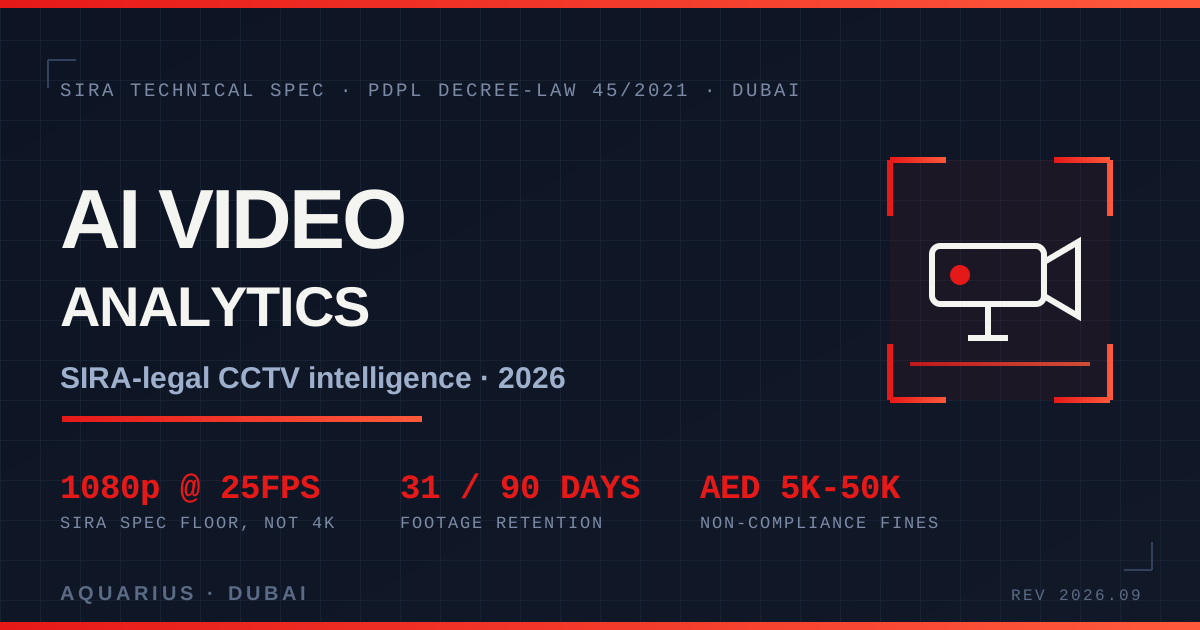
Short answer: adding an AI analytics layer to CCTV you already own costs roughly AED 11–55 per camera per month for an off-the-shelf analytics licence, or AED 90,000–160,000 to build a custom analytics and dashboard layer for a single Dubai site, rising to AED 250,000–500,000+ for a multi-site deployment with edge inference and integrations. The expensive mistake is not the software. It is ripping out compliant cameras because a vendor told you SIRA now requires 4K — the published SIRA technical specification floor is 1080p Full HD at 25 frames per second, with pixel density, not marketing resolution, deciding whether footage identifies anyone. Updated September 2026.
Key takeaways
- SIRA baseline: 1080p minimum, 25fps live viewing per camera, 48 dB signal-to-noise, IP66 outdoors, 110 dB WDR facing glare, and 300 pixels per metre where footage must identify a person.
- Retention is 31 days minimum for general commercial premises and up to 90 days for higher-risk categories such as banks, jewellers, exchange houses and large malls — plus 20% spare storage above the minimum.
- SIRA penalties run AED 5,000–50,000, and a failed inspection can hold up a trade licence renewal, which usually costs more than the fine.
- Face recognition is sensitive personal data under UAE PDPL. It needs explicit, separate, withdrawable consent plus a DPIA — which is why almost every commercial Dubai deployment should be anonymous analytics, not identity matching.
- Global video analytics spend is forecast to go from USD 14.65 billion in 2026 to USD 41.39 billion by 2031 at a 23.1% CAGR. The technology is cheap now; the compliance design is what you are actually buying.
Why Dubai businesses are suddenly buying video analytics
Three numbers explain the shift. The global video analytics market is projected to grow from USD 14.65 billion in 2026 to USD 41.39 billion by 2031, a 23.1% compound annual growth rate — growth driven by exactly the smart-city and retail-security use cases the Gulf is funding. The UAE artificial intelligence market was valued at around USD 8.3 billion in 2026. And the national AI strategy targets an AI contribution of AED 335 billion by 2031, roughly 20% of non-oil GDP.
Dubai is not theorising about this. Dubai Police launched the Oyoon AI surveillance programme in 2018 with more than 5,000 cameras across the Metro, tourist sites and public transport, and reported 319 wanted suspects arrested in a single year off the back of it. Government set the precedent, and enterprise procurement followed.
The commercial driver is loss, not novelty. Inventory shrinkage averages 1.6% of retail sales in the latest NRF benchmark. The UAE held 22.3% of the Middle East retail market in 2025 — a market valued at USD 868.89 billion in 2025 and forecast at USD 932.54 billion in 2026. For a single Dubai retailer turning over AED 50 million a year, that 1.6% is AED 800,000 walking out of the building annually. That is the budget conversation.
The myth most Dubai vendors are selling you: you need 4K
Search SIRA CCTV requirements in 2026 and half the results tell you 4K Ultra HD is now mandatory. Read the published technical specification and the baseline is 1080p Full HD, with live viewing at a minimum of 25 frames per second per camera. What SIRA actually regulates is image usefulness:
- 300 pixels per metre where the camera must support identification of a person — that is a lens, distance and placement calculation, not a sensor-megapixel purchase.
- 48 dB minimum signal-to-noise ratio, so footage stays usable in low light.
- 110 dB WDR or equivalent for cameras facing direct or reflected light — non-negotiable in Dubai, where a glass shopfront at 3pm destroys a camera without it.
- IP66 minimum for outdoor continuous operation, and remote zoom and focus for anything installed 4 metres or higher.
- A dedicated private network with redundancy, and network segmentation and management once 200 or more devices are connected.
A correctly placed 1080p camera hitting 300 px/m at the till beats a 4K camera mounted where it frames a car park. Buying resolution instead of placement is the single most common way Dubai businesses overspend and still fail an inspection.
What SIRA requires, what analytics adds, and where the money goes
Analytics sits on top of compliance, never instead of it. The base obligations are fixed; the intelligence layer is where you choose.
| Layer | 2026 requirement or option | Typical cost | Who needs it |
|---|---|---|---|
| SIRA-certified cameras and recorder | 1080p min, 25fps, 48 dB SNR, IP66 outdoor, 110 dB WDR, SIRA-certified devices installed by a SIRA-licensed company | Hardware and installation, quoted per site | Every Dubai commercial premises |
| Retention and storage | 31 days minimum, up to 90 days for banks, jewellers, exchange houses and large malls, plus 20% spare capacity | Storage sizing, scales with camera count | Every Dubai commercial premises |
| Off-the-shelf analytics licence | People counting, queue detection, intrusion, PPE and safety-zone alerts | AED 11–55 per camera per month | Single sites, standard use cases |
| Cloud VMS with analytics | Hosted recording, remote access, event search | AED 37–110 per camera per month typical; AED 110–220 with long retention and heavy AI | Multi-branch operators without a server room |
| Custom analytics and dashboard layer | Your metrics, your integrations, ERP or POS correlation, Arabic and English reporting | AED 90,000–160,000 single site build | Anyone whose value is in the analysis, not the footage |
| Multi-site platform | Edge inference, central dashboards, role-based access, audit trails, API integrations | AED 250,000–500,000+ | Retail chains, developers, logistics, facilities operators |
Two things to note about the per-camera pricing. First, almost every major VMS — Genetec, Milestone, Avigilon, Bosch, Hanwha — licenses per camera or device channel, not per server, so a 200-camera estate multiplies every line. Second, at around AED 55 per camera per month, a 120-camera operator is paying roughly AED 79,000 a year in licences alone. That is the point where a custom layer starts to pay for itself inside two to three years — the same crossover we walk through for security guard and patrol management software in Dubai.
The PDPL line: anonymous analytics yes, face recognition almost never
This is where most Dubai deployments quietly break the law. Under Federal Decree-Law No. 45 of 2021, the UAE Personal Data Protection Law, biometric data — facial images, fingerprints, iris scans — is sensitive personal data in a higher-protection category. Processing it requires explicit consent, specific to the biometric purpose, separate from your general terms, freely withdrawable, with withdrawal as easy as giving it — and it triggers a data protection impact assessment plus stricter security obligations.
Consider what that means in a shop. You cannot obtain explicit, purpose-specific, withdrawable consent from a stranger walking through a door. So face recognition on general public footfall is not a feature you switch on; it is a legal exposure you take on. The architecture that works instead:
- Count and classify, do not identify. Footfall, dwell time, queue length, zone occupancy, direction of travel — all deliverable from detections that are discarded after inference.
- Process on the edge, store the number. Run inference on-device or on a local box and persist the metric, not the face crop. Nothing biometric is retained, so the sensitive-data regime does not engage.
- Keep analytics data separate from SIRA footage. Footage obeys the 31 or 90 day retention rule. Analytics metrics are business data with their own, usually longer, retention and their own access control.
- Reserve identity matching for consented, closed groups. Staff time-and-attendance or a members-only facility, with signed explicit consent and a documented DPIA.
- Log who looked. An access audit trail on both the footage and the dashboard is the control that survives contact with an auditor.
Our UAE PDPL compliance checklist for websites and apps covers the consent, DPIA and 72-hour breach-notification mechanics in full. If the analytics feed also touches building systems, the same data-separation logic applies to IoT and smart building software.
The use cases that actually return money in Dubai
Skip anything that only produces a dashboard nobody opens. The deployments that pay back here are the ones wired to a decision:
- Retail queue and staffing. Queue-length alerts that trigger a till opening. Against shrinkage averaging 1.6% of sales and mall rents at Dubai levels, conversion recovered at the till is the fastest measurable win.
- Shrink and sweethearting detection at POS. Correlating a detection stream with till events catches voids and no-scans that footage alone never surfaces — pair it with your POS and inventory system.
- Construction and industrial safety. PPE detection, exclusion-zone breach and vehicle-pedestrian proximity. In a jurisdiction where a site incident stops work, prevention has a hard AED value.
- Logistics yard and dock. Trailer dwell time, bay utilisation, licence-plate-driven gate automation — all vehicle data, none of it biometric.
- Facilities and footfall reporting for landlords. Occupancy and peak-hour evidence that feeds service-charge and leasing conversations.
What it costs to build properly, and how Aquarius scopes it
Our build bands for a custom analytics layer on existing SIRA-compliant CCTV, excluding cameras, installation and 5% VAT:
| Scope | AED band | What is included | Timeline |
|---|---|---|---|
| Single-site analytics core | 90,000–160,000 | Edge or server inference for 2–3 use cases, metrics database, web dashboard, alerting to WhatsApp or email, role-based access | 8–12 weeks |
| Integrated operations layer | 180,000–280,000 | Adds POS, ERP or access-control correlation, Arabic and English reporting, scheduled report packs, audit trail | 3–5 months |
| Multi-site platform | 250,000–500,000+ | Central multi-branch dashboards, edge fleet management, model retraining pipeline, API for third parties, DPIA documentation pack | 5–8 months |
Plan for annual run costs of 15–20% of build — model drift is real, and a detector tuned in November behaves differently once store layouts change in Ramadan. We scope the compliance work as a deliverable, not a disclaimer: the PDPL data-flow map, the retention split between footage and metrics, and the DPIA if any identity matching survives the design review. Full bands are on our pricing page, and the broader context sits in our custom software development cost in Dubai guide.
On risk reversal: we do not ask you to replace working cameras. The first engagement is a paid two-week assessment — we audit the existing estate against the SIRA spec floor, confirm which cameras can already support the analytics you want, and tell you if the answer is an off-the-shelf licence at AED 11–55 per camera instead of a build. Several clients have stopped there, and that is a good outcome.
FAQ
Does SIRA require 4K cameras in Dubai in 2026?
No. The published SIRA technical specification sets a floor of 1080p Full HD with live viewing at a minimum of 25 frames per second, alongside 48 dB signal-to-noise, IP66 outdoors and 110 dB WDR where cameras face glare. Where footage must identify a person, the binding requirement is 300 pixels per metre, which depends on lens and placement far more than sensor resolution.
How long must Dubai businesses keep CCTV footage?
A minimum of 31 days for general commercial premises, extending to 90 days for higher-risk categories such as banks, jewellers, exchange houses and large shopping malls. Storage should be sized with about 20% spare capacity above the minimum, and footage must be exportable to standard media.
Is facial recognition legal for a private business in Dubai?
Only with a proper legal basis. Facial images are sensitive personal data under Federal Decree-Law No. 45 of 2021, requiring explicit, purpose-specific, withdrawable consent separate from general terms, plus a data protection impact assessment. That is achievable for staff or members who sign consent, and effectively unachievable for anonymous public footfall, which is why commercial deployments should use anonymous counting instead.
What does AI video analytics cost per camera?
Analytics licences run about AED 11–55 per camera per month in 2026. Cloud VMS with recording and analytics typically lands at AED 37–110 per camera per month, rising to AED 110–220 with long retention and heavy AI processing. Most major VMS platforms license per camera channel, so costs scale linearly with estate size.
What happens if my CCTV fails a SIRA inspection?
Penalties generally range from AED 5,000 to AED 50,000 depending on severity and whether it is a first offence, and a non-compliant system can trigger a corrective installation order, hold up a trade licence renewal and leave you exposed to civil liability if an incident happens and no usable footage exists.
Can analytics run on the cameras we already have?
Often yes. If existing cameras meet the SIRA spec floor and are positioned where the detections matter, an analytics layer can read their streams without replacing hardware. The constraint is usually placement and lighting, not the camera.
Get a straight answer on your CCTV estate
Send us a camera list and a floor plan and we will tell you what your existing estate can already deliver, where PDPL draws the line on your intended use case, and whether you need a licence or a build. See Aquarius pricing or request an assessment — most Dubai sites need less new hardware than their last vendor quoted.