
Oil & Gas Field Services Software in Dubai (2026): ICV Scores, Field Tickets and Real AED Build Costs
Dubai runs the UAE’s oilfield service base. Real 2026 AED build costs for field tickets, inspection and HSE — plus the ICV score that quietly decides tenders.
- PUBLISHED
- 17 OCT 2026
- READ TIME
- 13 MIN
- AUTHOR
- AQUARIUS · DUBAI
- UNIT
- REV 2026.09
Short answer: Oil and gas field services software in Dubai costs AED 45,000 for a single-crew field-ticket MVP, AED 90,000–220,000 for a growth platform covering tickets, inspection and HSE, and AED 220,000–500,000+ for a multi-base enterprise build with ERP and asset integration. Off-the-shelf oilfield ticketing SaaS runs roughly AED 147–275 per user per month, or AED 3,670–9,180 a month on platform tiers.
But the number that decides the project is not the licence fee. It is your ICV score and your ticket-to-cash cycle — because in the UAE, a service company that cannot evidence In-Country Value scores zero on that tender criterion, and one that still bills on paper waits one to two months for cash that a digital ticket turns around in 7 to 10 days.
Key takeaways
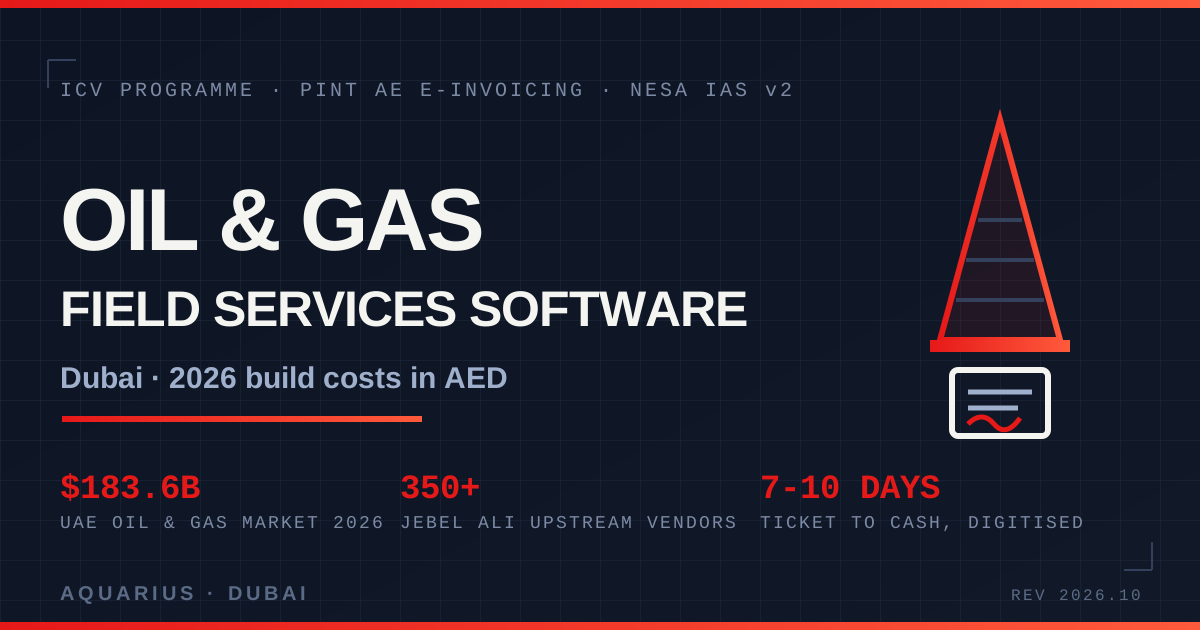
- The UAE oil and gas market is worth USD 183.6 billion in 2026, growing at a 4.2% CAGR toward USD 265.88 billion by 2035. Jebel Ali alone hosts more than 350 upstream vendors and underpins over 40% of oilfield services delivered in the UAE.
- ADNOC will invest USD 150 billion across 2026–2030, and announced USD 55 billion of accelerated spending on production, refining and petrochemicals. Its AI-powered well digitalisation contract alone is worth up to USD 920 million (AED 3.38 billion) — and more than 80% of that value flows back into the UAE economy under the ICV programme.
- Rystad Energy puts the cumulative value of AI and digitalisation for upstream operators at close to USD 500 billion between 2026 and 2030. Early adopters report 15–20% ROI inside two years.
- Phase 1 UAE e-invoicing hits businesses with revenue of AED 50 million or more: appoint an Accredited Service Provider by 30 October 2026, mandatory issuance from 1 January 2027 in PINT AE v1.0.1 XML. Most field-ticket spreadsheets cannot feed that.
Why Dubai service companies are digitising now, not in 2028
Dubai is not where the oil is. It is where the service companies are. Jebel Ali’s port and industrial zones support more than 350 upstream vendors and over 40% of the oilfield services delivered in the UAE, serving onshore and offshore rigs across the whole Gulf. The work is inspection, NDT, tool rental, wireline, coil tubing, valve and pump overhaul, catering and camp logistics, mobilisation and demob — all of it invoiced against a ticket somebody signed in a field, at night, on a clipboard.
Three forces are closing on that clipboard at once in 2026.
First, scale. The UAE oil and gas market is USD 183.6 billion in 2026 and ADNOC is committing USD 150 billion over 2026–2030, with USD 55 billion accelerated into production, refining and petrochemicals. More tenders, bigger scopes, and tighter documentation demands at every award.
Second, the operator is already digital. ADNOC’s AI-powered well digitalisation programme — a contract worth up to USD 920 million (AED 3.38 billion), due for completion in 2027 — puts remote monitoring and control on more than 2,000 wells. ADNOC has committed USD 1.5 billion of digital capital expenditure against a target of USD 1 billion of annual value creation, having already reported USD 500 million of AI-driven value in 2023. When the client runs its wells from a control room, a vendor who reports by WhatsApp photo looks like a liability.
Third, the money. Rystad Energy estimates AI and digitalisation will create close to USD 500 billion in cumulative value for upstream companies between 2026 and 2030 through lower cost, higher production and faster project delivery. Service companies capture their share of that only if their own data is machine-readable.
What “field services software” actually means here
Most Dubai energy-services companies do not need a drilling simulator. They need four things joined up.
1. Digital field tickets
A ticket raised on a tablet at the wellsite, with crew, hours, equipment, consumables, standby time and client signature captured offline and synced when there is signal. This is where the cash is. Documented results from digital ticketing: ticket-submission-to-payment falling from one to two months to 7–10 days, customers paid 30 days faster on average, 60–80% less manual data entry, 2–3x faster ticket-to-invoice cycles and up to 40% fewer billing disputes.
2. Inspection, NDT and certification records
Every lifting accessory, pressure vessel, BOP and test rig carries a certificate with an expiry. Tracking those in Excel is how a mobilisation gets stopped at the gate. A proper asset register ties serial number to calibration date, inspection report, photo evidence and the next due date — and refuses to let a crew book out an expired item.
3. HSE and permit-to-work
Toolbox talks, JSAs, incident reports, near-miss logs, man-hours worked without LTI. Operators audit this, and the UAE’s cybersecurity and critical-infrastructure regime now reaches into supplier systems too. We cover the standalone side of this in our guide to HSE and safety compliance software in Dubai.
4. Billing that survives a 2027 audit
Ticket → approval → invoice → VAT → e-invoice. Phase 1 of the UAE e-invoicing mandate requires taxpayers with AED 50 million or more in annual revenue to appoint an Accredited Service Provider by 30 October 2026 and issue structured PINT AE v1.0.1 XML from 1 January 2027, with the next VAT-registered wave following from 1 July 2027. The pilot opened in July 2026. If your tickets live in paper files, your e-invoice project has no source data. See UAE e-invoicing ERP integration for the plumbing.
Buy or build: 2026 AED price reality
Oilfield ticketing SaaS exists and some of it is good. It is also priced in dollars, built for Permian and Alberta workflows, and indifferent to ICV declarations, WPS payroll and PINT AE. Here is the honest comparison.
| Option | 2026 price (AED) | Best fit |
|---|---|---|
| Spreadsheets and WhatsApp | 0, plus the disputes | One crew, one client, short term only |
| Generic FSM / CMMS, per user | 100 – 400 / user / month | Maintenance tickets, no well context |
| Oilfield ticketing SaaS, per user | 147 – 275 / user / month | 10–50 field users, US-style scopes |
| Oilfield SaaS, platform tier | 3,670 – 9,180 / month | 26–100 users across multiple crews |
| Localisation of a foreign platform | 100,000 – 350,000+ | Closing ICV, VAT, WPS and Arabic gaps |
| Custom field-ticket MVP | 45,000 one-time | Single base, offline tickets, PDF invoices |
| Custom growth platform | 90,000 – 220,000 one-time | Tickets, assets, HSE and ERP sync |
| Custom enterprise build | 220,000 – 500,000+ | Multi-base, SCADA and IoT feeds, ICV reporting |
Run the arithmetic the way a finance director would. A 40-user team on a mid-tier oilfield SaaS at AED 200 per user per month is AED 96,000 a year, or AED 288,000 over three years before implementation — and you still own nothing and still cannot produce an ICV-ready cost breakdown. The same three-year budget buys a custom platform that does fit, with the source code on your side of the table. Our pricing page sets out how we phase that.
The ICV score is a software problem, and most vendors miss it
This is the part Dubai energy-services companies get wrong most often. An ICV certificate is not paperwork you file once — it is a score that decides tenders, and it is computed from your own cost data.
The mechanics: suppliers register on ADNOC’s Supplier Portal, and while a certificate is not strictly required to bid, a bidder without a valid ICV certificate takes a score of zero on that criterion. Certified suppliers get up to a 5% price preference, and a minimum 30% ICV is frequently required on scope. Certification fees run AED 500 to AED 10,000 depending on company structure, with a 14 to 28 working day turnaround, and suppliers are expected to demonstrate year-on-year improvement against their previous financial year’s certificate.
For a service provider the score is weighted roughly: 50% goods and services spend (purchase value multiplied by each supplier’s own ICV, plus Emirati and expatriate costs, over total cost), 25% investment, and 15% Emiratisation. Read that again as a data requirement. To move your score you have to know, per purchase order, which supplier it went to, what their ICV factor is, and how the cost splits between local and foreign content. Note the precedent in ADNOC’s own awards: over 80% of the USD 920 million well digitalisation contract value flows back into the UAE economy under ICV. That is the standard being set.
A procurement module that tags every PO with supplier ICV factor and local-content split turns the annual certification scramble into a report. A generic imported platform has no such field, which is why “we will handle ICV in Excel at year end” quietly costs tenders.
OT security and the compliance floor you cannot skip
If your software touches operator networks, sensor feeds or critical infrastructure data, the UAE Information Assurance Standard applies. NESA’s IAS — now under the UAE Cybersecurity Council, with v2 updated in 2025 and 188 controls across five domains — explicitly covers oil and gas as critical information infrastructure. Tier 1 entities implement all 188 controls with annual independent assessment; Tier 2 and Tier 3 run reduced sets on two- and three-year cycles. In 2026 regulators sharpened expectations on continuous monitoring, AI governance and supply chain assurance — meaning your client’s auditor can ask about your system.
The downside is priced. Penalties reach AED 500,000 to AED 3,000,000 for harm to critical infrastructure, and AED 100,000 to AED 1,000,000 under the PDPL for personal-data failures — and field apps are full of personal data: Emirates IDs, medical fitness records, certificates of competency, GPS traces of named individuals.
Practical floor for a field-ops build: UAE-region hosting, role-based access, audit trails on every ticket edit, encrypted offline storage on devices, no production data in test environments, and a documented retention schedule. We build to that by default — see our services.
What this costs to build, and what not building costs
A realistic phasing for a Dubai service company with 3 to 8 crews:
- Phase 1 — AED 45,000, 4 to 6 weeks. Offline-first mobile field ticket with client signature, crew and equipment capture, PDF output, approvals dashboard. Stops revenue leakage immediately.
- Phase 2 — AED 90,000–220,000, 10 to 16 weeks. Asset and certification register with expiry blocking, inspection and NDT reports, HSE and permit-to-work, VAT-correct invoicing with an e-invoicing-ready export, Arabic interface where crews need it.
- Phase 3 — AED 220,000–500,000+. Multi-base rollout, ERP and payroll integration, procurement with ICV tagging, client portals, IoT and SCADA feeds, BI dashboards on utilisation and DSO.
Now the cost of inaction, which is the number that actually closes these projects. A company turning over AED 20 million a year carries roughly AED 1.67 million of revenue per month. Cutting ticket-to-cash from 45 days to 15 — the documented digital-ticketing outcome — releases about AED 1.67 million of working capital permanently. Add 40% fewer billing disputes on a 3% dispute rate and you recover another AED 240,000 a year. Against a Phase 1 and 2 spend of AED 135,000–265,000, that is why early adopters report 15–20% ROI inside two years.
How Aquarius builds this
We build field-ops platforms the way the field actually works: offline first, because signal at a wellsite is a courtesy not a service; signature and photo evidence attached to the ticket, because that is what wins a dispute; and the compliance fields — TRN, VAT treatment, ICV tagging, PINT AE export, Emirates ID handling under PDPL — designed in from the first sprint rather than retrofitted in 2027.
You get the source code and the repository. Fixed-scope phases, a working Phase 1 in production before Phase 2 is signed, and no per-seat tax for adding crews during a busy mobilisation. If asset utilisation is the bigger pain than ticketing, start with equipment rental management software; if your reporting burden is emissions rather than invoicing, start with ESG and carbon reporting.
FAQ
Do I need an ICV certificate to bid for ADNOC work?
Not strictly — but bidding without a valid ICV certificate means accepting a score of zero on that evaluation criterion, which in practice loses competitive tenders. Certified suppliers receive up to a 5% price preference, and a minimum 30% ICV is often specified. Certification costs AED 500 to AED 10,000 and takes 14 to 28 working days.
Does the UAE e-invoicing mandate apply to my service company?
Phase 1 captures taxpayers with annual revenue of AED 50 million or more: appoint an Accredited Service Provider by 30 October 2026 and issue PINT AE v1.0.1 XML from 1 January 2027. The next wave of VAT-registered businesses follows from 1 July 2027, so smaller firms should structure their ticket data now rather than rebuild later.
Should we buy oilfield SaaS or build custom?
Buy if you run US or Canada style scopes, have under about 20 field users, and can live with ICV and VAT handled outside the system. Build if you need Arabic, ICV tagging, WPS-aware payroll links, PINT AE output, or you are already paying AED 200+ per user per month across 30 or more users — at that point three years of licences exceeds the cost of a platform you own.
How long does a field-ticket system take to go live?
A single-crew offline ticketing MVP ships in 4 to 6 weeks. A growth platform with asset certification, inspection reports, HSE and invoicing takes 10 to 16 weeks. The constraint is rarely engineering — it is getting sign-off on the one-page ticket format every one of your clients will accept.
Will crews actually use it?
Only if it works without signal and takes less time than the paper it replaces. That means a ticket completable in under two minutes, large touch targets for gloved hands, a camera button for evidence, and no mandatory field a supervisor cannot answer at 2am. Adoption is a design problem, not a training problem.
Dubai’s energy-services sector is being pulled digital by clients who already are. The service companies that will still be on tender lists in 2028 are the ones whose tickets, certificates and cost data come out of a system — not a filing cabinet. Tell us what your current ticket looks like and we will scope Phase 1 against it.