
HSE & Safety Compliance Software Development in Dubai (2026): Real AED Costs, MOHRE Fines and Permit-to-Work Done Right
A serious UAE safety violation now carries AED 100,000 to 1,000,000 per worker and MOHRE wants injury notice in 48 hours. What HSE software really costs in Dubai, buy versus build.
- PUBLISHED
- 06 OCT 2026
- READ TIME
- 13 MIN
- AUTHOR
- AQUARIUS · DUBAI
- UNIT
- REV 2026.09
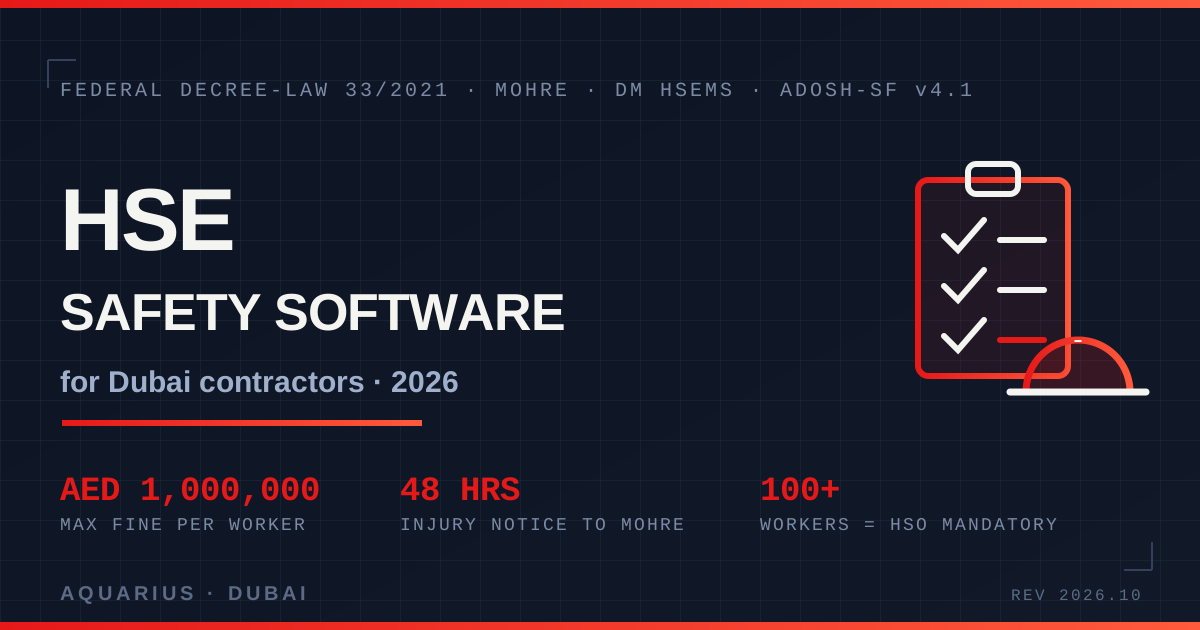
Short answer: HSE compliance software for a Dubai contractor costs either AED 55 to 110 per user per month on an off-the-shelf platform, or AED 90,000 to 380,000 once to build a system you own. Off-the-shelf wins below roughly 120 site users. Above that, per-seat pricing passes the build cost every single year. Implementation is the number nobody quotes: enterprise EHS rollouts carry AED 73,000 to 184,000 in setup fees on top of the subscription.
And here is the stat that belongs on the first slide of your business case: under UAE Federal Decree-Law No. 33 of 2021 and its implementing resolutions, serious labour and safety violations are penalised at AED 100,000 to AED 1,000,000 per affected worker. Not per incident. Per worker. A single uncontrolled event on a 40-man crew is mathematically capable of exceeding your entire annual IT budget — and the evidence that decides which way the file goes is whatever your paperwork can prove, on the day the inspector asks.
Why Dubai contractors are buying HSE software in 2026
Three numbers explain the rush.
The workforce is at a record. UAE construction employed roughly 1.42 million workers in Q1 2026 — the highest level since the Expo 2020 build cycle — making it the second-largest employing sector at about 17.44% of total workforce employment, growing at a 4.2% CAGR since the 2020 trough. More workers means more sites, more inductions, more permits, more paper.
The pipeline is enormous. UAE clients awarded roughly USD 30 billion across 114 contracts in Q1 2026 alone, and Dubai is set to award a further AED 55 billion (USD 14.8 billion) of Al Maktoum International Airport packages by the end of 2026. Named anchor programmes — Etihad Rail Phase 2 at a peak of around 12,000 workers, Wynn Al Marjan at around 8,500, the Saadiyat cultural district at around 6,000 — add a combined incremental peak demand of 65,000 to 72,000 workers above the 2025 baseline. Every one of those workers needs an induction record, a training-matrix entry and a daily toolbox-talk signature.
Enforcement is real and it is counted. MOHRE ran over 10,000 inspections during the 2025 midday-break period and has held national compliance above 99% for several years running. That number cuts both ways: at 99%+ compliance, being the exception is conspicuous. Midday-break violations alone are AED 5,000 per worker, capped at AED 50,000 per case, and repeat or severe cases can mean suspension of the establishment file, a downgrade in the MOHRE classification tier, and referral to public prosecution where a worker was injured.
Most Dubai businesses get this wrong: they buy HSE software to reduce incidents. Incidents are reduced by supervision. Software exists to make compliance provable — timestamped, geotagged, signed, retrievable in 90 seconds when an inspector, a principal client or an insurer asks. The firms that get audited badly are rarely the unsafe ones. They are the ones who did the right thing and cannot evidence it.
For context on how young this software category still is locally: the UAE EHS management software market is forecast at roughly USD 82.11 million in 2026 (about AED 302 million), growing at a 6.5% CAGR through 2035. Across the UAE and Saudi Arabia, EHS system deployment grew 44% in large-scale energy projects, and 61% of new GCC Vision-era projects now require EHS compliance software as a contractual condition. It is becoming a prequalification item, not an efficiency play.
What UAE law actually obliges you to record
This is where generic international EHS products quietly fail a Dubai audit. The obligations are federal, emirate-level and free-zone-level at the same time.
Federal (MOHRE). Federal Decree-Law No. 33 of 2021, effective 2 February 2022, sits on top of Cabinet Resolution No. 1 of 2022, Ministerial Resolution No. 44 of 2022 and Administrative Decision No. 19 of 2023. The duties that generate data:
- Documented risk assessments — not a one-off file, a living register.
- Workplace injury or death reported to MOHRE within 48 hours of the incident.
- An internal injury-monitoring system at establishments with 50 or more workers.
- A dedicated Occupational Health and Safety Officer (HSO) for industrial and construction establishments with 100 or more workers.
- Midday break — no outdoor work in direct sunlight between 12:30 and 15:00, 15 June to 15 September. You are expected to show adherence, not assert it.
- Valid health insurance for every employee.
Dubai (DM HSEMS). Dubai Municipality requires a full HSE Plan prepared by a qualified HSE professional for construction projects valued above AED 5 million, or for any project involving high-risk activity regardless of value, submitted as part of the permit application — with site-specific risk assessments, safe work procedures and HSO appointment at 100+ workers. Note the carve-outs: DM HSEMS does not cover DIFC, JAFZA or Dubai Airport Free Zone.
Abu Dhabi (ADOSH-SF, formerly OSHAD). If the same company opens a site in Abu Dhabi, a Dubai-shaped compliance posture will not satisfy it. ADOSH-SF — currently at version 4.1 (February 2026), administered via the Abu Dhabi Public Health Centre and aligned to ISO 45001:2018 — is structured around 11 mechanisms covering risk management, training, incident management, occupational health, PPE, workplace monitoring and management review. Its permit-to-work regime explicitly spans six categories: hot work, confined space, excavation, work at height, energy isolation and lifting, and contractor management runs the full lifecycle: prequalification, mobilisation checks, performance monitoring, demobilisation.
Free zones. JAFZA runs its own HSE department with inspection and stop-work authority. DMCC issues HSE Community Guidelines. ADGM sits under ADOSH-SF plus its own employment framework. DIFC runs a common-law framework under DIFC Employment Law No. 2 of 2019. All of them remain subject to federal labour-law minimums.
The practical consequence: a UAE contractor working across emirates and free zones needs one system that can carry several rulebooks at once and report against each. That is a configuration problem, and it is precisely what imported single-jurisdiction products handle worst.
What off-the-shelf HSE software costs in the UAE
These are 2026 list prices, converted at the pegged rate of AED 3.6725 to the US dollar. Treat them as floors.
| Platform | List price | AED equivalent | What it is good at |
|---|---|---|---|
| SafetyCulture (Mitti) — Free | Free, up to 10 users | Free | Proving the concept on one site. Hard ceiling at 10 users. |
| SafetyCulture Premium | USD 24 / seat / month annual (USD 288 / yr) | AED 88 / month · AED 1,058 / year | Inspections, checklists, actions, mobile-first capture. The category default. |
| SafetyCulture Lite seat add-on | USD 5 / seat / month | AED 18 / month · AED 220 / year | Workers who submit roughly 12 reports a year. The key to making large headcounts affordable. |
| SiteDocs | around USD 30 / user / month | around AED 110 / month | Construction-native paperwork, signatures, worker-facing simplicity. |
| SafetySync | around USD 15 / user / month | around AED 55 / month | Training matrices and competency tracking at a low seat price. |
| Procore (safety inside the platform) | USD 375+ / month per project | AED 1,377+ / month per project | Projects where safety must sit inside the main PM record. Priced per project, not per user. |
| Intelex (enterprise EHS) | USD 500 – 1,000+ / month small; USD 5,000+ / month large | AED 1,836 – 3,673+ / month; AED 18,363+ / month | Multi-site enterprise governance, deep audit and analytics. |
Now the fees that arrive after the signature. Across the market, EHS implementation runs USD 5,000 to 50,000 (AED 18,400 to 184,000), and at the Intelex end specifically USD 20,000 to 50,000 (AED 73,000 to 184,000). Training adds USD 2,000 to 10,000 (AED 7,300 to 36,700), data migration USD 1,000 to 15,000 (AED 3,700 to 55,100), and add-on modules another USD 5 to 20 per user per month (AED 18 to 73). Procore implementation alone is USD 5,000 to 25,000 (AED 18,400 to 91,800). Note too that SafetyCulture’s August 2026 AI features are metered per seat rather than bundled flat — budget for usage, not just licences.
The seat-count arithmetic that decides buy versus build
Run it on a real Dubai headcount. A mid-size contractor with 600 people needing system access — 100 supervisors, engineers and HSE staff who use it daily, 500 workers who sign toolbox talks and raise the occasional near-miss:
| Approach | Year 1 | Year 3 cumulative | Year 5 cumulative |
|---|---|---|---|
| All 600 on full seats at AED 1,058 / yr | AED 634,800 + setup | AED 1.90m + | AED 3.17m + |
| Tiered: 100 full + 500 Lite seats | AED 215,800 + setup | AED 647,400 + | AED 1.08m + |
| Custom build you own (mid-range) | AED 180,000 – 280,000 | plus AED 36,000 – 90,000 / yr hosting & care | AED 324,000 – 640,000 all-in |
Two honest conclusions. First, licence tiering is the single biggest lever in an off-the-shelf deal, and most UAE resellers will quote full seats for everybody because it is a bigger invoice — insist on a Lite or read-only tier for the workforce before you compare anything else. Second, build economics only win at scale or at genuine configuration complexity. At 40 users on one site, buy. At 600 users across three emirates and two free zones with a principal client demanding custom KPI reporting, own it.
The modules that actually earn their place
Most HSE platforms sell twenty modules and clients use five. These are the five, plus the two UAE-specific ones that imported products almost never ship.
- Mobile inspections and observations — offline-first capture with photos, geotag and timestamp. Offline matters: basements, shafts, tunnels and desert sites have no signal, and a form that fails at the point of work gets filled in later from memory, which is worse than nothing.
- Permit to work — digital issue, approval chain, time-boxed validity and auto-expiry across the six ADOSH-SF categories. The single highest-value module, because expired-permit findings are both common and severe.
- Incident and near-miss management — classification, investigation workflow, root cause, corrective actions with owners and due dates, and a 48-hour MOHRE notification clock that starts automatically and escalates. Automate that one deadline and the system has justified itself.
- Training and competency matrix — certificate expiry tracking per worker per trade, with gate-level blocking. Unverified training certificates are a named, recurring audit failure.
- Toolbox talks and inductions — digital signature capture per worker per day. This is the largest volume of paper on a UAE site and the easiest to lose.
- Midday-break and heat-stress logging (UAE-specific) — a date-aware module that activates 15 June to 15 September, logs 12:30–15:00 stand-downs by crew and location with supervisor sign-off, records rest-shade-water provision, and produces a per-site compliance export for an inspector on request.
- Multi-rulebook reporting (UAE-specific) — the same underlying records reported three ways: MOHRE federal, DM HSEMS for Dubai projects over AED 5 million, ADOSH-SF v4.1 mechanisms for Abu Dhabi, plus free-zone variants.
Measure it with the indicators auditors already use. Lagging: TRIR, LTIFR and severity rate on ADOSH-SF definitions. Leading, reported monthly: inspections completed, observations raised, near-miss rate, training coverage and toolbox-talk attendance. Build those as live dashboard tiles, not quarterly spreadsheets.
The four audit failures worth designing against
- Statistics that do not reconcile to source records. Your reported LTIFR must be derivable row by row from the incident table. Hand-keyed monthly figures always drift. Compute, never type.
- Risk registers reviewed annually while the work changes monthly. Force a review cadence tied to activity change, with the review itself logged.
- Unverified training certificates. Store the document, the issuer, the expiry and a verification state — not just a tick.
- Corrective actions closed without evidence. Make photographic or documentary proof mandatory to close. If it can be closed with a dropdown, it will be.
What a custom HSE platform costs to build in Dubai
These are the delivery ranges we see in the Dubai market in 2026, excluding 5% VAT and excluding hosting. They assume bilingual EN/AR where the workforce needs it, which on a labour-facing app is not optional.
| Scope | What you get | Typical AED | Timeline |
|---|---|---|---|
| Compliance and systems audit | Obligation map across MOHRE, DM HSEMS and ADOSH-SF v4.1, current-state gap list, buy-versus-build cost curve at your real headcount | 12,000 – 30,000 | 1 – 3 weeks |
| Inspection and observation MVP | Offline-first mobile capture, photo and geotag, configurable checklists, actions with owners, supervisor dashboard | 90,000 – 160,000 | 6 – 10 weeks |
| Permit-to-work module | All six categories, approval chains, time-boxed validity, auto-expiry, QR permit verification at the point of work | 70,000 – 140,000 | 5 – 9 weeks |
| Incident management with MOHRE clock | Classification, investigation workflow, root cause, corrective actions, automatic 48-hour notification timer and escalation, regulator-ready export | 60,000 – 120,000 | 4 – 8 weeks |
| Training, competency and induction | Per-worker matrix, certificate expiry and verification state, gate blocking, digital induction with signature capture | 55,000 – 110,000 | 4 – 8 weeks |
| Midday-break and heat-stress logging | Seasonal activation, crew and location stand-down logs, supervisor sign-off, rest-shade-water records, inspector export | 25,000 – 55,000 | 2 – 4 weeks |
| Full multi-emirate platform | All of the above, multi-rulebook reporting, bilingual EN/AR, role model across projects and subcontractors, TRIR / LTIFR analytics, SSO | 240,000 – 380,000 | 14 – 22 weeks |
| ERP / HR / payroll integration | Worker master sync from HR, trade and crew mapping, WPS-aligned headcount, document expiry feeds | 35,000 – 95,000 | 3 – 7 weeks |
| Hosting, support and care plan | UAE-region hosting, monitoring, regulatory updates when ADOSH-SF or MOHRE rules change, enhancements | 3,000 – 7,500 / month | ongoing |
Those figures sit alongside our broader custom software development cost guide for Dubai. If the real need is project controls rather than safety records, read the construction project management software guide first — buying an HSE platform to fix a scheduling problem is a common and expensive mis-step. If your inspections are mobile crews rather than fixed sites, field service management software may be the better-shaped tool.
Two constraints that change the architecture
Worker data is personal data. Medical fitness records, injury details, photographs of workers, passport and visa documents in the induction pack — all of it falls under the UAE PDPL, Federal Decree-Law No. 45 of 2021, where penalties reach AED 5 million. Health data is the most sensitive category you can hold. Build role-based access so a site supervisor sees competency status but not medical detail, keep an access audit trail, and decide your residency position before you pick a hosting region. Our PDPL compliance checklist has the build-side list.
Subcontractors are the hard part. ADOSH-SF contractor management expects prequalification, mobilisation checks, performance monitoring and demobilisation per contractor. If your subcontractors cannot enter data, your principal-contractor dashboard is fiction. That means free or near-free subcontractor access, a login a foreman can actually use, and bilingual interfaces — which is also exactly where per-seat commercial platforms become brutally expensive, because every subcontractor foreman is another paid seat.
How Aquarius approaches an HSE build
We start with the obligation map, not the feature list. Every engagement opens with a written matrix of what MOHRE, Dubai Municipality and ADOSH-SF each require you to hold and produce, set against what your current system can actually evidence today. Then a seat-count cost curve: off-the-shelf tiered pricing versus owning, over five years, at your real headcount including subcontractors. Perhaps a third of the time that review tells a client to buy a commercial platform, negotiate a Lite worker tier, and spend a fraction of the saved budget on the two UAE-specific modules nobody sells them — midday-break logging and multi-rulebook reporting — wired in by API. We would rather bill for an AED 25,000 integration than a AED 300,000 platform the client did not need.
When a build is the right answer: offline-first from day one because UAE sites demand it, the 48-hour MOHRE clock automated and escalating, every reported statistic computed from source rows rather than entered, corrective actions that cannot close without evidence, bilingual EN/AR worker-facing screens, and UAE-region hosting with a documented PDPL role model. You own the code and the data. See our pricing for how we package delivery and our services for the integration stack.
The cost of doing nothing, in numbers. One midday-break case caps at AED 50,000. One general workplace safety violation runs AED 10,000 to 100,000. One serious violation runs AED 100,000 to 1,000,000 per affected worker, with file suspension, MOHRE tier downgrade and prosecution referral available on top. Against that, a mid-range HSE build at AED 180,000 to 280,000 is cheaper than a single bad finding on a crew of three. And with 61% of new GCC projects already requiring EHS compliance software contractually, the system is quickly becoming the thing that lets you bid at all — which makes it revenue, not overhead.
FAQ
How much does HSE compliance software cost in Dubai in 2026?
Off-the-shelf runs roughly AED 55 to 110 per user per month — SafetyCulture Premium is AED 88 per seat per month (AED 1,058 a year), SiteDocs around AED 110, SafetySync around AED 55, with a SafetyCulture Lite worker seat at AED 18 a month. Enterprise platforms like Intelex start at AED 1,836 to 3,673 a month and exceed AED 18,363 a month at scale. Add implementation of AED 18,400 to 184,000. A custom platform you own costs AED 90,000 to 380,000 to build plus AED 3,000 to 7,500 a month to run.
What are the fines for workplace safety violations in the UAE?
Serious labour and safety violations carry AED 100,000 to AED 1,000,000 per affected worker. General workplace safety violations run AED 10,000 to 100,000. Midday-break violations are AED 5,000 per worker, capped at AED 50,000 per case. Employing someone without a valid work permit is AED 50,000 per worker, escalating to AED 200,000 for repeat offences. Severe or repeated cases can also mean suspension of the establishment file, a MOHRE classification downgrade, and referral to public prosecution.
How quickly must a workplace injury be reported to MOHRE?
Within 48 hours of the incident, under Federal Decree-Law No. 33 of 2021, which took effect on 2 February 2022. This is the one deadline worth automating: the clock should start the moment an incident is logged, with escalation to named owners well before the 48 hours expires. Separately, establishments with 50 or more workers must operate an internal injury-monitoring system.
When does a Dubai company need a dedicated safety officer?
A dedicated Occupational Health and Safety Officer is mandatory for industrial and construction establishments with 100 or more workers. Dubai Municipality expects the same HSO appointment at 100+ workers on DM-regulated projects, alongside a project HSE Plan prepared by a qualified HSE professional for construction projects valued above AED 5 million or involving any high-risk activity regardless of value.
Does Dubai Municipality HSE compliance satisfy Abu Dhabi requirements?
No. A posture built to Dubai Municipality HSEMS will not satisfy ADOSH-SF (formerly OSHAD) if the same business opens in Abu Dhabi. ADOSH-SF v4.1 (February 2026) is structured around 11 mechanisms with its own permit-to-work and contractor-management codes of practice. The practical strategy for multi-emirate contractors is to build to the ADOSH-SF baseline, which generally meets or exceeds DM requirements, then layer the Dubai-specific project HSE Plan obligations on DM-regulated jobs. Note also that DM HSEMS does not cover DIFC, JAFZA or Dubai Airport Free Zone, and JAFZA operates its own HSE department with stop-work authority.
Should a Dubai contractor buy or build HSE software?
Buy below roughly 120 system users on one or two sites with standard requirements — the subscription will not come close to a build budget. Build above that, or wherever subcontractor access, multi-emirate multi-rulebook reporting, or client-mandated custom KPIs are involved. At 600 users on full seats, off-the-shelf is AED 634,800 a year, around AED 3.17 million over five years; the same scope owned outright runs roughly AED 324,000 to 640,000 all-in over five years. Before comparing anything, demand a tiered worker-seat price — it is the biggest single lever in the deal.
What is the UAE midday break rule and how do I evidence compliance?
No outdoor work in direct sunlight between 12:30 and 15:00, from 15 June to 15 September. MOHRE ran over 10,000 inspections during the 2025 break period and reports national compliance above 99%. Evidence, not assertion, is what passes an inspection: per-crew, per-location stand-down logs with supervisor sign-off, timestamped rest-shade-water provision records, and an export you can hand an inspector on the spot. A seasonal module that switches itself on each 15 June costs AED 25,000 to 55,000 to build — half the cost of one capped violation.
The one-line version
UAE construction is at a record 1.42 million workers, serious violations are priced at AED 100,000 to 1,000,000 per worker, MOHRE wants injury notice in 48 hours, and 61% of new GCC projects already require EHS software contractually. The decision is not whether to digitise safety records — it is whether to rent seats or own the system. Price both curves at your real headcount, including subcontractors, before anyone demos anything.
Want your obligation map across MOHRE, DM HSEMS and ADOSH-SF v4.1, with a five-year buy-versus-build cost curve at your actual headcount? Book a compliance and systems audit — you keep the obligation matrix and the cost model whether or not we build anything.