
In-App Purchases vs Web Checkout for UAE Apps (2026): The 30% Most Dubai Apps Do Not Owe
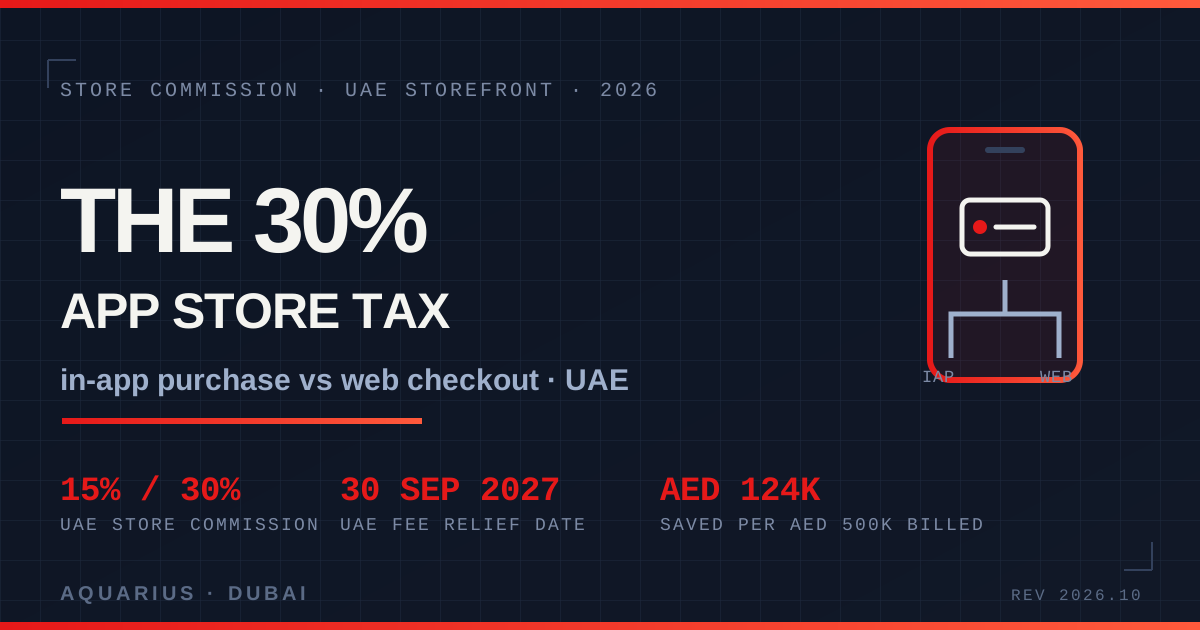
Apple and Google still take 15-30% on the UAE storefront, and the 2026 fee cuts skip the UAE until 30 September 2027. Most Dubai apps sell real-world services and owe 0%. The AED maths.
- PUBLISHED
- 18 OCT 2026
- READ TIME
- 11 MIN
- AUTHOR
- AQUARIUS · DUBAI
- UNIT
- REV 2026.09
Short answer: On the UAE storefront in 2026, Apple and Google still take 15% to 30% of every in-app purchase of digital goods — and the widely reported 2026 fee cuts do not reach the UAE until 30 September 2027. But in-app purchase is only mandatory for digital content consumed inside the app. If your Dubai app sells a real-world service — a cleaning visit, a salon slot, a car rental, a clinic appointment, a delivery — you must not use in-app purchase, and the store commission on those payments is zero.
That single distinction is worth six figures a year to a mid-size UAE app, and it is the one most teams get backwards. Some Dubai businesses route real-world bookings through Apple’s billing and donate 30% they never owed. Others build a digital subscription, assume they can simply link out to their own checkout the way US apps now do, and get rejected under Guideline 3.1.1 because that right does not exist on the UAE storefront. This guide gives you the 2026 rates, the UAE-specific dates, the VAT treatment, and the AED arithmetic.
Key takeaways
- Estimates put the UAE mobile application market near USD 2.6 billion of revenue in 2025 (≈ AED 9.6 billion), forecast toward USD 8 billion by 2033 at roughly 15% CAGR. Mobile is where UAE spend already lives: in May 2026 the TDRA reported smartphones accounted for more than 60% of usage of the official UAE Government platform.
- Apple: 30% standard, 15% under the Small Business Program (under USD 1 million / ≈ AED 3.67 million annual proceeds), and 15% on auto-renewing subscriptions after a subscriber passes one year.
- Google Play on the UAE storefront: 15% on the first USD 1 million of annual earnings, 30% above it, 15% on auto-renewing subscriptions.
- Google’s new 10% + 5% structure and billing-choice programme went live 30 June 2026 in the US, UK and EEA, reaches Australia on 30 September 2026 and Japan and Korea on 31 December 2026 — and the rest of the world, including the UAE, on 30 September 2027.
- Apple external purchase links exist only on the US (currently 0% fee), EU (20%) and South Korea (26%) storefronts, plus Dutch dating apps. Not the UAE — so an app shipped without a storefront check fails review here.
- On AED 500,000 of annual billings, moving digital subscriptions from a 30% in-app rail to your own UAE gateway keeps roughly AED 124,000 a year.
The myth that costs Dubai apps the most money
Apple’s rule is narrower than its reputation. In-app purchase is required for digital content, features, subscriptions and services consumed within the app: a premium tier, a course, unlocked chapters, extra AI credits, a game currency. Physical goods and real-world services are explicitly outside it — and not merely allowed outside it, but required to be. You cannot take a home-cleaning booking through Apple’s billing even if you want to.
Look at what Dubai actually builds. Home services, laundry, car wash, movers, fuel delivery, salon and spa booking, clinic appointments, padel courts, car rental, grocery and restaurant delivery, event tickets, holiday-home stays, chauffeur bookings. Every one of those is a real-world service or a physical good. The store commission on all of it is 0%, and the only payment cost is your gateway. If you are paying 30% on any of that, you are paying a fee the rules never asked you for.
The inverse mistake is worse, because it fails review. Teams read about the US position after the Epic ruling — where an iOS app can now link out to the developer’s own web checkout for digital goods with no Apple cut — and build that flow globally. On the UAE storefront that link is anti-steering, and the app gets a Guideline 3.1.1 rejection. External purchase rights are regional, not universal: the US, the EU at a 20% fee, South Korea at 26%, Japan at 21% for in-app-to-web checkout, and the Netherlands for dating apps. The UAE is on none of those lists. For more on the submission side, see our guide to publishing a Dubai app on the App Store and Google Play.
What the stores actually charge a UAE developer in 2026
| What you are selling | Apple (UAE storefront) | Google Play (UAE storefront) | Your own web checkout |
|---|---|---|---|
| Digital subscription, first-year subscriber | 30%, or 15% on the Small Business Program | 15% (auto-renewing) | Not linkable from inside the app |
| Digital subscription, after 1 year | 15% | 15% | Not linkable from inside the app |
| One-off digital unlock or credits | 30% / 15% (SBP) | 15% to USD 1m, then 30% | Not linkable from inside the app |
| Real-world service (booking, visit, ride, rental) | 0% — IAP not permitted | 0% — IAP not permitted | UAE gateway: ~1.75–3.4% + ~AED 1 |
| Physical goods and delivery | 0% | 0% | UAE gateway: ~1.75–3.4% + ~AED 1 |
| Developer account | USD 99/yr (≈ AED 364) | USD 25 one-time (≈ AED 92) | Gateway setup AED 0–1,500 |
Why the fee cuts in the headlines are not yours yet
Google’s 2026 restructure reads well: a 10% service fee on the first USD 1 million of earnings and on auto-renewing subscriptions, plus 5% only if you use Google Play Billing — so 15% through Play, or 10% if you route the payment yourself. It is real, and it is geographically rationed. It started on 30 June 2026 in the US, the UK and the EEA. Australia follows on 30 September 2026, Japan and South Korea on 31 December 2026, and everywhere else — the UAE included — on 30 September 2027. User-choice billing is likewise unavailable on the UAE storefront today; the published eligibility list runs Australia, Brazil, Indonesia, Japan, South Africa, the UK, the US, the EEA, South Korea and India.
So a Dubai developer in 2026 plans against the old numbers, with a dated improvement to pencil into the 2027 budget. Anyone quoting you 10% on a UAE build this year is quoting someone else’s storefront.
The VAT question nobody asks until the first FTA filing
This is where the two rails genuinely differ, and it is usually missed in the fee comparison.
When you sell through the App Store or Google Play, the store is the merchant of record. Apple calculates, collects and remits local consumption tax across its territories, so the 5% UAE VAT is already inside the price your Dubai customer sees, and Apple — not you — accounts for it. Commission is then taken on the tax-exclusive amount, and what reaches your bank is net of both. Your own revenue line is a payment from a non-resident platform, not a consumer sale, which for a UAE-resident developer generally falls under the export-of-services rules and can be zero-rated where the recipient has no relevant UAE presence — a treatment you must document, and confirm with your tax adviser.
Run your own web checkout and that convenience disappears. You are the merchant of record: you charge 5% VAT to UAE consumers, issue compliant tax invoices, and file. Registration is mandatory once taxable supplies pass AED 375,000 in twelve months, and voluntary from AED 187,500. The fee saving is large enough to pay for that overhead many times over, but it is work, not free money — and it is the reason a web rail should be scoped with invoicing and filing in it, not bolted on afterwards.
The AED maths on AED 500,000 of billings
Take a Dubai app billing AED 500,000 a year in digital subscriptions, VAT-inclusive, across about 5,000 transactions. VAT inside that price is AED 23,810, leaving AED 476,190 net. The three outcomes:
| Rail | Fee taken | You keep (after VAT and fees) | Versus best case |
|---|---|---|---|
| In-app purchase at 30% | AED 142,857 | AED 333,333 | − AED 124,107 |
| In-app purchase at 15% (SBP / subscriptions) | AED 71,429 | AED 404,762 | − AED 52,679 |
| Own web checkout, UAE gateway at 2.75% + AED 1 | AED 18,750 | AED 457,440 | — |
Scale that and the shape holds: roughly AED 25 per AED 100 of digital billings separates the 30% rail from a UAE gateway, and about AED 10.50 per AED 100 separates the 15% rail from it. At AED 2 million of annual digital billings, the 30% rail costs around AED 496,000 a year more than your own checkout. That is a senior developer and a half. Our breakdown of payment gateway integration cost in Dubai has the current Telr, PayTabs, Stripe and N-Genius rates, and the UAE recurring-billing guide covers the failed-payment tax that eats into the saving if you do not instrument retries.
Two honest caveats. First, in-app purchase converts better: one Face ID tap against a card form, no checkout abandonment, no 3-D Secure drop-off. A web rail that converts 20% worse than IAP has given back the whole 15% saving. Second, the store handles refunds, dunning, tax and chargebacks for you. The right answer for most apps is therefore both rails — web-first for acquisition and renewals from your own marketing, in-app purchase retained inside the app for the users who will never leave it — with entitlements reconciled server-side so a subscriber who paid on the web is recognised instantly on their phone.
What each rail costs to build
Our 2026 Dubai ranges, for a build that is production-grade rather than a demo:
| Scope | AED range | What is in it |
|---|---|---|
| In-app purchase, done properly | 18,000–40,000 | StoreKit 2 and Play Billing, server-side receipt validation, restore purchases, sandbox and store review |
| Full subscription stack | 35,000–75,000 | Entitlement service, remote paywall with A/B tests, trials and intro offers, churn and cohort analytics |
| Web checkout rail | 30,000–65,000 | UAE gateway, account linking, 5% VAT invoicing, dunning, entitlement sync to the apps |
| Hybrid, both rails reconciled | 70,000–140,000 | Single source of truth for entitlements, cross-rail reporting, migration of existing subscribers |
Add infrastructure if you use it. RevenueCat is free to USD 2,500 of monthly tracked revenue (≈ AED 9,200) and then charges 1% of tracked revenue — on gross, before the store takes its cut. Adapty is free under USD 5,000 over a rolling 30 days and also 1% after that, having dropped its USD 99/month minimum in February 2026. On AED 500,000 of billings that is about AED 5,000 a year to avoid building receipt validation and paywall tooling yourself, which is almost always the correct trade.
How Aquarius does it
We start with the classification, not the code, because it decides everything downstream: a two-page memo on whether your product legally requires in-app purchase, what you may and may not say inside the app on the UAE storefront, and which rail each SKU belongs on. If the answer is that you owe the stores nothing — which it is for most Dubai service apps — we tell you that before you have paid for a build, and the engagement becomes a straightforward gateway integration.
Where a digital subscription is genuinely in scope, we ship the hybrid: StoreKit 2 and Play Billing with server-side validation, a web checkout on a UAE gateway with VAT-compliant invoicing, and one entitlement service both rails write to, so finance has a single revenue number and support has a single answer. Fixed-price scope, fixed timeline, and the store-review risk sits with us — we handle resubmission if a payment flow draws a 3.1.1 rejection. Our pricing page sets out the engagement bands.
FAQ
Do I have to use Apple in-app purchase for my Dubai app?
Only for digital content, features or subscriptions consumed inside the app. Physical goods and real-world services — bookings, visits, rides, rentals, deliveries — must not use in-app purchase, and carry 0% store commission. Most Dubai service apps fall on the free side of that line.
What commission do Apple and Google take in the UAE in 2026?
Apple: 30% standard, 15% under the Small Business Program (under USD 1 million of annual proceeds), and 15% on auto-renewing subscriptions after the subscriber’s first year. Google Play on the UAE storefront: 15% on the first USD 1 million of annual earnings, 30% above it, 15% on auto-renewing subscriptions.
When do Google’s lower 10% fees reach the UAE?
30 September 2027. The new structure and billing-choice programme launched on 30 June 2026 in the US, UK and EEA, extends to Australia on 30 September 2026 and to Japan and South Korea on 31 December 2026, with the rest of the world — the UAE included — last.
Can I link users from my app to my own website to pay?
Not on the UAE storefront. Apple’s external purchase rights exist only in the US (currently 0%), the EU (20%), South Korea (26%), Japan for in-app-to-web checkout (21%) and for Dutch dating apps. An app that shows a link-out without a storefront check will be rejected here under Guideline 3.1.1. You can still sell on the web and let users sign in to the app with what they bought.
Who pays the 5% UAE VAT on in-app purchases?
The store does. Apple acts as merchant of record, so UAE VAT is already inside the customer price and Apple remits it. Sell through your own checkout and you are the merchant of record: you charge the 5%, invoice and file, with registration mandatory above AED 375,000 of taxable supplies and voluntary from AED 187,500. Confirm your own treatment with a tax adviser.
Not sure which side of the in-app purchase line your product sits on? Send us your pricing page and a list of your SKUs and we will classify each one against the 2026 rules for the UAE storefront, free, before anyone writes a line of billing code.