
How to Publish a Dubai App on the App Store and Google Play in 2026: Licences, TDRA Rules and Real Costs
One in four app submissions gets rejected. What a Dubai business really needs to ship on the App Store and Google Play in 2026: licence, D-U-N-S, TDRA approvals and AED costs.
- PUBLISHED
- 29 SEPT 2026
- READ TIME
- 10 MIN
- AUTHOR
- AQUARIUS · DUBAI
- UNIT
- REV 2026.09
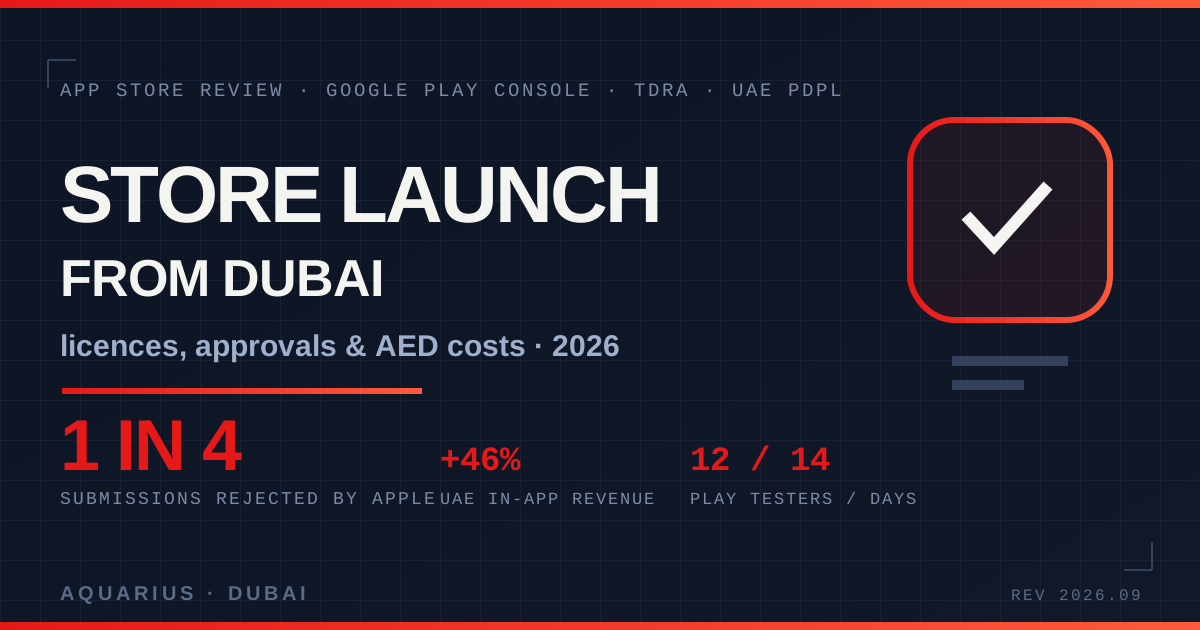
Short answer: a Dubai business can be live on both stores in 4 to 8 weeks, and the store fees themselves are trivial — USD 99 a year (about AED 365) for the Apple Developer Program and a one-off USD 25 (about AED 92) for Google Play. The real cost is everything Apple and Google will not tell you about: you need a UAE trade licence with the right activity, a free D-U-N-S number for organisation enrolment, a UAE business bank account to receive payouts, and, for whole categories of app, a UAE regulator sign-off before the store one. Apple rejects roughly one submission in four. Updated September 2026.
Key takeaways
- Apple’s own App Store Transparency Report shows 1,931,400 rejections out of 7,771,599 submissions — about 24.8%, or one in four.
- UAE in-app purchase revenue grew 46% between Q1 2024 and Q1 2026, the fastest in the GCC, while downloads across the region rose only 9%. Revenue is growing roughly 4.5x faster than installs.
- New Google Play personal developer accounts must run a closed test with at least 12 testers for 14 continuous days before they can even apply for production access.
- Apple organisation enrolment needs a D-U-N-S number tied to your UAE legal entity. Publishing a company app from a personal account is the single most expensive mistake we see.
- Some apps need a UAE regulator first: TDRA for any voice or messaging over IP, DHA and NABIDH integration for Dubai health apps, CBUAE for stored value and payments.
Why the UAE store bar moved in 2026
The UAE is no longer a download market; it is a spending market. In-app purchase revenue in the UAE climbed 46% between Q1 2024 and Q1 2026 — the highest growth rate in the GCC — against GCC-wide in-app revenue growth of 41% and global growth of just 21%. Downloads over the same window rose 9%. Read those two numbers together and the conclusion is blunt: regional in-app revenue is growing about 4.5 times faster than installs, so the money is in monetising the users you already reach, not in chasing raw volume.
The addressable base supports it. UAE smartphone penetration sits above 95%, and the UAE mobile app market is projected to reach USD 2.36 billion by 2030 at a 10.3% annual growth rate. Even the plumbing is growing: the UAE mobile apps and web analytics market was estimated at USD 312 million in 2025 and is forecast to hit USD 437 million by 2032.
That is exactly why the gatekeeping tightened. Both stores spent 2025 and 2026 adding identity verification, testing quotas and technical deadlines — and a UAE launch stacks a second, national layer of approvals on top of the platform one.
The mistake most Dubai businesses make: the wrong developer account
We get called in to rescue this roughly once a quarter. A founder or an outsourced freelancer publishes the company app under a personal Apple or Google account. It works, briefly. Then the app is legally owned by an individual, payouts land in an individual’s bank account, and when that person leaves you discover that transferring an app requires their active cooperation.
What an organisation account actually requires:
- Apple Developer Program, Organisation enrolment. A D-U-N-S number so Apple can verify your legal entity with Dun & Bradstreet. It is free and issued against your UAE trade licence, but allow up to two weeks. The person enrolling must have legal signing authority. Membership is USD 99 per year.
- Google Play Console, Organisation account. A one-off USD 25 registration fee, identity verification with government-issued ID, and, under the Android developer verification rollout, a verified developer identity linked to the app.
- The 12-for-14 rule. New personal Play accounts must run a closed test with a minimum of 12 testers opted in for 14 consecutive days before applying for production access. Registering as an organisation from the start is the cleaner path.
- A UAE business bank account in the company name. Both platforms pay out to a business payment method tied to the enrolled entity.
The prerequisite behind all of it is a UAE trade licence carrying a software or IT activity. Free zone software licences typically start around AED 12,500, mainland around AED 20,000 to 40,000 depending on activity and visa quota — we break the choice down in our software company licence in Dubai guide.
What a Dubai app launch actually costs to get listed
Store fees are the cheapest line on the page. Here is the honest 2026 picture, excluding the build itself and 5% VAT.
| Line item | 2026 cost | Lead time | Notes |
|---|---|---|---|
| Apple Developer Program (Organisation) | USD 99/yr (approx. AED 365) | 2–14 days | Requires D-U-N-S and signing authority |
| Google Play Console (Organisation) | USD 25 one-off (approx. AED 92) | 1–7 days | ID verification; developer verification rollout |
| D-U-N-S number | Free | Up to 2 weeks | Issued against the trade licence |
| UAE trade licence with software activity | AED 12,500 free zone / AED 20,000–40,000 mainland | 3–15 days | Prerequisite for entity enrolment and payouts |
| TDRA approval (voice, video or messaging over IP) | Case by case | Weeks to months | Unapproved VoIP is blocked at carrier level |
| Store-readiness package (assets, listings, compliance) | AED 6,000–18,000 | 1–3 weeks | Bilingual listing, screenshots, privacy manifest, ASO |
| Closed testing cohort (Play, where required) | Internal or AED 1,500–4,000 | 14 days minimum | 12 testers, 14 continuous days |
Treat the store-readiness line as revenue work, not admin. App Store Optimisation is where a UAE listing wins or loses discovery, and Arabic listing metadata is still under-used by local competitors — see our ASO guide for Dubai apps.
The UAE approval layer that sits above Apple and Google
This is the part imported launch guides omit, and it is the part that gets Dubai apps pulled. Passing App Review means nothing if a national regulator has not cleared the feature.
- TDRA, for anything that carries a call. The Telecommunications and Digital Government Regulatory Authority maintains a list of approved VoIP applications, and anything outside it is blocked at the carrier level. Consumer calling on WhatsApp, FaceTime, Skype and Viber remains restricted; BOTIM and C’ME are the licensed consumer alternatives, with Microsoft Teams, Zoom, Webex and Google Meet usable for work and education. If your app has in-app voice or video, you need TDRA clearance before that feature ships, not after.
- DHA, for Dubai health and telehealth apps. There is no standalone telemedicine licence; the practitioner’s licence covers remote consultations, but the facility must hold telehealth authorisation and meet the DHA Telehealth Standard that took effect in November 2025. Dubai platforms must integrate with NABIDH, the emirate’s health information exchange. The trap is infrastructure: a platform hosted offshore breaches the data-residency requirement from its first consultation, with fines reported up to AED 700,000 before licensing is even discussed.
- CBUAE, for money movement. Wallets, stored value and payment initiation need Central Bank authorisation. Our e-wallet and SVF licence guide covers the route.
- UAE Media Council, for promotional content. From 1 February 2026 advertisers and content creators must hold a valid Advertiser Permit for paid and unpaid promotion across digital platforms. The permit itself is free; the underlying electronic media economic activity licence is where the cost sits, with an annual renewal of AED 1,000 from the fourth year.
- PDPL, for everything else. Under Federal Decree-Law No. 45 of 2021, any app collecting so much as a UAE user’s email address is in scope, with a 72-hour breach-notification window. Both stores now require an accurate privacy label, and a label that contradicts your actual SDK behaviour is a rejection — and a regulatory exposure. Work through our UAE PDPL compliance checklist before you fill in the privacy questionnaire.
Review times, rejections and the technical deadlines
Apple’s published transparency data is the number to plan around: 1,931,400 of 7,771,599 submissions were rejected. Budget for at least one rejection cycle and it stops being a crisis.
Timings in 2026, from current submission data:
- New iOS apps: typically 2 to 5 days, with spikes past 7 days around major OS releases and the year-end freeze.
- iOS updates: typically 24 to 72 hours.
- Google Play: fast for established organisation accounts, but a new account adds the 14-day closed-test floor before production access is even requestable.
- Android target API: Play enforces a rising target API level each year, with API 36 the 2026 deadline. An app built against an older target is simply not publishable.
The rejection reasons that hit UAE apps hardest are predictable: a privacy label that does not match the SDKs actually bundled, forced sign-in on an app that does not need an account, subscription screens that fail to disclose renewal price and cancellation clearly, placeholder content in a build submitted as final, and a missing or unreachable support URL. Every one of those is fixable before submission, and every one of them costs a week if it is not.
A realistic timeline, and how Aquarius runs it
Assuming the build is finished, a clean dual-store launch from Dubai looks like this:
| Week | Work | Owner |
|---|---|---|
| 1 | Trade licence activity check, D-U-N-S application, Play organisation registration | Client + Aquarius |
| 1–2 | Regulator triage: TDRA, DHA, CBUAE or none. Scope any approval work | Aquarius |
| 2–3 | Apple organisation enrolment, banking and tax forms, App Store Connect setup | Aquarius |
| 3–4 | Store assets: bilingual listing, screenshots, privacy manifest, data-safety form, age rating, ASO keywords | Aquarius |
| 4–6 | TestFlight and Play closed testing, 12 testers for 14 continuous days where required | Both |
| 6–8 | Submission, review, one rejection cycle absorbed, production release | Aquarius |
On the money side, the conversion case is straightforward. With UAE in-app revenue up 46% while downloads rose 9%, every week a finished app sits unlisted is a week of a growing spend pool going to a competitor who cleared the paperwork first. Store fees of roughly AED 457 in year one are not the constraint; a four-week delay is.
How we de-risk it: we enrol the app under your entity, never ours, so ownership, payouts and the signing certificates stay with you from day one — the same principle as our domain and asset handover policy. We run a pre-submission compliance pass against the current review guidelines before anything is uploaded, and if a rejection still lands on a launch we managed, we resolve and resubmit at no extra charge. Ranges for build and launch packages are on our pricing page.
FAQ
Do I need a UAE trade licence to publish an app on the App Store from Dubai?
To publish as a company, yes. Apple organisation enrolment requires a verifiable legal entity and a D-U-N-S number, and both stores pay out to a business account in the entity’s name. You can technically publish as an individual, but the app is then legally yours personally, not the company’s, and transferring it later depends on that individual’s cooperation. A free zone software licence from around AED 12,500 is the usual route.
How much does it cost to publish an app in the UAE in 2026?
Platform fees are USD 99 per year for Apple and a one-off USD 25 for Google Play, roughly AED 457 in year one. On top of that budget the trade licence (AED 12,500 free zone, AED 20,000 to 40,000 mainland), a free D-U-N-S number, and AED 6,000 to 18,000 for a proper bilingual store-readiness package. Regulator approvals for VoIP, health or payment apps are priced case by case.
Why do apps get rejected, and how often?
Apple’s transparency report shows 1,931,400 rejections out of 7,771,599 submissions, roughly one in four. The most common causes are inaccurate privacy labels, unnecessary forced sign-in, unclear subscription renewal and cancellation terms, placeholder content, broken support links, and crashes on the reviewer’s device. Most are cleared in a single resubmission if you fix the cited guideline precisely.
Does my app need TDRA approval in the UAE?
If it lets users call, video call or otherwise carry voice over the internet, yes. TDRA maintains a list of approved VoIP applications and blocks anything outside it at the carrier level, which is why consumer calling on several global apps remains restricted while BOTIM and C’ME operate as licensed alternatives. Apps without any calling feature do not need a TDRA service licence, but still sit under PDPL and any sector regulator that applies.
Who handles VAT on app sales in the UAE?
For purchases made through the stores’ own billing, the platform acts as the taxable party: Google is responsible for VAT in the UAE and across the Middle East and Africa, and Apple administers collection and remittance of the UAE’s 5% VAT. That does not remove your own obligations — UAE VAT registration is mandatory once taxable supplies exceed AED 375,000, and any revenue billed outside store billing, such as web checkout or B2B invoicing, is yours to account for.
How long does it take to get a Dubai app live on both stores?
Four to eight weeks from finished build, assuming no sector regulator is involved. The long poles are the D-U-N-S number (up to two weeks), Apple organisation verification, and Google Play’s 12-testers-for-14-continuous-days closed test where it applies. TDRA, DHA or CBUAE approval adds weeks to months and should start before the build is finished, not after.
Launching a UAE app and want the paperwork handled alongside the build? Talk to Aquarius — we scope the entity, the regulator path and the store submission as one piece of work, so nothing is discovered the week you were planning to launch.