
FTA Tax Audit Readiness in Dubai (2026): The FAF, Your Records and the 40-Day Clock
FTA tax audits rose 46% in 2025 and inspections found AED 608 million in liabilities. What an audit asks your systems for in 2026, the FTA Audit File, and the 40-business-day dispute clock.
- PUBLISHED
- 17 NOV 2026
- READ TIME
- 13 MIN
- AUTHOR
- AQUARIUS · DUBAI
- UNIT
- REV 2026.09
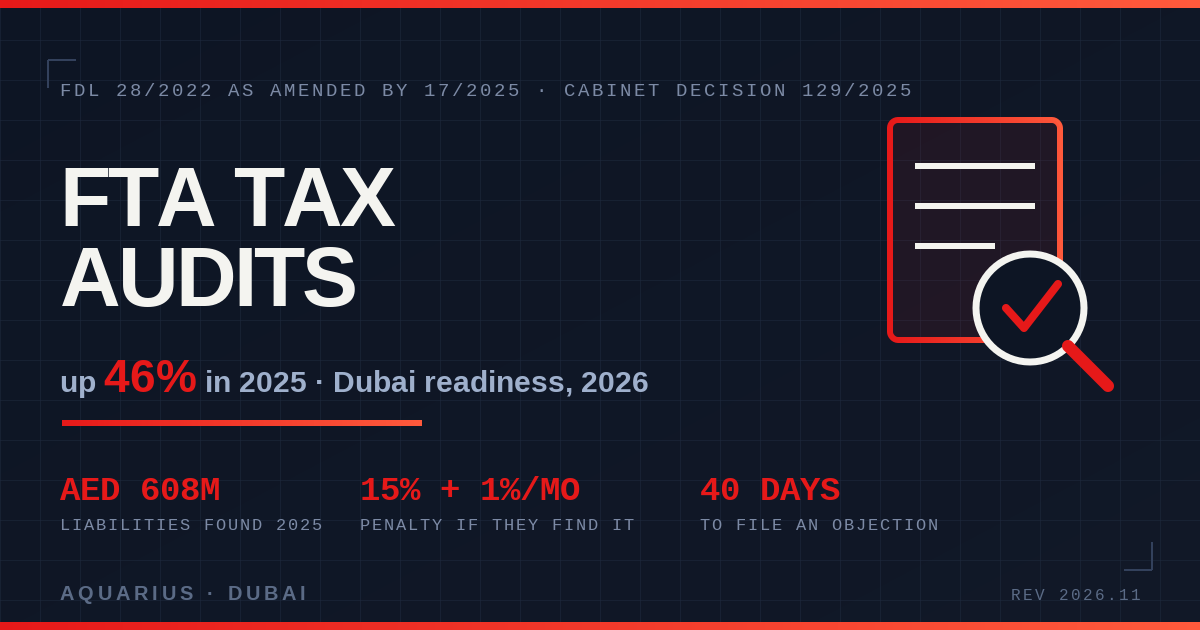
Short answer: an FTA tax audit in 2026 is a data request with a clock on it, not a conversation. The Federal Tax Authority increased formal tax audits by 46% during 2025 and that enforcement generated more than USD 1 billion in additional tax revenue, according to its own annual report. If your accounting system cannot produce a complete FTA Audit File, five to seven years of supporting documents and a clean trail from invoice to return, the audit is decided before anyone reads your argument — and from 14 April 2026 the penalty for an error the FTA finds is a fixed 15% of the tax difference plus 1% per month.
The enforcement curve, in the FTA's own numbers
The “grace period” framing that dominated Dubai tax commentary in 2024 is finished. The FTA’s 2025 annual report records formal tax audits up 46% year on year and market inspection visits up 89%, reaching approximately 176,000 visits across all seven emirates. Those inspections alone identified more than AED 608 million in outstanding tax liabilities and related penalties. Total VAT and excise revenue reached AED 46 billion in 2025, a 15% rise from AED 41 billion.
The pace carried into this year. The FTA reported 103,680 field inspection visits in the first half of 2026, up 21% from roughly 86,000 in the same period of 2025, with tax dues and fines on seized goods exceeding AED 174 million. It also issued 3,343 registration notices to businesses that were not registered for VAT, against 2,845 a year earlier.
Now put that against the size of the register: 651,000 corporate tax registrants, 547,000 VAT registrants, 1,777 excise registrants and 806 licensed tax agents, with EmaraTax having processed over 893,490 corporate tax registration transactions. The first full cycle of corporate tax returns has been filed. The FTA now has three years of VAT returns, a full set of CT returns and transaction-level excise data to run against each other. Audit selection in 2026 is a query, not a hunch.
Most Dubai businesses prepare for an audit by hiring a tax consultant. The consultant’s first question is always the same: can your system export this? That is a software problem, and it is the one nobody budgeted for.
What the FTA actually asks for — and the file most systems cannot produce
Under Article 16 of Federal Decree-Law No. 28 of 2022 (the Tax Procedures Law), the FTA must give at least 10 business days’ written notice before auditing you at your premises — unless it suspects tax evasion or believes notice would obstruct the audit, in which case it can arrive without warning. The notification lands in EmaraTax, and the clock starts on the notification date, not the day somebody opens the message. First document requests commonly carry a 5 to 10 business day deadline.
The centrepiece request is the FTA Audit File (FAF). The FTA’s requirements document for tax accounting software specifies that compliant software must automatically generate the FAF, in comma-separated value (.csv) format, complete and accurate and readable by the FTA. The same requirements cover non-editable return files, access controls so only authorised users touch tax data, and validation that prevents incomplete or invalid records reaching a return. Every VAT-registered business in the UAE is expected to be able to produce an FAF on request — regardless of which software it runs.
Alongside the FAF, expect the FTA to ask for:
- Tax invoices and credit notes in sequence, with no gaps, matched to the output tax reported in each return.
- Input tax support — the supplier invoice, proof of payment and evidence of the business purpose, for every recovery claimed. Partially exempt businesses should also expect their apportionment workings; see our breakdown of VAT input tax apportionment and partial exemption.
- Reconciliations from trial balance to VAT return to corporate tax return. Divergence between the revenue in your CT return and the sum of your VAT returns is one of the cleanest selection signals there is.
- Customs and import records, reverse-charge calculations, and the TRN-to-customs-code linkage.
- Transfer pricing documentation and related-party schedules where thresholds are met.
Retention is longer than most Dubai SMEs assume. Corporate tax records must be kept for 7 years from the end of the relevant tax period. Real estate records run to 15 years. And where a dispute is live, records must be kept for a further 4 years or until the dispute is finally settled. Failure to keep records is now penalised at AED 1,000 per violation, rising to AED 20,000 for a repeated violation within 24 months, under Cabinet Decision No. 129 of 2025.
Two laws changed the maths in 2026
Federal Decree-Law No. 17 of 2025, effective 1 January 2026, amended the Tax Procedures Law. The standard limitation period stays at five years from the end of the relevant tax period, extending to 15 years where tax evasion is suspected and 15 years from the date a person should have registered where they failed to register at all. It also set a five-year window to claim a refund of a tax credit balance — and, crucially, gave the FTA power to audit or assess after the limitation period has expired in defined cases, including where a refund request is submitted in the final year. A refund claim can therefore reopen a period you considered closed. Transitional relief allows businesses whose five-year refund window expired before 1 January 2026, or expires within a year of it, to submit a refund request within one year from 1 January 2026, with a related voluntary disclosure within two years of that request.
Cabinet Decision No. 129 of 2025, effective 14 April 2026, rewrote the penalties. This is the single most important table in UAE tax this year, because it converts the decision “do we disclose, or do we wait and see” into arithmetic.
| Situation | Old penalty | From 14 April 2026 |
|---|---|---|
| Voluntary disclosure before audit notification | Tiered 5% – 40% by timing | 1% per month on the tax difference |
| Disclosure after audit notification, or no disclosure at all | 50% fixed + 4% monthly | 15% fixed + 1% per month |
| Late payment of tax due | 2% immediately + 4% monthly | 14% per annum, non-compounding, applied monthly |
| Failure to keep required records | AED 10,000 / AED 20,000 repeat | AED 1,000 per violation; AED 20,000 if repeated within 24 months |
| Incorrect tax return | AED 1,000 – 2,000 | AED 500 |
Read the first two rows together, because that is the whole game. The fixed 15% applies only if you did not disclose before the audit notification arrived. On AED 500,000 of under-declared tax found 24 months late, the fixed component alone is AED 75,000 — and it disappears entirely if the same error is self-reported before the notification. The 1% monthly charge and the 14% annual late-payment charge apply either way. You are not buying forgiveness by disclosing early; you are buying out a fixed 15%, and the only way to find the error first is to have a system that surfaces it.
The dispute clock: 40 business days, and you pay first
Most Dubai businesses discover the appeal route after they have already missed a step on it. The chain is strict and each link is measured in business days.
| Step | Filed with | Your deadline | Their timeline |
|---|---|---|---|
| Reconsideration request | FTA, via EmaraTax (free) | 40 business days from the decision | Up to 45 business days to respond, extendable |
| Objection to the Tax Disputes Resolution Committee | TDRC, Ministry of Justice | 40 business days from the reconsideration decision | Decision within 20 business days |
| Appeal to the competent Federal Court | Court | 40 business days from notification | Court timetable |
Two details decide outcomes. First, the TDRC will not accept an objection until the disputed tax and penalties are paid in full — so a disputed assessment is a cash-flow event on day one, not after you win. Second, where the dispute is below AED 100,000, the TDRC’s decision is final and binding with no further appeal. Above that threshold you can go to court. A reconsideration request also has to be supported by documents and grounds at the point of filing; EmaraTax is not a place to promise evidence later.
Which brings the whole thing back to data. A reconsideration is won or lost on whether you can produce, inside 40 business days, a reconciled trail for a period that closed years ago — in a system you may since have migrated off.
Where Dubai systems actually fail an audit
Across the audit-readiness work we do, the same five failures repeat, and none of them are accounting failures:
- No FAF export. The business runs a general ledger, a separate POS or e-commerce platform and a spreadsheet layer in between. No single system holds a complete transaction set, so no system can generate a valid FAF. Somebody assembles it by hand and the totals do not tie to the filed returns.
- Editable history. Invoices renumbered, backdated credit notes, line items changed after a return was filed, with no immutable audit trail of who changed what and when. This converts an error into something that looks like concealment.
- Document separation. The numbers live in the ERP; the supporting PDFs live in email, WhatsApp and a shared drive, unlinked. Producing input tax support for 400 claims becomes 400 searches.
- Data aged out. The platform was migrated, the old licence lapsed, or a cloud tool retained 24 months by default — and year three of a seven-year retention requirement is gone.
- No cross-return reconciliation. Nothing in the stack compares CT-return revenue against the sum of VAT-return outputs. The FTA does run that comparison.
The e-invoicing mandate removes the hiding place for all five. Under Cabinet Decision No. 106 of 2025, failure to implement the e-invoicing system or appoint an Accredited Service Provider by the deadline is AED 5,000 per month; each e-invoice or e-credit note not transmitted on time is AED 100, capped at AED 5,000 per month; and failing to notify the FTA of a qualifying system failure in time is AED 1,000 per day. Penalties do not bite during the voluntary pilot phase, applying from each phase go-live — 1 January 2027 for the first wave and 1 July 2027 for the rest. Once invoices clear through an ASP in near real time, the FTA holds your sales ledger before you file. An audit stops being a discovery exercise and becomes a reconciliation of what they already have against what you reported.
What audit-ready costs to build in Dubai
These are the ranges we see for the systems workstream — the engineering, not the tax opinion. Your tax agent interprets the law; this is what makes the evidence producible on demand.
| Workstream | Typical AED | Duration |
|---|---|---|
| Audit-readiness assessment and FAF gap report | 12,000 – 30,000 | 1 – 2 weeks |
| FAF generator built against your ledger and POS data | 35,000 – 95,000 | 3 – 6 weeks |
| Immutable audit trail and document linking layer | 45,000 – 120,000 | 4 – 8 weeks |
| VAT-to-CT reconciliation dashboard with exception alerts | 30,000 – 80,000 | 3 – 5 weeks |
| 7-year retention archive with queryable historical exports | 25,000 – 70,000 | 2 – 5 weeks |
| ASP integration readiness for the 2027 e-invoicing go-live | 40,000 – 140,000 | 4 – 10 weeks |
Compare that to the downside. A single AED 500,000 under-declaration found at audit two years on carries the AED 75,000 fixed penalty you could have avoided, plus 1% monthly on the difference and 14% per annum on the unpaid tax — before any professional fees, and before you pay the disputed amount in full just to be heard by the TDRC. The FTA found AED 608 million in liabilities and penalties from inspections in a single year. The entire readiness programme above costs less than the fixed penalty on one mid-sized error.
There is a quieter upside too: the FTA’s corporate tax late-registration penalty waiver has already benefited more than 68,600 taxable persons, with the authority expecting the figure to pass 91,000. Relief exists for businesses that engage. It does not exist for businesses that cannot evidence anything.
What Aquarius builds is the evidence layer: an FAF your system generates in one click rather than one month, an immutable trail that shows every amendment with a timestamp and a user, supporting documents linked to the transactions they prove, reconciliations that flag a CT-versus-VAT divergence in the month it happens, and an archive that survives the software you used to run. If your books are the problem rather than the exports, start with corporate-tax-ready accounting software for Dubai SMEs; if the close itself is the bottleneck, see financial close and consolidation. Scope and rates are on our pricing page.
FAQ
How much notice does the FTA give before a tax audit?
At least 10 business days’ written notice before auditing you at your premises, under Article 16 of the Tax Procedures Law. There is an exception: no notice is required where the FTA suspects tax evasion or considers that notifying you would obstruct the audit. Notification is delivered through EmaraTax, and deadlines run from the notification date, not from when the message is read.
How far back can the FTA audit a Dubai business?
Five years from the end of the relevant tax period as standard. That extends to 15 years where tax evasion is suspected, and 15 years from the date registration was required where a business failed to register. Under Federal Decree-Law No. 17 of 2025, the FTA can also audit or assess after the limitation period expires in defined cases — including where a refund request is filed in the final year of the window.
What is an FTA Audit File and does my software have to produce one?
The FAF is a standardised export of your tax-relevant accounting data for a period, which the FTA’s tax accounting software requirements specify must be generated automatically in .csv format, complete and accurate. VAT-registered businesses are expected to be able to produce it on request, so the practical obligation attaches to you rather than to your vendor. If your stack is split across several tools, that normally means building a generator over the combined data.
Should we file a voluntary disclosure or wait and see?
From 14 April 2026 the arithmetic is explicit. A voluntary disclosure filed before an audit notification carries 1% per month on the tax difference. Filing after notification — or not filing — adds a fixed 15% of the tax difference on top of the same 1% monthly charge. The fixed 15% is the entire cost of waiting. Take advice from a licensed UAE tax agent on the specific facts, but the structural incentive now points one way.
Can we appeal an FTA assessment without paying it first?
You can file a reconsideration request with the FTA without paying, within 40 business days of the decision. You cannot escalate to the Tax Disputes Resolution Committee without first paying the disputed tax and penalties in full — that is an admissibility condition. Below AED 100,000 the TDRC’s decision is final; above it, you can appeal to the competent Federal Court within 40 business days.
How long do we have to keep tax records in the UAE?
Seven years from the end of the relevant tax period for corporate tax records, and 15 years for real estate records. Where a dispute with the FTA is live, add a further 4 years or keep them until the dispute is finally settled. Failure to keep records attracts AED 1,000 per violation, or AED 20,000 for a repeat violation within 24 months.
An FTA audit does not test whether you are honest. It tests whether you can prove it inside 10 business days, with files a system has to generate rather than a person reconstruct. Talk to Aquarius while the notification is still hypothetical — the readiness build takes weeks, and the clock does not.