
UAE Input Tax Apportionment Rewrite 2026: Output-Based VAT Recovery and the Wash-Up
Cabinet Decision 149 of 2026 flips the standard VAT apportionment method from input-based to output-based from 1 January 2028. For partially exempt Dubai businesses, that is a 60% swing in recovery.
- PUBLISHED
- 12 NOV 2026
- READ TIME
- 12 MIN
- AUTHOR
- AQUARIUS · DUBAI
- UNIT
- REV 2026.09
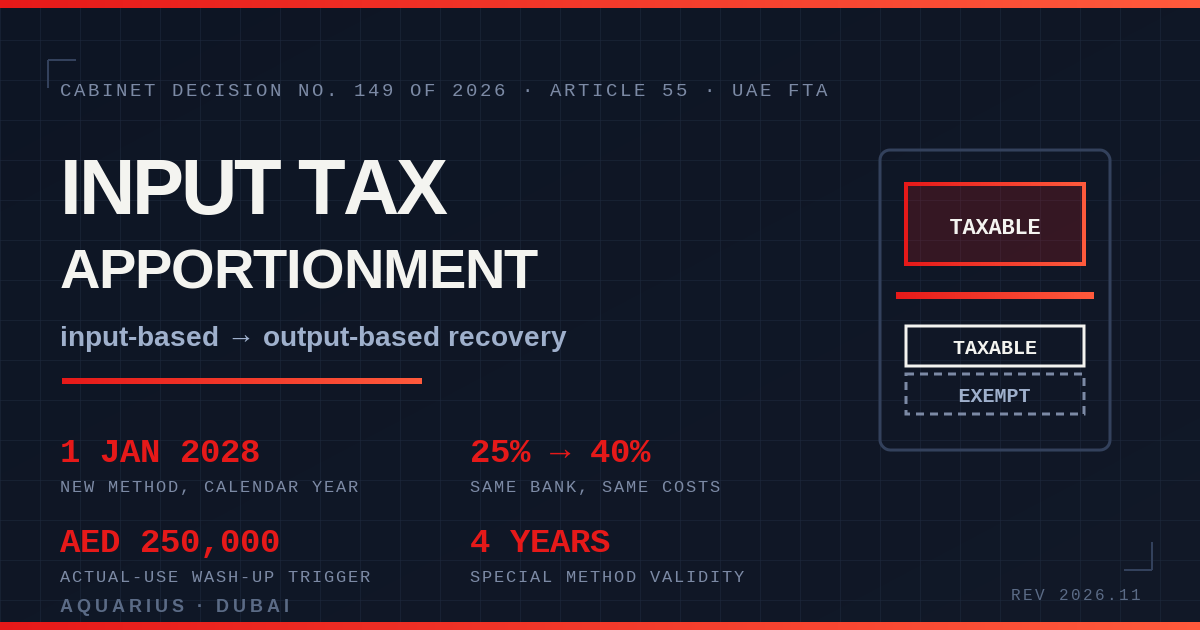
Short answer: If your Dubai business makes both taxable and exempt supplies, the way you recover VAT on shared costs is about to change. Cabinet Decision No. 149 of 2026 rewrote Article 55 of the VAT Executive Regulations: the standard apportionment method moves from an input-based ratio — recoverable input tax over total input tax — to an output-based turnover ratio, the value of supplies within Article 54(1) over the total value of all supplies. Most of the Decision took effect on 1 October 2026, but the apportionment rewrite applies only from the first tax year beginning after 1 October 2027, which for a calendar-year taxpayer means 1 January 2028. You have one full financial year to model both numbers — and to decide whether to apply for a special method before the switch.
Three numbers that explain why this matters now
Partial exemption used to be a quiet corner of UAE VAT. It is not quiet any more, because the Federal Tax Authority has shifted from registering taxpayers to reading their returns.
- AED 46 billion collected, and audits up 46%. The FTA’s 2025 annual report put VAT and excise tax revenue at AED 46 billion, up from AED 41 billion in 2024 — a 15% rise the Authority attributed to both growth and improved compliance. In the same year the FTA increased the number of tax audits it conducted by 46%, reviewed roughly 1.7 million registration-department transactions (up more than 20%), and carried out about 176,000 field inspection visits across the seven emirates — an 89% jump from around 93,000 in 2024.
- 98,000 new VAT registrations in one year. The FTA completed 98,000 VAT registration applications during 2025. Every new registrant with any exempt activity — an intercompany loan, a staff apartment, a residential floor above the shop — inherits an apportionment obligation most of them do not know they have.
- Dubai’s biggest exempt supply is its rental market. Dubai Land Department data for 2025 shows 1.38 million registered tenancy contracts worth AED 126.4 billion, volumes up 6% and value up 17% year on year, with more than 513,000 new contracts (up 10%). Residential leases are exempt from VAT. Set that against AED 686.8 billion of property sales across 215,736 transactions in the same year, and you have thousands of Dubai entities sitting on precisely the mixed taxable-and-exempt profile that Article 55 governs.
Here is what most Dubai finance teams get wrong. They treat apportionment as a year-end percentage — one ratio, applied once, to a cost pool nobody has actually defined. The regulation does not work that way, and from 2028 it will work differently still.
The three buckets before any percentage exists
Apportionment is step three, not step one. Every input tax amount has to be attributed first:
- Wholly attributable to taxable supplies — standard-rated or zero-rated output. Recover in full.
- Wholly attributable to exempt supplies — under Article 46 of the VAT Law the exempt categories are narrow: certain financial services, residential buildings supplied by sale or lease, bare land, and local passenger transport. Recover nothing.
- Residual — shared overhead that drives both: head-office rent, group IT, audit fees, the ERP licence, the marketing retainer. Only this pool gets apportioned.
If your general ledger cannot tell those three apart at transaction level, no formula helps you. A recovery percentage applied to the wrong pool is wrong twice: you apportion costs that were fully recoverable, and you fully recover costs that were blocked. That is the finding an FTA auditor writes up, and it is a data problem, not a tax-technical one.
A useful sanity check: healthcare and education providers are mostly zero-rated, not exempt, so they are outside this regime entirely. The businesses inside it are banks and insurers, residential landlords and developers, bare-land holders, local passenger transport operators — plus the long tail of ordinary Dubai companies with incidental exempt activity.
Old formula versus new formula
The change is a shift in what gets measured: from the cost side of the business to the revenue side.
| Until the last tax year beginning before 1 Oct 2027 | From the first tax year beginning after 1 Oct 2027 | |
|---|---|---|
| Basis | Input-based (input tax ratio) | Output-based (turnover ratio) |
| Numerator | Recoverable input tax for the tax period | Value of supplies within Article 54(1): taxable, zero-rated, and supplies made outside the UAE that would have been taxable if made in the UAE |
| Denominator | Total input tax for the tax period | Total value of all supplies |
| Excluded | — | Supplies of capital assets attributable to the taxable person, and receipts under the Article 48 reverse charge (Article 55(7)(b)) |
| Question it answers | How much of my VAT cost is recoverable? | How much of my turnover permits recovery? |
Read that exclusion carefully, because it is the single most misread line in the Decision. It excludes supplies of capital assets — disposals — from the ratio. It does not exclude capital expenditure from recovery: input tax on capital assets continues to run through the Capital Asset Scheme in Articles 57 and 58. Selling a building in the year no longer distorts your recovery percentage; buying one still has its own ten-year or five-year adjustment life.
What the switch is worth, in dirhams
Take the worked example published by UAE tax advisers analysing the Decision: a bank with AED 40 million of taxable fee income and AED 60 million of exempt interest margin, sitting on a residual input tax pool of AED 500,000.
| Method | Recovery % | Recovered from AED 500,000 pool |
|---|---|---|
| Current input-based standard method | 25% | AED 125,000 |
| Revised output-based standard method | 40% | AED 200,000 |
| Difference | +15 points | +AED 75,000 (a 60% increase) |
Same bank, same costs, same year — a 60% swing in recovery from a definitional change alone. It cuts the other way just as hard. A developer whose exempt residential sales dwarf its taxable commercial leasing can see its percentage collapse. Nobody can tell you which direction you move without running both calculations on your own numbers, which is the entire argument for doing it in 2027 rather than discovering it in a 2028 return.
The annual wash-up, and the AED 250,000 trigger almost nobody tests
Within the tax year you recover on a provisional percentage, period by period. At year end you recalculate on the full year’s figures and adjust — the annual wash-up — in the first tax period following the end of the tax year.
Then comes the step that gets skipped. Under Article 55(11), you must compare the recovery percentage produced by the standard method after the wash-up against the actual use of the goods and services acquired during that year. Where the resulting difference in recoverable input tax exceeds AED 250,000, a further actual-use adjustment is required. The FTA has clarified that the threshold is pro-rated for a tax year shorter than twelve months: on a five-month tax year it falls to AED 104,166.67 (250,000 x 5/12).
The myth worth busting: “we did the wash-up, so we are compliant.” The wash-up is the formula. The AED 250,000 test is the reality check against it — and it demands an actual-use dataset, not a ratio. Most Dubai businesses have never built one, which means they cannot demonstrate they passed the test or that they failed it.
Actual use means evidence: floor area by activity, headcount or time by function, transaction counts, system usage, square metres of a mixed-use tower split between exempt residential and taxable retail. That is operational data, and it lives outside the finance system. The FTA updated its Input Tax Apportionment guide on 30 September 2025 with the mechanics of combining input tax recovered in returns, recalculating the recoverable amount and computing the wash-up adjustment — worth reading before your next tax-year end, not after.
When the standard method is unfair: the special method route
If the standard ratio does not reflect how you actually consume shared costs, you can apply to change it. Cabinet Decision 149 leaves this framework intact — special methods, sectoral methods and an FTA-specified fixed recovery percentage all survive the rewrite.
| Item | Non-sectoral method | Sectoral method |
|---|---|---|
| FTA processing time | 45 business days from receipt | 65 business days from receipt |
| Approval validity | 4 years | 2 years |
| Application fee | Free | Free |
| Channel | EmaraTax only | EmaraTax only |
Eligibility is cumulative: you must be VAT-registered with the FTA for at least six months, make both taxable and exempt supplies, and show that the standard method does not give a fair and reasonable recovery result. The application needs calculations under the standard method over a 12-month period, the same calculations under your proposed method, supporting evidence, and a signed letter on company letterhead explaining the business and the rationale. Reapplication is required before expiry if you want to keep using the method.
Two practical consequences of the timetable. First, a four-year non-sectoral approval granted in 2027 carries you straight through the 2028 transition. Second, 45 to 65 business days of processing plus a 12-month comparison dataset means a 2027 application starts in early 2027, not December.
The rest of Cabinet Decision 149 that already applies
The apportionment clauses are deferred. These are not — they have been live since 1 October 2026:
- A cash-payment block on input tax. Recovery is blocked on a supply above a value to be specified by the Minister of Finance where the consideration is paid, or intended to be paid, in cash. For cash-heavy Dubai sectors this is a reason to get supplier payments onto traceable rails now, and to capture payment method as a field on the purchase record rather than a note in a bank statement.
- Employee benefits, specified rather than argued. The Decision sets out recoverable staff costs with conditions — transport to work, food at remote sites, operationally required accommodation, up to 30 days of temporary housing for new hires, work telecommunications and business parking — each needing a genuine business purpose and a documented policy. Employer-provided accommodation is recoverable where labour law requires it. “Documented policy” is the operative phrase: this is an evidence requirement dressed as a concession.
All of it lands on the same substrate as the UAE e-invoicing mandate. Once invoice data flows to the FTA through accredited service providers in a structured format, the gap between what your return claims and what your transaction data supports stops being private. Apportionment is where that gap is widest.
What the data layer costs to build in Dubai
You do not need a tax engine. You need four things your ERP almost certainly does not have: an attribution flag on every input tax line, a residual pool that computes itself, both Article 55 formulas running in parallel, and an actual-use dataset to test the AED 250,000 threshold against. These are our 2026 bands.
| Scope | AED | Typical timeline |
|---|---|---|
| Attribution mapping: chart of accounts and tax codes split into taxable / exempt / residual, applied retrospectively to one year | 28,000–65,000 | 2–4 weeks |
| Dual-formula apportionment model: old and new Article 55 methods on your own data, with impact report | 22,000–55,000 | 2–3 weeks |
| Wash-up and actual-use engine: provisional recovery by period, annual recalculation, AED 250,000 variance test with evidence trail | 65,000–160,000 | 5–9 weeks |
| Special method application pack: 12-month comparative calculations, sectoral modelling, FTA submission documentation | 35,000–95,000 | 3–6 weeks |
| Group build: multi-entity or tax group, sectoral splits, capital asset scheme tracking, e-invoicing alignment | 180,000–420,000 | 10–16 weeks |
| Ongoing care: quarterly recompute, decision and rate updates, audit support | 3,500–12,000 / month | Retainer |
Now the cost of inaction, which is cheaper than it used to be but not cheap. Under the revised penalty framework an incorrect tax return draws AED 500 for a first violation and AED 2,000 for repeat violations. Voluntary disclosure moved to a 1% monthly charge on the tax difference until the disclosure is filed, replacing the old 5%–40% fixed scale, and the fixed penalty for a disclosure made after an audit notification was cut from 50% to 15%. Late payment starts at 2% and compounds to a cap of 300% of unpaid tax.
Do the arithmetic on a mid-size Dubai group. A 15-point error in the recovery percentage on an AED 8 million residual pool is AED 1.2 million of VAT. At 1% per month during the window before anyone notices, the carrying cost alone is AED 12,000 a month — more than the retainer that would have caught it. And with audits up 46% in a single year, “nobody noticed” is a weaker assumption in 2026 than it was in 2023.
How Aquarius builds it
We start with one year of your own posted transactions, not a software demo. Pull the GL and the VAT return workings, classify every input tax line into the three buckets, and show you the residual pool you have actually been apportioning — which is almost never the pool in the spreadsheet. Then we run both Article 55 formulas side by side so you can see your 2028 position in dirhams, and build the actual-use dataset that the AED 250,000 test needs from systems you already run: leasing records, floor area, headcount, transaction volumes. The output is a recovery percentage derived by the system every period, with an evidence trail, feeding the same close process as your corporate tax and deferred tax numbers. Fixed scope, fixed price — see pricing.
FAQ
When exactly does the new output-based method start?
From the first tax year beginning after 1 October 2027. It is entity-specific, keyed to your own tax year end rather than a single national switch date, so a calendar-year taxpayer starts 1 January 2028 while a business with a September year end starts in October 2027. Keep using the input-based standard method until then; the rest of Cabinet Decision 149 already applied from 1 October 2026.
We only make a few exempt supplies. Does this apply to us?
Probably yes. Incidental exempt activity is enough to trigger apportionment — an interest-bearing loan to a related party, a residential apartment let to staff, a plot of bare land. There is no “mostly taxable” exemption from the mechanism itself. What small exempt activity does change is whether the standard method produces a fair result, which is the test for applying for a special method.
Will the change increase or reduce our recovery?
Either, depending on how your turnover mix compares with your cost mix. Businesses whose taxable share of revenue is higher than their taxable share of input tax — typically banks and insurers with large exempt margin income but taxable fee lines — tend to gain. Businesses with heavy taxable-cost bases supporting exempt revenue tend to lose. The only reliable answer is both calculations on your own figures.
Does the wash-up replace the actual-use test?
No, it precedes it. The wash-up recalculates the standard-method percentage on full-year figures and is adjusted in the first tax period after the tax year ends. The Article 55(11) test then compares that result to actual use, and requires a further adjustment where the difference in recoverable input tax exceeds AED 250,000 — pro-rated for tax years shorter than twelve months.
Should we apply for a special method before 2028?
Model first, apply second. If the output-based standard method gives you a fair result, an approval you have to renew and defend is pure overhead. If it does not, you need a 12-month comparative dataset plus 45 to 65 business days of FTA processing, which puts a realistic application window in the first half of 2027.
One closing number. The FTA collected AED 46 billion of VAT and excise in 2025 while running 46% more audits and 176,000 field inspections. Apportionment is the most judgement-heavy number in a UAE VAT return and the one least often supported by data. From 2028 the formula that produces it changes. The businesses that come out ahead are the ones that spend 2027 building the dataset rather than 2028 reconstructing it.
Want to see your 2028 recovery percentage before the FTA does? Talk to Aquarius — we will run both Article 55 formulas over one year of your own ledger before you commit to anything.