
Electronics and Mobile Ecommerce Websites in Dubai (2026): Real AED Build Costs, TDRA Type Approval and the 76% Abandoned Cart
Electronics is the single largest UAE ecommerce category, yet 76% of its carts are abandoned. Real AED build costs, the TDRA and ECAS paperwork, and the AED 100,000 warranty fine.
- PUBLISHED
- 09 OCT 2026
- READ TIME
- 14 MIN
- AUTHOR
- AQUARIUS · DUBAI
- UNIT
- REV 2026.09
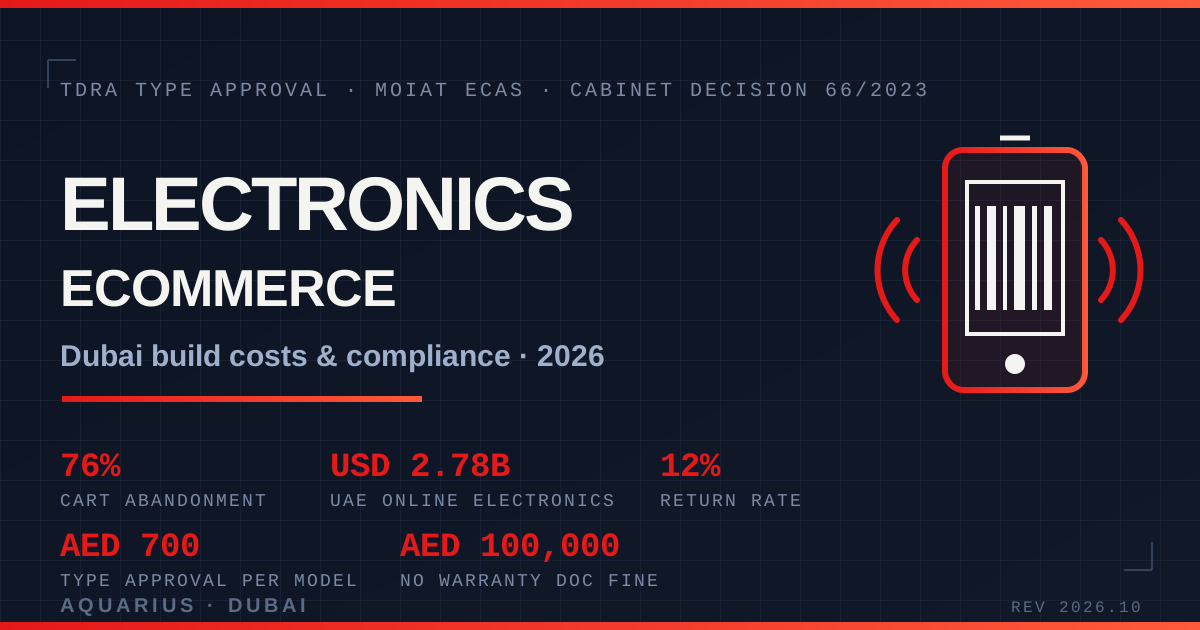
Short answer: A serious electronics or mobile-phone ecommerce store in Dubai — bilingual storefront, serial and IMEI-level inventory, warranty and RMA engine, BNPL and cash-on-delivery, plus the compliance data your regulators expect — costs AED 55,000–140,000 on a well-configured Shopify or WooCommerce build and AED 160,000–420,000 as a custom headless platform with trade-in, service tickets and ERP sync. The market justifies it: electronics is the largest single category in UAE ecommerce at roughly 34% of total online revenue, with online electronics sales of about USD 2,778 million in 2025 growing 10–15% a year. The problem is that 75.5–76.0% of electronics carts in this market are abandoned and the average return rate sits near 12%. In high-ticket electronics, your checkout and your warranty workflow decide profit — not your homepage.
Key takeaways
- Electronics is where UAE shoppers actually spend online. It is the biggest ecommerce category in the country at about 34% of total online revenue, and online now accounts for roughly 30–35% of all electronics sales in the UAE. Consumer electronics alone contributes 66% of that online electronics revenue.
- The funnel leaks at the end, not the start. Add-to-cart rates run 8.5–9.0%, which is healthy — but cart abandonment is 75.5–76.0%. On an AED 4,000 laptop, recovering two carts a day is worth more than a year of blog posts.
- Your product data is regulated data. Any device with Bluetooth, Wi-Fi, cellular or GPS needs TDRA type approval before it can be sold or distributed in the UAE — published fees of about AED 5,500 one-time for supplier registration (five-year validity) and roughly AED 700 per device model (AED 500 review plus AED 200 certificate), with certificates valid three years. Regulated categories also need MoIAT ECAS certification, where technical assessor fees are published at AED 2,500 per working day.
- Missing paperwork is a five-figure fine, per violation. Under Cabinet Decision No. 66 of 2023, the executive regulations of Federal Law No. 15 of 2020 on Consumer Protection, failing to provide a warranty document carries AED 100,000, failing to issue an invoice in Arabic AED 100,000, no periodic maintenance service AED 300,000, and recurrent failure to replace or refund a defective product AED 500,000. The schedule runs to 46 penalty categories between AED 100,000 and AED 1,000,000.
- Most Dubai electronics sellers get this backwards. They spend the budget on a glossy product page and treat warranty, serial tracking and returns as an email inbox. Then one Samsung TV comes back twice, a customer cites the replacement right, and the entire quarter’s margin on that SKU is gone — because nobody can prove which unit was sold, when, or under what warranty.
The numbers that set the stakes in Dubai
Three figures explain why so many Dubai electronics retailers are rebuilding their stores in 2026 rather than tweaking them.
- The category is the market. Electronics is the largest contributor to UAE ecommerce revenue at roughly 34% of the total, inside a national online market of about USD 12.3 billion in 2026. UAE online electronics revenue was around USD 2,778 million in 2025 and is growing at 10–15%, with online penetration of electronics retail at 30–35%. This is not an emerging channel here. It is the channel.
- Your competition is Amazon and Noon, and that is survivable. Amazon leads the UAE electronics ecommerce ranking, with Noon and Apple close behind. Marketplaces take the generic, price-led demand. What they handle badly is configured, serviced and warrantied product: bundled AV installs, business laptops with imaging, gaming rigs, commercial displays, trade-in. That is the gap a direct store can hold.
- The second-hand flow is now a first-class revenue line. The UAE used and refurbished smartphone market is tracking toward USD 2.5 billion by 2030 at about 12% CAGR, with the UAE holding 30–35% of regional value, and an estimated 70% of secondary devices expected to move through structured, certified channels by 2026. Dubai is the regional re-export hub for exactly this trade.
Here is the shareable number. A UAE electronics store converts a visitor into a cart roughly 9 times in 100, then loses 76 of every 100 carts before payment clears. At a typical AED 2,500 electronics basket, every single percentage point of recovered checkout is worth real money — and almost all of it is won with boring work: stock truth, a visible warranty promise, instalments at the right price point, and a delivery date you can actually commit to. If you are still costing the project, start with our Dubai ecommerce website cost breakdown.
What an electronics store has to do that a fashion store does not
Electronics breaks generic ecommerce templates in five specific places. Each one is a build decision, not a plugin.
1. Unit-level identity: serials, IMEIs and warranty start dates
Fashion sells SKUs. Electronics sells units. The customer who returns a phone in month ten needs the warranty tied to that handset, not to the model. Your catalogue therefore needs a serial or IMEI register captured at pick-and-pack, bound to the order, with a warranty clock that starts at delivery. This single feature kills the most expensive dispute in the business — a warranty claim nobody can verify — and it is also what makes legitimate grey-stock questions answerable in one search.
2. Compliance fields as product data
Any device transmitting Bluetooth, Wi-Fi, cellular or GPS requires TDRA type approval before it may be sold or distributed in the UAE. Approval tiers run roughly one working day for low-risk equipment, about five working days for medium-risk, and up to ten working days for high-risk or new designs. As clarified in February 2026, a customs clearance permit is required in addition to the type approval itself. Dealer registration is valid five years; type approval certificates three years.
For regulated categories such as low-voltage equipment, lighting, RoHS and energy labelling, MoIAT ECAS certification applies, typically two weeks for products with existing accredited test reports and up to six weeks where fresh testing is needed, with certificates valid one year and assessor fees published at AED 2,500 per working day. A first-time electronics importer should plan six to ten weeks before the first container clears.
Practical build consequence: put type approval reference, certificate expiry, ECAS status and energy label on the product record as structured fields with expiry alerts. A store that cannot report which live SKUs have a certificate expiring in sixty days is one audit away from pulling listings by hand.
3. Warranty, RMA and service as a first-class module
Under the Consumer Protection executive regulations, suppliers must warrant the product for the period specified by the producer or commercial agent, the warranty period must be extended to cover time the customer could not use the product because of repair or maintenance delay, and maintenance information must be provided in writing in at least Arabic and published on the supplier’s website. Consumers can claim repair, replacement or refund on defective goods.
That is a software spec, not a legal footnote. You need an RMA flow that issues a ticket against a serial number, records fault symptoms, tracks the unit through the service centre, auto-extends the warranty end date by the downtime, and exposes status to the customer without a phone call. Build it once and the AED 500,000 recurrent-failure exposure becomes an audit trail instead of an argument.
4. Payments: instalments do the heavy lifting at this ticket size
Nobody puts AED 6,000 on a card casually. Buy-now-pay-later changes the decision for mid-to-high baskets, and the integration detail matters: eligibility messaging on the product page, not just at checkout. Cash on delivery is still roughly 30% of orders in this market, and close to 20% of COD orders end in return-to-origin — which on a boxed television is a brutal cost. Our guides to Tabby and Tamara BNPL integration and last-mile delivery and COD integration cover the mechanics; the store-level rule is simple — cap COD by basket value and category, and push instalments above that cap.
5. Returns and trade-in: the same pipe, two directions
Electronics returns average about 12% in this market, and every returned unit is a graded asset, not a refund line. Grade it (A/B/C), decide resale, refurbishment or RMA to supplier, and relist it with its own serial history. The same pipeline runs trade-in: quote by model and condition, deduct at checkout, receive, inspect, regrade. Done properly, the returns dock becomes a second catalogue instead of a cost centre — see ecommerce returns and reverse logistics in Dubai.
What it costs to build in Dubai, in AED
Realistic 2026 ranges for a Dubai build, excluding 5% VAT. Platform choice drives the top of the range far more than design does.
| Module | What it covers | Cost (AED) | Timeline |
|---|---|---|---|
| Discovery and catalogue architecture | Attribute model for specs, variants, bundles, compliance fields, warranty terms per category, COD and BNPL policy | 8,000–20,000 | 1–2 weeks |
| Storefront (Shopify or WooCommerce) | Bilingual Arabic and English with RTL, spec-sheet comparison, filtering by attribute, stock and delivery-date display | 28,000–75,000 | 4–7 weeks |
| Custom headless storefront | Next.js front end, own search, personalised merchandising, sub-second category pages at 10,000-plus SKUs | 90,000–240,000 | 8–14 weeks |
| Serial and IMEI inventory layer | Unit-level stock, capture at pack, order binding, warranty clock, grey-stock traceability | 22,000–60,000 | 2–4 weeks |
| Warranty, RMA and service portal | Ticket by serial, service-centre tracking, automatic warranty extension for downtime, Arabic maintenance documentation | 25,000–70,000 | 3–5 weeks |
| Trade-in and refurbished grading | Quote engine by model and condition, checkout deduction, inspection workflow, A/B/C grading, relisting | 20,000–55,000 | 2–4 weeks |
| Payments and checkout optimisation | Gateway plus BNPL with product-page messaging, COD rules by basket and category, abandoned-cart recovery, 3DS2 tuning | 12,000–35,000 | 2–3 weeks |
| Integrations | ERP or POS sync, courier APIs with COD reconciliation, VAT invoicing with TRN, compliance-expiry alerting, analytics | 15,000–45,000 | 2–4 weeks |
Running costs decide whether the store is profitable in year two. Budget AED 900–4,000 per month for hosting, search and CDN at mid scale; payment processing around 2.4–2.9% plus AED 1 per transaction, with BNPL providers charging a higher merchant fee in exchange for conversion; courier and COD handling per parcel; and 15–20% of build cost per year for maintenance, platform updates and catalogue work. Import maths sits on top: 5% customs duty on CIF value plus 5% VAT on the cleared total for mainland imports, and note that the AED 1,000 low-value courier exemption does not apply to commercial imports under a trade licence — see the AED 1,000 exemption explained.
Where the money actually comes from: fixing the 76%
Abandonment in electronics is rarely about price alone. It is about uncertainty, and each source of uncertainty has a fix with a measurable return.
- Stock truth. “In stock” must mean a unit is physically available, because the apology email for an oversold laptop costs a customer for life. Unit-level inventory makes this automatic.
- Delivery commitment. Show a date, not a range of business days, and show it on the product page. For large items, show the installation slot too.
- Total price before checkout. VAT-inclusive display, delivery cost and any COD fee up front. Surprise at step three is the classic abandonment trigger.
- Warranty in plain language. State the warranty length, who services it in the UAE, and that repair downtime extends the cover — which is your legal obligation anyway, so say it and convert on it.
- Instalments priced at the product page. “From AED 500 per month” reframes an AED 6,000 decision.
- Recovery sequence. Abandoned-cart email and WhatsApp within an hour, with the exact unit reserved for a short window. On a 9% add-to-cart rate, this is the cheapest revenue in the build.
Treat these as a measured program, not a redesign. Each item is an experiment with a baseline, and the reporting should live in your analytics stack from day one rather than being retrofitted after launch. Our note on conversion rate optimisation cost in Dubai sets out what a disciplined testing cycle costs here.
The compliance exposure, priced
This is the BOFU maths that gets budget approved. A single AED 100,000 penalty for a missing warranty document is more than the entire serial-and-warranty module costs to build. The published schedule under Cabinet Decision No. 66 of 2023 includes:
| Violation | Fine (AED) | What prevents it in software |
|---|---|---|
| No warranty document provided | 100,000 | Warranty certificate auto-generated per unit and attached to the order |
| Invoice not issued in Arabic | 100,000 | Bilingual VAT invoice template with TRN, Arabic by default |
| No periodic maintenance services | 300,000 | Service schedule and reminders tied to the serial register |
| Failure to advise of potential harm | 500,000 | Safety and recall notices pushed to affected serial numbers |
| Recurrent failure to replace or refund | 500,000 | RMA history per unit, with escalation at the second fault |
Two more items belong on the same page. Marketing content is regulated too: the UAE Media Council Advertiser Permit has been enforced since 1 February 2026 for anyone publishing promotional content from inside the UAE, paid or unpaid, so keep permit numbers on file for every creator promoting your products — our breakdown of influencer marketing cost in Dubai covers the register we use. And price transparency rules bite: suppliers must inform customers of discounts applied within a week of purchase and refund the difference within 30 days.
How we build electronics stores at Aquarius
We build the unit layer first — serials, warranty clock, RMA — and the storefront second. It feels backwards to clients until the first warranty claim arrives and the answer takes four seconds. Then the compliance fields go onto the product record with expiry alerting, so a TDRA certificate approaching its three-year limit raises a flag before a listing becomes a liability. Checkout comes next with COD caps, BNPL messaging and a recovery sequence instrumented from day one, because the 76% is where the growth is hiding. Arabic is built in from the first commit, not bolted on; RTL retrofits on a spec-heavy catalogue are genuinely expensive.
Scope is fixed in phases with AED ranges before anything is written, you own the repository and the data, and nothing in the stack is licensed back to us. If you are deciding between a configured platform and a custom build, our comparison of Shopify versus custom ecommerce in Dubai is the honest version — a well-run Shopify store beats a badly run custom one every time. Current engagement rates are on our pricing page, and a 30-minute scoping call will tell you which of the two you actually need.
FAQ
Do I need TDRA approval to sell phones and laptops on my own website in Dubai?
If the device transmits on Bluetooth, Wi-Fi, cellular or GPS, it needs TDRA type approval before it is sold or distributed in the UAE, and since February 2026 a separate customs clearance permit is required alongside it. Published fees are around AED 5,500 one-time for supplier registration, valid five years, and roughly AED 700 per device model, with the certificate valid three years. Approval takes about one working day for low-risk equipment and up to ten for high-risk or new designs.
How much does an electronics ecommerce website cost in Dubai in 2026?
A bilingual store on Shopify or WooCommerce with serial tracking and a warranty workflow runs AED 55,000–140,000. A custom headless platform with trade-in, service tickets and ERP integration runs AED 160,000–420,000. The deciding factors are catalogue size, whether you need unit-level inventory, and how much of the service operation moves into software.
Can I refuse returns on opened electronics?
Not on defective goods. Under the Consumer Protection executive regulations consumers can claim repair, replacement or refund on defective products, the warranty must be extended for the time the item was unusable during repair, and recurrent failure to replace or refund carries a fine of up to AED 500,000. Your own change-of-mind policy can be stricter than that, as long as it is stated clearly before purchase.
Is cash on delivery worth offering for high-value electronics?
Selectively. COD is still around 30% of orders in this market, but close to 20% of COD orders end in return-to-origin, and the return freight on a large appliance eats the margin. Cap COD by basket value and category, verify the order by phone or WhatsApp above the cap, and steer higher baskets to BNPL or card.
Should I sell on Amazon and Noon instead of building my own store?
Do both, with different jobs. Marketplaces win price-led, generic demand; your own store wins configured, bundled and serviced sales where you keep the customer, the warranty relationship and the trade-in. Electronics is about 34% of UAE online revenue, so there is room for both — but only the direct channel compounds into an asset you own.