
Dubai Raised the E-Commerce Duty-Free Limit to AED 1,000: What Changes for Your Online Store in 2026
Notice 16/2026 lifted the duty-free limit on cross-border parcels from AED 300 to AED 1,000 on 3 August. What it saves, what VAT still costs, and what your checkout must change.
- PUBLISHED
- 28 SEPT 2026
- READ TIME
- 11 MIN
- AUTHOR
- AQUARIUS · DUBAI
- UNIT
- REV 2026.09
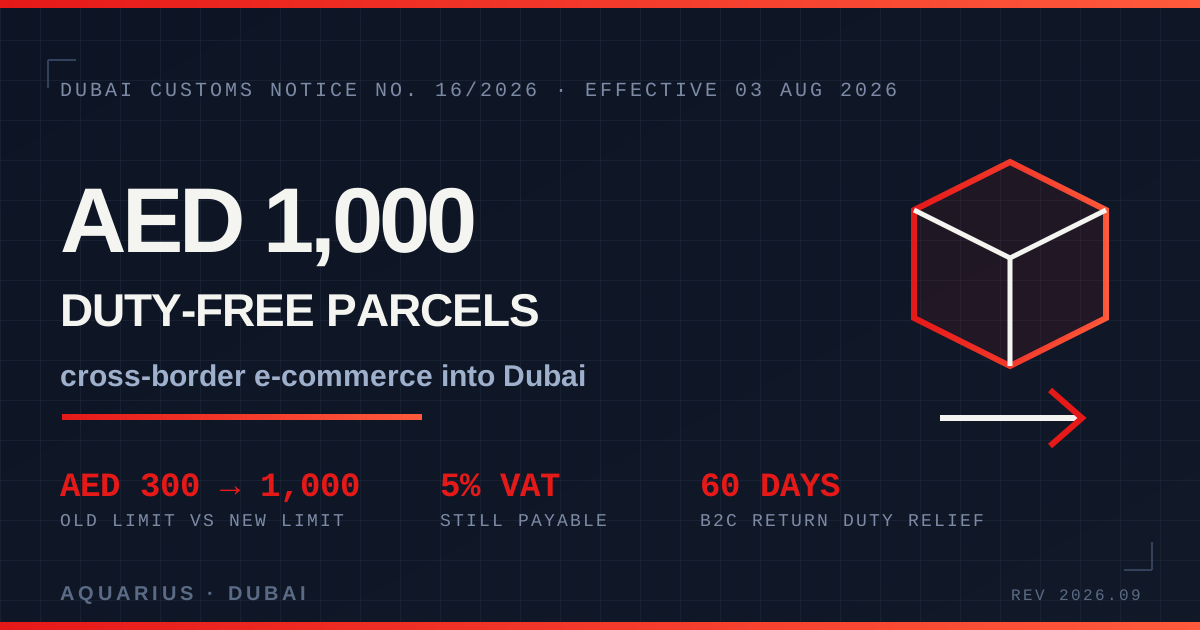
Short answer: since 3 August 2026, Dubai Customs Notice No. 16/2026 has exempted cross-border e-commerce shipments valued at AED 1,000 or less from the 5% customs duty, up from a AED 300 limit. Duty is gone on that band, but 5% import VAT still applies, and tobacco, vaping devices, nicotine liquids and alcohol are excluded. Returned B2C goods that already carried duty are now duty-exempt if they leave within 60 days. If your store still quotes duty on a AED 800 parcel, you are overcharging customers by roughly AED 42 per order and losing checkouts for no reason.
Key takeaways
- Dubai moved the opposite way to the rest of the world. While the US retired its USD 800 de minimis and the EU moved against its EUR 150 threshold in 2026, Dubai raised its e-commerce exemption from AED 300 to AED 1,000 under Notice No. 16/2026, effective 3 August 2026.
- The band that matters is where most baskets sit. Average UAE e-commerce order value is around AED 375, so the overwhelming majority of B2C parcels now cross the border duty-free.
- Duty is not tax. The exemption removes the 5% duty on CIF value. The 5% import VAT remains, and excluded categories still pay duty.
- Returns got cheaper, if you can prove it. Duty-paid B2C returns exported within 60 days of the original date of exit are exempt. That is a documentation problem, and documentation is software.
- Showing real landed cost pays. Up to 73% of shoppers abandon over cost uncertainty, and merchants who display full landed cost at checkout report conversion lifts of up to 3x. A landed-cost engine wired into a Dubai store costs AED 18,000 to 45,000.
What actually changed on 3 August 2026
Dubai Customs issued Notice No. 16 of 2026, amending customs procedures for cross-border e-commerce. The headline change: goods valued at AED 1,000 or less are exempt from customs duty, replacing the AED 300 limit enforced since 1 January 2023. The stated intent is competitiveness - lower costs, faster clearance, more e-commerce investment into Dubai.
Three details decide whether your store benefits or quietly breaks:
- Exclusions. The exemption does not cover tobacco and tobacco products, electronic smoking devices and their accessories, nicotine-containing liquids, or alcoholic beverages and food preparations containing alcohol. Those remain dutiable at their own rates.
- VAT is untouched. The standard 5% UAE VAT on imports still applies. An AED 900 duty-free parcel is not a tax-free parcel.
- Returns relief. B2C goods returned through companies, where duty payment is proven, are exempt if returned within 60 days of the date of exit. Miss the window or lose the paper trail and the relief disappears.
Dubai Customs also stated that companies wanting these facilities must adjust their own processes to match the new provisions. That line is the whole point of this article: the benefit is not automatic at your checkout.
Why this is a bigger deal in Dubai than anywhere else
The UAE e-commerce market is worth roughly USD 12.3 billion in 2026 and is forecast to reach about USD 21.0 billion by 2031, an 11.29% CAGR. There are approximately 11.04 million online shoppers in the country, and smartphones carried 78.67% of 2025 transaction volume.
Now the part that makes a customs threshold strategic rather than administrative: this is a cross-border market by default. Roughly 58% of online purchases in the UAE are made from international vendors, and more than 65% of UAE online shoppers buy from international websites. Dubai also has the fulfilment layer to exploit it - same-day delivery now reaches 90% of the city's urban population.
Against that, 2026 has been the year the rest of the world tightened. The United States ended its USD 800 duty-free allowance - a lane that carried more than 1.3 billion packages in 2024 - and the EU moved against its EUR 150 threshold. Dubai went the other direction. For a Dubai store selling inbound to UAE customers, or a regional brand deciding where to place stock, that divergence is a real commercial advantage for the next few years.
The landed-cost math, parcel by parcel
UAE customs duty is generally 5% of CIF value (cost plus insurance plus freight), and import VAT is 5%, charged on CIF value plus any duty. Here is what the change is worth on typical baskets. Figures assume a standard dutiable, non-excluded product and a CIF value including freight.
| CIF value | Duty before (5%) | Duty now | Import VAT (5%) | Total tax now | Saved per parcel |
|---|---|---|---|---|---|
| AED 400 | 20.00 | 0.00 | 20.00 | AED 20.00 | AED 21.00 |
| AED 800 | 40.00 | 0.00 | 40.00 | AED 40.00 | AED 42.00 |
| AED 1,000 | 50.00 | 0.00 | 50.00 | AED 50.00 | AED 52.50 |
| AED 1,200 | 60.00 | 60.00 | 63.00 | AED 123.00 | AED 0.00 |
| AED 2,500 | 125.00 | 125.00 | 131.25 | AED 256.25 | AED 0.00 |
Two things fall out of that table. First, with a typical UAE order value near AED 375, most of your parcels now sit comfortably inside the exemption. Second, there is a hard cliff at AED 1,000 - a parcel at AED 1,001 pays duty on the whole CIF value, not on the excess. On a 500-parcel month of AED 800 shipments, the change is worth around AED 21,000 in duty no longer payable. That is money that either stays with your customer as a lower price or stays with you as margin - but only if your checkout knows the rule.
What most Dubai stores get wrong
Almost every store we audit handles duty in one of three broken ways.
1. Hardcoded duty, never revisited
A flat "customs and handling" line item added in 2023 against the AED 300 threshold, still firing on every order. It now overcharges legitimate low-value parcels and, worse, it is a price-accuracy problem in a market where the regulator cares about advertised prices.
2. Duty collected at the door (DDU)
The courier bills the customer on delivery. This is how you convert a happy buyer into a refused parcel. In the UAE, cash on delivery is still 25-30% of transactions (down from 40% in 2022) and roughly 20% of COD orders end as return-to-origin. Adding a surprise charge at the door on top of that behaviour is how a delivery becomes a double-freight loss.
3. Nothing shown at all
The most common. Duty and tax stay invisible until something goes wrong. Up to 73% of online shoppers cite uncertainty over total cost as their reason for abandoning, against an overall cart abandonment rate near 70%. Merchants who show the complete landed cost - shipping, duty, VAT - before payment report conversion improvements of up to 3x.
The fix is a single calculated field: true landed cost, computed at checkout, with the AED 1,000 rule and the exclusion list encoded in one place rather than in a support agent's head. If you are already reviewing your last-mile and COD integration, this belongs in the same sprint.
The compliance layer nobody budgets for
Customs is one of four rule sets that land on a Dubai online store at once, and the newer ones carry real penalties.
- Modern technology-based trade. Federal Decree-Law No. 14 of 2023 gives technology-enabled commerce its own framework, sitting alongside the Consumer Protection Law, the PDPL, electronic transactions rules and tax obligations.
- Returns and refunds. Buy online from a UAE-licensed seller and you generally have 14 days from receipt to return an unused item in original packaging, with the refund due within 14 days of the seller receiving it. Perishables, personalised goods, unwrapped intimate items and accessed digital content are the usual exceptions.
- Price transparency. Prices must be displayed clearly and misleading price claims are prohibited. Breaches of the consumer protection regime under Federal Law No. 15 of 2020 can attract fines of up to AED 2,000,000.
- Tax paperwork. VAT stays at 5%, and UAE e-invoicing obligations arrive on their own schedule - covered in our VAT and e-invoicing guide.
Operationally, importing in your own name means a Dubai Customs client code - registration runs about AED 100 per business type plus AED 20 knowledge and innovation fees, commonly quoted at around AED 120, typically with a refundable AED 5,000 security deposit. Declarations are filed through Mirsal 2 on the Dubai Trade portal with HS codes, shipment value and consignee details, and declaration service fees run roughly AED 15 to AED 100 depending on type and channel. Broker fees on top are commercial, not fixed.
Returns: where the 60-day rule earns its keep
Returns are not an edge case in this market. The average UAE return rate sits near 17%, with apparel around 26%, against a global average near 24.5%. Layer on a COD return-to-origin rate near 20% and a mid-sized store is moving a meaningful share of its volume backwards.
The new relief only pays out if you can evidence two things: that duty was paid on the original import, and that the goods physically exited within 60 days of the date of exit on the original movement. In practice that means your returns portal has to carry the original declaration reference, the duty proof, the HS code, the dates and the outbound movement against each RMA - not an email thread and a spreadsheet. Build the evidence chain into the RMA record and the relief becomes a report you run. Leave it to operations and it is money you never claim.
What it costs to build in Dubai, in AED
These are the ranges we quote in 2026 for cross-border e-commerce work. All figures exclude 5% VAT.
| Build | Scope | AED range | Timeline |
|---|---|---|---|
| Landed-cost engine at checkout | HS code mapping, CIF duty and VAT calculation, AED 1,000 threshold and exclusion rules, DDP display | 18,000-45,000 | 3-5 weeks |
| Courier and customs integration | Carrier APIs, commercial invoice and declaration data, Mirsal 2 field mapping, tracking webhooks | 25,000-60,000 | 4-7 weeks |
| Returns and RMA portal | Self-serve RMA, 14-day window logic, duty-proof and 60-day export evidence pack, refund workflow | 30,000-70,000 | 5-8 weeks |
| COD and reconciliation module | COD flagging, RTO scoring, courier remittance reconciliation, fee and loss reporting | 22,000-55,000 | 4-6 weeks |
| Full cross-border commerce stack | All of the above with multi-currency, VAT-compliant invoicing, admin roles and audit trail | 120,000-260,000 | 3-5 months |
Sequence matters more than scope. Build the landed-cost engine first, because it is the cheapest item on the list and the only one that moves conversion this quarter. The returns evidence pack comes second, since it turns the 60-day rule into recovered cash. COD reconciliation is third unless COD is more than a third of your orders, in which case move it up. Our pricing page shows how we phase these, and services covers what each stage includes.
How Aquarius builds it
We model the rule, not the workaround. One rules table holds the threshold, the excluded HS categories, the duty and VAT formulas and the effective dates, so when Dubai Customs moves the number again - and the last three years say it will - you change a row, not a codebase. The checkout reads that table, the commercial invoice reads that table, and the returns evidence pack reads that table. No parallel logic in three places drifting apart.
You get the source code, the hosting accounts and the documentation in your name. Where you hold customer data you also inherit PDPL duties, which we wire in at the same time rather than as a retrofit. If you run one check this week, pull your last 100 orders, filter to CIF value under AED 1,000, and see whether your checkout charged duty on any of them. Every hit is a refund you owe or a customer you overcharged. Send us your last 100 orders and we will tell you what the new threshold is worth to your store.
Customs, tax and consumer-protection details reflect published rules as of September 2026, including Dubai Customs Notice No. 16/2026. Confirm current requirements with Dubai Customs, the FTA and your broker before relying on them commercially.
FAQ
What is the duty-free limit for e-commerce parcels into Dubai in 2026?
AED 1,000 or less in value, under Dubai Customs Notice No. 16/2026, effective 3 August 2026. The previous limit was AED 300. The exemption covers cross-border e-commerce shipments and excludes tobacco and tobacco products, electronic smoking devices and accessories, nicotine liquids, and alcohol or alcohol-containing food preparations.
Do I still pay VAT on a duty-free parcel?
Yes. The exemption removes the 5% customs duty only. 5% import VAT still applies, calculated on CIF value plus any duty charged. On an AED 800 parcel that is AED 40 of VAT with no duty, against AED 82 of combined duty and VAT before the change.
What happens to a parcel worth AED 1,200?
It is fully dutiable. The exemption is a threshold, not an allowance, so duty applies to the entire CIF value once you cross AED 1,000 - roughly AED 60 of duty plus AED 63 of VAT on an AED 1,200 parcel. Splitting genuine single orders to dodge the threshold is a compliance risk, so price and bundle deliberately instead.
Can I reclaim duty on returned goods?
Under Notice No. 16/2026, duty-paid B2C goods returned through companies are exempt from duty if returned within 60 days of the date of exit, provided duty payment is proven. You need the original declaration reference, duty proof and dated export evidence tied to the return - which is exactly what an RMA record should store.
How much does it cost to add duty and landed cost to a Dubai store checkout?
A landed-cost engine with HS mapping, CIF duty and VAT calculation, threshold and exclusion rules and DDP display runs AED 18,000-45,000 over three to five weeks. A full cross-border stack with carrier integration, returns evidence and VAT-compliant invoicing runs AED 120,000-260,000. Figures exclude 5% VAT.