
Data Clean Rooms vs Incrementality Testing: Dubai Ad Measurement in 2026
AWS Clean Rooms runs in 11 regions and none are in the Gulf. Why Dubai advertisers should run free incrementality tests before buying a clean room, with real AED costs and UAE geo-test design.
- PUBLISHED
- 25 OCT 2026
- READ TIME
- 11 MIN
- AUTHOR
- AQUARIUS · DUBAI
- UNIT
- REV 2026.09
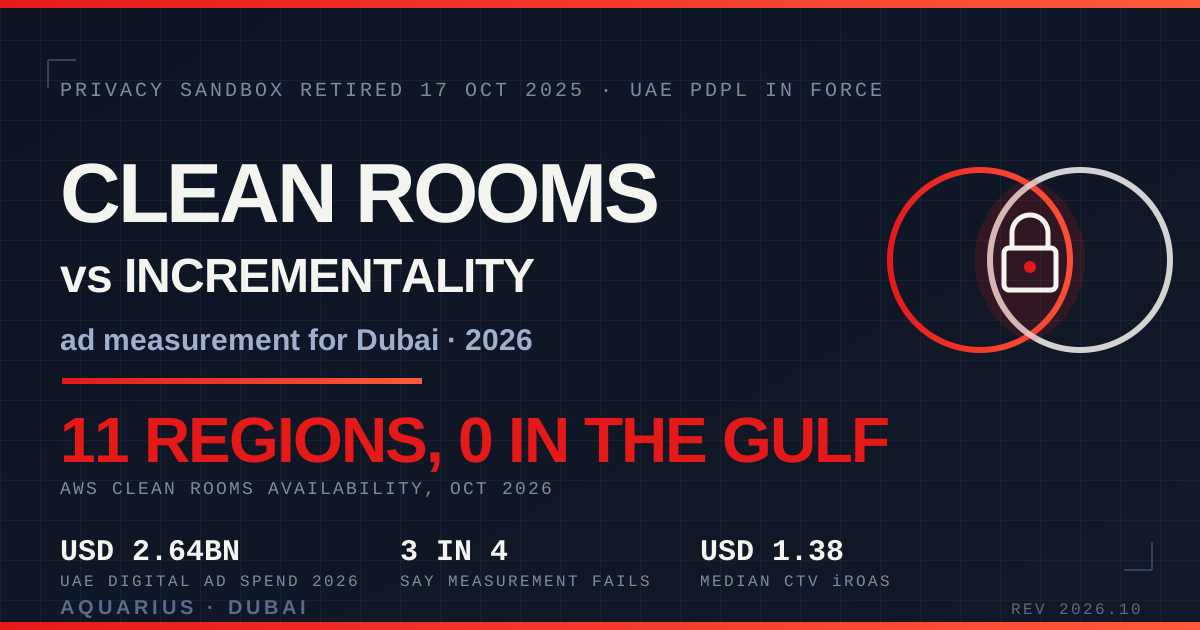
A data clean room tells you who overlapped; an incrementality test tells you what you actually caused. Dubai advertisers in 2026 need both, but in a specific order: run geo-based incrementality tests first because they are free and answer the budget question, then add a clean room only when you need cross-publisher overlap or audience modelling. And check the region before you sign anything — most "privacy-safe" clean rooms have no Gulf footprint at all, so your customer data leaves the UAE to be matched.
Why Dubai's measurement stack broke this year (TOFU)
Three numbers frame the problem. UAE digital ad spend is forecast to grow 15.2% to about USD 2.64 billion in 2026, up from roughly USD 2.29 billion in 2025, on a path toward USD 4.3 billion by 2029. Across MENA, WPP Media projects total ad spend rising about 7% to USD 8.4 billion in 2026. And in IAB's "State of Data 2026" report, published 3 February 2026, three in four marketers said their attribution, incrementality and marketing-mix measurement are not delivering what the business needs.
Then the technical floor moved. On 17 October 2025 Google announced it was retiring ten Privacy Sandbox APIs — Topics, Protected Audience, Attribution Reporting and others — while third-party cookies stay in Chrome indefinitely under existing user controls. Only a handful of pieces survived, notably CHIPS (partitioned cookies), FedCM and Private State Tokens. The industry spent four years building for a cookieless future that then changed shape.
The practical consequence for a Dubai media buyer: nobody is coming to rescue deterministic cross-site tracking. Platform-reported ROAS stays inflated by the demand you were going to capture anyway, iOS signal loss stays, and the only reliable instruments left are the ones that measure cause directly or match data inside a controlled environment.
What a data clean room actually is
A clean room is a query environment where two parties — usually an advertiser and a publisher — join their data without either side seeing the other's row-level records. You submit SQL; the system returns aggregates only, above a minimum-user threshold, often with noise added. The main options a UAE brand can realistically reach in 2026:
- Google Ads Data Hub. Query Google and YouTube ad logs against your own BigQuery data. Privacy checks enforce roughly 20 unique users per output row with noise injection, around 50 when a query risks difference attacks, and about 10 for click-and-conversion-only data. Rows with null or zeroed user IDs are excluded, and each account runs against a data-access budget that warns with
DATA_ACCESS_BUDGET_IS_NEARLY_EXHAUSTEDbefore it locks you out. - Amazon Marketing Cloud. Free inside the Amazon Ads console, available across 17 marketplaces including the UAE and Saudi Arabia. Since unBoxed 2024 it is no longer DSP-only — Partner Network agencies serving sponsored-ads-only advertisers can access it, which matters for Dubai brands whose Amazon.ae budget is mostly Sponsored Products.
- Meta Advanced Analytics. A waitlist-gated, clean-room-style environment. Meta's 2025 MeasureUp disclosures cited results such as 14% incremental revenue lift for a travel advertiser and 42% lower-funnel lift for a beverage brand across a programme of roughly 120 tests.
- AWS Clean Rooms and Snowflake. The neutral, bring-your-own-partner route: you collaborate with retailers, publishers or data partners on infrastructure you control, priced by compute rather than by seat.
The myth most Dubai teams get wrong: "privacy-safe" is not the same as "stays in the UAE"
Checked on 25 October 2026, AWS Clean Rooms is sold in just 11 AWS regions — and none of them is in the Middle East. There is no me-central-1 option. Google Cloud, which underpins BigQuery and Ads Data Hub, has no UAE region at all; the nearest are Doha (me-central1), Dammam (me-central2) and Tel Aviv (me-west1). Microsoft Azure does have UAE North (Dubai) and UAE Central. Snowflake is the notable in-country exception, listing AWS me-central-1 (UAE) and Azure uaenorth (Dubai) among its deployments.
So the compliance story flips. A clean room is excellent at preventing your partner from seeing individual records — and simultaneously a cross-border transfer of UAE personal data to a region you did not choose. Under Federal Decree-Law No. 45 of 2021 (PDPL), cross-border transfer is permitted where the destination offers adequate protection or where appropriate contractual safeguards are in place, so this is a paperwork-and-architecture problem, not a prohibition. But it is a problem to answer in your records of processing before the first query runs, not after a regulator asks. The same discipline we apply to consent banners under UAE PDPL applies to the measurement layer behind them.
Clean rooms vs incrementality tests vs MMM (MOFU)
These three are not competitors. They answer different questions, and buying the expensive one first is the classic Dubai mistake.
| Method | Question it answers | Data leaves UAE? | Indicative cost |
|---|---|---|---|
| Geo holdout / lift test | Did this channel cause incremental revenue? | No — uses your own aggregates | Free to run; cost is the held-out spend |
| Platform lift tools (Conversion Lift, GeoLift) | Causal lift inside one platform | Data already sits with the platform | Free; holdouts typically 5–20% of audience |
| Marketing mix modelling (Google Meridian) | How to split budget across all channels | Model runs wherever you host it | Open-source and free; needs ~2 years of weekly data |
| Publisher clean rooms (Ads Data Hub, AMC) | Reach overlap, frequency, path to conversion | Yes — no Gulf region for Ads Data Hub | No licence fee; you pay BigQuery compute |
| AWS Clean Rooms (SQL) | Custom joins with a retail or data partner | Yes — nearest region is outside MENA | USD 0.656 per CRPU-hour (AED 2.41) in us-east-1 |
| AWS Clean Rooms (Custom SQL / Spark / PySpark) | Modelled audiences, heavier analytics | Yes | USD 2.00–4.00 per CRPU-hour (AED 7.35–14.69) |
| Snowflake clean room | Same, with UAE data residency available | No, if deployed on UAE North or me-central-1 | Contract-based; storage from USD 23/TB/month (AED 84) |
Two more data points worth having in the room when the budget conversation starts. Google's Meridian MMM framework is open-source and free, opened to all advertisers on 29 January 2025, with GeoX reaching general availability on 9 September 2026 alongside Meridian 2.0.0 — so the modelling layer costs engineering time, not licence fees. Commercial incrementality and MMM platforms are a different order: vendor-reported pricing for enterprise measurement suites runs from tens to hundreds of thousands of US dollars a year on annual contracts, which for a Dubai advertiser spending under AED 2 million a year on media is simply the wrong instrument.
And the reason any of this matters: in Measured's Q1 2026 benchmarks across 148 brands, median incremental ROAS was USD 1.38 for CTV, USD 1.26 for YouTube and USD 0.75 for linear TV — with the middle 50% of CTV results spanning USD 0.50 to USD 3.07. Those medians come from a dataset of 25,000-plus experiments across 160-plus brands and USD 35 billion in spend, and demand-capture tactics consistently measured far below their platform-reported ROAS. If your Dubai dashboard says branded search returns 12x, incrementality testing is the only thing that will tell you how much of that you would have got for free.
The UAE-specific catch nobody warns you about: geo tests are hard here
Geo holdouts work by splitting a country into comparable test and control regions. The UAE does not split cleanly. Dubai alone passed 4.8 million residents in September 2026, up 19.6% year on year from roughly 4.02 million, inside a national population of about 11.57 million as of October 2026. One emirate holding that much of your addressable demand means a standard emirate-level split produces badly unbalanced cells.
The workable alternatives for UAE advertisers: run synthetic-control designs (the approach behind Meta's GeoLift) that build a weighted control from several smaller geos; split within Dubai by district or targeting radius; use time-based switchback tests on a single geo; or run audience-level holdouts inside the platform instead of geographic ones. All four are available without buying software — they just have to be designed before the campaign launches, because a holdout cannot be created retroactively.
What this costs to stand up in Dubai (BOFU)
Honest ranges, from projects we scope for UAE clients:
- Measurement foundation — AED 18,000–35,000, 2–3 weeks. Server-side tagging, consented first-party identity, offline conversion imports, a clean channel taxonomy. Without this nothing downstream is trustworthy — see our breakdown of server-side tracking setup costs in Dubai.
- Incrementality programme — AED 25,000–60,000 for the first four tests. Test design, power calculation, holdout construction, read-out and a decision memo per test. The bigger real cost is the deliberately unspent media in the holdout cell.
- Open-source MMM build — AED 45,000–120,000. Data pipeline, Meridian implementation, calibration against your incrementality results, quarterly refresh. Needs roughly two years of weekly history to be worth doing.
- Clean-room collaboration — AED 30,000–90,000 plus compute. Partner agreement, residency and PDPL assessment, query development, aggregate reporting. Usually only worth it when a retail or publisher partner brings data you genuinely cannot get elsewhere — Amazon.ae and Noon retail media is the common case.
Here is the cost of inaction, stated plainly. On a UAE media budget of AED 1 million a year, a 15% misallocation toward tactics that measure below USD 1.00 incremental ROAS is AED 150,000 buying revenue you already owned. A four-test incrementality programme costs a fraction of that and is the only way to find it. IAB's 2026 research also found around half of marketers already scaling AI inside measurement workflows, with more than 70% of the rest expecting to by 2027 — the gap between teams that measure causally and teams that read platform dashboards is widening, not closing.
How we approach it at Aquarius: start with one geo or audience holdout on your largest channel, deliver a read-out you can defend to a CFO, and only then decide whether a clean room earns its place in the stack. Identity and consent plumbing is built on your own infrastructure — the same first-party foundation we describe in our Dubai CDP guide — so your measurement does not depend on one vendor's region list. Fixed scope, fixed fee, documented assumptions. See transparent pricing or book a measurement audit.
FAQ
Do I need a data clean room if I only advertise on Meta and Google in the UAE?
Almost certainly not yet. Both platforms give you free causal tools — Conversion Lift and GeoLift on Meta, geo experiments on Google — and those answer the incremental question directly. A clean room earns its cost when you need cross-publisher reach overlap, retail-partner data, or audience modelling you cannot do in-platform.
Is a data clean room PDPL-compliant?
It is privacy-protective by design, but compliance depends on where it runs and what you document. Because AWS Clean Rooms has no Middle East region and Google Cloud has no UAE region, most clean-room setups involve transferring UAE personal data abroad. PDPL permits that with adequacy or appropriate contractual safeguards, so treat it as transfer governance: lawful basis, data processing agreement, transfer mechanism, records of processing. Snowflake on UAE North or AWS me-central-1 is the route to keep data in-country.
How much media do I have to hold out for a valid incrementality test?
Platform lift tests typically use holdouts of 5–20% of the eligible audience. For geo tests the number falls out of a power calculation on your conversion volume and variance — low-volume advertisers need bigger holdouts or longer tests. Design it before launch; a holdout cannot be added retroactively.
Is marketing mix modelling realistic for a mid-size Dubai business?
Yes, if you have the history. Google Meridian is free and open-source, but it wants around two years of weekly data across channels. Under that, spend the budget on incrementality tests instead — they take weeks, not years, and they produce the calibration an MMM would later rely on anyway.
What about Amazon Marketing Cloud for UAE sellers?
AMC is free in the Amazon Ads console and the UAE is one of the 17 supported marketplaces, so for anyone with meaningful Amazon.ae spend it is the cheapest real clean room available. Access now extends through Partner Network agencies for sponsored-ads-only advertisers, not just Amazon DSP buyers.
Measurement in 2026 is not about rebuilding the tracking you lost. It is about running experiments you can defend. If you want a second pair of eyes on your UAE measurement setup before you commit a 2027 budget, talk to Aquarius.