
Customer Data Platform (CDP) in Dubai (2026): Build vs Buy, Real AED Costs and the 70% Failure Trap
CDP licences in Dubai run AED 440-5,000 a month and builds AED 35,000-250,000 - but around 70% of CDP projects fail. Real 2026 AED pricing, composable vs packaged, and the PDPL residency rules.
- PUBLISHED
- 15 OCT 2026
- READ TIME
- 12 MIN
- AUTHOR
- AQUARIUS · DUBAI
- UNIT
- REV 2026.09
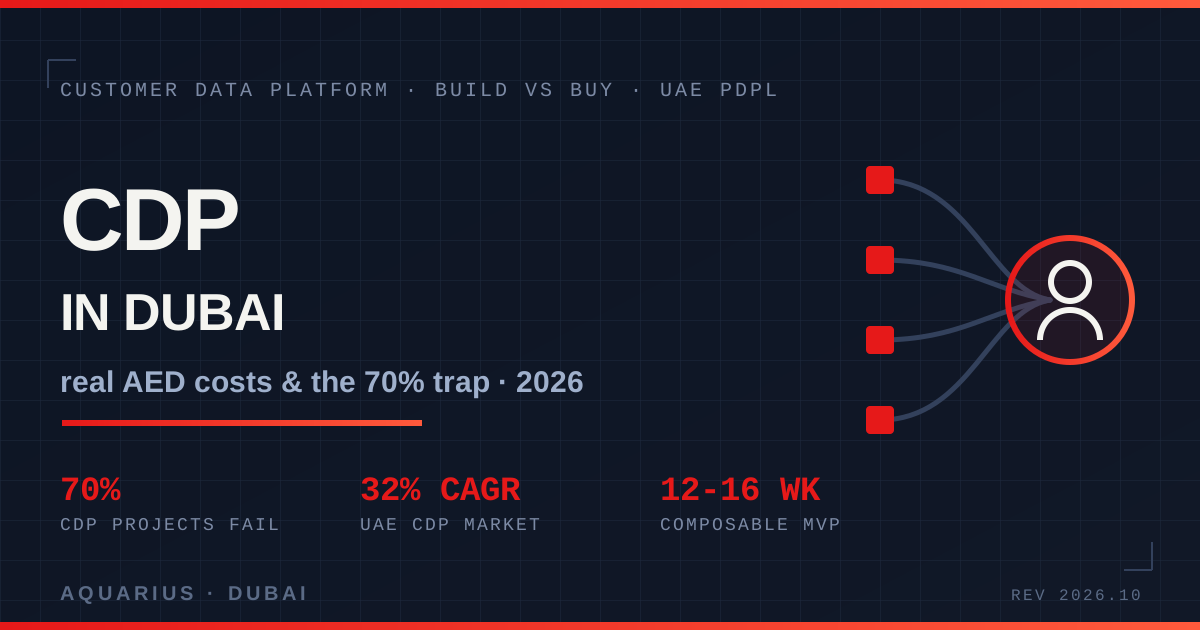
Short answer: a customer data platform in Dubai costs AED 440–5,000 a month in licence fees for an SME-scale packaged tool, or nothing in licence at all if you go composable on a warehouse you already pay for — the real money is the build, at AED 35,000–90,000 for a focused first version and AED 90,000–250,000 for a multi-brand or multi-country rollout. The uncomfortable part: industry reporting puts CDP project failure at around 70%, and only 22% of marketers report high use of the CDP they bought. Almost none of that is the software’s fault.
The Dubai numbers behind the 2026 rush
This is not a niche martech experiment any more. The UAE customer data platform market was valued at USD 81.16 million in 2025 and is estimated at USD 105.61 million in 2026 — roughly AED 388 million — on its way to USD 423.38 million by 2031 at a 32.01% CAGR. Cloud deployment already accounted for 72.84% of that UAE market in 2025, so the on-premise debate is effectively settled here.
The demand driver is retail scale. UAE e-commerce reached AED 42.2 billion in 2025 and is forecast to hit AED 67.2 billion by 2030 at a 9.9% CAGR, with online penetration moving from 15.7% of total retail in 2025 to above 20% by 2030. Dubai’s wholesale and retail trade sector alone produced AED 50.9 billion in real gross value added in Q1 2026, about 22% of the emirate’s GDP. When a fifth of your market’s economy runs through retail and a fifth of retail runs online, the business that knows which human is behind which order wins the repeat purchase.
Most Dubai businesses get this wrong in the same way: they buy a CDP to fix a data problem they have never actually written down. The tool arrives, the silos stay, and the licence renews anyway.
What a CDP is — and the three things Dubai teams keep confusing it with
A customer data platform ingests behavioural, transactional and profile data from every source you own, resolves it into one persistent identity per human, and pushes those segments out to the tools that act — email, WhatsApp, ads, your app.
- It is not a CRM. A CRM is where your sales team types. A CDP is where machine-generated events land. If your question is “who called this lead last,” you want a CRM — see our Dubai CRM cost comparison.
- It is not a data warehouse. A warehouse stores and models; it does not natively resolve identity or activate audiences. Costing one is a separate exercise — our data warehouse pricing guide for Dubai covers it.
- It is not analytics. GA4 tells you what happened in aggregate. A CDP tells you what to do to one named customer tomorrow morning.
Packaged vs composable: the split that defines 2026 pricing
Two architectures are now genuinely competitive, and they price completely differently.
Packaged means the vendor stores a copy of your customer data in their own cloud (Segment, Klaviyo, Bloomreach). Fast to start, priced per tracked user or per event, and it duplicates personal data into a third-party system — which is where your PDPL transfer assessment begins.
Composable or warehouse-native means the profiles stay in your own warehouse and only activation sits on top. The market is moving this way hard: warehouse-native vendors grew headcount 7.8% in H2 2025, close to six times the 1.3% industry average, and more than a quarter of CDPs now support a warehouse-centric architecture. A composable MVP — warehouse, ingestion pipelines, dbt modelling, first activation destinations — typically lands in 12–16 weeks, against 3–12 months for a traditional packaged rollout.
Licence cost in AED, 2026
| Platform | 2026 list price | AED equivalent | Pick it when |
|---|---|---|---|
| Segment (Team) | USD 120/mo for 10,000 MTUs; overage USD 10–12 per extra 1,000 | ~AED 440/mo; ~AED 37–44 per extra 1,000 MTU | Single D2C brand, under ~25k monthly tracked users |
| Segment (Business) | Custom quote, typically from 100,000 MTU; bundles identity resolution and Reverse ETL | Quote-only, six figures AED per year | You need vendor-side identity resolution and have the budget |
| RudderStack (Growth) | USD 265/mo for 1M events; USD 750 at 5M; USD 1,250 at 10M; USD 4,500 at 50M | ~AED 975 / 2,755 / 4,590 / 16,525 per month | Event-heavy app or marketplace; you want warehouse-first |
| Klaviyo (Advanced tier) | USD 120,000–600,000+ per year | ~AED 440,000–2.2m per year | Enterprise retail already deep in Klaviyo messaging |
| Composable on your own warehouse | No CDP licence; you pay warehouse compute plus a reverse-ETL tool | Warehouse spend you already carry | You have a warehouse and a PDPL residency constraint |
Note the shape of that table: the licence is rarely the decisive number. RudderStack at 10M events a month is AED 4,590 — less than one mid-level analyst salary for a month in Dubai. The cost that kills projects is the integration work nobody scoped.
Implementation cost in Dubai, 2026
| Scope | What you get | Typical AED | Timeline |
|---|---|---|---|
| Focused first version | 3–5 sources, identity resolution on email and phone, 2–3 activation destinations, consent flags wired through | AED 35,000–90,000 | 8–14 weeks |
| Multi-brand or multi-country | 8–15 sources, offline and POS data, Arabic and English messaging, per-market consent and suppression logic | AED 90,000–250,000 | 4–7 months |
| Enterprise programme | Group-wide identity graph, loyalty integration, data governance, in-country residency architecture | AED 250,000–600,000+ | 6–12 months |
| Ongoing run | Pipeline monitoring, new destinations, segment QA, schema change management | AED 6,000–20,000 per month | Retainer |
The PDPL question every Dubai CDP buyer has to answer
Federal Decree-Law No. 45 of 2021 is in force. Its Executive Regulations are still unpublished, which some operators read as permission to wait — a bad bet, because the Decree-Law itself provides for administrative fines reaching AED 5,000,000 per violation, and the consent and data-subject obligations already apply. Our UAE PDPL compliance checklist has the operational detail.
For a CDP, three things matter in practice:
- Consent has to travel with the record. If a visitor refuses marketing cookies, that refusal must suppress them in every downstream destination, not just in the banner. A CDP that stores consent as a tag rather than enforcing it as a rule is a liability.
- Residency narrows your vendor list. AWS runs a UAE region (me-central-1) and Azure runs two — UAE North in Dubai and UAE Central in Abu Dhabi. Google Cloud has no UAE region as of 2026; the nearest are Doha and Dammam. If your board has committed to in-country storage, that fact alone eliminates several packaged CDPs.
- Collection needs to survive the browser. Client-side pixels drop a material share of events before they ever reach a CDP, which is why server-side collection and a CDP are usually one project — see GA4 and server-side tracking costs in Dubai.
Does it pay back? The honest version
The upside is real and well documented. McKinsey puts the revenue lift from personalisation at 10–15%, with company results spanning 5–25% by sector and execution quality, and finds that faster-growing companies draw 40% more of their revenue from personalisation than slower-growing peers. Marketers using first-party data for core functions report up to 2.9x revenue uplift and 1.5x cost savings.
Now the cost of getting it wrong. Industry estimates put 30–50% of CDP projects as failing to deliver expected value in year one, with broader reporting putting failure near 70%; only 22% of marketers report high use of the CDP they bought, and more than a third of deployed CDPs deliver little or no value. On an AED 150,000 build plus AED 60,000 a year in licence, a stalled project burns past AED 200,000 before anyone admits it. The documented causes are not technical: no written use case, no data preparation, no cross-functional owner, and scope creep that turns a 12-week job into a two-year platform programme.
How we scope it at Aquarius
We start from the activation, not the architecture. You name the three campaigns you cannot run today — abandoned cart in Arabic within 40 minutes, high-value lookalike seeding for Meta, a win-back for lapsed loyalty members — and we build only the pipelines those three need. Composable first if you already have a warehouse, packaged if speed to first campaign matters more than licence cost. You get a fixed-scope first phase with a named go-live date, the AED number before we start, and the pipelines documented in your repo, not ours. If phase one does not move those three campaigns, you have not committed to phase two.
FAQ
Do I need a CDP if I only sell on Shopify?
Usually not yet. A single storefront with one email tool already has unified data. The case appears when you have two or more customer touchpoints that cannot see each other — store POS and website, an app and a web checkout, or a marketplace channel alongside your own store.
What is the cheapest real CDP setup for a Dubai SME?
A warehouse-native setup: data you already load into BigQuery, Snowflake or Postgres, plus a reverse-ETL tool, plus roughly AED 35,000–60,000 of integration work. No per-MTU licence, and your personal data never leaves infrastructure you control.
How long before a CDP produces revenue?
First activated segment in 8–14 weeks on a focused scope; measurable campaign lift usually one full purchase cycle after that. Anyone promising attributable revenue in month one is selling you a dashboard.
Does a CDP make us PDPL compliant?
No. It makes compliance enforceable — one place to honour a deletion request or a consent withdrawal across every tool. Compliance itself still needs the policy, the records and the transfer assessment.
Can a CDP handle Arabic and English customer records?
Yes, but identity resolution has to be configured for it. Arabic name variants, transliteration differences and UAE mobile formats (+971 with and without the leading zero) are the three matching rules that quietly break profile unification in this market.
Get a real number before you sign a licence
Send us your source list — website, app, POS, CRM, WhatsApp, marketplaces — your rough monthly active customers and the three campaigns you want to run. We come back with a costed scope in AED, packaged versus composable with the trade-off written out, and the PDPL residency implication of each. See our pricing or tell us what you are trying to fix, and we will tell you honestly if you do not need a CDP at all.