
Cyber Insurance in Dubai (2026): Real AED Premiums and the Application Form That Voids Your Claim
A Dubai SME pays AED 18,000-45,000 a year for AED 2-5m of cyber cover. Real 2026 premium bands, the five controls underwriters demand, and why non-admitted policies fail at claim time.
- PUBLISHED
- 24 OCT 2026
- READ TIME
- 12 MIN
- AUTHOR
- AQUARIUS · DUBAI
- UNIT
- REV 2026.09
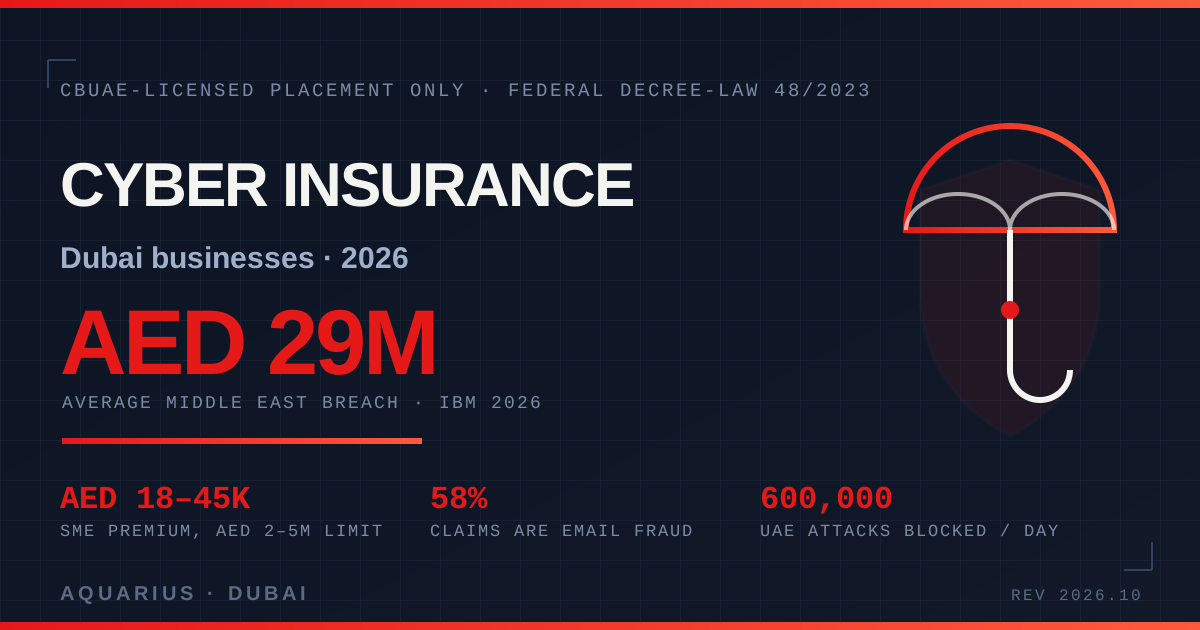
Short answer: cyber insurance for a Dubai SME costs roughly AED 18,000 to AED 45,000 a year for AED 2m to AED 5m of limit, and AED 4,000 to AED 9,000 for a micro business on an AED 1m limit. Rates have been softening for three years straight. The hard part is no longer the price — it is that the application form has quietly become a technical audit, and that under UAE law the policy must be placed with a CBUAE-licensed insurer or broker to be worth anything on the day you claim.
Most Dubai businesses that buy cyber cover buy it in the wrong order. They get a quote, tick the boxes on the proposal form in a hurry, pay the premium, and file the certificate. Then they find out what they actually signed up to on the day they need it: a ransomware sub-limit cut to a quarter of the policy, a social-engineering sub-limit of AED 250,000 against a AED 1.4m fraudulent transfer, or an MFA warranty nobody in the business can honestly say was true.
The numbers that moved underwriters, not marketers
Three figures set the stakes for any UAE business looking at this in 2026.
- The UAE cyber insurance market is worth about USD 70 million — roughly AED 257m — according to the UAE Cyber Security Council in May 2026. For an economy this size, that is a rounding error. IMARC separately values the 2025 UAE market at USD 83.7m and projects USD 350.2m by 2034 at a 17.2% CAGR. Either way: penetration is low and climbing fast.
- 80% of UAE institutions say cyber insurance is essential to their risk framework. Only about 30% of UAE SMEs actually hold a policy, though adoption reportedly rose 45% in the first half of 2026 against the same period a year earlier.
- The UAE Cyber Security Council reports blocking around 600,000 cyberattacks a day — roughly 416 a second — with a single 24-hour period in September 2026 exceeding 640,000. Across 2025–2026 authorities logged 15,642 financial cyber-fraud cases and recovered AED 140m.
Against that, the loss side. IBM’s 2026 Cost of a Data Breach study puts the Middle East average breach at USD 8.0m, about AED 29.4m — the second-highest region in the study. That is the number your AED 2m limit is standing in front of, which is the first uncomfortable thing to notice about how most Dubai SMEs buy this.
Most Dubai businesses get this backwards: they treat the policy as the control. In 2026 the policy is the receipt for controls you already built.
What a UAE cyber policy actually pays for
Cyber is two policies stapled together, and knowing which half you are buying changes what limit you need.
First-party — your own losses. Forensic investigation, incident response, data recovery and system rebuild, business interruption, ransomware extortion costs, breach notification and call-centre costs, crisis PR. This is where SMEs claim.
Third-party — liability to others. Privacy liability for leaked customer data, regulatory defence costs, PCI DSS card-scheme assessments (which can run past AED 1m per incident), and network-security liability if your systems become the launch pad for someone else’s loss.
What it never covers: physical hardware damage (that is property), employee theft (crime and fidelity), professional advice gone wrong (professional indemnity), and director liability (D&O). A cyber policy is narrow by design, and brokers who sell it as “covers everything digital” are the reason denial letters surprise people.
What cyber insurance costs in Dubai in 2026
Broker-indicated UAE market ranges for 2026 — annual premium, before negotiation and before any control-related loading:
| Profile | Typical limit | Annual premium (AED) |
|---|---|---|
| Micro business, under 10 staff, under AED 10m revenue | AED 1m | 4,000 – 9,000 |
| Small professional services firm | AED 1m | 8,000 – 18,000 |
| SME, 10 – 50 staff | AED 2m – 5m | 18,000 – 45,000 |
| Mid-market, 50 – 250 staff | AED 5m – 10m | 35,000 – 90,000 |
| E-commerce holding cardholder data | AED 10m | 60,000 – 180,000 |
| DFSA or FSRA regulated firm | AED 10m | 50,000 – 150,000 |
| Healthcare provider | AED 10m | 70,000 – 200,000 |
| Large enterprise, AED 500m+ revenue | AED 25m | 180,000 – 600,000 |
As a rule of thumb, a well-controlled Dubai SME pays roughly AED 8,000 to AED 15,000 per AED 1m of limit. Timing is also in your favour: global cyber rates fell 4% in Q3 2026 on Marsh’s index — the thirteenth consecutive quarterly decline. Howden Re forecasts primary cyber rate reductions of 5.4% in 2026, slowing from 8.2% in 2025 and 7.3% in 2024, while mid-2026 reinsurance renewals came in 10% to 40% down risk-adjusted. Capacity is plentiful, competition is real, and a clean risk has leverage at renewal it did not have in 2022.
The five controls that decide your price — or your declination
This is the part Dubai finance directors underestimate. Underwriters in 2026 condition or refuse cover on a small, boring, non-negotiable set of controls:
- MFA everywhere that matters — corporate email, VPN and remote access, cloud admin consoles, privileged accounts. Partial MFA is no longer accepted; full coverage is frequently a condition of binding at all.
- EDR or XDR on roughly 95%+ of endpoints, monitored. Legacy signature antivirus reads as no EDR and can be an outright decline.
- Immutable or offline backups with a dated restore test — daily backups, 30 days retention minimum, and evidence you actually restored something recently.
- Patching and access hygiene — critical vulnerabilities inside 30 days, no end-of-life operating systems, no RDP exposed to the internet.
- An incident response plan exercised in the last 12 months, plus security awareness training for staff.
Miss them and the quote does not just get worse, it changes shape. Brokers report 50% to 200% premium loadings where controls are weak, plus two structural penalties: ransomware sub-limits cut to 25% to 50% of the policy limit where immutable backups cannot be evidenced, and cyber-crime or funds-transfer-fraud sub-limits set at AED 250,000 to AED 2m rather than the full limit. Business interruption typically only starts paying after an 8 to 12 hour waiting period, so a six-hour outage is on you regardless. No MFA on email, VPN or admin accounts, open RDP, or no EDR are the three answers that trigger an automatic decline rather than a loading.
Which is the real reason to read this as an engineering brief rather than a procurement one. Every item on that list is a project: identity and MFA rollout, backup and recovery you have actually tested, monitoring that someone watches, and an annual penetration test to prove the rest is true.
The claim you will actually make is an email, not a ransomware headline
Coalition’s 2026 Cyber Claims Report, covering more than 100,000 policyholders across calendar 2025, is the clearest picture of what insured businesses really lose money to:
- Business email compromise and funds transfer fraud together are 58% of all claims. BEC alone is 31% of claims at an average loss of USD 27,000. FTF is 27% at an average loss of USD 141,000 — and 52% of those frauds began in a compromised mailbox, with 71% involving social engineering.
- Claims frequency rose 3% while average severity fell 19% to USD 116,000. The overall claims rate was 1.54% of policyholders — roughly 1 in 65 businesses claimed in the year.
- Initial ransom demands jumped 47% to over USD 1m on average, yet 86% of victims refused to pay, and where payment happened, negotiation cut it by an average of 65%. 70% of ransomware incidents involved both encryption and data theft.
- 64% of closed claims left the policyholder with zero out-of-pocket loss, and insurers clawed back USD 21.8m of stolen funds, averaging USD 202,000 per recovery.
Read that list twice if you run a Dubai trading, contracting or logistics business paying overseas suppliers in USD. Your realistic loss event is not an encrypted server farm. It is an accounts clerk paying a genuine-looking revised-bank-details email at 4pm on a Thursday. The control that stops it is dull: out-of-band verbal verification of any change to payment details, plus MFA on mail. The second one is the one nobody has finished.
Three ways a paid Dubai premium still fails
1. The policy was never a valid UAE placement
The UAE prohibits non-admitted insurance. Risks, assets and liabilities situated in the UAE must be insured with a CBUAE-licensed insurer, placed through a CBUAE-licensed broker. Federal Decree-Law No. 48 of 2023 consolidated insurance supervision under the Central Bank and tightened broker licensing; the only carve-out is where the cover genuinely is not available in the UAE market, and then only under controls set by the CBUAE Board. Unlicensed insurance activity now carries administrative fines reported up to AED 500m plus potential criminal exposure. A cyber policy bought online in forty seconds from a foreign carrier is not a UAE placement, and a claim is a bad place to discover that.
There is a practical consequence too: local capacity is capped. Domestic insurers such as Sukoon, Orient and AXA commonly top out near AED 5m of limit. Above that, placements are fronted or syndicated into international markets — Beazley, AIG, Chubb, Tokio Marine, Liberty Specialty, Coalition, CFC — through a licensed local broker.
2. The proposal form was a warranty, and it was wrong
When you confirm MFA on all remote access and it turns out two legacy service accounts were exempted, you have not made a clerical error. You have misdescribed the risk. That is the most common route from paid premium to denied claim anywhere in the world, and it is entirely preventable: answer the form from evidence, not from memory, and keep the evidence pack filed with the policy.
3. The exclusions you did not read
Since 31 March 2023, Lloyd’s Market Bulletin Y5381 has required every standalone cyber policy written in the Lloyd’s market to carry a state-backed cyber attack exclusion — the LMA5567-series clauses. The current drafting turns on impact thresholds and an “impacted state” definition rather than clean attribution: loss arising from war, and from state-backed operations that materially impair a state’s essential services or security capabilities, is out. Given the UAE’s threat profile, which includes state-aligned and increasingly AI-enabled activity, that is not a theoretical carve-out. Ask your broker which clause variant is attached and how attribution is determined before you bind.
Second trap: sanctions screening. OFAC and UN screening is mandatory before any ransom payment. Pay a sanctioned actor and the coverage goes with it — a large part of why the ransom decision is taken jointly with the insurer, counsel and forensics rather than by your IT manager at 2am.
Buying it properly, in the right order
The sequence that gets a Dubai business the cheapest real cover:
- Fix the five controls first. Six to eight weeks of focused work moves you out of the loaded-or-declined bucket before anyone quotes you.
- Build the evidence pack — MFA coverage report, EDR deployment percentage, last restore-test date, patch SLA, IR plan with exercise date. This is what lets a proposal form be answered truthfully in an afternoon.
- Size the limit against the loss, not the budget. If AED 29.4m is the regional average breach cost and your limit is AED 2m, say out loud what you are insuring: the response costs, not the catastrophe.
- Check the sub-limits, not the headline limit. Funds-transfer-fraud sub-limit, ransomware sub-limit, BI waiting period. For most Dubai SMEs the FTF sub-limit matters more than the top line.
- Place it through a CBUAE-licensed broker and get the licence number on file.
The economics are not subtle. A well-controlled SME pays AED 18,000 to AED 45,000 a year for AED 2m to 5m of limit against a regional average breach of AED 29.4m, with a 1.54% annual probability of claiming and a 64% chance of zero out-of-pocket cost if you do. The expensive version is the one where you pay the premium and still fund the incident yourself, because a control you warranted was not actually in place.
How Aquarius fits
We are not insurance brokers and we do not sell policies. We build the side of this that underwriters actually price: MFA and single sign-on across your stack, passwordless login where passwords are the weak point, logging and alerting, tested backup and restore paths, out-of-band payment-change verification built into your finance workflow, and the PDPL documentation the same form asks about. You take the evidence pack to your broker. A readiness engagement typically sits in the AED 25,000 to AED 90,000 range depending on how much identity and backup work is outstanding — see pricing for how we scope it.
FAQ
Is cyber insurance mandatory in the UAE?
No. There is no UAE mandate to hold cyber insurance. What is mandatory is that any policy covering UAE risks is placed with a CBUAE-licensed insurer through a licensed broker — non-admitted insurance is prohibited. Separately, DFSA and FSRA regulated firms face incident reporting obligations in the 24 to 72 hour range, and PDPL expects breach notification to the UAE Data Office within 72 hours.
Will my policy cover a PDPL fine?
Regulatory defence costs are commonly covered; fines usually are not, and in the UAE the question is partly academic. The PDPL has been in force since 2 January 2022, but as of October 2026 the Executive Regulations and the penalty schedule still have not been published, so there is no official fine table to insure against. Treat PDPL exposure as response and defence cost today, not a quantified fine.
How much limit does a Dubai SME actually need?
The market baseline is USD 1m, about AED 3.7m. Size up from your own numbers instead: your largest realistic supplier payment (that is your funds-transfer-fraud exposure), your daily gross profit times a realistic 5 to 10 day outage (business interruption), and the number of customer records you hold (notification and liability).
Does a penetration test lower my premium?
Not as a discount line, but it answers several proposal-form questions at once and it removes the findings that cause loadings. A recent test plus a remediated-findings list is one of the stronger things a Dubai SME can put in front of an underwriter.
We are a startup with no revenue yet. Too early?
If you hold customer data or move money, no. Micro-business cover at AED 1m runs AED 4,000 to AED 9,000 a year, less than many Dubai startups spend on software licences in a month. Just do the controls first, or you will be quoted in the loaded band from day one.
Not sure whether your current stack would survive an underwriter’s questionnaire — or a claim? Send us the proposal form and we will tell you which answers are currently untrue, and what it takes to fix them.