
Passkeys and WebAuthn in Dubai (2026): Shipping Passwordless Login, Killing SMS OTP Costs and Stopping Account Takeover
The CBUAE killed SMS OTP for banking on 31 March 2026 and 36% of global sign-ins are now passkeys. Real AED build costs, WebAuthn architecture and the fallback rules for UAE apps.
- PUBLISHED
- 20 OCT 2026
- READ TIME
- 12 MIN
- AUTHOR
- AQUARIUS · DUBAI
- UNIT
- REV 2026.09
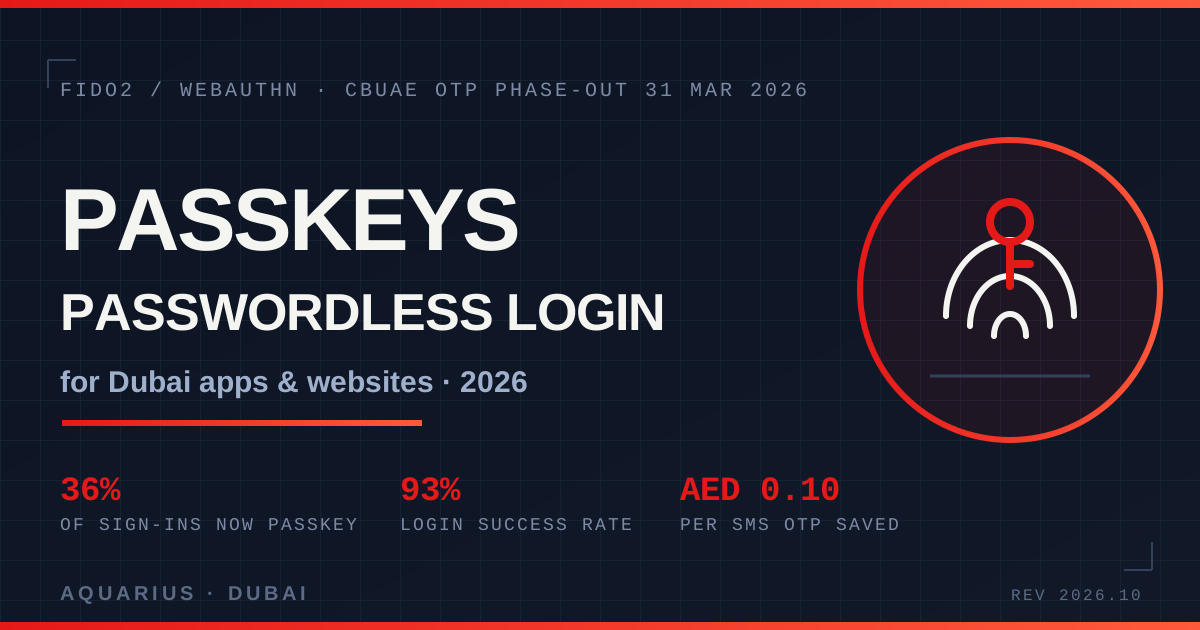
A passkey is a cryptographic key pair stored on your customer's phone or laptop, unlocked by Face ID, fingerprint or device PIN, with the private half never leaving the device. Because nothing shareable is ever typed or transmitted, a passkey cannot be phished, SIM-swapped or intercepted the way an SMS OTP can. For a Dubai business in 2026 the decision is no longer experimental: the Central Bank of the UAE forced SMS and email OTP out of banking by 31 March 2026, and more than one in three successful sign-ins worldwide (36%) now runs on a passkey.
The three numbers that should move this up your roadmap
First, adoption stopped being a pilot. The FIDO Alliance's 2026 State of Passkeys reporting puts roughly 5 billion passkeys in active use, with 90% consumer awareness, 75% of people having enabled a passkey on at least one account, and the passkey share of successful sign-ins rising from 26% in 2025 to 36% in 2026. About 48% of the world's top 100 websites now support them, more than double the 2022 figure, and 68% of organisations have deployed, piloted or begun rolling out passkeys for staff sign-in.
Second, the UAE threat picture is a credential problem, not a malware problem. The UAE Cybersecurity Council reports that more than 75% of breaches in the country start with a phishing email or fraudulent message. Abu Dhabi's Emergency, Crisis and Disaster Management Centre recorded a 32% rise in phishing incidents in Q1 2026 alone. A CyberArk study found 92% of UAE organisations suffered at least three successful identity-related breaches in the twelve months to April 2026, against an EMEA average of 80%. On the banking side, a BioCatch survey of 100 Emirati banking executives published in April 2026 found 66% reporting more fraud attempts, 58% reporting higher losses, and 62% estimating annual fraud losses above USD 5 million.
Third, the regulator already moved. CBUAE directed licensed financial institutions to phase out SMS and email OTP, with customer-facing changes starting 25 July 2025 and full compliance required by 31 March 2026. The accepted replacements named in the directive are exactly the phishing-resistant set: Emirates Face Recognition, FIDO2-based passkeys, cryptographic soft tokens with in-app approval, and UAE Pass. If you run a non-bank business in Dubai, you are not directly bound by that circular, but your customers have now been trained by their banks to expect biometric approval and to treat an SMS code as the weak option.
Why the UAE is an unusually good market for passkeys
Most passkey rollouts fail on device coverage. The UAE does not have that problem: internet penetration sits at 99.0% with 11.3 million users, there are 23.0 million mobile connections against a population of roughly 11.4 million, and 96% of UAE internet users reach the web from a phone.
Device readiness is the single biggest predictor of whether a passkey rollout converts, and the UAE is close to the ceiling. Android holds 81.06% of UAE mobile OS share and iOS 18.8% — both platforms have shipped synced passkeys through Google Password Manager and iCloud Keychain for years, which means the credential survives a lost handset. Add near-universal biometric hardware and the country ends up with a higher realistic passkey ceiling than most European markets.
The thing most Dubai businesses get wrong is the framing. They treat passwordless as a security project and park it behind the roadmap. It is a conversion and cost project that happens to also remove your largest fraud vector.
What a passkey actually replaces, and what it does not
A passkey replaces the password and the second factor in one step, because possession of the device plus a local biometric already satisfies two-factor requirements. It does not replace identity verification. Knowing that the person holds the key says nothing about whether they are the Emirates ID holder they claimed to be at sign-up. That is a separate layer, and in the UAE it is usually UAE Pass integration or a KYC provider doing document and liveness checks.
| Method | Phishing-resistant | Per-login cost | Typical UAE use in 2026 |
|---|---|---|---|
| Password only | No | AED 0 | Legacy accounts; the breach entry point in most incidents |
| SMS OTP | No (SIM swap, phishing proxy) | AED 0.05 – 0.18 | Banned in UAE banking since 31 Mar 2026; still common in retail apps |
| Email OTP | No | Near AED 0 | Also banned in banking; mailbox takeover makes it circular |
| Authenticator app (TOTP) | Partially | AED 0 | Decent interim step; still typed, so still proxy-phishable |
| In-app push approval | Partially | Near AED 0 | CBUAE-accepted; vulnerable to approval fatigue without number matching |
| Passkey (FIDO2 / WebAuthn) | Yes, by design | AED 0 | The target state; origin-bound so a fake domain cannot use it |
| UAE Pass | Yes | Per integration | Government-adjacent and regulated flows needing federal identity assurance |
The origin-binding point is worth repeating because it is the whole security argument. A passkey created for yourstore.ae physically will not produce a signature for yourstore-login.co. Every phishing kit on the market works by convincing a human to type a secret into the wrong box. There is no box.
The architecture, in the order you build it
- Keep the account, change the key. Do not build a parallel user table. A passkey is one more credential attached to an existing account record: credential ID, public key, signature counter, AAGUID, and a human label such as "Deepak's iPhone".
- Register after a trusted moment. The highest-converting prompt is immediately after a successful login or a completed order, not on the sign-up form. Asking a first-time visitor to create a passkey before they trust you is how rollouts stall at 4% adoption.
- Use conditional UI for sign-in. WebAuthn's autofill-style prompt surfaces the passkey in the username field itself, so the returning customer taps once. This is the difference between a feature nobody finds and the default path.
- Allow multiple passkeys per account. Phone, laptop, and ideally a hardware key for admin roles. One credential per account creates a lockout the moment a device dies.
- Design the recovery path first. Account recovery is where passwordless systems actually get breached, because teams bolt an SMS code onto the back of a phishing-resistant front door and recreate the hole they just closed. Recovery should use a second registered passkey, verified identity re-check, or a supervised flow — not a code sent to a number an attacker can port.
- Instrument everything. Registration prompt impressions, accept rate, passkey login share, fallback rate, and support tickets per thousand logins. Without those five you cannot prove the saving.
Arabic and RTL deserve a line of their own: the browser renders the passkey dialog in the device language, so your consent copy, error states and recovery instructions need Arabic versions that match. A half-translated recovery screen is a support call in any market, and an abandoned checkout in this one.
The money: what you save and what it costs in AED
Start with the line item that disappears. A2P SMS to a UAE number runs AED 0.05 to 0.18 per message depending on route and volume, with Etisalat and du direct pricing at AED 0.08 to 0.12, plus a one-time TDRA sender ID approval of AED 1,500 to 3,000 and monthly maintenance of AED 500 to 1,500 per ID. Those figures are broken down route by route in our guide to SMS, OTP and WhatsApp messaging costs in Dubai.
Run the arithmetic on a mid-sized UAE app. At 100,000 OTP messages a month and AED 0.10 per message, that is AED 10,000 monthly, AED 120,000 a year, before retries, before failed-delivery re-sends, and before the sender ID maintenance. Shift 60% of logins to passkeys and roughly AED 72,000 a year stops leaving the business — permanently, because a passkey authentication has no marginal cost at all.
Then the performance side, which is the larger number for most retailers. Passkeys show roughly a 93% login success rate against 63% for traditional methods. Google's research measured sign-in at 14.9 seconds with a passkey versus 30.4 seconds with a password. eBay reported passkey sign-in latency down 80% compared with password-plus-SMS-OTP. Amazon has 175 million passkey-enabled customers and describes the experience as six times faster. Organisations deploying passkeys report 81% fewer sign-in-related help desk calls.
| Workstream | AED range | Timeline | What you get |
|---|---|---|---|
| Passwordless readiness audit | 6,000 – 15,000 | 3 – 5 days | Device and browser coverage, login funnel baseline, OTP spend, fallback and recovery plan |
| WebAuthn on an existing web app | 25,000 – 65,000 | 3 – 5 weeks | Registration and sign-in ceremonies, conditional UI, credential management screen, audit log |
| Native iOS and Android passkeys | 35,000 – 90,000 | 4 – 8 weeks | Associated domains, app-site association files, biometric prompts, cross-device sign-in |
| Managed IdP route (Auth0, Okta, Firebase, Keycloak) | 18,000 – 45,000 build | 2 – 4 weeks | Faster delivery, vendor MAU fees ongoing; sensible for under roughly 50,000 users |
| Recovery and step-up authentication design | 12,000 – 35,000 | 1 – 3 weeks | Risk-based step-up, device-loss flow, admin override with full audit trail |
| UAE Pass or Emirates ID verification layer | 20,000 – 60,000 | 3 – 6 weeks | Federal identity assurance where the use case needs a verified person, not just a verified device |
For most Dubai SMEs the honest starting point is the managed IdP route plus a proper recovery design: roughly AED 30,000 to 80,000 all-in, four to six weeks, against an SMS line that was already costing six figures a year.
What goes wrong, and the cost of waiting
Three failure patterns show up repeatedly. The first is fallback that eats the benefit: leaving "send me a code instead" as a visible button on the login screen means most users take it and your OTP bill never drops. Make the passkey the default path and the fallback a deliberate second click. The second is no recovery plan, which converts a lost phone into a lost customer. The third is treating it as a security ticket rather than a funnel change, so nobody measures login completion before and after and the project cannot defend itself at the next budget review.
The cost of inaction is documented in the UAE specifically. The Global Anti-Scam Alliance recorded more than 40,000 fraud victims in the UAE losing an average of USD 2,194 each, roughly USD 87 million in total, in a single year — losses concentrated in exactly the OTP-interception, SIM-swap and social-engineering patterns that a passkey makes structurally impossible. For e-commerce operators there is a second bill behind that one: fraudulent logins become fraudulent orders, and fraudulent orders become chargebacks, which we cover in chargeback and fraud prevention for Dubai e-commerce.
How Aquarius ships it
We start with the audit, because the business case is usually already sitting in two numbers nobody has put side by side: your monthly OTP spend and your login completion rate. Then we ship passkeys onto the account system you already have — no migration, no forced re-registration — with conditional UI so returning customers see one tap, a credential management screen so they can see and revoke their own devices, and a recovery flow designed before the happy path rather than after it. Fallback stays available for the long tail of old devices, but it is deliberately the second option, which is what actually moves the SMS line down. Arabic and English copy ship together.
Risk reversal: the audit is fixed-fee and the deliverable is yours regardless — coverage data, a costed rollout plan and the 90-day measurement framework. Build ranges are published on our pricing page, and if your flow needs verified identity as well as a verified device, we scope the UAE Pass layer in the same engagement.
FAQ
Does the CBUAE OTP ban apply to my Dubai e-commerce store?
No. The directive binds licensed financial institutions, not retailers. But your customers now bank with institutions that moved to biometrics and passkeys by 31 March 2026, so an SMS code on your checkout reads as dated, and it still carries the SIM-swap and phishing risk the regulator moved to eliminate.
What happens when a customer loses their phone?
On both major platforms the passkey is synced through the user's Google or Apple account, so a replacement device restores it at sign-in — this is the most common misconception, that passkeys die with hardware. For the genuine edge cases, register a second passkey on a laptop at onboarding and design a verified recovery flow. Never fall back to an SMS code for recovery; that reopens the exact hole you closed.
Can I keep passwords during the transition?
Yes, and you should at first. Run both, make the passkey the default, and track the share of logins using it. Only remove the password once that share is high enough and your recovery flow has been tested under real support load. Most UAE rollouts we see reach a usable share within one quarter.
Do passkeys work with Arabic interfaces and older Android devices?
The system dialog follows the device language, so Arabic is handled by the OS. Device support is effectively universal on Android 9+ and iOS 16+, which with 23.0 million UAE mobile connections and 96% mobile-first internet use leaves a very small tail. That tail is what your fallback is for.
How long until we see the saving?
Measure at 90 days. Reported benchmarks cluster at a 20 to 30% reduction in account-step abandonment and a 40 to 60% reduction in login-related support tickets inside the first three months, with the SMS line falling in direct proportion to the passkey share of logins.
The UAE's regulator has already decided that typed codes are not good enough. Your customers learned it from their banking app in March 2026. Every SMS OTP your Dubai product still sends is a cost line, a conversion leak and a phishing surface you are choosing to keep. Book a passwordless readiness audit and we will put your OTP spend and login completion rate on one page before we change a line of code.