
Auto Spare Parts Ecommerce in Dubai (2026): Real AED Build Costs, Fitment Data and the Returns Trap
Online auto parts returns run 20-35% and fitment errors cause most of them. Real AED costs to build a spare parts ecommerce store in Dubai in 2026, plus ECAS, fitment data and the counterfeit crackdown.
- PUBLISHED
- 05 OCT 2026
- READ TIME
- 12 MIN
- AUTHOR
- AQUARIUS · DUBAI
- UNIT
- REV 2026.09
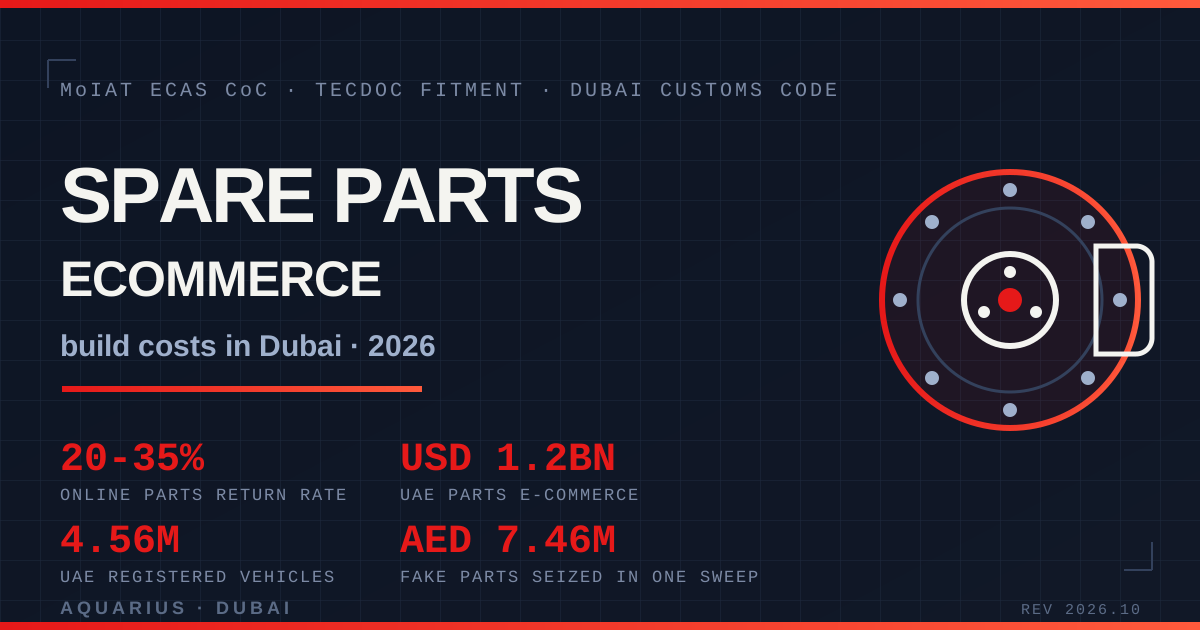
Short answer: a catalogue-led auto spare parts store for a Dubai trader costs AED 45,000-85,000 for a single-warehouse launch, AED 95,000-180,000 for a full multi-brand build with VIN and year-make-model fitment, Arabic, COD and BNPL, and AED 180,000-350,000 once you add a B2B workshop portal with credit limits and re-export quoting. The line item that decides whether the store makes money is not the theme or the payment gateway. It is fitment data, because online auto parts carry a 20-35% return rate - the worst in retail - and fitment errors cause close to half of those returns.
That is the whole article in one paragraph. Dubai is the GCC's parts counter, the stock is already in the warehouse, and the opportunity is real. But a parts store is not a fashion store with pistons instead of shirts: get the vehicle-to-part mapping wrong and every third order comes back at your cost. Below are the real UAE numbers, the compliance layer nobody quotes upfront, and what each module costs in dirhams.
Why Dubai parts traders are moving online now (awareness)
Three hard numbers set the stakes.
The car park is growing faster than almost anywhere on earth. Active registered vehicles in the UAE reached 4.56 million by June 2025, up from 4.17 million in June 2024 - a 9.35% year-on-year rise that added roughly 390,000 vehicles to the roads in twelve months. The RTA puts 3.5 million vehicles on Dubai's roads during daytime hours, and Dubai's registered-vehicle count has grown about 10% over two years against a global average of 2-4%. Average vehicle age on UAE roads sits near 5.2 years, which is young - so the demand skews toward service parts, consumables and accessories rather than heavy repair.
The aftermarket is big and the online slice is still being carved. The UAE automotive aftermarket was worth about USD 7.3 billion in 2024 and is forecast to reach roughly USD 10.5 billion by 2033 on a 3.8% CAGR. Inside that, the UAE automotive spare parts e-commerce market is valued at about USD 1.2 billion across the 2025-2030 outlook - with more than 200 active online retailers already competing and mobile projected to carry around 60% of sales. Average annual vehicle maintenance spend of roughly AED 1,500 per car is what funds all of it.
The buyers are already online. UAE ecommerce reached USD 12.3 billion (about AED 45.1 billion) in 2026 and is forecast to hit USD 21.01 billion by 2031, served by more than 11 million online shoppers. And Dubai's trade position compounds it: Dubai Customs has listed automotive spare parts among the top five re-exported goods out of Jebel Ali, which means a Dubai store is never only selling to Dubai - Saudi Arabia, Oman, Kuwait and East Africa are a shipping label away.
Most Dubai parts traders get this wrong: they treat the website as a catalogue upload. A parts catalogue is not a product list - it is a relationship table between vehicles and articles, with OE numbers, cross-references and supersessions. Skip that and you have built a search box that returns the wrong brake pad with total confidence. One study of automotive ecommerce attributed 86% of product returns to inaccurate fitment information, and retailers who deploy proper fitment tools report return rates dropping around 30%, with 20-40% fewer fitment-related returns after adding year-make-model filtering.
What a Dubai parts store actually has to do (consideration)
Strip the marketing away and a working spare parts ecommerce platform is six systems wearing one login.
- Vehicle and fitment engine. Year-make-model-engine selection, VIN decode, and a part-to-vehicle applicability table. This is the product. Everything else is plumbing.
- Catalogue and cross-reference core. OE part numbers, aftermarket equivalents, supersessions, brand tiers (genuine, OEM-supplier, aftermarket), and the dimensional or technical criteria that distinguish two parts with the same name.
- Inventory and multi-location stock. Deira shop, Al Quoz warehouse, supplier drop-ship and inbound container ETAs, shown as honest availability rather than a green tick that lies.
- Pricing layers. Retail, workshop, trade and export price lists on the same SKU, plus quantity breaks - the same problem a B2B wholesale portal solves, bolted to a retail front end.
- Checkout for this market. Card, COD, and BNPL. Cash on delivery is still offered by 71.2% of UAE retailers even though COD volumes have fallen about 37% over four years, and over 40% of UAE consumers now use Tabby or Tamara. Parts baskets above AED 500 convert measurably better with instalments available.
- Returns and warranty workflow. RMA numbers, core returns on exchange items like starters and alternators, photo evidence, and a credit note path that reconciles to accounting. Build this on day one, not after the first hundred returns.
The UAE compliance layer nobody quotes upfront
This is where Dubai parts projects overrun, and none of it ships in an imported ecommerce theme.
- ECAS conformity on safety-critical parts. The Emirates Conformity Assessment Scheme is run by the Ministry of Industry and Advanced Technology (MoIAT) - the scheme older documents still call ESMA - and motor vehicle spare parts are inside the regulated product scope. Safety-critical items such as brake systems, brake pads, tyres and batteries need a valid Certificate of Conformity before they are legally imported, manufactured or sold in the UAE. Practically, that means your product record needs a certificate field, an expiry date and a document attachment, so a listing cannot go live uncertified.
- The counterfeit crackdown is active and expensive. Dubai Customs reported seizing 10.8 million counterfeit items across 54 operations in 2024, and a single coordinated sweep took more than 2.5 million fake auto spare parts worth close to AED 7.46 million. Shops caught selling fakes face fines from a minimum of AED 5,000 up to 50% of the value of the counterfeit stock, with repeat or high-volume offenders assessed in the AED 15,000-30,000 band, under Federal Decree-Law No. 42 of 2023 on Combating Commercial Fraud. Dubai Police's economic crimes unit has logged 1,297 cases and AED 8.7 billion in counterfeit goods since 2019. A store that cannot evidence supplier provenance per SKU is carrying that risk in public, indexed by Google.
- Licence and customs plumbing. A Dubai mainland auto spare parts trading licence runs roughly AED 18,000-35,000 all-in (commonly quoted near AED 24,000), against free zone options from about AED 12,500 in Meydan or AED 19,500 in Dubai CommerCity with issuance in 5-10 working days. You will also need an Ejari-registered shop or warehouse and a customs code before your first container clears.
- Cross-border duty thresholds. If you sell into the UAE from abroad or ship parts out, the AED 1,000 duty exemption rules change your landed-cost maths per order - we unpack it in the Dubai Customs AED 1,000 exemption guide.
- VAT and e-invoicing. 5% VAT with a compliant tax invoice per order, plus a data model that survives the UAE's phased e-invoicing rollout. Retrofitting invoice structure into a live parts store is the most avoidable rework in this category.
- Arabic, properly. Not a translated menu - RTL layout, Arabic part-name synonyms, and Arabic search that still matches a Latin OE number typed mid-sentence.
The fitment data decision that sets your budget
You have three ways to get vehicle-to-part data, and they price very differently.
Licence it. TecAlliance's TecDoc is the aftermarket standard and is licensed directly from the owner, typically as a percentage of shop turnover against an annual minimum, with the final figure driven by article groups, vehicle types, languages and refresh frequency. Entry-level catalogue seats for lookup-only use are advertised around USD 200-300 per year, but a store-grade data feed is a commercial negotiation, not a shelf price. Build the ingestion layer so the data source is swappable - that single architectural decision is worth more than any discount you negotiate.
Inherit it. Many brands and regional distributors will hand you their own applicability files. Free, narrower, and inconsistent across suppliers - which means the real work is normalisation.
Build your own. Viable if you are deep in one or two makes. You map your top SKUs to vehicles from supplier catalogues and your own counter history. Cheap to start, expensive to maintain, and it quietly becomes the most valuable asset in the business.
What it costs to build in Dubai (decision)
Real AED ranges for a parts store built properly, assuming a modern headless stack rather than a plugin pile. Scope drives the band more than anything else.
| Scope | What you get | AED | Timeline |
|---|---|---|---|
| Catalogue-led launch | Year-make-model selector, up to ~5,000 SKUs, one warehouse, card + COD, VAT invoices | 45,000 - 85,000 | 5 - 8 weeks |
| Full multi-brand store | VIN decode, cross-references and supersessions, multi-location stock, BNPL, Arabic RTL, RMA workflow | 95,000 - 180,000 | 10 - 16 weeks |
| Retail + B2B workshop portal | Trade price tiers, credit limits and statements, quote-to-order, re-export quoting, workshop accounts | 180,000 - 350,000 | 16 - 24 weeks |
| Fitment data ingestion | Feed pipeline, normalisation, SKU-to-vehicle mapping, supersession handling (excludes third-party data licence) | 25,000 - 60,000 | 3 - 5 weeks |
| Arabic localisation | RTL layout, Arabic part synonyms, bilingual search and invoices | 12,000 - 30,000 | 2 - 4 weeks |
| ERP / POS integration | Live stock and pricing sync with your existing counter system | 20,000 - 65,000 | 3 - 6 weeks |
| Care plan | Hosting, catalogue updates, monitoring, conversion work | 3,500 - 12,000 / month | ongoing |
Note what is missing from that table: the data licence and the logistics. Both are yours, both are recurring, and parts logistics in this market is quietly inflationary - industry analysis of the UAE parts ecommerce segment flags logistics costs rising by as much as 15%. Model delivery as a line item per order, not a rounding error. Our last-mile and COD integration guide has the current Dubai courier numbers.
The conversion number that justifies the whole build
Here is the cost-of-inaction maths, and it is the most persuasive number in this article. Take a store doing AED 400,000 a month in parts orders at an industry-typical 28% return rate. That is AED 112,000 a month of reversed revenue, plus reverse logistics, restocking labour and the shelf life lost on a part that came back scuffed. Cut fitment-driven returns by the reported 30% and you recover roughly AED 33,600 of monthly revenue - about AED 403,000 a year. A fitment engine costing AED 60,000 to build pays for itself in under two months. No other feature in a parts store has that return profile.
How Aquarius builds it
We start with your data, not your design. Week one is a catalogue audit: how many SKUs, what OE references exist, which categories are ECAS-regulated, what your counter staff actually get asked for. That audit decides the architecture - and it is the reason our parts builds do not need rescuing at month six.
From there: a headless storefront on Next.js for speed and search visibility, a swappable fitment ingestion layer, ECAS certificate fields enforced at the product level, Arabic and English as equals, and checkout wired for card, COD and BNPL. If you also run workshops, we connect the store to garage and workshop management so a job card can pull parts without a phone call. Fixed scope, fixed price, source code and domain handed to you - see pricing, or read the broader Dubai ecommerce build cost breakdown for context on where parts stores sit against general retail.
FAQ
How much does an auto spare parts website cost in Dubai?
Between AED 45,000 and 85,000 for a catalogue-led launch with year-make-model lookup and one warehouse, AED 95,000-180,000 for a full multi-brand store with VIN decode, Arabic and BNPL, and AED 180,000-350,000 with a B2B workshop portal. Third-party fitment data licensing and logistics are separate recurring costs.
Do I need ECAS certification to sell car parts online in the UAE?
Yes for regulated items. Motor vehicle spare parts fall inside the MoIAT-run ECAS scope, and safety-critical products such as brake systems, brake pads, tyres and batteries require a valid Certificate of Conformity before being imported, manufactured or sold. Build the certificate reference and expiry into the product record so uncertified stock cannot be published.
Is TecDoc data mandatory for a parts store?
No, but some structured fitment source is. TecDoc is the aftermarket standard and is licensed from TecAlliance, usually as a percentage of turnover against an annual minimum. Smaller traders often start with supplier applicability files or their own mapping for top SKUs - the important thing is building the ingestion layer so you can upgrade the data source without rebuilding the store.
Why are auto parts returns so high online?
Fitment. Online auto parts return rates run 20-35%, the highest in retail, and inaccurate fitment information is the dominant cause - one analysis put it at 86% of returns. Year-make-model filtering and VIN decode are the two interventions with measurable impact, reported at roughly a 30% drop in overall returns and 20-40% fewer fitment-related ones.
Should I sell on Noon and Amazon.ae instead of building a store?
Do both, but understand the trade. Marketplaces give you traffic and take margin plus the customer relationship; your own store keeps both and compounds into SEO equity. Parts is a category where fitment accuracy is a genuine differentiator, which is hard to express inside a marketplace listing template. We compare the economics in selling on Noon and Amazon versus your own store.
Can one store serve Dubai retail and GCC re-export?
Yes, and in Dubai that is the point - spare parts are among the emirate's top re-exported goods through Jebel Ali. It needs separate price lists, per-destination landed-cost logic, duty thresholds, and documentation generated at checkout rather than by email afterwards. Design it in from the start; retrofitting export flows into a retail-only store is close to a rebuild.
The one-line version
Dubai has 4.56 million registered vehicles in the national fleet, a USD 1.2 billion parts ecommerce market, over 200 competitors already online, and a category-wide 20-35% return rate waiting to eat your margin. The store that wins is the one whose search returns the correct part the first time. Everything else is decoration.
Want the fitment-first version costed against your actual SKU list? Send us your catalogue and we will come back with a scope, a timeline and a fixed price - no obligation, and you keep the audit either way.