
AI Browsers and Agent-Ready Websites in Dubai (2026): The Second Audience Your Site Keeps Blocking
Agent requests on Cloudflare grew 1,700% in a year and AI traffic now converts 42% better than human traffic. What Dubai sites must fix: WAF rules, the accessibility tree, Content Signals and WebMCP.
- PUBLISHED
- 19 OCT 2026
- READ TIME
- 12 MIN
- AUTHOR
- AQUARIUS · DUBAI
- UNIT
- REV 2026.09
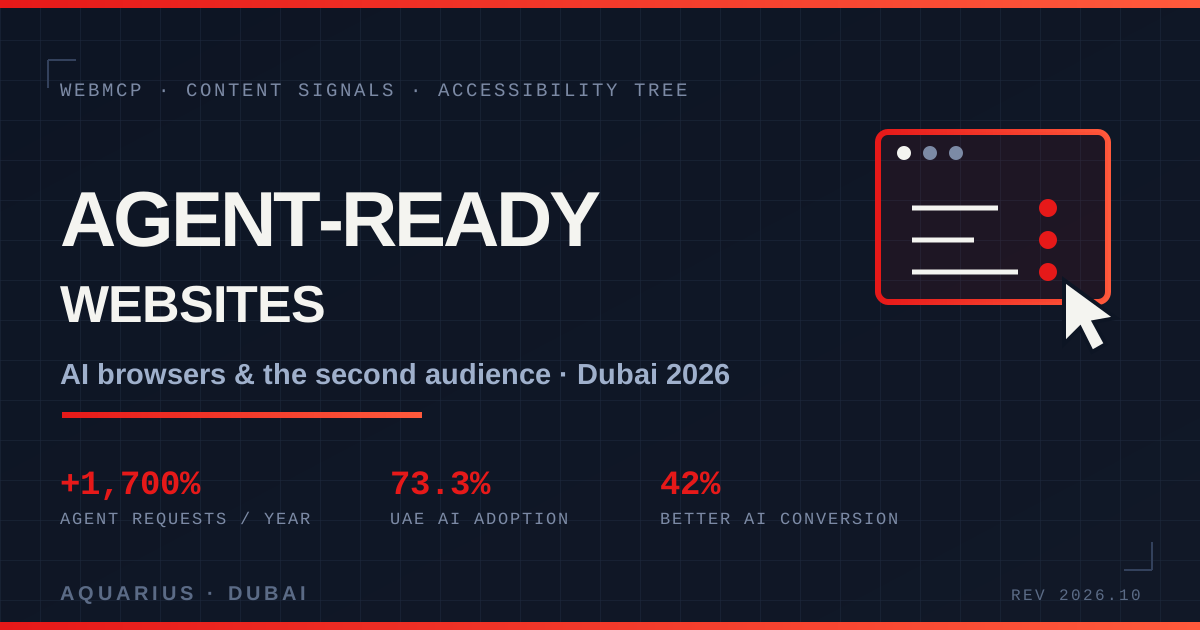
Short answer: your Dubai website now has two audiences — people, and the AI agents acting on their behalf inside browsers and chat assistants. Making a site agent-ready is not a new SEO discipline and it is not llms.txt: it is four unglamorous technical jobs — let verified agents through your WAF, keep a clean accessibility tree, state your permissions in robots.txt with Content Signals, and expose your key actions as structured tools. Budget AED 12,000–45,000 for a retrofit on a typical UAE business site. Most Dubai sites are currently failing on the first one without knowing it.
Half the traffic hitting your site is already not a person
Cloudflare, which fronts a double-digit share of the web, reported that by 2026 more than half of internet traffic was not human, with its network handling roughly 115 million HTTP requests per second — nearly double the 63 million/second of late 2024. The sharper number is the growth rate: daily requests from AI agents grew by more than 1,700% in a single year, and AI training crawlers rose from 22% of crawler requests in spring 2025 to 52% by June 2026. Cloudflare now validates over 500 billion verified bot requests every week.
The UAE is not a bystander in this. UAE AI adoption hit 73.3% of the working-age population (15–64) in 2026 — the highest rate measured globally — after gaining 9.3 percentage points between H2 2025 and June 2026, more than any other top-ten country. A Google/Ipsos survey of 21 countries put past-year generative AI use highest in the UAE at 85%, and 97% of UAE tech leaders say they have embedded AI agents into workflows, products or services, against an 87% global average.
And this traffic buys. Adobe Analytics, tracking over a trillion visits to US retail sites, found AI-referred traffic up 393% year on year in Q1 2026. More importantly, the conversion story flipped: in March 2026 AI traffic converted 42% better than non-AI traffic, an 80-percentage-point swing from March 2025 when it converted 38% worse. AI-referred shoppers spent 48% longer on site, browsed 13% more pages and produced 37% more revenue per visit. On Shopify, AI-referred traffic grew roughly 8x year on year in Q1 2026 while AI-referred orders grew nearly 13x.
Most Dubai businesses are optimising for the audience that converts worse and blocking the one that converts better.
Crawlers and agents are not the same thing — and you should treat them differently
This is where almost every Dubai agency conversation goes wrong. Three distinct machine visitors arrive at your site, and lumping them together is what causes the damage:
- Training crawlers collect your pages once to train a model. You get nothing back directly. Blocking these is a defensible commercial choice.
- Search and answer crawlers index you so you can be shown and cited. Blocking these removes you from AI answers entirely.
- Agents are a human sitting right there, right now, who asked an assistant to compare three Dubai suppliers or book a service. They return repeatedly, they follow human weekly rhythms and they dip over summer holidays. Blocking these is blocking a customer mid-purchase.
Cloudflare’s own data shows how lopsided current practice is: fewer than 1% of sites block search crawlers, but 17% block training crawlers — and the blunt rules people write to stop training routinely catch agents too. Then on 15 September 2026, Cloudflare changed its defaults so that the Training and Agent classifications are blocked by default on pages that display ads, with Search still allowed. If your Dubai site runs ads or you inherited a hardened WAF profile, you may already be turning away buyers you never saw in GA4.
The good news is that agent traffic is now identifiable rather than guessable. Under Web Bot Auth, operators including OpenAI, Google and AWS cryptographically sign their agents’ HTTP requests, so your origin can distinguish a genuine agent from an impersonator without relying on IP ranges or user-agent strings. From 1 July 2026, Cloudflare also separates Direct from Intermediary access in its bot metadata — the difference between a company-run bot and an agent a real person is driving. That distinction is the one your firewall rules should be built on.
The AI browser moment, minus the hype
2026 was the year agentic browsing stopped being a demo. ChatGPT Atlas reached roughly 11 million monthly active users in Q1 2026, up from about 1.6 million a year earlier, and one enterprise study found 27.7% of organisations had at least one employee install it — rising to 67% in the technology sector. OpenAI has since folded that browser-based agentic work back into ChatGPT and Codex rather than keeping a standalone browser, which is the real lesson: the surface keeps moving, the behaviour does not. Your customers will keep handing navigation and comparison to an assistant regardless of which app wins.
Google, meanwhile, shipped the tooling. From Chrome M150, Lighthouse includes an Agentic Browsing category. It deliberately does not give you a 0–100 score — it reports a fraction of audits passed and is explicitly informational and unbenchmarked. It checks three things:
- Accessibility — because agents use the accessibility tree derived from your DOM as their primary data model, exactly like a screen reader does.
- Stability — measured with Cumulative Layout Shift, because an agent clicking a moving target clicks the wrong thing.
- WebMCP tools — whether your page registers structured tools an agent can call.
Read that list again, because it is the most useful thing in this article: two of the three agent-readiness checks are things your team already owed you. A site with a proper accessibility tree and controlled layout shift is most of the way agent-ready before anyone writes a line of new code. If those are weak, start with our guides to web accessibility compliance for Dubai websites and Core Web Vitals in the UAE rather than chasing anything new.
WebMCP: worth preparing for, not worth panicking about
WebMCP is a proposed standard, developed jointly by Google and Microsoft and incubated in a W3C Community Group, that lets a page declare its capabilities as structured tools through a browser API called navigator.modelContext. Instead of an agent screenshotting your booking form and guessing which field is which, your site says: here is checkAvailability, here is requestQuote, here are the arguments. It is testable today behind a Chrome flag at chrome://flags/#enable-webmcp-testing.
Now the honest part, because plenty of Dubai pitches will skip it: WebMCP is a Draft Community Group Report, not a ratified W3C standard, it is running as a Chrome origin trial, and the mainstream assistants your customers actually use do not call WebMCP tools yet. Shipping a full tool layer in 2026 is an informed bet, not table stakes. What is defensible right now is making the bet cheap: pick the two or three actions that represent real revenue on your site, make sure they work without JavaScript gymnastics, and keep them in one place so registering them as tools later is an afternoon rather than a rebuild.
| Layer | What it does for agents | Status in 2026 | Do it now? |
|---|---|---|---|
| WAF and bot rules | Decides whether an agent reaches you at all | Live, defaults changed Sept 2026 | Yes — highest risk, lowest effort |
| Accessibility tree | The agent’s primary model of your page | Live, audited by Lighthouse M150 | Yes — you owed this to users anyway |
| Layout stability (CLS) | Stops agents clicking the wrong element | Live, audited | Yes — same work as Core Web Vitals |
| Content Signals in robots.txt | States your search / AI-input / AI-training terms | Live, voluntary compliance | Yes — one file, ten minutes |
| Structured data (JSON-LD) | Lets agents resolve price, branch, hours, identity | Mature | Yes |
| WebMCP tools | Lets agents call your actions directly | Origin trial, draft spec | Prepare the surface, ship later |
| llms.txt | Nothing, currently | Unused by AI systems | No |
Content Signals: the robots.txt lines almost no Dubai site has set
Cloudflare’s Content Signals Policy adds three machine-readable directives to robots.txt, each a yes or no: search (index me and show links and snippets), ai-input (use my content as input to an AI-generated answer) and ai-train (use my content to train a model). Customers have enabled the managed version on over 3.8 million domains, and more than 2.5 million websites now fully disallow AI training.
Two caveats you must price in before promising a client anything. First, compliance is voluntary — robots.txt expresses a preference and does not technically prevent access, and Google has not committed to honouring these signals. Second, the combination most UAE businesses actually want is counter-intuitive: search=yes, ai-input=yes, ai-train=no. You want to be quoted in the answer your customer is reading; you may not want your pages baked into next year’s model for free. Set those three deliberately rather than inheriting whatever your host toggled on.
What you should not spend money on is llms.txt. Google’s John Mueller has stated flatly that no AI system currently uses llms.txt, Google’s Search team does not endorse it, and Google’s own generative-AI optimisation guidance lists it among the tactics you do not need — alongside content chunking, AI-specific rewriting and special schema. The file costs nothing to publish and may matter later. If someone in Dubai is invoicing you a retainer for it, that is the tell.
What agent-readiness costs in Dubai
These are our AED ranges for a typical UAE business site, excluding hosting and ad spend.
| Scope | What you get | AED | Timeline |
|---|---|---|---|
| Agent-access audit | WAF and bot-rule review, signed-agent policy, log analysis of what you are currently blocking, Content Signals block, Lighthouse Agentic baseline | 3,500–7,500 | 3–5 days |
| Agent-readiness retrofit | The audit plus accessibility-tree fixes on key templates, CLS remediation, JSON-LD for entity, pricing and branches, server-rendered critical paths | 12,000–45,000 | 2–5 weeks |
| WebMCP tool layer | Two to five structured tools on real revenue actions (quote, availability, booking, catalogue search), behind a flag, with an agent-interaction test suite | 18,000–60,000 | 3–6 weeks |
| Measurement | GA4 and server-log segmentation for AI referrals and agent sessions, so this stops being a matter of opinion | 4,000–9,000 | 1 week |
Set that against the cost of inaction. UAE ecommerce is running at roughly AED 45.1 billion (USD 12.3 billion) in 2026, growing at about 11% a year, with 11 million-plus online shoppers and penetration at around 15.7% of retail in 2025 heading past 20% by 2030. Dubai’s wholesale and retail trade sector alone generated about AED 50.9 billion in Q1 2026, roughly 22% of the emirate’s GDP. If AI-referred traffic converts 42% better and carries 37% more revenue per visit, then a firewall rule that quietly turns those sessions away is not a technical detail — it is a pricing decision made by whoever last clicked a security preset.
How Aquarius does it
We start with your logs, not your opinions. Before touching a template we pull what machine traffic actually reaches your origin, what gets challenged and what gets blocked, and separate signed agents from training crawlers from impersonators. In most Dubai audits the biggest single win is a firewall rule, not a rebuild — which is a cheap finding to deliver and an expensive one to miss. Then we fix the two Lighthouse audits that are really accessibility and performance work in a new costume, set your Content Signals deliberately, and leave your revenue actions consolidated so a WebMCP layer is a short job whenever the standard lands. We will tell you plainly if your site already passes and you need content work instead — see how to get cited by AI search and the AI Overviews impact guide for UAE businesses. If you sell online, pair this with agent-ready product data for your Dubai store.
FAQ
Is agent-readiness a new kind of SEO I need to buy separately?
No. Two of Lighthouse’s three Agentic Browsing checks are accessibility and layout stability — work that was already on your backlog. The genuinely new items are your bot and WAF policy, Content Signals in robots.txt, and optionally WebMCP tools. Treat it as a technical hygiene project with a deadline, not a retainer category.
Should my Dubai site block AI crawlers?
Block training crawlers if you do not want your content used to train models — over 2.5 million sites have. Do not block search and answer crawlers unless you want to disappear from AI answers, and be very careful not to block agents, which are human customers acting through an assistant. The three classifications need three separate decisions.
Do I need llms.txt?
Not for results today. Google’s John Mueller has said no AI system currently uses llms.txt, and Google’s own guidance lists it among tactics you do not need. It is cheap to publish as a hedge. It is not worth paying a monthly fee for.
How do I know whether agents are already visiting me?
Server logs first, analytics second. Look for signed-agent requests and verified-bot classifications at the edge, then segment AI referrals in GA4 — our GA4 setup for AI search traffic in Dubai covers the configuration. Agent traffic has a human rhythm, so a weekday pattern in non-human requests is usually agents rather than crawlers.
Is WebMCP safe to ship in production now?
It is a Chrome origin trial against a draft community-group spec, and the major assistants do not call those tools yet. Ship it behind a flag on two or three actions if you want the learning and the first-mover position. Do not rewrite your front end for it in 2026.
Find out what you are blocking
Send us your domain and we will run the agent-access audit and the Lighthouse Agentic Browsing baseline, then tell you in one page whether your problem is a firewall rule, an accessibility tree or your content. See what we build and Aquarius pricing, or request the audit — audits start at AED 3,500 and the fix is usually cheaper than the quote you are expecting.