Aesthetic and Med Spa Clinic Software in Dubai (2026): NABIDH, the 5% VAT Trap and the No-Show Bill
Cosmetic treatments are 5% VAT, not zero-rated, and NABIDH connection now gates licence renewal. Real AED software costs for Dubai aesthetic clinics, plus the no-show maths that pays for the build.
- PUBLISHED
- 18 OCT 2026
- READ TIME
- 11 MIN
- AUTHOR
- AQUARIUS · DUBAI
- UNIT
- REV 2026.09
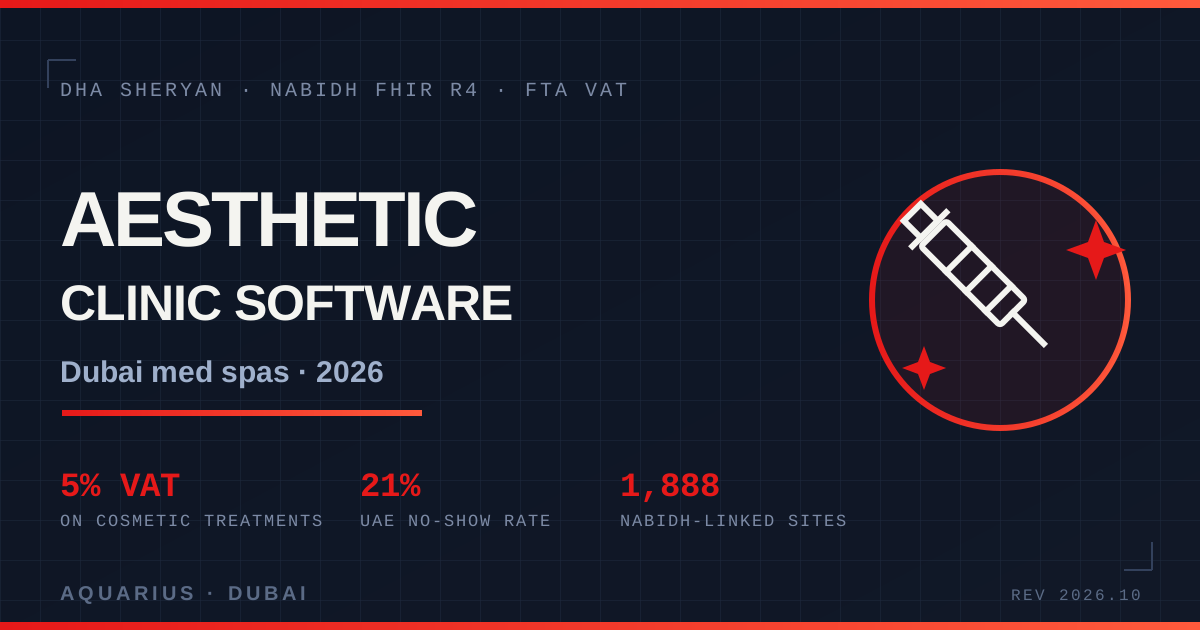
Short answer: A Dubai aesthetic or med spa clinic needs three things its software must handle natively: a NABIDH-connected clinical record, invoicing that separates zero-rated medical work from 5% standard-rated cosmetic work, and a booking engine that kills no-shows. Off-the-shelf spa software fails the first two, and generic EMRs fail the third. Expect AED 200-1,800 per practitioner a month for a configured cloud stack, or AED 180,000-450,000 for a custom build.
Dubai is the densest aesthetics market in the region, and the regulators have finally caught up with it. In the last twelve months DHA tightened medical advertising on social media, NABIDH connection became a gate on licence renewal, and the FTA rewrote its penalty framework. Most clinic owners are running all of that on a calendar app, a card machine and an accountant who sees the numbers six weeks late.
The market: why Dubai aesthetics is worth getting right
The UAE dermatology and aesthetic market was valued at roughly USD 455.8 million in 2025 and is projected to reach about USD 918.5 million by 2032, with Dubai holding the largest single share at around 46% and accounting for more than 60% of all aesthetic procedures performed in the UAE. Industry estimates put the UAE at 800 to 1,000 aesthetic facilities, and the wider aesthetic sector has been sized at about USD 2.3 billion in local reporting.
Medical tourism is the accelerant. Dubai attracted 691,478 medical tourists in 2023, spending more than AED 1.034 billion directly, with a further AED 2.3 billion in indirect revenue. DHA reported an 18% rise in medical tourists in Q1 2026, more than 200,000 international patients in a single quarter, and the authority expects medical tourism revenue to pass AED 5 billion by the end of 2026. Dermatology has consistently been the top health-tourism specialty by volume.
A clinic that cannot produce a clean, VAT-correct invoice in English and Arabic within 60 seconds of a treatment is leaking money at exactly the moment the market is growing fastest.
NABIDH is a licence gate, not an IT project
NABIDH, Dubai's health information exchange, is mandatory for DHA-licensed facilities. As of June 2025 it held 10.41 million unified patient records across 1,888 connected facilities, 53,659 clinicians and 91 integrated EMR systems, running on the HL7 FHIR R4 standard with ICD-10-CM diagnoses and CPT procedure coding.
The commercial point is blunt: non-connection blocks facility activation, licence renewal and insurance empanelment. A med spa that bought a beauty-salon booking tool because it looked prettier will discover at renewal that the tool cannot emit a NABIDH Minimum Data Set, and will then pay twice: once for a bridge, once for the migration. If you are at that decision point, our walkthrough of NABIDH integration for Dubai clinics covers the data-set mechanics.
What aesthetics needs that a standard EMR does not
- Treatment-plan sessions: a laser course is 6-8 sessions sold once and delivered over months. The record and the revenue must track separately.
- Batch and lot tracking for injectables: toxin and filler vials need lot numbers, expiry and volume-used against each patient, both for clinical safety and stock control.
- Consent with risk disclosure, versioned: every procedure variant needs its own signed, time-stamped consent you can retrieve two years later.
- Clinical photography: stored inside the patient record, not on a practitioner's phone. This is health data under the UAE PDPL and it is now also an advertising-compliance asset.
- Dual pricing logic: the same practitioner performing two procedures in one visit at two different VAT rates.
The 5% VAT trap most Dubai clinics are still getting wrong
This is the single most expensive misunderstanding in the sector. Preventive and curative healthcare supplied by a licensed facility is zero-rated. Purely cosmetic, elective work is standard-rated at 5% even when it is performed by a licensed doctor inside a licensed clinic. Cosmetic botulinum toxin, aesthetic fillers, elective veneers and aesthetic dermatology all sit in the 5% band. The textbook example: rhinoplasty to correct a breathing impairment is zero-rated, the same operation for appearance is 5%.
Misclassifying cosmetic work as zero-rated alongside genuine medical treatment is one of the most common errors the FTA finds in healthcare audits. Two structural traps follow from it:
- Mixed visits. A medically indicated procedure and a cosmetic add-on in the same appointment must split across two VAT treatments on one invoice. Spa software usually cannot do this; it applies a single rate per invoice.
- Input VAT recovery. Because the standard-rated share of your revenue is real, the input VAT on devices, consumables and marketing is recoverable in proportion. Clinics that book everything as zero-rated frequently under-claim what they are owed.
The penalty regime changed under Cabinet Decision No. 129 of 2025, effective 14 April 2026. An incorrect tax return now carries AED 500 for a first violation and AED 2,000 for a repeat. Voluntary disclosure moved to 1% of the tax difference per month until the disclosure is filed, rising to a fixed 15% if you file after an audit notification. The fine is not the problem. The 1% monthly clock on two years of misclassified revenue is.
What the software actually costs in Dubai
| Route | What you get | Cost (AED) | Fit |
|---|---|---|---|
| Salon or spa booking tool | Calendar, deposits, SMS reminders. No NABIDH, no split VAT. | 200-700 / month | Non-medical beauty only |
| Entry clinical cloud | Charting, scheduling, invoicing, vendor-supplied NABIDH link | 200-400 per practitioner / month | 1-3 treatment rooms |
| Mid-market clinic suite | Adds packages, patient portal, photo records, reporting | 700-1,800 per provider / month | 3-8 rooms |
| Multi-branch / enterprise | Central patient record across sites, SLAs, deep integrations | 2,500-15,000+ / month | Chains and groups |
| Custom build (Aquarius band) | Bespoke clinic platform, booking funnel, package ledger, VAT engine, your data | 180,000-450,000 one-off | Scale or differentiation |
Add integration and migration on top of any subscription route: NABIDH onboarding and testing, payment gateway, WhatsApp reminders and the data import from whatever you run today. Budget AED 25,000-80,000 for that first mile. Our general pricing bands and the comparable dental practice software breakdown give useful reference points.
Packages and prepaid credits: the liability on your balance sheet
Aesthetics runs on prepaid courses, and that is where unsoftwared clinics quietly lose control. A six-session laser package sold for AED 4,800 is not AED 4,800 of revenue on the day the card clears. It is a delivery obligation with VAT already due at the point of supply, plus an unredeemed balance that walks out of the door if a practitioner leaves and the patient follows.
Your system needs a package ledger that tracks sold value, delivered value, remaining sessions, expiry and the VAT treatment of each component separately. The practical test when you demo any product: ask the vendor to show you a report of unredeemed package liability by branch, as of today. Most cannot produce it.
Advertising rules your booking funnel now touches
In September 2026 DHA moved on aesthetic clinics over edited social media images. The current standards require medical advertising to be truthful, evidence-based and to state the associated risks. Superlatives like best, safest, miraculous and 100% are out. Before-and-after images are permitted only if unedited, shot with the same lens, backed by written patient consent, and carrying a disclaimer that results vary from one individual to another, set in the same font size as the rest of the advert. Influencer promotion needs an advertiser permit and medical-director approval.
That is a software requirement, not just a marketing one. If your website gallery pulls images from the patient record, the system has to store the consent flag, the lens metadata and the disclaimer with the asset, and refuse to publish anything missing one of them. Our guide to DHA advertising permits for Dubai clinic marketing goes deeper on the permit side.
No-shows: the fastest payback in the build
UAE no-show rates are estimated around 21%, with typical UAE medical centres running 15-25%. At Dubai specialist-clinic economics, a missed slot is worth roughly AED 400-800; on 30 appointments a day at a 20% no-show rate, that is AED 2,400-4,800 lost every day. A published before-and-after study at Emirates Health Services primary care centres cut no-shows from 20.82% to 10.25% using real-time analytics and AI-driven intervention.
You do not need a research programme to capture most of that. Bilingual WhatsApp confirmation at booking, a 48-hour and a 3-hour reminder, one-tap reschedule, and a card-on-file deposit for high-value slots. Halving a 20% no-show rate on a clinic billing AED 500,000 a month is worth roughly AED 50,000 a month, which pays back a mid-size build inside a year.
How Aquarius builds it
We scope aesthetics clinics in three phases: a booking and reminder funnel that goes live in weeks and starts recovering no-show revenue immediately; then the clinical and consent layer with NABIDH connectivity; then packages, inventory by lot number and the VAT-correct invoicing engine. Discovery is fixed-price, the architecture is documented, and the code and data are yours. Typical first-phase go-live is 4-6 weeks, full platform 12-20 weeks.
FAQ
Is botox or filler zero-rated for VAT in the UAE?
No. Purely cosmetic botulinum toxin and dermal fillers are standard-rated at 5%, even in a DHA-licensed facility with a licensed doctor. Only preventive or curative treatment qualifies for zero-rating, and the clinical record has to support that classification.
Does a med spa have to connect to NABIDH?
If the facility is DHA-licensed to deliver medical services, yes. NABIDH connection is checked at facility activation, licence renewal and insurance empanelment. A purely non-medical beauty salon under a DET trade licence sits outside the health-authority regime.
Can we use a salon booking app for an aesthetic clinic?
For the front desk, briefly. It will fail on NABIDH data exchange, split-rate VAT invoicing, lot-tracked injectables and versioned consent. Clinics that start there usually migrate within two years and pay for the data cleanup.
What does an aesthetic clinic platform cost in Dubai?
Configured cloud software runs AED 200-1,800 per practitioner a month plus AED 25,000-80,000 of integration and migration. A custom platform for a multi-branch group sits in the AED 180,000-450,000 band, with ongoing hosting and support on top.
How fast can we go live before the next licence renewal?
Booking, reminders and deposits in 4-6 weeks. Clinical records with NABIDH connectivity depend on the integration queue and testing, so plan 10-16 weeks before a renewal date, not 4.
Running an aesthetic clinic or med spa in Dubai and unsure whether your current stack survives the next DHA renewal or an FTA review? Send us your setup and we will map the gaps against the checklist above, free, before anyone talks about a build.