
Dental Clinic Software in Dubai (2026): NABIDH, eClaimLink Pre-Approvals and Real AED Costs
Dental software in Dubai runs AED 199-3,000 per provider per month off the shelf, or AED 220,000-600,000 custom. The NABIDH, eClaimLink and PD-05-2025 rules that set the price.
- PUBLISHED
- 03 OCT 2026
- READ TIME
- 12 MIN
- AUTHOR
- AQUARIUS · DUBAI
- UNIT
- REV 2026.09
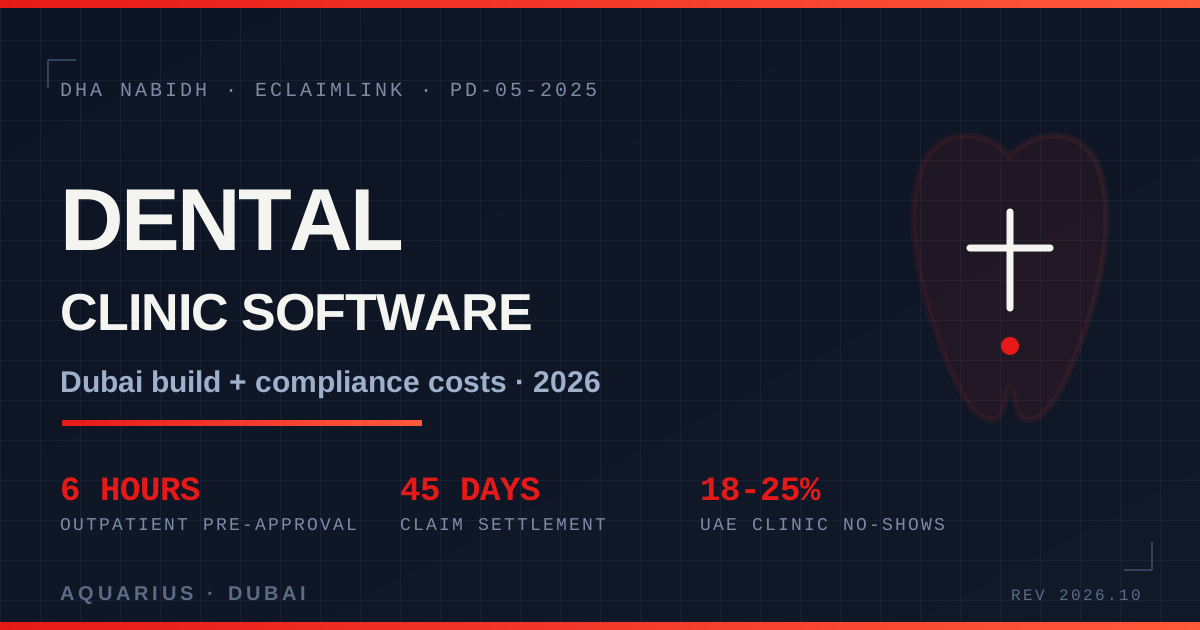
Short answer: dental clinic software in Dubai costs roughly AED 199-1,835 per chair or provider per month for an off-the-shelf cloud system, AED 10,000-50,000 a year once NABIDH-compliant hosting and support are added, and AED 220,000-600,000 for a custom practice platform. What sets the price is not the chart notes. It is three Dubai-specific obligations - NABIDH connectivity, eClaimLink claims under Policy Directive PD-05-2025, and pre-approval handling for the exact procedures dentistry sells most.
Key takeaways
- NABIDH is a licensing pre-condition, not a feature. A DHA-licensed dental facility cannot activate or renew without a NABIDH-connected EMR carrying ICD-10-CM diagnoses and CPT procedures.
- PD-05-2025 took effect on 16 November 2025. Outpatient elective pre-authorisation must be answered within 6 hours, inpatient within 24 hours, and claims settled with remittance advice within 45 days - 30 days for resubmissions.
- Dentistry is a pre-approval business. Molar root canals, crowns, bridges, dentures, orthodontics, surgical extractions and anything above AED 1,000 per appointment typically need prior authorisation. Missing it means near-certain denial, and retroactive approvals are rarely granted.
- Cash matters more than most clinics plan for. Dubai's Essential Benefits Plan covers only basic emergency dental; implants, veneers and whitening are excluded outright, so your software has to run insurance and self-pay as equals.
- No-shows are the cheapest money in the building. UAE clinics run 18-25% no-show rates, and structured WhatsApp reminder sequences are reported to cut them by 40% or more.
The Dubai dental market in three numbers
Dentistry in the UAE is no longer a cottage sector. Three figures explain why software decisions now carry real money:
- The UAE dental services market was valued at about USD 195.3 million in 2024 and is forecast to reach USD 290.49 million by 2030 at a 6.8% CAGR, with the clinic segment at roughly USD 207.7 million in 2025. More than 1,800 dental clinics compete inside that pool, and Dubai plus Abu Dhabi dominate it.
- Dental tourism is the growth engine. UAE dental tourism generated about USD 172.5 million in 2025 and is projected to reach USD 439.0 million by 2033 (12.3% CAGR). Dentistry already accounted for roughly 24% of Dubai's medical-tourism specialty mix in 2023, when the emirate hosted over 691,000 international health tourists spending more than AED 1.03 billion. Dubai's stated target is 500,000 medical tourists a year by 2030.
- Technology adoption is already past the tipping point. Intraoral-scanner penetration passed 50% of Dubai private clinics during 2025, and AI plug-ins now ship as default on high-end CAD/CAM platforms. Digital impressions create files, and files need somewhere to live that an auditor can follow.
Translation: you are competing for an international patient who compares three Dubai clinics on a phone, books the one that answers first, and expects a treatment plan and a quote before the flight. The practice management system is the thing that either delivers that or loses it.
Most Dubai dental clinics get this wrong: they buy software on chairside features - perio charting, imaging bridges, smile design - then bolt on NABIDH and eClaimLink later. Both are regulatory gates. Treating them as phase two means re-architecting your patient record while a licence renewal clock runs, which is the most expensive sequence in Dubai clinic IT.
What a Dubai dental system must do that an imported one will not
Dentrix, Open Dental and the rest were built for American practices with an NPI number and a clearinghouse. The clinical half transfers fine. The Dubai half does not.
1. NABIDH connectivity
Every DHA-licensed facility - including single-specialty dental clinics, with no exemption for size or scope - must integrate a NABIDH-compliant EMR before the facility licence activates, and keep it connected to renew. Compliance means coding diagnoses to ICD-10-CM and procedures to CPT, meeting the NABIDH Minimum Data Set (demographics, encounters, diagnoses, procedures, prescriptions, lab and radiology results, discharge summaries), and sharing records with other DHA-connected facilities when clinically required. For a dental clinic that practically means your charting software has to emit coded encounters, not free-text tooth notes. See our deeper walkthrough on NABIDH EMR integration for Dubai clinics.
2. eClaimLink on PD-05-2025 clocks
Dubai requires dental claims to be submitted electronically through eClaimLink; manual and paper submissions are no longer accepted for in-network providers. Since Policy Directive PD-05-2025 came into force on 16 November 2025, the whole cycle runs on fixed timers: outpatient elective pre-authorisation answered within 6 hours, inpatient elective within 24 hours, emergencies approved verbally and confirmed in writing within 24 hours, and remittance advice plus payment within 45 days of submission, or 30 days for a resubmission. Those clocks only help a clinic whose first submission is clean, which is a software problem long before it is a billing-clerk problem. More detail in our guide to medical billing and eClaimLink claims software in Dubai.
3. A pre-approval engine built for dental procedures
This is where generic clinic software quietly costs you money. Under Dubai's mandatory scheme, the Essential Benefits Plan covers only basic emergency dental treatment; comprehensive dental arrives as a rider on mid-tier and premium plans. Prior authorisation is normally required for molar root canals, crowns, bridges, dentures, orthodontics, surgical extractions and any procedure above AED 1,000 per appointment, while implants and cosmetic work such as whitening and veneers are excluded entirely. Claims filed without the required authorisation are almost always denied, and retroactive approvals are rarely granted. Rejected claims then have to be fixed and resubmitted inside the insurer appeal window, typically 7 to 14 days.
A dental-aware system therefore needs the treatment plan itself to know the rules: flag the PA-required line items before the patient leaves the chair, hold the eligibility snapshot, track the authorisation reference against the tooth and surface, and start an appeal timer the moment a rejection lands.
4. The dental-specific clinical spine
- Odontogram and perio charting tied to tooth, surface and quadrant - and mapped to billable codes.
- Imaging: OPG, periapicals and CBCT stored against the chart with UAE-resident hosting, not on the radiography PC.
- Multi-visit treatment plans with phased quotes, partial insurance cover and a self-pay balance.
- Lab case tracking for crowns, bridges and aligners, with due dates that match the next appointment.
- Recall and hygiene scheduling - six-month recalls are the highest-margin appointments a practice owns.
- Arabic and English patient communication, because your patient mix is not monolingual.
What it costs in 2026
Published and quoted pricing clusters into five routes. Figures exclude 5% VAT.
| Route | What you get | Cost (AED) | Fit |
|---|---|---|---|
| Entry cloud PMS | Charting, scheduling, invoicing, NABIDH connection via vendor | 199-400 per practitioner / month | 1-3 chairs |
| Mid-market cloud | Adds recalls, patient portal, reporting, claim workflows | 693-1,835 per provider / month | 3-8 chairs |
| Established dental suites | Dentrix on-premise or Ascend cloud, full clinical depth | 1,500-3,000 / month | Group practices |
| Enterprise / multi-branch | Centralised multi-site, SLAs, deep integrations | 2,500-15,000+ / month | Chains and DSOs |
| Custom build (Aquarius band) | Bespoke PMS, patient portal, pre-approval engine, your data | 220,000-600,000 one-off | Scale or differentiation |
Two line items most budgets miss. First, a NABIDH-approved EMR plus its connector, UAE-resident hosting, support and training lands at roughly AED 10,000-50,000 a year depending on clinic size and vendor - a recurring compliance cost, not a one-off. Second, the licensing itself: DHA facility licensing for a dental clinic runs about AED 10,000-40,000, professional licences roughly AED 3,000-10,000 per dentist, with Sheryan initial approval around AED 1,000, inside a total clinic setup of AED 300,000-700,000. Software is a small share of that number and the largest single lever on whether the rest of it earns.
Build or buy: how to decide in one pass
Buy if you run one to five chairs, your workflows are conventional, and your edge is clinical rather than operational. A configured cloud PMS at AED 199-700 per provider per month beats anything custom on time-to-value, and you can switch later.
Build when one of three things is true: you operate multiple branches and need a single patient record with central reporting; your revenue depends on a workflow no vendor supports, such as a dental-tourism funnel that quotes, collects a deposit and schedules around a flight; or your insurance mix is complex enough that a tailored pre-approval and denial-management engine pays for itself in recovered claims. For most Dubai groups the honest answer is hybrid - keep the licensed clinical core, build the patient-facing and revenue layer around it. Our services page covers how those integrations get scoped.
The number that usually decides it
UAE clinics report no-show rates of roughly 18-25%, with a typical medical centre seeing 30 consultations a day; aesthetic-led practices run worse, at 25-35%. Reported results from structured WhatsApp reminder sequences - one at 24 hours, one at 2 hours - start around a 40% reduction, helped by WhatsApp's near-universal UAE penetration and roughly 98% message open rate. On a six-chair clinic at an average AED 600 per appointment, clawing back even a third of a 20% no-show rate is a five-figure monthly swing - more than the entire software bill at any tier in the table above.
What we do differently at Aquarius
We build the Dubai half properly, because that is the half that breaks. That means NABIDH message mapping from coded charting rather than retyped notes; an eClaimLink submission path designed for first-pass acceptance with PD-05-2025 timers surfaced in the interface; a pre-approval engine seeded with the procedures Dubai insurers actually gate; bilingual Arabic and English patient journeys with RTL done correctly; and UAE-resident hosting so your imaging and records sit inside the jurisdiction that regulates them. See pricing for indicative bands, and read our note on DHA advertising rules for clinic marketing before you promote any of it.
Risk reversal is simple: we scope compliance in week one, in writing, with the NABIDH and eClaimLink work inside the fixed price rather than as a change request after go-live.
FAQ
Is NABIDH integration mandatory for a dental clinic in Dubai?
Yes. DHA requires a NABIDH-compliant EMR for every facility category it licenses, including single-specialty dental clinics. There is no exemption based on clinic size or scope, and the connection is a condition of both activation and renewal.
How fast must an insurer answer a dental pre-approval in Dubai?
Under Policy Directive PD-05-2025, effective 16 November 2025, outpatient elective prior authorisation must be issued within 6 hours and inpatient elective within 24 hours. Emergency cases get immediate verbal approval with written confirmation inside 24 hours.
Does Dubai mandatory health insurance cover dental treatment?
Only minimally. The Essential Benefits Plan covers basic emergency dental treatment; routine and major dental work needs a rider on a mid-tier or premium plan. Implants and cosmetic procedures such as whitening and veneers are excluded, which is why self-pay billing has to be a first-class feature rather than an afterthought.
How much does dental practice software cost per month in Dubai?
Entry cloud systems start near AED 199 per practitioner per month, mid-market options run AED 693-1,835 per provider, established suites such as Dentrix sit around AED 1,500-3,000 per month, and enterprise multi-branch platforms reach AED 8,000-15,000 or more. Budget a further AED 10,000-50,000 a year for NABIDH-compliant EMR, hosting and support.
Can we migrate from an existing system without losing patient history?
Usually yes, but data quality decides the timeline. Charting, imaging links and financial ledgers migrate at different levels of fidelity, and anything that was free text has to be mapped to ICD-10-CM and CPT before NABIDH will accept it. Budget migration as its own workstream rather than a line in the install.
Where to start
Pick the compliance gates first, the clinical features second, and the brand polish third. A dental clinic in Dubai that submits clean first-pass claims, answers an international enquiry in minutes and holds its recall calendar will out-earn a prettier practice that does none of those. Tell us your chair count and insurer mix and we will come back with a scoped build or a buy recommendation - whichever actually fits.