
Water Delivery App Development in Dubai (2026): Real AED Costs, Bottle Deposits and Route Density
The UAE drinks 285 litres of bottled water per person a year, yet a 5-gallon bottle earns AED 10.20 and costs AED 25-40 to deliver. Real AED build costs and the economics that decide it.
- PUBLISHED
- 10 OCT 2026
- READ TIME
- 12 MIN
- AUTHOR
- AQUARIUS · DUBAI
- UNIT
- REV 2026.09
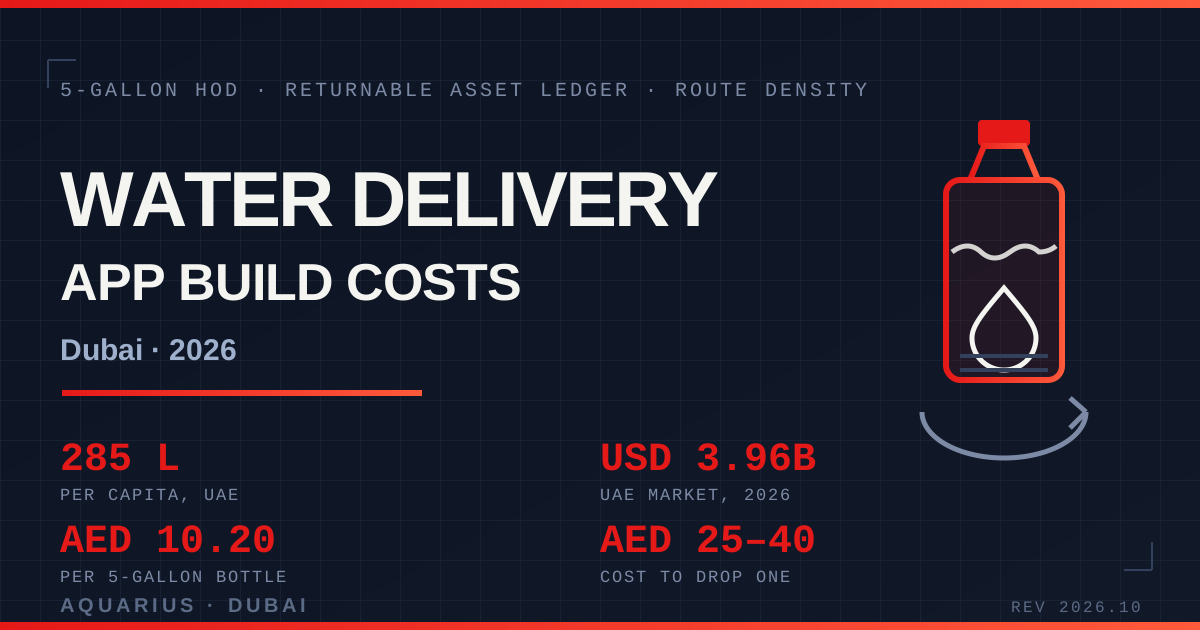
Short answer: A custom water-delivery platform for a Dubai bottled-water business — customer app, driver app, dispatch console and a returnable-bottle ledger — costs AED 60,000–140,000 for a working MVP and AED 150,000–420,000 for the full build with route optimisation, a B2B office portal and deposit reconciliation. A white-label delivery platform gets you live faster for AED 70,000–160,000 plus licences, but it will not model the two things that decide whether you make money: the AED 20-per-bottle deposit sitting on your balance sheet, and route density. A five-gallon bottle retails around AED 10.20, while an in-house last-mile drop in the UAE costs AED 25–40 blended. Single-bottle stops lose money on every single delivery, and no app feature fixes that except the dispatch logic.
Key takeaways
- The demand is enormous and already digital. The UAE bottled-water market is worth USD 3.96 billion in 2026 and compounds at 8.33% a year through 2032. Per-capita consumption is 250–300 litres — a parliamentary report put it near 285 litres in 2024, against roughly 100 litres in the US and a global average of 24 litres.
- Most Dubai water suppliers get the unit economics backwards. They build an app to take more orders. The money is in fewer, bigger stops: at AED 10.20 a bottle against AED 25–40 per in-house drop, a one-bottle delivery is a loss you have just made easier to request.
- The bottle is an asset, not packaging. With a deposit of roughly AED 20 per bottle, 5,000 customers holding two bottles each is AED 200,000 of customer money on your books. If your software tracks bottles as a number rather than as serialised units per customer, you cannot reconcile it — and you cannot prove it to an auditor.
- Prepaid coupons are the retention mechanic that already works here. Mai Dubai sells a book of 10 coupons for AED 105. Subscription tiers with free delivery lift customer lifetime value by about 40% versus pay-per-order. Your app has to be a coupon wallet before it is a shop.
- Reporting is becoming a legal obligation. The UAE is standing up an Extended Producer Responsibility framework in 2026, with reporting penalties from AED 100,000 to AED 1,000,000. Producers will need traceable data, not estimates.
Why Dubai is the best water-delivery market on earth — and the hardest
Start with the size of the prize. The UAE bottled-water market sits at USD 3.96 billion in 2026 and grows at a 8.33% CAGR through 2032. That demand is not a marketing achievement; it is climate, a large expatriate population and constant tourist throughput. Per-capita consumption of 250–300 litres a year — around 285 litres in 2024 by one parliamentary estimate — makes the UAE the world's heaviest bottled-water consumer, roughly 12 times the global average of 24 litres.
The ordering behaviour is already on a phone. UAE quick commerce runs at USD 154 million in 2026, heading to USD 198.9 million by 2032, with grocery and essentials taking about 45% of it and 78.67% of all orders placed on mobile. Dubai and Abu Dhabi residents are now habituated to 12–15 minute delivery windows, and back in 2024 63% of UAE shoppers said they would pay extra for same-day delivery. A water customer who can get groceries in fifteen minutes will not accept "sometime Tuesday" from their water supplier.
Now the hard part. Water is the lowest-value, highest-weight item in anyone's basket. A five-gallon bottle weighs about 19 kg and sells for roughly AED 10.20 direct from the producer — AED 11.55 to AED 17.00 through retail and marketplace channels. Meanwhile UAE in-house last-mile delivery costs AED 25–40 per delivery on a blended basis including fixed costs, versus AED 17.31 flat for some outsourced services. Fuel alone runs about AED 0.27 per kilometre at AED 3.21 per litre for E-Plus 91 as of July 2026, and a light-vehicle delivery driver in Dubai costs AED 2,500–4,500 a month, averaging AED 2,860 on reported Dubai figures from September 2026.
Put those two numbers next to each other and the whole business model falls out of it. One bottle delivered to one address is revenue of AED 10.20 against a cost of AED 25–40. Four bottles to the same address is AED 40.80 against the same stop cost. Water delivery is not a demand problem. It is a stop-density problem. That is arithmetic on the cited figures above, not a forecast — and it is why so many Dubai water apps grow their order count and their losses at the same time.
What a Dubai water-delivery platform actually has to do
Generic delivery software — the kind built for food or parcels — assumes the thing you deliver leaves and never comes back. Water does not work that way. Five-gallon home-and-office delivery (HOD) is a returnable-asset business with a prepaid ledger bolted to it. Six modules carry the weight:
- Returnable bottle ledger. Every bottle is a serialised asset with a location: your plant, a van, or a specific customer. Deposits attach to units, not to counts. Empties collected must net off against fulls delivered on the same stop, in one scan sequence the driver cannot skip.
- Coupon and subscription wallet. Prepaid books, standing weekly orders, pause and skip, auto top-up, expiry rules. This is the retention engine — treat the coupon balance as the primary object in the customer's app, not as an account-page footnote.
- Density-first dispatch. Route planning that clusters by building and tower, enforces minimum drop sizes by zone, and offers the customer the cheap slot (the day your van is already in their community) rather than any slot.
- Driver app, offline-first. Basement car parks and service lifts have no signal. Job capture, bottle scan in and out, photo or OTP proof of delivery, and cash-on-delivery reconciliation all have to work with no network and sync later.
- B2B office accounts. Offices, villas under facilities management, clinics and schools buy differently: multi-site, per-floor dispensers, cost centres, credit terms, consolidated 5% VAT tax invoices with a valid TRN.
- Dispenser and asset service records. Coolers and dispensers you own need sanitisation schedules, filter changes and an audit trail. In a food-safety-inspected category, the service log is the defence.
Two more things belong in the data model from day one. First, deposit liability reporting — bottles outstanding by customer, aged, with the AED value, because that figure is real money you are holding. Second, packaging volumes placed on the market, by material and weight, because the UAE's EPR framework is arriving in 2026 and the reporting penalties range from AED 100,000 to AED 1,000,000. Retrofitting weight-per-SKU into an order history is a miserable, expensive job. Capturing it from the first order is free.
Real AED build costs in Dubai, 2026
Our scoping bands for this category, assuming React Native for both apps, Node with PostgreSQL and PostGIS for the geospatial side, and Next.js for the consoles:
| Module | What it must do | Typical AED range | Timeline |
|---|---|---|---|
| Customer app (iOS + Android) | Coupon wallet balance front and centre, standing orders, pause/skip, address and tower picker, slot selection, empties-due count, invoices | 40,000 – 95,000 | 5–9 weeks |
| Driver app (offline-first) | Route sequence, barcode/QR bottle scan in and out, empties reconciliation, photo or OTP proof of delivery, COD cash ledger, failed-delivery reasons | 35,000 – 80,000 | 4–7 weeks |
| Dispatch and route console | Clustering by building and community, minimum drop enforcement, slot inventory per zone per day, van capacity in bottles, live map and exceptions | 40,000 – 110,000 | 5–10 weeks |
| Coupon, subscription and deposit ledger | Prepaid books, renewals, serialised bottle registry, deposit liability by customer, loss and breakage write-off workflow | 25,000 – 65,000 | 3–6 weeks |
| Payments and wallet layer | Cards, Apple Pay, digital wallets, COD reconciliation, corporate credit terms, refunds of deposits on account closure | 15,000 – 40,000 | 2–4 weeks |
| B2B office portal | Multi-site accounts, dispenser registry and service schedules, cost centres, consolidated VAT invoicing, approval flows | 25,000 – 70,000 | 4–7 weeks |
| Reporting: deposits, VAT and packaging data | Deposit liability ageing, route profitability per stop, packaging weight placed on market, exportable regulator evidence | 15,000 – 38,000 | 2–4 weeks |
| Maintenance, hosting and support | Ongoing, all custom builds | 2,500 – 9,000 / month | — |
The three realistic routes to market:
| Route | Up-front AED | Time to live | Trade-off |
|---|---|---|---|
| MVP: customer app + driver app + coupon and bottle ledger | 60,000 – 140,000 | 8–14 weeks | Enough to run one depot properly. Manual route planning until volume justifies the optimiser |
| White-label delivery platform + integrations | 70,000 – 160,000 + licences | 6–10 weeks | Fastest start, but generic dispatch and no native concept of a returnable deposit — you will keep the bottle ledger in a spreadsheet, which is how the money goes missing |
| Full custom build, multi-depot | 150,000 – 420,000 + licences | 16–28 weeks | Highest up-front cost; the only route where route density, deposit reconciliation and B2B terms are genuinely yours |
Operating costs sit outside any software quote: the trade licence and food-category approvals, vans, bottles (at roughly AED 20 of customer deposit each, your fleet of bottles is a seven-figure asset at scale), dispensers, plant or supply agreement, drivers and insurance. Any agency that quotes an app without asking about your bottle fleet has not understood the business. Our Dubai grocery delivery app cost guide covers the shared last-mile mechanics in more depth, and subscription billing and recurring payments in the UAE covers the prepaid side properly. Transparent bands for every module are on our pricing page.
The three things that decide whether this makes money
1. Minimum drop size, enforced in software
If one in-house drop costs AED 25–40 and a bottle yields around AED 10.20, you need three to four bottles per stop before the stop washes its face — more if you are also collecting empties and servicing a cooler. The fix is not a surcharge buried in terms and conditions. It is a slot engine that makes the dense option the attractive one: "Thursday, free delivery, we are already in your tower" versus "tomorrow, AED 15 express". Discounting the day you were coming anyway costs you nothing and reshapes the whole route.
2. Prepayment, because it funds the fleet
The coupon book is not a quaint legacy of the paper era; it is working capital. Mai Dubai's 10-coupon book at AED 105 collects ten deliveries of revenue up front at AED 10.50 a bottle, and subscription tiers that include free delivery are associated with roughly 40% higher customer lifetime value than pay-per-order. Build the wallet first: balance on the home screen, one-tap reorder against balance, auto top-up before it hits zero. Then make sure your finance team and tax advisor agree on how a prepaid coupon redeemable for a specific product is treated for 5% VAT — the timing of that recognition is a question to settle before launch, not after your first audit.
3. Churn, because Dubai is actively reducing bottle use
This is the risk nobody models. Dubai tap water meets DEWA, GCC and WHO standards, and the city is campaigning on it: Dubai Can has cut consumption of over 30 million 500ml single-use plastic bottles in three years and dispensed more than 15 million litres through 53 refill stations. Dubai's single-use plastics ban reached its final phase on 1 January 2026, covering plastic plates, cups and lids, cutlery, straws, stirrers, foam food containers and bags under 50 microns.
Read correctly, that is not a threat to five-gallon HOD — it is a tailwind, because a refillable 19-litre bottle on deposit is the circular option and a case of 200ml bottles is not. But it only reads that way if your app says so: litres delivered in reusable packaging, single-use bottles avoided, deposit returns completed. A sustainability panel in a water app is not decoration in this market; it is a retention feature and, once EPR reporting lands, a compliance asset.
FAQ
How much does a water delivery app cost in Dubai?
A working MVP with a customer app, driver app and the coupon-plus-bottle ledger runs AED 60,000–140,000 and takes 8–14 weeks. A full multi-depot build with route optimisation and a B2B portal is AED 150,000–420,000 over 16–28 weeks. Budget AED 2,500–9,000 a month for hosting, maintenance and support.
Can I just use a white-label delivery app?
You can launch on one, and for a single small route it is a defensible start at AED 70,000–160,000 plus licences. The limitation is structural: white-label platforms model a parcel that leaves and never returns, so the serialised bottle, the deposit liability and the empties reconciliation end up in a spreadsheet. That is exactly where unexplained bottle losses accumulate.
How many bottles does a stop need for the delivery to be profitable?
On published UAE figures — AED 25–40 per in-house drop against roughly AED 10.20 a five-gallon bottle — you need around three to four bottles per stop to cover the stop, before overheads. Outsourced flat rates near AED 17.31 lower that bar but cost you control of the delivery promise.
Do I need to track each bottle individually?
Yes, if you charge a deposit. At roughly AED 20 a bottle, 5,000 customers holding two each is AED 200,000 of liability. Serialised bottles with scan-in and scan-out at the door turn that into a reconcilable ledger, make loss and breakage visible per route and driver, and give you the packaging-weight data EPR reporting will want.
What about Arabic and payment methods?
Ship Arabic and English with proper RTL from the first release, not as a later phase — see our notes on Arabic localisation and RTL. On payments, digital wallets lead UAE e-commerce at 43.92% share, with BNPL the fastest-growing method at a 13.27% CAGR, so support wallets and Apple Pay alongside cards and cash on delivery.
How Aquarius builds these
We start with your route data, not your wireframes. One week of discovery on real delivery history — stops, bottles per stop, failed deliveries, empties returned, cash collected — tells us where the margin actually leaks, and that determines what gets built first. The bottle ledger and the coupon wallet ship in phase one because they protect money you are already handling. Route optimisation ships when your volume can pay for it.
Fixed-scope phases, fixed prices, two-week demos you can touch, and you own the repository and the data from day one. No per-order revenue share, no hostage hosting. If an existing app is already live and the problem is route profitability rather than features, we will say so and scope the smaller job.
Running or planning a water delivery operation in Dubai? Tell us your routes and bottle counts and we will come back with a scoped build and an honest view of what it should earn back. Or browse what we build first.