
Vending Machine Business in Dubai (2026): Permits, AED Costs and the Software That Runs It
Real 2026 numbers: AED 40,000-120,000 startup, the DET and Dubai Municipality permits, why cashless lifts baskets 37%, and what a vending management system costs to build.
- PUBLISHED
- 17 OCT 2026
- READ TIME
- 13 MIN
- AUTHOR
- AQUARIUS · DUBAI
- UNIT
- REV 2026.09
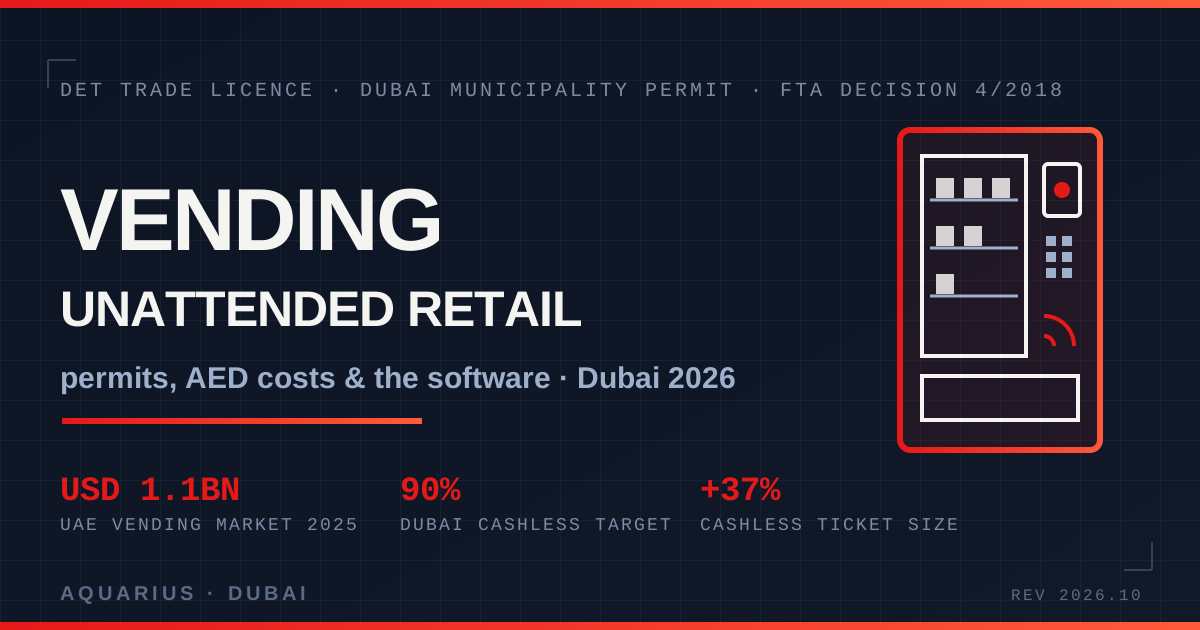
Short answer: A vending machine business in Dubai costs roughly AED 40,000 to AED 120,000 to start, needs a DET mainland commercial licence plus a Dubai Municipality vending and food-safety clearance before a single machine goes on a wall, and lives or dies on two things nobody quotes you for: cashless acceptance and telemetry. The UAE vending market was about USD 1.1 billion in 2025, Dubai wants 90% of all transactions cashless by the end of 2026, and a cash-only machine in that environment is a machine quietly losing a third of its basket.
Key takeaways
- The UAE vending machines market was estimated at USD 1,098 million in 2025 and is projected to reach USD 1,597 million by 2032 (6.4% CAGR). The smart-vending slice grows nearly twice as fast at 11.21% CAGR, heading to USD 328.58 million by 2032.
- Dubai's Cashless Strategy, launched October 2024, targets 90% cashless transactions across government and private sectors by 2026, with a projected economic contribution of more than AED 8 billion a year.
- Operator payment data for 2025 shows 78% of vending sales now cashless (up from 73%), contactless at 85% of that, and an average cashless ticket of USD 2.24 against USD 1.78 for cash — a 37% bigger basket.
- Telemetry is an operations lever, not a dashboard toy: connected fleets report roughly 13% fewer machine visits per route, a 30% improvement in service time per stop from pre-kitting, and one documented programme cut routes by 40%.
- The VAT rule most new operators miss: FTA Decision No. 4 of 2018 means no tax invoice is required for a supply through a vending machine, and the date of supply is the date the funds are collected from the machine — not the date of the sale.
Why Dubai is a better unattended-retail market than it was three years ago
Unattended retail works where footfall is dense, labour is expensive and payment is frictionless. Dubai has been moving hard on the third variable. The Dubai Cashless Strategy was launched in October 2024 by Sheikh Hamdan bin Mohammed, Crown Prince of Dubai, and is run by Dubai Finance with a stated goal of 90% cashless transactions across government and private sectors by 2026. A dedicated Digital Payment Systems Regulatory Division was set up inside the Department of Finance in December 2024 to drive it, and the programme is projected to add more than AED 8 billion a year to the economy through fintech growth.
That matters for a machine on a wall more than it does for a shop with a till. A retail store with a card terminal and a cashier is already compliant with the direction of travel. A coin-and-note vending machine is the single most visible piece of cash infrastructure left in a modern building lobby.
The market numbers back the shift. The UAE vending machines market was estimated at USD 1,098 million in 2025, forecast to reach USD 1,597 million by 2032 at a 6.4% CAGR. Inside that, retail vending is valued at roughly USD 185 million and industrial vending — tool cribs, PPE dispensers, consumables for sites and warehouses — at about USD 140 million. The fastest-growing segment is smart vending, projected to grow at 11.21% CAGR to USD 328.58 million by 2032. In other words: the overall market grows steadily, and the connected, cashless, software-managed part of it grows almost twice as fast.
What it actually costs to start in Dubai
Here is a realistic 2026 build-out for a small Dubai operator putting three to five machines into business centres or metro-adjacent locations. These are market ranges, not our quotes.
| Line item | Typical AED range | Notes |
|---|---|---|
| Trade name registration | 620 – 1,200 | One-off, before licensing |
| Commercial licence (mainland DET or free zone) | 10,000 – 20,000 | Annual; approval usually 5–10 business days |
| Dubai Municipality / food safety permit | 1,000 – 3,000 | Required for food and beverage machines |
| Investor visa + Emirates ID | 3,500 – 7,000 | Per person |
| Vending machine (per unit) | 10,000 – 18,000 | Higher for refrigerated and smart units |
| Custom branding and setup | 1,500 – 4,000 | Per machine |
| Opening inventory | 2,000 – 5,000 | Per machine |
| Transport and installation | 1,000 – 3,000 | Per machine |
| Insurance and compliance | 1,000 – 2,500 | Annual |
| All-in startup | 40,000 – 120,000 | Depending on machine count and licence route |
On the revenue side, a reasonably sited machine in Dubai generates roughly AED 3,000 to AED 7,000 a month in sales at gross margins of 35% to 55%. Business-centre placements commonly net AED 1,800 to AED 2,700 of monthly profit, metro-adjacent sites AED 2,000 to AED 2,800. Site owners typically take a commission of 10% to 25% of monthly sales, and most operators reach break-even in the first 6 to 12 months. Operating without the right commercial licence attracts fines in the AED 5,000 to AED 15,000 band, which is the cheapest mistake on this page to avoid.
The permits, in the order you need them
- Commercial licence. The Department of Economy and Tourism issues the mainland trade licence. Free zone routes exist (DMCC, IFZA, SHAMS are the usual suspects), but if your machines will sit in mainland Dubai buildings, the mainland licence is the straightforward path.
- Dubai Municipality clearance. Machines dispensing food or drink need health and safety approval from Dubai Municipality on top of the trade licence.
- Location approval and landlord NOC. Each site needs a No Objection Certificate from the building owner or facilities manager. This is also where most placement deals die — negotiate commission and electricity supply in the same conversation.
- Dubai Civil Defence clearance. Needed where machines are installed in public buildings.
Cash is the expensive option now
This is the part that separates operators who scale from operators who stall. The most detailed public payments data on vending comes from US operator networks, and while the absolute figures are a different market, the direction is unambiguous and matches what Dubai's cashless push is engineering. In 2025, 78% of vending sales were cashless, up from 73% a year earlier, with contactless accounting for 85% of all cashless vending sales. The number that should change your hardware spec: the average cashless ticket was USD 2.24 versus USD 1.78 for cash — 37% higher. Industry reporting consistently puts the sales lift from converting a cash-only machine to cashless in the 20% to 35% range.
Translate that to Dubai. A machine doing AED 5,000 a month on coins and notes is plausibly a machine doing AED 6,000 to AED 6,750 with a contactless reader on the front — and the reader costs a fraction of the machine. The acceptance set you want in this market is wider than a card terminal: Apple Pay and Google Pay are table stakes for a population this phone-first, and account-to-account rails are now a real option. We cover the integration mechanics in our guides to Apple Pay and Google Pay integration in Dubai and Aani and Jaywan payment integration.
There is a second, quieter cost to cash. Someone has to physically collect it, count it, reconcile it against machine counters and bank it. On a five-machine estate that is an annoyance. On a thirty-machine estate it is a part-time salary and a shrinkage problem.
What a vending management system actually does
Vending software sounds like a dashboard. The useful version is an operations system with four jobs.
- Telemetry. A connected controller reads sales and inventory events off the machine bus (MDB for payment peripherals, DEX for audit data) and pushes them to your platform over a SIM. You stop guessing what sold.
- Dynamic routing and pre-kitting. Instead of visiting every machine every week, you visit the machines that need visiting, with the stock they need already picked. Connected fleets report roughly 13% fewer machine visits per route versus offline operations, and pre-kitting delivers about a 30% improvement in service time per stop. One documented programme with a large operator cut total routes by 40% after deploying telemetry-driven route planning.
- Planogram and price management. Change a price or a product mix remotely, per machine, per location. A machine in a labour accommodation and a machine in a DIFC tower should not be running the same planogram or the same prices.
- Maintenance and alerts. Coil jams, fridge temperature excursions, reader offline, door open. Published research on predictive maintenance for connected vending reports a 32% reduction in unplanned downtime and a 27% drop in unnecessary technician dispatches. An offline machine with a jammed coil is a machine earning zero and training its best customers to walk past.
If your estate includes refrigerated food, the temperature log stops being a nice-to-have and becomes your evidence file for a Dubai Municipality inspection. The same logic applies to a fleet of kiosks — see our breakdown of self-service kiosk software development in Dubai — and to any route-based operation, which we cover in van sales and route distribution software.
Licence a platform or build your own?
| Option | Indicative AED | Fits when |
|---|---|---|
| Off-the-shelf VMS plus telemetry hardware | Per-machine monthly fee plus controller cost per unit | Under roughly 30 machines, standard snack and drink mix, no unusual integrations |
| Telemetry MVP (own dashboard, bought controllers) | 55,000 – 120,000 build | You want your own data model and reporting, hardware stays commodity |
| Full custom platform (routing, planogram, finance integration, operator app) | 150,000 – 350,000 build | Multi-brand estates, micro-markets, landlord revenue-share reporting, ERP or POS integration |
| Connectivity and hosting | 25 – 60 per machine per month | SIM data, cloud, monitoring — budget it from day one |
Those build figures are our own Dubai delivery ranges, not a market survey; current detail is on our pricing page. The honest rule: under 30 machines, licence something and spend your money on placements. Above that, or the moment you are reporting revenue share to landlords and reconciling three payment providers, the per-machine fee starts looking like a tax on growth and an owned platform pays for itself.
The VAT and e-invoicing detail most operators get wrong
Most Dubai businesses get this backwards, and it is worth two paragraphs because it changes your software's data model.
First, invoices. Under FTA Decision No. 4 of 2018, a VAT-registered person making supplies of goods or services through a vending machine is not required to issue a tax invoice for those supplies. Second, timing. For supplies paid through a vending machine, the date of supply is the date on which funds are collected from the machine — not the moment the customer tapped. That means your VAT position is driven by collection events, so your platform needs to record collections as first-class objects with dates, amounts and machine references, reconciled against sales. Operators who treat the cashless provider's settlement file as the only truth end up unable to evidence either number.
Then there is e-invoicing, which is arriving on a fixed timetable set by Ministerial Decision No. 244 of 2025 as amended by Ministerial Decision No. 66 of 2026. Voluntary use of the system opens 1 July 2026. Businesses with revenue of AED 50 million or more must appoint an Accredited Service Provider by 30 October 2026 and go live 1 January 2027; all other VAT-registered businesses follow on 1 July 2027, and in-scope government entities on 1 October 2027. The mandate is B2B and B2G, so your consumer sales at the machine are not the exposure — your corporate invoices are. If you run micro-markets for a contractor, bill a free zone landlord for a revenue share, or supply industrial dispensers to a logistics company, those invoices are in scope. Our UAE e-invoicing integration guide covers the patterns.
How we would build it, and what to do next
Our bias for a Dubai operator is unglamorous and it is sequenced on purpose. Get cashless on every machine first — it is the cheapest intervention with the largest documented revenue effect, somewhere in the 20% to 35% band, and it is also what the emirate's 90%-cashless-by-2026 target is pulling you towards anyway. Then add telemetry, because routing decisions made on real sales data are what turn a 10-machine side business into a 50-machine operation without a 5x increase in driving. Then build the platform, once you know which reports you actually read every Monday.
The cost of inaction is quantifiable here, which is rare. On a ten-machine estate doing AED 5,000 per machine per month, a 25% cashless uplift is roughly AED 150,000 of additional annual revenue, and a telemetry-driven 13% cut in machine visits saves a meaningful slice of a driver's week. Against that, a telemetry MVP in the AED 55,000 to AED 120,000 range is a one-year payback at estate scale — and an unlicensed machine is an AED 5,000 to AED 15,000 fine and a removal order.
Aquarius builds the software layer: telemetry ingestion, cashless reconciliation, planogram and price control, route planning, landlord revenue-share reporting and the VAT-correct collection records described above. We work in fixed-scope phases so you can stop after the MVP if the numbers do not justify phase two. Tell us how many machines you run and where and we will come back with a scoped phase one and an AED number, not a brochure.
FAQ
Do I need a separate licence for each vending machine in Dubai?
You need one commercial licence for the business, plus Dubai Municipality approval covering the machines themselves where food or drink is dispensed, and a location approval with a landlord NOC for each site. The per-site paperwork, not the per-machine paperwork, is what slows expansion.
How much does a vending machine cost in Dubai in 2026?
AED 10,000 to AED 18,000 per unit is the normal band, with refrigerated and smart units at the top of it. Add AED 1,500 to AED 4,000 for branding and setup and AED 2,000 to AED 5,000 for opening stock. All-in startup for a small estate runs AED 40,000 to AED 120,000.
Is cashless payment mandatory for vending machines in Dubai?
There is no vending-specific mandate. Dubai's Cashless Strategy is a target — 90% of transactions cashless by 2026 — not a per-machine rule. The commercial case does the work instead: cashless tickets average 37% larger than cash tickets, and converting a cash-only machine typically lifts sales 20% to 35%.
Do I have to issue a VAT invoice for vending machine sales?
No. FTA Decision No. 4 of 2018 removes the tax-invoice requirement for supplies made through vending machines. You still owe the VAT, and the date of supply is the date funds are collected from the machine, so keep auditable collection records per machine.
Can I run a Dubai vending business from a free zone company?
Free zone licences exist for the activity, but placing machines in mainland Dubai buildings is cleanest on a mainland DET licence. Decide this before you sign placement agreements — changing licence structure after the fact means redoing site approvals.
Related reading: payment gateway integration cost in Dubai and POS and inventory software development. Or see what we build on our services page.