
Super App and Mini App Development in Dubai 2026: AED Cost
Mini app inside an existing super app: AED 45,000-150,000. Your own multi-service app: AED 180,000-450,000. A host platform: AED 600,000+. Which route fits.
- PUBLISHED
- 17 OCT 2026
- READ TIME
- 10 MIN
- AUTHOR
- AQUARIUS · DUBAI
- UNIT
- REV 2026.09
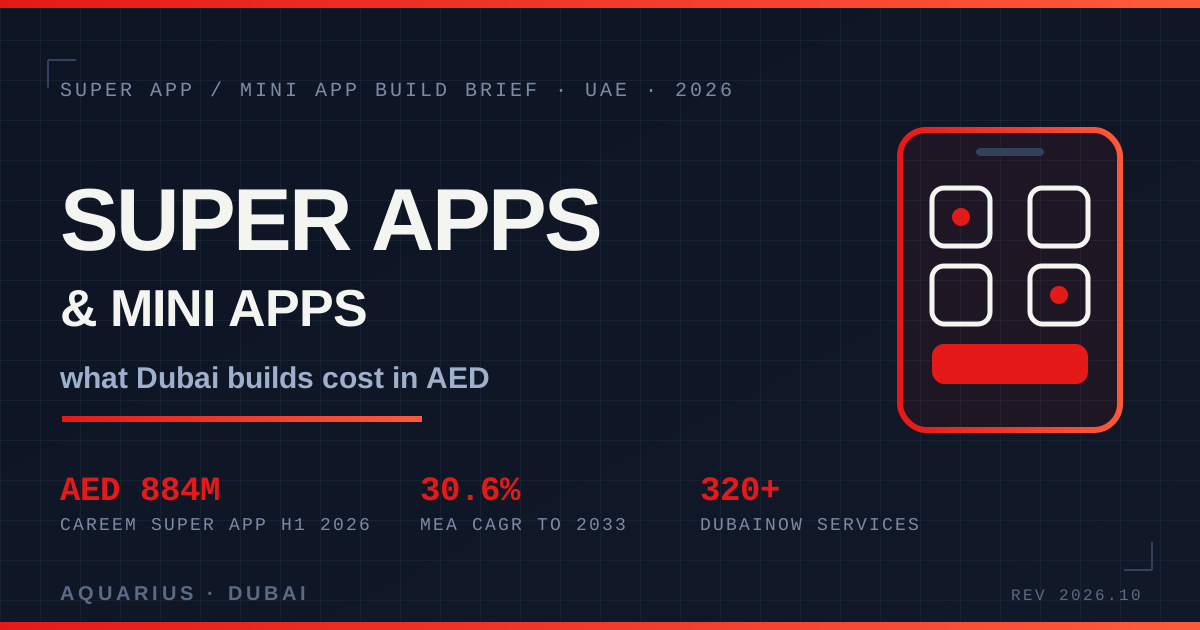
Short answer: In Dubai in 2026 there are three realistic routes, not one. Launching your service as a mini app inside an existing super app costs roughly AED 45,000 to AED 150,000; building your own multi-service app (several services, one login, one wallet) runs AED 180,000 to AED 450,000; and becoming a host platform that carries other companies’ mini apps starts near AED 600,000 and behaves like a product company, not a project. Most UAE businesses asking for a super app actually need the first option.
The super app model is no longer a China-only story. Careem’s super app business posted revenue of AED 884 million in the first half of 2026, up 20 percent year on year, while operating losses climbed to about AED 447 million — proof that the demand is real and that the economics are brutal if you finance the whole shell yourself. This guide prices all three routes in AED, names the UAE-specific plumbing (UAE Pass, wallet licensing, PDPL, Arabic right-to-left) and shows which route fits which business.
Key takeaways
- The Middle East and Africa super apps market is forecast to grow at a 30.6 percent CAGR from 2026 to 2033, reaching about US$71.5 billion.
- The UAE has 23.0 million mobile connections, about 202 percent of the population, and 11.3 million internet users at 99 percent penetration. The phone is the channel.
- DubaiNow already aggregates 320+ services from 50+ entities, with more than 180 further services due by the end of February 2027. Government set the expectation your customers now have.
- Distribution beats construction: in August 2026 Dubai Municipality launched the Al Freej Gardener licensed-gardener service inside Careem rather than shipping a new app.
- If your app holds balances you are in CBUAE licensing territory, not just engineering territory. e& money, with more than 2 million customers, only received a Finance Company licence in February 2026.
Why Dubai businesses keep asking for a super app in 2026
The pressure comes from three directions at once, and all three are measurable.
The device base is saturated. The UAE runs 23.0 million mobile connections against a population of roughly 11.4 million, and 11.3 million internet users at about 99 percent penetration, with an average of 8 hours 11 minutes of daily internet use. Android holds roughly 81 percent of UAE mobile OS share, which matters the moment someone proposes an iOS-first build.
The habit already exists. Careem reports more than 50 million users, around 2.5 million captains and close to 80 million monthly transactions across 100-plus cities, with about 48 percent ride-hailing share in MENA. UAE users average three transactions a week on the app. Your customer is not learning a new behaviour; they are already inside someone else’s shell.
Government normalised it. DubaiNow puts 320-plus services from more than 50 government and semi-government entities behind one login, and Digital Dubai has said 180-plus additional services are due by the end of February 2027. When a resident can pay DEWA, renew a licence and settle Salik in one place, a single-purpose app for one small task starts to feel like friction.
Add the market forecast, a 30.6 percent CAGR for MEA super apps from 2026 to 2033, and the boardroom question writes itself. The mistake is answering it with a build instead of a strategy.
What a super app actually is: three layers, not one app
A super app is not a normal app with more screens. Stacking ten unrelated features into one binary produces a slow app with a confused home screen. A real super app has three separable layers:
- The shell (host). Navigation, identity, payments, notifications, support, analytics. This is the expensive part, and on its own it earns nothing.
- The spine. One account, one wallet, one address book, one order history shared across every service. Without a shared spine you have an app launcher, not a super app.
- The mini apps. Individual services, yours and other companies’, delivered as sandboxed modules the host loads on demand, so adding a service does not require a full app-store release.
The mini-app pattern is what makes the model scale. In the mature version of this market, WeChat’s mini programs draw roughly 410 million daily active users, and overseas mini-program transaction volume grew more than 40 percent year on year in 2025. The lesson for Dubai is not “copy WeChat”. It is that the value sits in the distribution the host owns, and in 2026 you can rent that distribution instead of financing it.
The three routes, priced in AED
The ranges below are the bands we quote at Aquarius for Dubai builds in 2026, before VAT; our standard tiers are on the AED pricing page. Timelines assume a decided scope and one responsive decision-maker.
| Route | Build cost (AED) | Timeline | Annual run cost (AED) | When it fits |
|---|---|---|---|---|
| 1. Mini app inside an existing super app — partner integration: catalogue, pricing, bookings, settlement through the host | 45,000 – 150,000 | 6 – 12 weeks | 18,000 – 60,000 plus host revenue share | You have a service and no audience. Fastest path to transactions. |
| 2. Your own multi-service app — 3 to 6 services, one login, stored cards, loyalty, Arabic and English | 180,000 – 450,000 | 4 – 8 months | 60,000 – 180,000 | You already own repeat customers: retail group, clinic network, property manager, fuel or F&B chain. |
| 3. Host platform carrying third-party mini apps — mini-app SDK, partner console, sandboxing, revenue split, KYC | 600,000 + | 9 – 18 months to a credible v1 | 250,000 + | You have millions of monthly users or an exclusive channel. Otherwise, do not. |
| Add-on: stored-value wallet — balances, top-up, refunds, reconciliation, licence support | +120,000 – 300,000 | +3 – 6 months, licence-dependent | +90,000 + | Only when balances measurably lift repeat purchase. |
Two numbers decide route 2 against route 3. First, Careem absorbed AED 447 million of operating loss in six months of 2026 to hold a shell that already has 50 million users. Second, a route-1 mini app can be live in under three months for less than the legal bill on a wallet licence. If you do not have a captive audience, you are not buying a super app, you are buying customer acquisition at the worst possible price.
The myth-bust: most Dubai businesses should be a mini app, not build one
The clearest 2026 example is not a startup. In August 2026 Dubai Municipality, working with Dubai Police and the General Directorate of Identity and Foreigners Affairs, launched Al Freej Gardener, a licensed-gardener booking service, inside the Careem app. A government entity with unlimited brand recognition still chose someone else’s distribution over a new icon on your home screen.
Careem now carries more than a dozen UAE services, including third-party ones it does not operate: laundry, home cleaning and car rental among them. Each of those companies gets the host’s install base, payment rails and push notifications without paying for the shell.
Run the arithmetic before you argue with it. A standalone consumer app in Dubai competes for installs at roughly AED 5 to AED 20 each on paid channels, so 50,000 installs is AED 250,000 to AED 1,000,000, more than the build itself, and most of those users never open the app a second time. A mini app starts inside an audience that already transacts three times a week. The ego answer is your own super app. The commercial answer, for most UAE SMEs, is to be the best mini app in someone else’s.
The UAE plumbing you cannot skip
This is where international super-app blueprints fail in Dubai. Four items are non-negotiable, and all four are cheaper to design in than to retrofit.
Identity: UAE Pass
Multi-service apps need verified identity once, not per service. UAE Pass is the national digital identity and the expected sign-in for anything touching government data or regulated services. Budget it as a first-class integration, not a sprint-ten task. Our UAE Pass integration guide for Dubai apps covers the flow.
Money: a wallet is a licence, not a feature
A stored balance, a top-up or a transfer between users puts you under Central Bank of the UAE supervision. The prize is real: the UAE prepaid card and digital wallet market is tracked at about US$8.28 billion in 2026, growing around 12.7 percent a year. So is the barrier: e& money, with more than 2 million customers, only secured a Finance Company licence from CBUAE in February 2026. Most route-2 builds should use cards, Apple Pay and Google Pay plus a closed-loop loyalty balance instead. Our e-wallet development and CBUAE SVF licence guide shows where the line sits.
Data: PDPL and one shared profile
The whole point of a super app is a shared customer profile across services, which is exactly the structure UAE Federal Decree-Law No. 45 of 2021 (PDPL) scrutinises. You need a lawful basis per service, purpose limits between them, and consent design that does not silently leak order history from your clinic module into your retail module.
Language: Arabic right-to-left, properly
Translated strings are not an RTL product. Mirrored navigation, Arabic numerals, bilingual receipts and mixed-direction forms have to be tested on real devices in an Arabic locale, and in a multi-service shell every mini app must respect the host’s direction switch.
What we would actually build first, and what it costs
Our standing recommendation for Dubai clients is a 90-day wedge, not a platform. Pick the single service with the most repeat demand, ship it where the audience already is, then decide whether the shell is worth owning.
- Weeks 1 to 2: route decision, host shortlist, revenue-share terms, licence check. Fixed fee of AED 15,000 to 25,000, credited against the build.
- Weeks 3 to 10: build and launch one service, with payment, notifications, Arabic and English, and analytics on every step. AED 45,000 to 150,000 depending on host and integration depth.
- Weeks 11 to 14: read the data. Repeat-purchase rate, basket size, support load. If three services clear the bar, scope route 2 against real numbers instead of a pitch deck.
Cost of getting this backwards: an AED 300,000-plus multi-service app with a shell nobody opens, plus a wallet licence process you did not need. Cost of getting it right: one live, revenue-producing service inside a quarter, and an evidence-based case for the bigger build. For the underlying per-app economics see our Dubai mobile app development cost guide, and for the retention layer that makes multi-service pay, our loyalty and rewards app guide.
FAQ
How much does it cost to build a super app in Dubai?
A credible host platform carrying third-party mini apps starts around AED 600,000 and takes 9 to 18 months, with annual running costs from AED 250,000. Your own multi-service app with 3 to 6 services is AED 180,000 to AED 450,000 over 4 to 8 months. Launching as a mini app inside an existing super app is AED 45,000 to AED 150,000 in 6 to 12 weeks.
What is the difference between a super app and a mini app?
The super app is the host: identity, payments, navigation and distribution. A mini app is a single sandboxed service loaded inside that host on demand, which means it ships and updates without a full app-store release. One super app can carry hundreds of mini apps from different companies.
Do I need a CBUAE licence for a super app wallet?
If you hold customer balances, allow top-ups or move money between users, you are in Central Bank licensing territory. Card payments, Apple Pay, Google Pay and a closed-loop loyalty balance usually are not. Decide this before engineering, because it changes architecture, timeline and cost.
Is a super app worth it for a Dubai SME?
Rarely as a host. The model monetises attention you already have, and Careem needed 50 million users and heavy losses to sustain its shell. For most UAE SMEs the better return is one excellent service placed inside an existing super app, or a focused multi-service app for customers you already serve weekly.
How long does a mini app integration take in the UAE?
Six to twelve weeks is typical once the host partnership is agreed: catalogue and pricing feed, booking or ordering flow, payment and settlement, Arabic and English content, then the host’s review. Commercial negotiation, not engineering, is usually the long pole.
Decide the route before you spend the budget
Super apps are the right read of the UAE market. Mobile connections at 202 percent of the population, a 30.6 percent regional growth forecast and a government app with 320-plus services all point the same way. The expensive error is assuming that means you should build the shell. Send us your service list and your monthly active customer count and we will come back with the route, the AED band and the licences your feature list triggers, free, and useful even if you build it elsewhere.
Talk to Aquarius about your app, or see our development services and fixed AED pricing.