
Study Abroad and Education Consultancy Software in Dubai 2026: CRM, Applications, Commissions
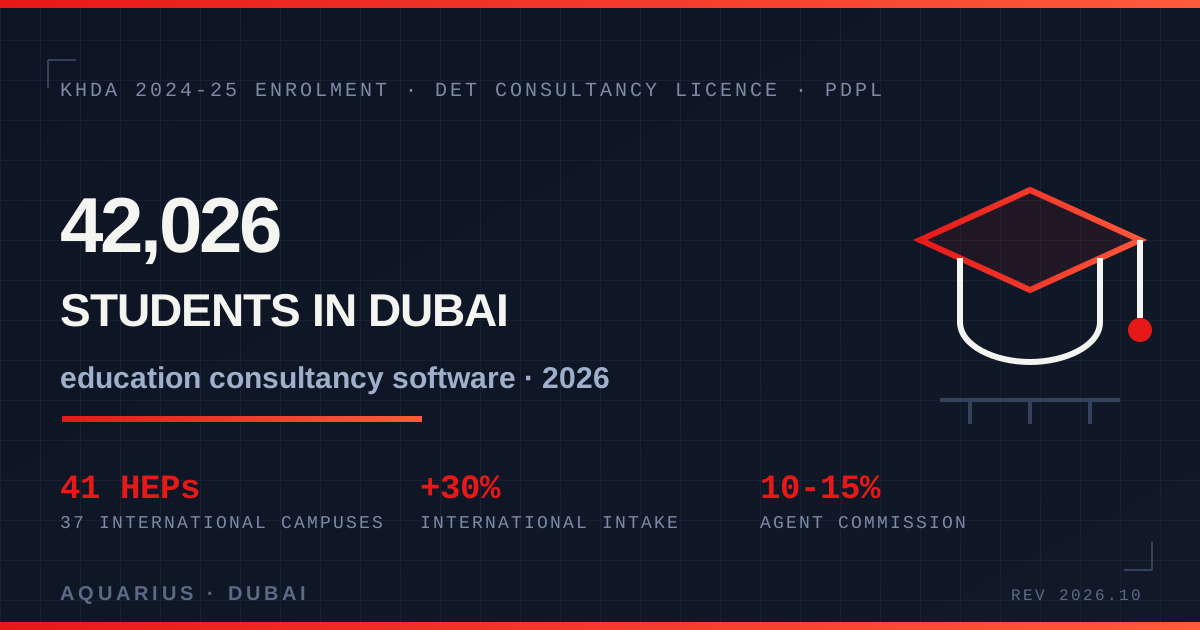
Dubai now hosts 42,026 students at 41 licensed institutions with international intake up 30%. What a study abroad CRM costs in AED, and how to get commissions paid.
- PUBLISHED
- 15 OCT 2026
- READ TIME
- 09 MIN
- AUTHOR
- AQUARIUS · DUBAI
- UNIT
- REV 2026.09
Short answer: a Dubai education consultancy can run on an off-the-shelf study abroad CRM for roughly AED 33 to AED 1,470 per month, or commission a custom platform for AED 45,000 to AED 300,000+ one-off plus AED 20,000-50,000 a year in support. The deciding factor is almost never the student pipeline. It is the commission ledger: a 2026 survey of institutions found 67% release nothing until every tuition fee is collected, so an agency without an auditable per-application money trail is financing universities for free.
Dubai has quietly become a source market and a destination market for international education at the same time. That double flow is what makes counselling here different from an agent in Hyderabad or Lagos: one Dubai consultancy may place a student in Manchester this intake and recruit a student into Dubai Knowledge Park the next. The software has to handle both directions, in two languages, under UAE data law. Here is what that actually requires in 2026, with real numbers.
Key takeaways
- KHDA reports 42,026 students across 41 licensed higher education providers in Dubai for 2024-25, of which 37 are international branch campuses.
- International enrolment rose nearly 30% year on year and international students are now 35% of the student body. KHDA’s Education 33 strategy targets 50%.
- UNESCO-based figures put 18,600 Emirati students abroad in 2024-25, about 51% above 2018.
- An AIRC survey of 61 institutions fielded March-April 2026 found the most common commission basis was a fixed post-enrolment fee (48%), then net tuition percentage (39%); typical rates were 15% of gross or 10-15% of net, with fixed fees mostly US$2,000-3,500 (AED 7,345-12,854) per student.
- Generic CRMs start near US$9-14 per seat per month (AED 33-51); study abroad specialist tools run US$200-400 a month (AED 735-1,470); a custom UAE build lands at AED 45,000-300,000+.
- Student files are personal data. UAE PDPL exposure reaches AED 5,000,000 per violation, and passport scans living in WhatsApp threads is the single most common finding when we audit a consultancy.
The Dubai numbers behind the hiring spree
Agencies are opening here because the market grew on both sides of the ledger at once.
On the inbound side, the Knowledge and Human Development Authority reported a record 42,026 students at 41 private higher education providers in Dubai for 2024-25, of which 37 are international branch campuses. International enrolment, meaning students who came to Dubai specifically to study, grew nearly 30% and now accounts for 35% of all students. Emirati enrolment rose 22% to 3,832. The emirate added 91 new programmes, taking the catalogue to 706 courses, and the Education 33 agenda sets public targets of 50% international students, three universities in the QS top 100, and a tenfold increase in education tourism.
On the outbound side, UNESCO-derived data counts roughly 18,600 Emirati students studying abroad in 2024-25, about 51% more than in 2018, with the United Kingdom the largest destination. The National Scholarship Programme drew 2,767 applications for 244 awards in 2026 and now supports 596 students across 22 countries. Add the expatriate families whose children apply to the UK, Canada, Australia, India and Europe every intake and you get a counselling market where one office juggles several destination countries, visa regimes and commission contracts simultaneously.
That is three or four distinct workflows. Most Dubai consultancies still run all of them on a shared spreadsheet, a WhatsApp Business inbox and the memory of one senior counsellor.
What a study abroad platform must do in Dubai
A generic sales CRM models one deal with one value and one close date. A student is not a deal. One student generates five to twelve applications across two or three countries, each with its own deadline, document set, conditional offer, deposit, visa stage and commission rate. Any tool that cannot hold that shape gets abandoned within two intakes.
Student and application records, not leads
The structure that works is student → applications → offers → enrolment → commission. Each application carries its own institution, programme, intake month, status, fee and owner. Student-level reporting only tells you how busy you are; application-level reporting tells you which universities actually convert for your office.
Document vault with expiry logic
Passports, Emirates IDs, transcripts, IELTS or PTE scores, bank statements, attestations. Each has a validity window, and a missing attestation discovered in week six is a lost intake. The vault should flag expiring documents before the deadline calendar does, and it should end the habit of emailing scans back and forth.
Deadline and visa calendar
Intakes are fixed and unforgiving: UK January and September, Australia February and July, Canada September and January, with scholarship cut-offs months earlier. You need one merged calendar of application deadlines, deposit dates and visa lodgement windows per student, with automated reminders in English and Arabic.
Sub-agent and referral management
Most Dubai consultancies feed from sub-agents, school counsellors and freelance referrers. If you cannot see which sub-agent sourced which application, you cannot split a commission without an argument. Give sub-agents a scoped portal, not access to your whole database.
The commission ledger
This is where the money is won or lost, and it deserves its own section.
Commission tracking: the part spreadsheets always break
The AIRC survey of 61 institutions, fielded in March and April 2026 and reported by ICEF Monitor, is the clearest recent picture of how agent money actually moves.
| Practice | 2026 finding | What it means for a Dubai agency |
|---|---|---|
| Commission basis | Fixed post-enrolment fee 48%, net tuition percentage 39%, gross tuition 6% | Your ledger must support three calculation models at once |
| Typical rate | 15% most common on gross tuition; 10-15% on net tuition | Rate varies by contract, not by country, so it belongs on the agreement record |
| Fixed per-student fee | Mostly US$2,000-3,500 (AED 7,345-12,854) | Headline percentages mislead on low-tuition programmes |
| Payment release | 67% pay nothing until all tuition and fees are received | Cash lands months after enrolment; you fund the gap |
| Duration | 51% pay commission on the first two semesters only | Year-two revenue in your model is probably wrong |
| Institution engagement | 75% of surveyed institutions now work with agencies, up from 62% in 2018 | More contracts to track and more tiered clauses to enforce |
Read the fourth row again. Two-thirds of institutions hold the money until the student has paid in full, and half stop paying after two semesters. A consultancy placing 120 students a year at a mid-range AED 10,000 commission is carrying roughly AED 1.2 million of receivables arriving unpredictably, often net of clawbacks when a student defers or withdraws. Tiered contracts make it worse: a university that lifts you from 10% to 15% at 20 enrolments per intake will not volunteer the uplift. You have to invoice for it, which means counting enrolments per institution per intake accurately. A spreadsheet maintained by whoever is least busy does not do that.
A real ledger stores the agreement (rate, basis, tiers, clawback terms, payment trigger), links every enrolment to it, computes expected commission on offer acceptance, ages the receivable, and reconciles part-payments against remittance advice. That one feature usually pays for the whole build.
Buy or build: 2026 AED cost comparison
USD figures use the fixed 3.6725 AED/USD peg. Vendor prices are 2026 list prices and exclude 5% UAE VAT.
| Option | Published price | Approx. AED | Best for |
|---|---|---|---|
| Generic CRM (monday CRM class) | From US$9 per seat per month | ≈ AED 33 per seat per month | Two or three counsellors, one destination country, manual commissions |
| Generic CRM (Zoho CRM class) | From US$14 per user per month | ≈ AED 51 per user per month | Agencies already on Zoho Books or Zoho One |
| Study abroad specialist platform | US$200-400 per month | ≈ AED 735-1,470 per month | Single-market agencies wanting application workflows out of the box |
| Custom UAE platform | AED 45,000-300,000+ one-off | Plus AED 20,000-50,000 a year support | Multi-country, sub-agent networks, bilingual portals, PDPL-controlled data |
Honest guidance: if you place fewer than 50 students a year into one destination country, licence something. Subscriptions are cheap and your constraint is counsellor time, not software. Build when at least two of these are true — you run a sub-agent network, you work three or more destination countries, commission disputes cost you real money, you need an Arabic student portal, or your institution partners audit your data handling. We walk the same line for other verticals in Zoho vs Salesforce vs custom CRM in Dubai, and institutions on the receiving end of your applications face it too in admissions and SIS software for Dubai universities.
Licence and compliance: what software cannot fix
Two compliance tracks matter before you spend anything on technology.
Your trade licence. Education consultancy in Dubai sits under a professional consultancy licence from the Department of Economy and Tourism. Published 2026 guidance puts a mainland professional licence at AED 9,000-15,000, with educational consultancy packages advertised from around AED 5,500 in some free zones, and realistic first-year mainland cost including trade name, establishment card, office and one visa landing between AED 25,000 and AED 55,000. The critical distinction is scope: advising a student on where and how to apply is consultancy. Teaching content, running test preparation classes or delivering training moves you into instruction, which needs KHDA permitting, commonly quoted at AED 10,000-25,000 with a KHDA application fee around AED 5,000. Many consultancies drift across that line by adding IELTS coaching and only discover it at renewal.
Student data. A counselling file is a dense bundle of personal data: passport copies, Emirates ID, family financial statements, academic history, sometimes medical notes. Under Federal Decree-Law No. 45 of 2021, the UAE Personal Data Protection Law, that needs a lawful basis, purpose limitation, retention limits and real security, with penalties reaching AED 5,000,000, breach notification duties and a 30-day clock on data-subject requests. The three findings we hit in nearly every consultancy audit are passport scans living permanently in WhatsApp threads, shared logins so no action traces to a person, and no deletion process once a student enrols or drops out. Our UAE PDPL compliance checklist for websites and apps covers the build-side controls, and because sub-agents are processors, your contracts with them have to say so.
What Aquarius builds, and what it costs
We deliver education consultancy platforms in stages so the commission ledger ships early and starts earning before the nice-to-haves.
| Stage | Scope | Indicative AED |
|---|---|---|
| Phase 1 — core | Student and application records, document vault with expiry alerts, intake and visa calendar, counsellor dashboard, role-based access | From AED 45,000 |
| Phase 2 — money | Agreement register with tiered rates, expected-commission engine, receivable ageing, clawback handling, remittance reconciliation, VAT invoicing with TRN | AED 35,000-80,000 |
| Phase 3 — scale | Sub-agent portal, bilingual EN/AR student portal, WhatsApp and email automation, AI document extraction, partner API feeds, BI dashboards | AED 40,000-150,000+ |
| Entry points | Business Site AED 2,500 · Custom App from AED 10,000 · Build AED 24,000 | See Aquarius pricing |
Work the arithmetic before signing anything. One recovered tier uplift — 15% instead of 10% on 20 enrolments at AED 80,000 first-year tuition — is AED 80,000 of commission that was already yours, found by counting correctly. One avoided clawback dispute on a deferred student is another AED 10,000. Against a Phase 1 plus Phase 2 build at roughly AED 80,000-125,000, the payback case rarely rests on efficiency gains at all. It rests on money you are currently not invoicing. Our web and app development services page lists the full stack, and we hand over the repository.
FAQ
How much does study abroad CRM software cost in Dubai in 2026?
Off-the-shelf options start around US$9-14 per seat per month, roughly AED 33-51, while study abroad specialist platforms publish US$200-400 a month, roughly AED 735-1,470. A custom UAE-built platform with a commission ledger and sub-agent portal runs AED 45,000-300,000+ one-off plus AED 20,000-50,000 a year in support.
What commission do universities pay education agents?
The AIRC survey of 61 institutions in March and April 2026 found 15% the most frequently reported rate on gross tuition and 10-15% on net tuition, with fixed per-student fees mostly US$2,000-3,500 (AED 7,345-12,854). Rates almost always apply to first-year tuition only, and 51% of institutions pay for just the first two semesters.
Why do commission payments arrive so late?
Because 67% of surveyed institutions release nothing until all tuition and other fees have been received from the student. Plan working capital around enrolment-plus-months rather than offer acceptance, and age every receivable in the system instead of chasing from memory.
Do I need a KHDA permit for an education consultancy in Dubai?
Pure advisory work — counselling students on destinations, universities and applications — runs on a DET professional consultancy licence. KHDA permitting applies once you deliver instruction such as test preparation or training courses. Keep your licensed activity scope matched to what you actually sell.
Is keeping student passports on WhatsApp a PDPL problem?
Yes, and it is the most common issue we find. Personal data needs a lawful basis, a defined retention period, traceable access and real security under Federal Decree-Law No. 45 of 2021, where penalties reach AED 5,000,000. A document vault with per-user access and automatic deletion rules fixes it in one step.
Can one platform handle outbound students and recruitment into Dubai?
It should. Dubai consultancies increasingly do both, and the data model is identical: student, applications, offers, enrolment, commission. What differs is the institution set, the visa workflow and the commission agreement, all of which belong in configuration rather than code.
Get a fixed quote for your consultancy platform
Tell us how many counsellors and sub-agents you have, which destination countries you place into, and how your commission agreements are structured. We will come back with a fixed AED quote, a staged delivery plan that puts the commission ledger first, and a straight answer on whether you should licence a tool instead. Request your quote or compare tiers on Aquarius pricing. Custom builds start at AED 10,000.