
Standard Costing in Dubai (2026): Why Your Product Cost Is Wrong and What That Costs You
Dubai manufacturing grew 0.5% in dirhams but shrank 0.9% in real terms in H1 2026. How to rebuild standard costs and variance analysis that IAS 2, the FTA and ICV all accept, with real AED build costs.
- PUBLISHED
- 12 NOV 2026
- READ TIME
- 12 MIN
- AUTHOR
- AQUARIUS · DUBAI
- UNIT
- REV 2026.09
Short answer: Standard costing is still legal, still useful and still the fastest way to price a Dubai factory’s output — but only if the standard is rebuilt against current conditions and the variances are explained every month. IAS 2 permits the standard-cost method only where the result approximates actual cost, so a standard set in 2024 and rolled forward into 2026 is not merely weak management information: it is an inventory valuation your auditor and the Federal Tax Authority can both reject. Rebuilding the standard and wiring up variance reporting in Dubai runs AED 22,000–55,000 for the costing baseline, AED 55,000–140,000 for a variance engine on your existing ERP, and AED 160,000–380,000 for a full product-costing and pricing layer.
The cost base Dubai manufacturers are actually pricing against
Three numbers explain why this stopped being an accounting hobby in 2026.
- Input costs are rising at a four-year high. The S&P Global UAE PMI released on 4 November 2026 put the headline index at 54.8 in October (down from 55.3 in September, Dubai at 54.6) with input cost inflation at its fastest pace since June 2022 — driven by raw materials, fuel, energy, freight, maintenance, storage and rent.
- Selling prices are rising faster than at any point on record. In the same survey, UAE non-oil output prices rose at the sharpest rate since the series began in August 2009. Everyone is repricing. The question is whether your price list is tracking your cost or guessing at it.
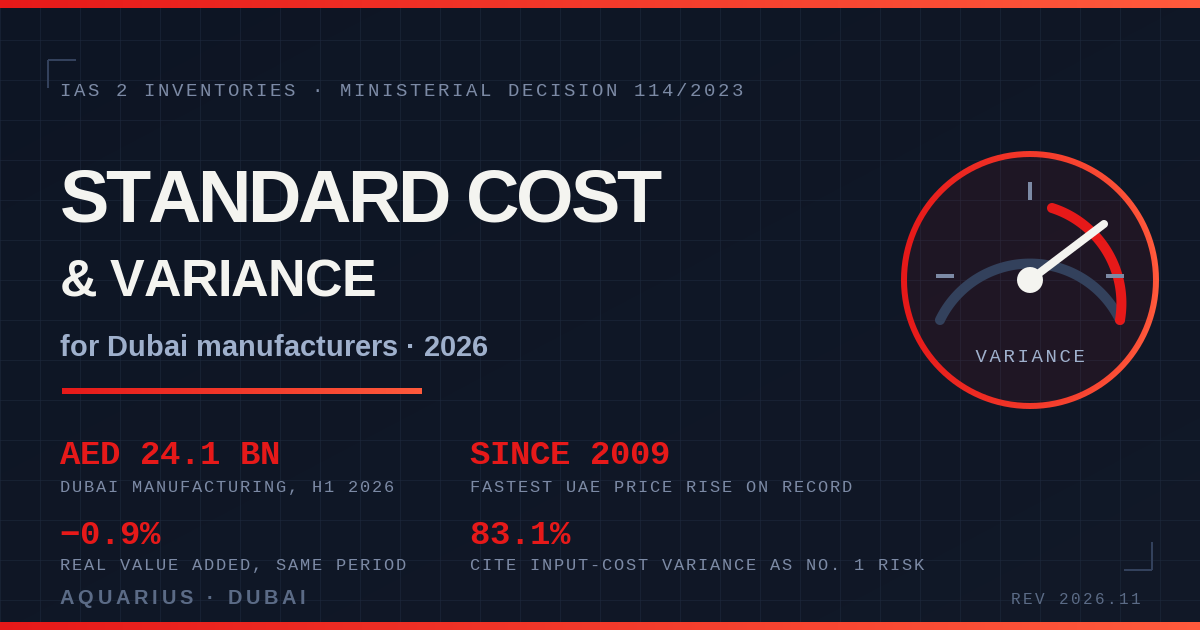
- Dubai manufacturing grew in cash and shrank in real terms. Dubai’s H1 2026 accounts show manufacturing value added of AED 24.1 billion at current prices, up 0.5%, but AED 23.7 billion at constant prices, down 0.9%, inside a city economy of AED 473 billion. That gap is the whole article: the sector billed more dirhams for less real output.
It is not a local quirk. In the US National Association of Manufacturers’ Q2 2026 Outlook Survey, 83.1% of manufacturers named rising raw material costs their top business challenge — up 25.6 percentage points from 57.5% a single quarter earlier — and expected input costs to rise 5.8% over the year. When a cost base moves that fast, a frozen standard cost does not just drift. It inverts: your best-selling SKU quietly becomes your worst-margin SKU and the P&L only tells you three quarters later.
Most Dubai manufacturers get this wrong the same way: they treat the standard cost as a budgeting number and the variance account as a dumping ground. Under IAS 2 it is the opposite — the standard is a measurement technique, and an unexplained variance is evidence that the measurement failed.
What IAS 2 actually permits
IFRS is mandatory for UAE corporate tax purposes under Ministerial Decision No. 114 of 2023, with IFRS for SMEs available where revenue does not exceed AED 50 million. Inventory therefore sits under IAS 2, and IAS 2 is unusually blunt about standard costing. The standard-cost method may be used for convenience if the results approximate cost. Standards must take into account normal levels of materials and supplies, labour, efficiency and capacity utilisation, and they must be regularly reviewed and, if necessary, revised in the light of current conditions.
Three consequences most Dubai finance teams have never operationalised:
- Fixed production overhead is absorbed on normal capacity, not on last month’s actual output. Absorb on actuals and a slow month inflates your unit cost and your closing stock with it.
- Unallocated overhead is expensed in the period incurred. You cannot park idle-capacity cost in inventory and release it when sales recover.
- Abnormal waste, storage and most admin cost never enter inventory at all. A scrap-heavy month is a P&L event, not a more expensive pallet.
Put together: the number you carry in stock has to be a current, normal-capacity cost, and the difference between it and what the floor really consumed has to be identified, named and either written off or used to revise the standard. That is variance analysis, and it is the part nobody built.
The five variances that explain your margin
Each one points at a different department. That is the reason to separate them rather than report a single “cost of sales variance” line.
| Variance | How it is computed | What it is really telling you |
|---|---|---|
| Material price (PPV) | (actual price − standard price) × actual quantity bought | Procurement and the market: FX, freight, customs duty, supplier mix |
| Material usage / yield | (actual quantity − standard quantity for output) × standard price | Scrap, rework, calibration, operator skill — the shop floor |
| Labour rate | (actual rate − standard rate) × actual hours | Overtime, shift premiums, visa and gratuity loading in the hourly rate |
| Labour efficiency | (actual hours − standard hours for output) × standard rate | Downtime, changeovers, waiting on material — usually the biggest single number |
| Overhead spending and volume | actual overhead − (standard rate × normal capacity hours) | Energy and maintenance drift, plus under-absorption when the plant runs slow |
A worked Dubai example. Say a packaging line runs 40,000 units a month on a standard material cost of AED 100 per unit, and purchase prices have crept to AED 108 because of freight and duty. The price variance alone is AED 320,000 a month — AED 3.84 million a year — sitting invisible inside cost of sales while the sales team still quotes off a 100-dirham cost card. Nothing in a standard ERP trial balance makes that visible. A variance report makes it the first line on the operations meeting agenda.
Overhead, normal capacity and your DEWA bill
Energy is where Dubai standards go stale fastest, because the tariff has two moving parts. DEWA’s industrial slab charges roughly 23 fils per kWh up to 10,000 kWh a month and 38 fils per kWh above that, and the monthly fuel surcharge — 6 fils per kWh in October 2026 — moves with the fuel price supplied to DEWA’s generation plants, with 5% VAT on the whole bill. A factory drawing 150,000 kWh a month is therefore paying a blended rate that can shift by several percent between quarters without a single machine changing.
If your overhead absorption rate was derived from a surcharge that no longer applies, every unit of closing stock is mispriced. The fix is not heroic: source the tariff and surcharge as data, recompute the machine-hour rate monthly, and let the costing layer revise the standard on a documented cadence instead of an annual scramble. Machine-hour denominators should come from real runtime, which is exactly what a shop-floor layer is for — see our note on why your ERP cannot see the shop floor.
What it costs to build in Dubai
Most mid-market Dubai manufacturers do not need a new ERP for this. They need the costing and variance layer the ERP shipped without, fed by data that already exists in purchasing, payroll and production.
| Scope | AED | Timeline |
|---|---|---|
| Costing baseline rebuild: BOM and routing clean-up, current standard cards, normal-capacity policy documented | 22,000–55,000 | 2–3 weeks |
| Variance engine on your existing ERP: PPV, usage, labour rate and efficiency, overhead absorption, monthly dashboards and exception alerts | 55,000–140,000 | 4–7 weeks |
| Full product-costing and pricing layer: multi-plant, multi-currency, landed cost, what-if repricing, IAS 2 absorption schedules, ICV cost extract | 160,000–380,000 | 10–16 weeks |
| Ongoing care: standard roll-forward automation, tariff and FX feeds, month-end variance pack | 4,000–15,000 / month | continuous |
Compare that with the alternative. A bank-grade or tier-one manufacturing cost module bought as an add-on module typically arrives with a multi-year licence and a six-figure implementation before anyone has looked at whether your BOMs are accurate — and inaccurate BOMs are the actual root cause in most Dubai engagements we see. Fix the data first; the engine is the cheap part. If the underlying system of record is also due, our ERP implementation guide for Dubai SMEs sets out that sequence, and our pricing page shows how these phases are packaged.
Why the costing file is now compliance evidence
Two UAE regimes read your cost data directly, and both of them accept it only if it is IFRS-grade.
Corporate tax. Taxable income starts from IFRS accounting profit. Closing inventory valuation is therefore a tax number: understate it and you understate profit, overstate it and you pay 9% on margin you never earned. With penalties starting at AED 500 for an incorrect return and a nine-month filing window, the cheap defence is a costing policy you can hand over, not a spreadsheet one person maintains.
ICV. In-Country Value scoring is how Dubai and federal buyers rank suppliers, and the MoIAT methodology is built on your audited financials: the statements used must be IFRS-compliant, signed and stamped by a UAE-licensed auditor and no more than two years old, every figure in the ICV template must reconcile to them, and the certificate is valid for 14 months from the audited statements’ issuance date. In-country manufacturing value is a cost-breakdown question. A factory that cannot split its own cost of goods into local spend, UAE wages, depreciation of UAE assets and imported material is leaving ICV points on the table in a market where MoIAT unlocked AED 18 billion of industrial financing at Make it in the Emirates in May 2026, and where the UAE industrial sector now contributes about AED 200 billion to GDP — roughly 70% above its 2021 level, against the AED 300 billion Operation 300bn target for 2031.
How Aquarius builds it
We start by testing the standard, not by writing software: pull twelve months of purchase prices, production output and payroll hours, recompute what the standard should have been each month, and show you the variance you have been absorbing. That one exercise usually pays for the project. From there we build the variance engine on the system you already own, feed it tariff, FX and duty data so standards revise themselves on a cadence, and hand over the IAS 2 normal-capacity policy and the ICV cost extract as documents, not tribal knowledge. If your forecasting and replenishment data is the weak link, that problem is covered in our guide to demand forecasting and replenishment in Dubai.
FAQ
Is standard costing allowed under IFRS at all?
Yes. IAS 2 explicitly permits the standard-cost method for convenience, provided the result approximates cost and the standards are reviewed regularly and revised for current conditions. It is the review that is conditional, not the method.
How often should a Dubai manufacturer revise standards in 2026?
Quarterly as a default, monthly for the material and energy components while UAE input cost inflation is running at a four-year high. Annual revision was defensible in a flat-cost decade; it is not defensible against October 2026 PMI data.
Can I just absorb overhead on actual production volume?
No. IAS 2 requires allocation based on normal capacity, with unallocated overhead expensed in the period incurred. Absorbing on actuals inflates unit cost in slow months and pushes idle-capacity cost into inventory, which is exactly what the standard prohibits.
Does any of this change my VAT position?
No. Variance analysis changes inventory valuation and therefore corporate tax, not VAT. VAT follows the supply and the tax invoice; a costing adjustment is not a supply.
We have an ERP already. Why is the costing still wrong?
Because almost every ERP will happily compute a cost from a bill of materials and a routing that were entered once at go-live. If the BOM yield, scrap allowance and machine rates have not been touched since, the ERP is not calculating your cost — it is reciting an old assumption with more decimal places.
One number to close on. Dubai manufacturing added 0.5% in dirhams and lost 0.9% in real output in H1 2026: the sector’s own accounts say cost, not volume, drove the top line. On a factory doing AED 50 million of revenue at a 20% gross margin, recovering just two points of margin that a frozen standard was hiding is AED 1 million a year — several times the cost of the variance engine that finds it.
Want to know whether your standard cost is still within touching distance of reality? Talk to Aquarius — we will recompute one product’s true cost from your own twelve months of data before you commit to anything.