
Shipping Agency and Port Call Software in Dubai (2026): Multi-Gateway Builds, PDA/FDA Control and Real AED Costs
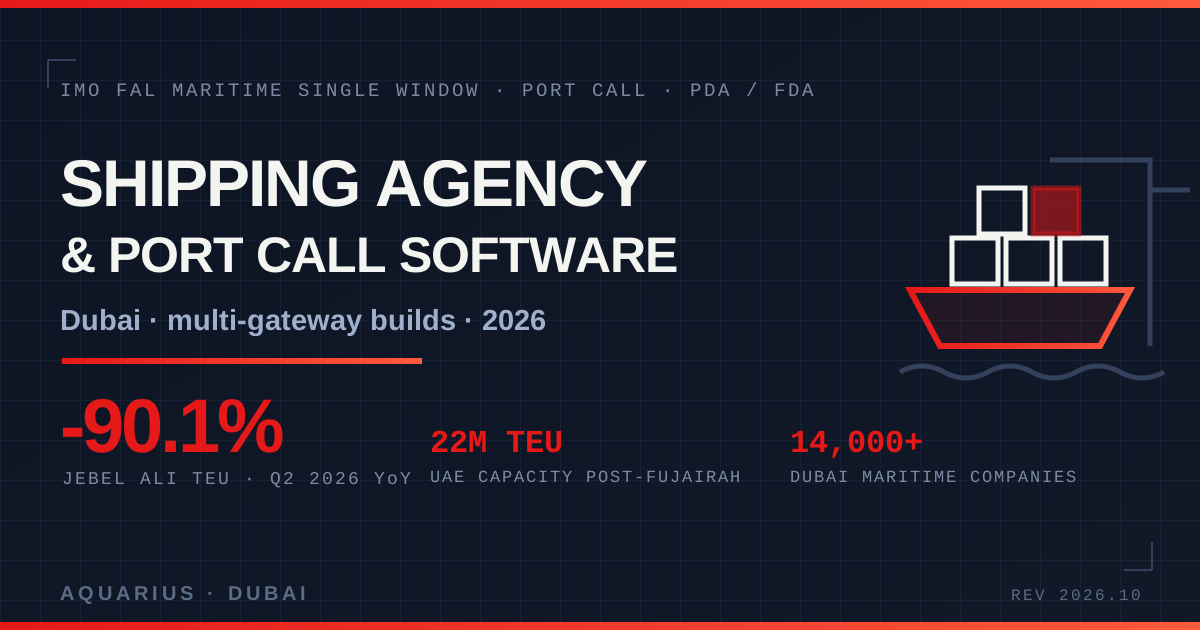
Jebel Ali handled 374,000 TEU in Q2 2026, down 90.1%. Real AED costs to build shipping agency and port call software in Dubai, and the multi-gateway rewrite 2026 forced.
- PUBLISHED
- 05 OCT 2026
- READ TIME
- 13 MIN
- AUTHOR
- AQUARIUS · DUBAI
- UNIT
- REV 2026.09
Short answer: a working shipping agency and port call system for a Dubai operator costs roughly AED 95,000 to AED 420,000 to build in 2026, depending on whether you stop at port-call and disbursement control or go through to customs, vendor settlement and principal portals. Off-the-shelf port agency platforms start far cheaper and are the right answer for a two-port agency. The custom case only opens when you run multiple UAE gateways, bonded road moves and non-standard principal reporting — which, after 2026, describes most Dubai agents.
For twenty years the operational assumption behind every Dubai trade system was the same: the box arrives at Jebel Ali. Spreadsheets, agency software, ERP integrations and principal reports were all built around one gateway, one customs path and one set of berth windows. In 2026 that assumption broke in a single quarter, and the systems built on top of it broke with it. Here are the real numbers, what port call software actually has to do, and what it costs in AED.
The year one gateway stopped being a safe assumption
Start with what Jebel Ali was. In 2024 the port handled 15.5 million TEU — its highest volume since 2015, and 18% of the 88.3 million TEU DP World moved globally. Dubai ranked 5th in the world and first in the Arab region on the 2025 International Shipping Centre Development Index. The emirate’s maritime sector grew 4.8% across the first nine months of 2025 to AED 16.6 billion, about 4.7% of Dubai’s GDP, spread across more than 14,000 maritime companies and 8,415 marine craft on the Dubai Maritime Authority register.
Then 2026. Following the strikes on Iran on 28 February 2026, transits through the Strait of Hormuz fell from more than 100 vessels a day to about five; on 27 September 2026 a single vessel transited against a pre-crisis baseline near 85 a day. By 21 April roughly 2,000 ships and 20,000 mariners were stranded inside the Gulf. War-risk cover went from 0.125% of hull value per transit to 0.2–0.4% — around USD 250,000 of extra premium on a single VLCC passage — and protection and indemnity cover was withdrawn outright on 5 March. Brent passed USD 100 for the first time in four years and peaked near USD 126.
The port-level effect was brutal and fast. Jebel Ali handled 2.77 million TEU in Q1 2026, down 30.5% year on year, then 374,000 TEU in Q2 against 3.8 million a year earlier — a 90.1% collapse, for a first half of 3.1 million TEU, down 59.5%. The port itself was never damaged and stayed fully operational; the vessels simply stopped coming through the strait. On the east coast, Fujairah bunker sales fell to about 1.63 million tonnes in H1 2026, down 55%, with a June low near 86,000 tonnes — against 7.40 million cubic metres sold across calendar 2025.
The instructive number is DP World’s own: group revenue still rose 13.1% to USD 12.7 billion in H1 2026, and excluding Jebel Ali, container volumes grew 6.5% like-for-like. Cargo did not disappear. It re-routed. Which means the commercial loss landed on whoever could not re-route their paperwork as fast as the cargo moved.
What shipping agency and port call software actually does
Port agency software is not a CRM with vessels in it. It is a system of record for a port call — one vessel, one port, one visit — and for the money that moves through it. The lifecycle it has to hold is fixed: nomination from the principal, pre-arrival documentation and clearances, a proforma disbursement account (PDA) estimating the call, berth and cargo operations, the statement of facts, vendor invoices as they land, and finally the final disbursement account (FDA) reconciled against the PDA with a variance explanation the principal will actually accept.
Two regulatory facts shape the build in the UAE. First, since 1 January 2024 the IMO FAL Convention has made a Maritime Single Window mandatory in every member state’s ports for the electronic exchange of arrival, stay and departure information, covering the ship, crew, passengers and cargo, with the principle that data is submitted once and reused. Paper-based submission is no longer a compliant fallback. Second, on the cargo side, Dubai Customs clears simple declarations through Mirsal 2 on the Dubai Trade portal in under two minutes, and import, export and free-zone transit declarations all run through it. If your agency system cannot speak to those two channels programmatically, your staff are the integration.
The modules that earn their place
- Port call register — vessel, voyage, principal, ETA/ETB/ETD, berth window, agent-on-duty, and a full audit trail of every revision.
- PDA and FDA engine — rate cards per port and per authority, auto-populated proforma, actuals captured as vendor invoices arrive, FDA closed with an automatic variance report line by line.
- Vendor and funds management — launch, pilotage, towage, stevedores, surveyors, chandlers, bunker suppliers; advance funding requests, remittance tracking and unapplied-cash visibility.
- Sanctions and compliance screening — vessel, owner, charterer and counterparty checks logged against each call, plus licence and certificate expiry tracking.
- Document automation — crew lists, cargo manifests, bills of lading, statements of facts, NOR and letters of protest generated from one dataset rather than retyped per authority.
- Principal portal — live call status, PDA approvals and FDA sign-off without an email thread, because principals receiving DAs now run their own cost-control desks.
- Operations reporting — cost per call by port, PDA-to-FDA variance by vendor, demurrage exposure, and turnaround benchmarking across gateways.
Most Dubai operators get this wrong: they digitise the invoice instead of the port call. A finance system that produces a tidy FDA but has no structured record of who approved which berth change, when the NOR was tendered, or why the towage line came in 40% over proforma gives you accurate bookkeeping and zero defensibility. In 2026 the arguments were not about arithmetic. They were about which gateway the cargo was supposed to clear through, and who authorised the change.
Build or buy, honestly
The port agency software market is mature. Agents running port calls and billing principals can shortlist Base, GAT-Ship, bluVerve, Pelican, PortPal, Enqlare or MagicPort; principals receiving DAs and wanting cost control look at DA-Desk, Harbor Lab or vendor-side equivalents. These are real products with PDA/FDA workflows, vendor management and accounting sync already built. The surrounding market is growing accordingly: global port management software was valued at USD 2.54 billion in 2025, is projected at USD 2.80 billion in 2026 and USD 6.09 billion by 2034 at a 10.2% CAGR, while the regional transportation management software market is forecast to run from USD 1.64 billion in 2025 to USD 6.41 billion by 2033.
| Situation | Right answer | Indicative AED |
|---|---|---|
| One or two UAE ports, under ~200 calls a year, standard DA reporting | Licensed port agency platform, configured properly | Licence plus 25,000 – 60,000 setup |
| Multi-gateway agency across Jebel Ali, Fujairah, Khor Fakkan and Abu Dhabi with bonded road moves | Platform core plus custom integration and routing layer | 95,000 – 220,000 |
| Agency plus freight forwarding plus bonded warehousing on one dataset | Custom platform with Mirsal 2 and WMS integration | 220,000 – 420,000 |
| Principal-side DA audit and cost control across several agents | Buy a DA audit service, do not build one | Subscription only |
The multi-gateway data model is the actual 2026 change
On 22 July 2026 DP World signed an agreement in principle with the Fujairah Ports Authority under a 50-year concession for two east-coast terminals: Al Rugaylat, designed for 2.5 million TEU a year plus 1.7 million tonnes of general cargo and 190,000 car equivalent units, and Dibba General Cargo, adding up to 3.6 million tonnes. Construction runs 24 to 30 months, and on completion DP World’s UAE container capacity rises from 19.4 million TEU to almost 22 million, with both terminals connected to Jebel Ali and Jafza through an inland logistics network. Fujairah and Khor Fakkan sit on the Gulf of Oman, outside the strait, roughly 130 to 150 km of highway from Dubai, with Etihad Rail feeding in from Khalifa Port.
Translated into schema: port can no longer be a constant, and gateway can no longer equal destination. A single consignment in 2026 may discharge at an east-coast or Omani terminal, clear there, move under bond by road into a Dubai free zone, and still have to produce one coherent cost and compliance record for the principal. Systems that modelled a shipment as one port, one declaration and one invoice stream needed a migration, not a config change. Anyone who had already normalised gateway, customs regime and inland leg as separate entities re-pointed their operations in days. That is the whole lesson of the year, and it is a data-modelling lesson, not a geopolitical one.
What it costs to build in Dubai, in AED
These are the bands we quote in Dubai in 2026 for maritime and trade systems that go into production rather than into a demo:
| Scope | Indicative build (AED) | Typical timeline |
|---|---|---|
| Port call register plus PDA/FDA engine with rate cards, variance reporting and role-based approvals | 95,000 – 165,000 | 8 – 12 weeks |
| Vendor, funds and remittance management with advance requests and unapplied-cash tracking | +45,000 – 90,000 | +4 – 6 weeks |
| Principal portal: live call status, PDA approval, FDA sign-off, document download | +40,000 – 85,000 | +4 – 6 weeks |
| Dubai Trade / Mirsal 2 declaration integration and Maritime Single Window submission mapping | 55,000 – 140,000 | 6 – 10 weeks |
| Multi-gateway routing and bonded road-move tracking across Jebel Ali, Fujairah, Khor Fakkan and Abu Dhabi | 60,000 – 130,000 | 5 – 8 weeks |
| Sanctions and counterparty screening integration with per-call audit log | 25,000 – 65,000 | 3 – 5 weeks |
| Accounting sync to an existing ERP, plus VAT-correct invoicing and TRN handling | 35,000 – 95,000 | 4 – 7 weeks |
| Operations BI: cost per call, variance by vendor, turnaround by gateway, demurrage exposure | 30,000 – 75,000 | 3 – 5 weeks |
| Managed run: hosting, monitoring, authority-format updates, quarterly review | 6,000 – 22,000 / month | Ongoing |
Our published pricing bands line up with the first and fourth rows. If your cargo side is the pressing problem rather than the vessel side, our freight forwarding and customs clearance software guide covers that build, and warehouse management systems cover the bonded storage leg. Trading houses settling cargo against letters of credit should read the commodity trading and trade finance breakdown alongside this one.
The cost of staying on spreadsheets
Run the arithmetic on a mid-sized Dubai agency handling 300 port calls a year. If PDA-to-FDA leakage averages a conservative AED 3,500 a call — an unbilled launch boat, a towage line nobody challenged, a surveyor invoice paid twice — that is AED 1.05 million a year walking out through the gap between estimate and actual. Against the AED 95,000 to 165,000 first row above, recovering a third of that leakage pays for the build inside a year. The 2026 version of the same sum is sharper: when Jebel Ali volumes fell 90.1% in a quarter and DP World’s non-Jebel-Ali volumes still grew 6.5%, the cost of a single-gateway system was not inefficiency. It was the calls you could not take.
How Aquarius builds it
We start with four real port calls from your archive — ideally one clean, one with a berth change, one with a disputed FDA, and one that re-routed in 2026. Those four tell us more than any requirements workshop, because they expose where your actual exceptions live. Then we build in this order: a gateway-neutral data model first, port call register and PDA/FDA engine second, authority integrations third, principal portal last. We deliberately ship the register before the integrations so your operations team is already working in one system while Mirsal 2 and Maritime Single Window mapping is still in test. Fixed scope, fixed price, and the data model is documented and yours — because the next schema-breaking event will not look like the last one.
FAQ
How much does shipping agency software cost to build in Dubai in 2026?
Expect AED 95,000 to AED 165,000 for a port call register with a proper PDA/FDA engine, AED 95,000 to AED 220,000 once multi-gateway routing and bonded road moves are in scope, and AED 220,000 to AED 420,000 for a full agency, forwarding and bonded-warehouse platform on one dataset. Managed hosting and support runs AED 6,000 to AED 22,000 a month.
Should a Dubai port agency buy a platform or build custom?
Buy, if you run one or two UAE ports, fewer than roughly 200 calls a year and standard DA reporting — Base, GAT-Ship, bluVerve, Pelican, PortPal, Enqlare and MagicPort all cover that ground for less than a build. Build or extend only when you operate several gateways, move cargo under bond by road, or owe principals reporting no product supports out of the box.
What is the difference between a PDA and an FDA?
A proforma disbursement account (PDA) is the estimate of a port call’s costs, issued before arrival so the principal can fund it. The final disbursement account (FDA) is the reconciled actual, issued after departure with vendor invoices attached. The variance between them is the number principals audit, which is why a line-by-line variance report matters more than a tidy total.
Is electronic port call reporting mandatory in the UAE?
Yes. Since 1 January 2024, amendments to the IMO FAL Convention require every member state to operate a Maritime Single Window for electronic exchange of ship, crew, passenger and cargo information on arrival, stay and departure, with data submitted once and reused. On the customs side, import, export and free-zone transit declarations run through Mirsal 2 on the Dubai Trade portal, where simple declarations clear in under two minutes.
How did 2026 change what Dubai trade software needs to do?
It removed the single-gateway assumption. Jebel Ali fell to 374,000 TEU in Q2 2026 from 3.8 million a year earlier while DP World’s volumes elsewhere grew 6.5%, and DP World committed to two new Fujairah terminals on a 50-year concession taking UAE capacity to almost 22 million TEU. Any system that hard-codes one port, one customs path or one inland leg now carries migration risk, not just technical debt.
How long does a maritime software build take in Dubai?
A port call register with PDA/FDA control is 8 to 12 weeks. Authority integrations add 6 to 10 weeks and are the least predictable part, because format and credential turnaround sits with the authority, not with you. Plan a phased release: operations in the new system first, integrations behind them.
If you run a shipping agency, forwarding desk or trading operation in Dubai and 2026 forced you to re-route faster than your systems could follow, send us four port calls and we will map where your data model breaks before anyone writes a line of code. Talk to Aquarius — and if a configured off-the-shelf platform is the better answer for your call volume, we will tell you that instead.