
Property Valuation and AVM Software Development in Dubai (2026): DLD Data, Error Bars and Real AED Build Costs
Dubai publishes every registered sale as open data and the DLD already ships an AI valuation with a 5 to 8% error band. What it takes to build an AVM that beats it, plus real AED costs.
- PUBLISHED
- 21 OCT 2026
- READ TIME
- 12 MIN
- AUTHOR
- AQUARIUS · DUBAI
- UNIT
- REV 2026.09
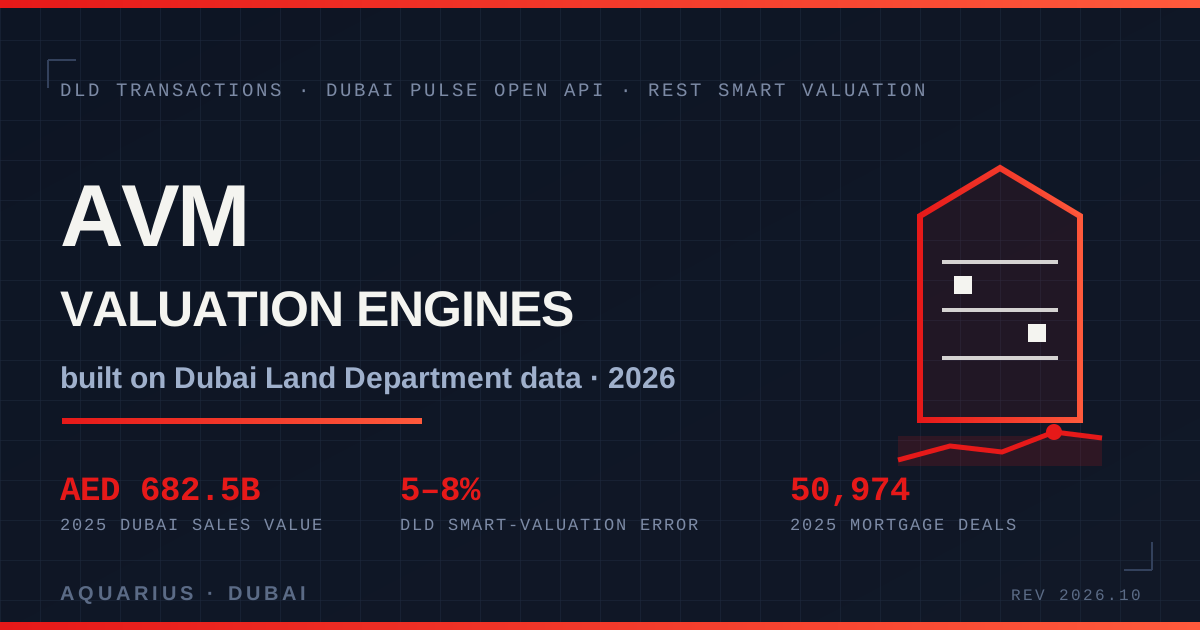
Short answer: A property valuation or automated valuation model (AVM) platform in Dubai is a data-engineering product wrapped in a regulated workflow. The raw material is free — the Dubai Land Department publishes every registered transaction as open data on Dubai Pulse — but the DLD already ships its own AI valuation inside Dubai REST and reports a margin of error of roughly 5 to 8%. Anything you build has to beat that band, or serve the cases it cannot touch: off-plan, portfolios, commercial assets and bank panel work. Expect AED 95,000 to AED 180,000 for a working comparables-and-AVM product, and AED 300,000 to AED 700,000 for a bank-grade valuation platform with audit trails and a RERA-registered valuer workflow.
Why Dubai is now one of the best AVM markets on earth
Valuation models need two things: volume and disclosure. Dubai has an unusual amount of both.
- The DLD recorded 214,912 sales transactions worth AED 682.5 billion in 2025 — volume up 18.86% and value up 30.7% year on year, a fifth consecutive record.
- Counting every registered operation — sales, mortgages, gifts — the market logged about 267,499 transactions worth roughly AED 919 billion, up 20.8%.
- 50,974 mortgage deals worth AED 179.26 billion were registered in 2025, volume up 22.5%. Almost every one of those required an independent bank valuation.
- The DLD's own price index rose 9.81% across 2025 — villas +14.83%, apartments +7.38%. Average closing price landed near AED 1,863 per sq ft.
Compare that to most markets, where sale prices are private and a model has to be trained on asking prices and guesswork. In Dubai, the registry is the ground truth and it is publicly queryable. That is why valuation tooling here can be genuinely accurate instead of decorative.
Most Dubai teams building a valuation tool benchmark against the wrong number. They quote US consumer AVMs — Zillow's Zestimate runs a median error around 1.7 to 2.4% on-market and 7% off-market, Redfin about 2.1% on-market — then promise the same in a market where 69% of 2025 transaction volume was off-plan. A tower that has never resold has no comparables. Your model needs a confidence score, not a single hero figure.
The competitor you are actually up against: DLD's own AI
Before scoping anything, understand what the government already gives away. The Dubai REST app issues an official Real Estate Valuation e-Certificate (the Taqyeemi certificate) using models trained on the DLD's full transaction database. For standard apartments and attached villas it is issued instantly; other asset types take up to seven working days because a physical inspection is still needed.
The economics of that certificate explain where a private product fits:
| Route | Typical cost | Turnaround | What it is good for |
|---|---|---|---|
| Dubai REST smart valuation (residential e-certificate) | AED 4,000 + AED 10 knowledge + AED 10 innovation fee | Instant for standard units | Golden visa threshold, gift transfer, official filings |
| DLD valuation for other asset classes | AED 2,000 (vacant land) to AED 15,000 (hotel buildings) | Up to 7 working days | Land, commercial, hospitality |
| RICS / RERA valuer report | AED 3,000 – 6,000 | 5 – 10 business days | Bank panel work, litigation, audit, IFRS reporting |
| Agent market appraisal | Free | 1 – 2 days | Listing price anchoring, not evidence |
| Your AVM / portfolio dashboard | Subscription or per-seat | Seconds | Screening at scale, monitoring, triage before a paid valuation |
Two details matter commercially. A DLD valuation certificate is valid for 90 days, so anyone holding property for residency, finance or audit purposes re-buys it repeatedly. And since February 2026, off-plan and mortgaged properties can qualify for the AED 2 million golden visa route on the DLD certified valuation rather than paid-up equity — which turns "what would my unit be certified at?" into a question hundreds of thousands of owners now ask before paying AED 4,000 to find out. That pre-check is the single most commercial screen a private AVM can own.
What goes inside a Dubai valuation platform
1. The data pipeline
The DLD transactions dataset lives on Dubai Pulse with an OAuth-protected open API and bulk CSV exports. Practical notes from building against it: you authenticate with an API key and secret issued per dataset grant, and the bearer token is short-lived — on the order of 30 minutes — so token refresh belongs in your ingestion layer, not in a cron script someone wrote once. Field-level quirks (procedure codes, transaction groups, area naming, off-plan versus ready flags) need lookup tables maintained as data, not hardcoded. The same discipline applies to any registry work; our notes on Ejari and DLD API integration cover the auth and reconciliation patterns in more detail.
2. The comparables engine
Before any machine learning, build a defensible comparables selector: same building first, then same cluster, then same community, filtered on size band, floor band, view, and recency with a market-movement adjustment applied from the price index. In a market that moved 9.81% in a year, a six-month-old comparable used raw is a wrong answer dressed as evidence. Most of the accuracy in a Dubai AVM comes from this layer, not from the model choice.
3. Building-level quality signals
The DLD's Smart Rental Index, launched for 2025, rates residential buildings 1 to 5 stars against more than 60 criteria — location, age, finishes, maintenance, security, sustainability, parking and services — replacing the old area-level approach with a per-building AI assessment. That is the closest thing Dubai has to an official quality variable, and it is a strong feature for both rental and capital value models.
4. Confidence, not false precision
Ship a value range and a confidence score driven by comparable count, recency and dispersion. For a five-year-old tower in Dubai Marina with forty same-line resales, you can be tight. For a handover-stage off-plan unit in a new community, say so and fall back to developer price plus index movement. Models that refuse to express doubt are the ones valuers and credit teams stop trusting after the third argument.
5. The regulated-workflow layer
If your product supports formal valuations rather than estimates, it has to sit inside the licensing reality. Valuation in Dubai may only be practised by valuers and firms registered with RERA: a valuer card costs AED 5,000 and requires two years of relevant experience for UAE nationals or five for expatriates (trainees serve one year in a RERA-approved office), the real estate valuation licence sits in the AED 10,020 annual fee band, and a firm needs ten registered valuers before it can open a branch. Build for that: valuer assignment, signature and card number on the report, inspection evidence, version history, and an immutable audit trail of which comparables and adjustments produced each figure.
What it costs to build in Dubai (2026 AED)
These are our own scoping ranges for UAE clients, assuming DLD open data as the primary source and a Next.js web product with an API.
| Build | Scope | AED range | Timeline |
|---|---|---|---|
| Valuation lead-gen tool | Single-page estimator on DLD comparables, email capture, admin dashboard | 35,000 – 70,000 | 3 – 5 weeks |
| Comparables + AVM product | Full ingestion pipeline, comparables engine, confidence scoring, PDF report, auth and billing | 95,000 – 180,000 | 8 – 14 weeks |
| Portfolio monitoring platform | Multi-asset tracking, revaluation alerts, rental index integration, exports for audit and IFRS | 180,000 – 320,000 | 12 – 20 weeks |
| Bank / panel-grade valuation system | Valuer workflow, inspection app, immutable audit trail, role permissions, lender integrations, SLA reporting | 300,000 – 700,000 | 5 – 9 months |
| Data and model upkeep | Daily ingestion, retraining, drift and accuracy monitoring, support | 4,000 – 15,000 / month | Ongoing |
The cost drivers that move these numbers most: how many asset classes you cover (residential only is far cheaper than land and commercial), whether you need an offline-capable inspection app, whether reports must be legally signed by a registered valuer, and bilingual Arabic/English output — which for a document-heavy product is real work, not a translation file. For how we price engagements generally, see our pricing page.
The ROI arithmetic, in the open
Run the numbers on the audiences rather than the technology. 50,974 mortgage registrations in 2025 each needed a bank valuation; brokerages and mortgage advisers lose deals when a bank valuation lands below the agreed price, and under Central Bank rules LTV is calculated on the lower of price or bank valuation — with first-property expat caps at 80% under AED 5 million and 70% above it. A tool that flags a likely down-valuation before the file goes to the bank saves a renegotiation on a seven-figure asset. That is the pitch to lenders and brokers, and it pairs naturally with a mortgage broker platform.
On the owner side, the 90-day certificate validity and the February 2026 golden visa rules create recurring, high-intent demand for "am I above AED 2 million?" — a question worth answering free, at scale, in exchange for a lead. For landlords and managers running real portfolios, valuation belongs next to the rest of the stack rather than in a spreadsheet; see property management software.
How Aquarius builds these
We start with a two-week data spike before any UI: ingest the DLD transaction history, rebuild last year's known sales out-of-sample, and report the median absolute error by community and asset type. If the error band is not commercially useful for your use case, you have spent two weeks instead of six months and you keep the pipeline either way. Then we build the product around the accuracy you actually have — ranges and confidence where the data is thin, tight estimates where it is dense, and a valuer workflow if the output has to be signed. Fixed scope, fixed price per phase, code and pipeline owned by you.
FAQ
Can I legally run a property valuation service in Dubai with software alone?
You can publish estimates and market analytics. You cannot issue a professional valuation: valuation practice in Dubai requires registration with RERA for both the individual valuer and the firm, and official valuation certificates are issued by the DLD itself. Most software products position as estimates and screening, then route formal work to a registered valuer.
Is Dubai Land Department transaction data free to use?
The DLD publishes registered transactions as open data via Dubai Pulse, accessible through an OAuth-protected API and bulk files. Access is free, but licensing terms vary by dataset and commercial packages exist — check the terms attached to the specific dataset grant, and budget engineering time for short-lived tokens, lookup tables and data cleaning.
How accurate can a Dubai AVM realistically be?
The DLD reports roughly a 5 to 8% margin of error for its own smart valuation of standard residential units. Dense, frequently traded buildings can do better than that; thin segments and off-plan stock do considerably worse. Publish your error rate by segment and a per-estimate confidence score rather than one headline accuracy claim.
How much does a property valuation cost in Dubai in 2026?
A DLD Real Estate Valuation e-Certificate for a residential apartment or villa is AED 4,000 plus AED 10 knowledge and AED 10 innovation fees, instantly issued for standard units. Other asset types run from about AED 2,000 for vacant land to AED 15,000 for hotel buildings, and independent RICS-standard reports typically fall between AED 3,000 and AED 6,000. Certificates are valid for 90 days.
How long does it take to build a valuation platform?
A lead-generation estimator ships in 3 to 5 weeks. A real comparables-and-AVM product takes 8 to 14 weeks including the data pipeline. A panel-grade system with a full valuer workflow and lender integrations is a 5 to 9 month programme.
Thinking about a valuation or proptech data product? Tell us the use case and we will come back with the data spike plan, the honest accuracy expectation for your segment, and a fixed-price first phase.