
PCI DSS Compliance Cost in Dubai (2026): Real AED Prices, Merchant Levels and the Script Rules That Fail Most Stores
The average Middle East data breach now costs AED 29.4 million, yet a Dubai store can validate PCI DSS for AED 15,000 to 40,000 a year. Real AED costs, merchant levels and the 2025 script rules.
- PUBLISHED
- 06 OCT 2026
- READ TIME
- 13 MIN
- AUTHOR
- AQUARIUS · DUBAI
- UNIT
- REV 2026.09
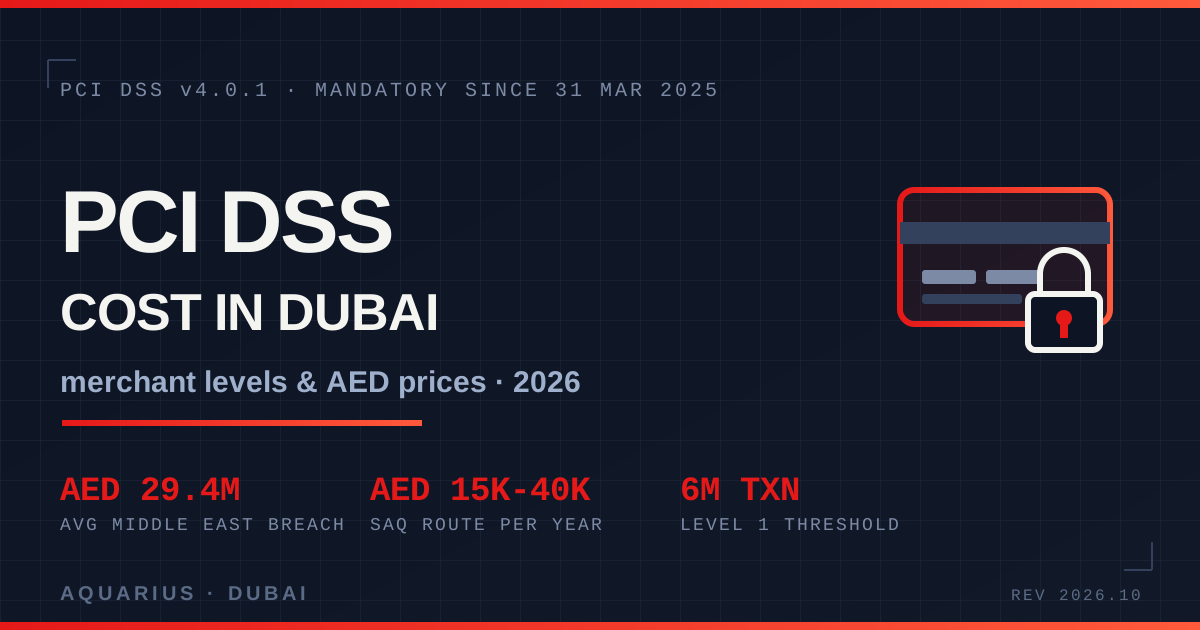
Short answer: PCI DSS compliance in Dubai costs AED 15,000 to 40,000 a year if you qualify for a self-assessment questionnaire, AED 50,000 to 150,000 for an assisted Level 2 or Level 3 programme, and AED 300,000 to 800,000+ for a full Level 1 Report on Compliance signed by a Qualified Security Assessor. The single biggest lever on that number is not your auditor’s day rate — it is how much of your own infrastructure ever touches a card number.
Here is the stat that should decide your budget. The average data breach in the Middle East now costs USD 8 million, roughly AED 29.4 million, according to IBM’s 2026 Cost of a Data Breach report — of which USD 3.57 million is lost business alone. A Level 3 Dubai merchant can validate compliance for about 0.3% of that figure. Most of the stores we audit are spending nothing and carrying all of it.
Why Dubai merchants are suddenly getting PCI letters from their banks
Three forces converged in 2025 and 2026, and your acquirer is the one passing them down to you.
The market got big enough to be worth attacking. UAE e-commerce reached roughly USD 12.3 billion (about AED 45.1 billion) in 2026, up from AED 42.2 billion in 2025, and is forecast to compound at around 11.3% to USD 21 billion by 2031. That volume is carried by over 45,000 active UAE online stores serving 11 million-plus online shoppers. Dubai’s wholesale and retail trade sector alone produced AED 50.9 billion of real gross value added in Q1 2026, about 22% of the emirate’s GDP.
Fraud moved online and stayed there. Card-not-present fraud — the exact risk PCI DSS exists to control — is projected at USD 28.1 billion globally by 2026, a 40% rise on 2023, and CNP now accounts for about 81% of all fraud cases and 65% of card fraud losses. Locally the picture is worse than the global average: a BioCatch study published in April 2026 found 66% of UAE banking institutions reported more fraud attempts, 58% saw losses rise, and 62% now estimate annual fraud losses above USD 5 million. SIM-swap attacks in the UAE grew 38% in 2025.
The regulator started counting. CBUAE Notice 3057 obliges licensed financial institutions to run 24/7 real-time transaction monitoring capable of declining suspicious transactions, with penalties for significant violations of up to AED 250,000 per violation from 31 March 2026. Banks under that pressure do not absorb merchant risk quietly — they push attestation requests, raise reserves, or offboard. If your acquirer has gone from never mentioning PCI to asking for an Attestation of Compliance every year, that is the mechanism.
Most Dubai businesses get this wrong: they treat PCI DSS as a certificate. It is not. There is no government PCI licence in the UAE, no DED approval, no Ministry portal. It is a contractual obligation you accepted inside your merchant agreement with Network International, Mashreq, Emirates NBD or your PSP — and the party who enforces it is your acquirer, who can fine you, hold your settlements, or terminate the account. Nobody from a regulator will ever hand you a PCI certificate, because none exists.
Which PCI level you are actually in
Your level is set by annual card transaction volume per brand, and your acquirer is formally responsible for confirming you validate at the right one. Note the 2024 change: Visa merged its Levels 3 and 4 into a single Level 3 effective 25 April 2024, so Visa now runs three merchant levels while Mastercard still runs four.
| Level | Annual card transactions | What you must produce | Typical Dubai cost per year |
|---|---|---|---|
| Level 1 | Over 6 million (any channel), or designated by a brand | On-site assessment and Report on Compliance by a QSA, plus quarterly ASV scans and an annual penetration test | AED 300,000 – 800,000+ |
| Level 2 | 1 million – 6 million | Annual SAQ, often QSA-signed at the acquirer’s demand, plus quarterly ASV scans | AED 50,000 – 150,000 |
| Level 3 | 20,000 – 1 million e-commerce transactions | Annual SAQ plus quarterly ASV scans | AED 25,000 – 70,000 |
| Level 4 (Mastercard) | Under 20,000 e-commerce transactions | Annual SAQ, ASV scans where the acquirer requires them | AED 15,000 – 40,000 |
Most Dubai SMEs sit in Level 3 or Level 4 and are therefore on the self-assessment path. That is good news financially — and it is exactly where the 2025 rule changes bite hardest, because the cheap questionnaire now carries an eligibility condition that most stores fail without knowing it.
What the individual line items cost in the UAE
Converted at the pegged rate of AED 3.6725 to the dollar. These are 2026 market figures, not quotes.
| Line item | AED range | Frequency | Notes |
|---|---|---|---|
| SAQ completion support (consultant-assisted) | 15,000 – 40,000 | Annual | Scoping, evidence pack, AOC drafting |
| Level 2–3 assisted compliance programme | 50,000 – 150,000 | Annual | Gap assessment, remediation oversight, re-test |
| Level 1 QSA on-site assessment and ROC | 275,000 – 800,000+ | Annual | Published UAE on-site ranges start near AED 75,000 for small scopes and climb past AED 300,000 for banking-grade environments |
| Senior QSA-grade consulting day rate | 1,500 – 3,500 / day | As used | Principal-level advisory runs AED 2,500 – 5,000 / day |
| ASV external vulnerability scanning | 700 – 11,000 | Quarterly, billed annually | From about USD 185 per year for a single IP or domain, up to USD 100 – 800 per IP per quarter at the high end |
| Annual penetration test (Req. 11.4) | 18,000 – 110,000 | Annual | USD 5,000 – 30,000 per engagement; SME-scoped web app tests land far lower |
| Remediation engineering (the real cost) | 30,000 – 250,000 | One-off | Network segmentation, logging, MFA, tokenisation, script governance |
Read that table again and notice the pattern: the audit is rarely the expensive part. Remediation is. A merchant who built a checkout that stores card data in its own database is buying a segmentation project, a logging stack, key management and an annual penetration test — forever. A merchant whose checkout never sees a card number is buying a questionnaire. Same brand, same revenue, ten times the difference in cost. Our breakdown of payment gateway integration cost in Dubai shows where that fork happens at build time.
The two script rules that fail most Dubai stores
On 31 March 2025, PCI DSS v4.0.1 became the only valid version and the 13 future-dated requirements that had been best practice under v4.0 became mandatory. Two of them target client-side skimming — Magecart-style attacks that inject a few lines of JavaScript into a live checkout page — and they are where UAE assessments now stall.
- Requirement 6.4.3 — script inventory and authorisation. Every script that loads on a payment page must be inventoried, individually justified in writing, explicitly authorised, and integrity-assured. Every analytics tag, chat widget, heatmap tool, remarketing pixel and A/B testing snippet.
- Requirement 11.6.1 — tamper detection. You must detect and alert on unauthorised modification to the HTTP headers and the content of the payment page, checked at least weekly.
These two fail more often on governance than on technology. The tooling is cheap. The written justification for forty-one marketing tags that someone added through Google Tag Manager in 2023 does not exist.
The sting in the tail is for small merchants. If you validate with SAQ A — the shortest questionnaire, used by stores that fully outsource checkout — 6.4.3 and 11.6.1 were removed from the question list but replaced with a new eligibility criterion: you must confirm your site is not susceptible to script attacks, either by implementing those controls yourself or by obtaining written confirmation from your PCI DSS compliant service provider. In practice a Dubai store on SAQ A needs a letter from its PSP, on file, before it can honestly sign. Most have never asked for one.
If your checkout is a redirect or a properly isolated iframe to Network International, Telr, PayTabs, Tap, Stripe or Checkout.com, you are on the cheap path — see our comparison of UAE payment gateways. If your page renders its own card fields and posts them anywhere through your own JavaScript, you have dropped out of SAQ A into SAQ A-EP and your cost multiplies.
How to cut the bill: scope, not negotiation
Every dirham you spend on PCI DSS is a function of how many systems can touch cardholder data. Shrink that set and the cost collapses. In order of return:
- Never let a card number reach your server. Hosted payment pages, redirects or gateway-hosted fields keep the primary account number entirely outside your environment. This one decision is the difference between SAQ A and SAQ D.
- Tokenise everything downstream. Store the gateway’s token for refunds, subscriptions and repeat orders. Never the card. Subscription billing built on tokens stays out of scope.
- Get call-centre payments off your floor. Phone orders typed into a CRM by an agent pull the entire office network, the CRM and its backups into scope. Use pause-and-resume recording or agent-assisted payment links instead.
- Audit your tag manager quarterly. Delete every script on the checkout path that does not earn its place. Each one you remove is one fewer 6.4.3 justification and one fewer breach vector.
- Segment before you assess. A flat network means every device is in scope. Segmentation done before the QSA arrives — and verified by a segmentation penetration test — routinely removes six figures from a Level 1 engagement.
Scope reduction up front typically pays for the consultant several times over, because every system you remove from the cardholder data environment also removes its recurring annual assessment, scanning and testing cost — not once, but every year afterwards.
How Aquarius handles this
We are a Dubai web and software team, not a QSA firm, and we will not pretend otherwise: the attestation has to be signed by a qualified assessor or by you. What we do is the part that sets the price — building and refactoring checkouts so the assessment is small.
- Checkout re-architecture to SAQ A eligibility — moving custom card fields to gateway-hosted fields or redirect flows, with tokenised refunds and repeat billing. Typically AED 18,000 – 55,000 depending on platform and order volume.
- Payment-page script governance — a documented inventory, Content Security Policy, subresource integrity, and weekly tamper alerting that satisfies 6.4.3 and 11.6.1 as evidence rather than as a promise. AED 12,000 – 30,000 to implement, then monitored under a maintenance plan.
- Evidence pack for your acquirer — architecture diagram, data-flow diagram, script register, and PSP attestation letters collected on your behalf. This is the bundle that turns a four-month SAQ into a three-week one.
Run the arithmetic one last time. A Level 3 Dubai store can get itself scoped, re-architected and validated for well under AED 100,000 all-in in year one, falling to AED 20,000 to 40,000 a year after that. The alternative is an average Middle East breach at AED 29.4 million, of which AED 13.1 million is lost business and AED 1.3 million is notification cost — before the acquirer’s fines, the forced forensic investigation, the card-brand assessments and the settlement hold that lands while you still have salaries to pay. IBM also found 26% of malicious Middle East breaches in 2026 were AI-enabled, with mismanaged secrets and keys the single largest cost amplifier. The attacker’s cost curve is falling faster than yours.
FAQ
Is PCI DSS legally mandatory in the UAE?
Not by statute. It is a contractual requirement from the card brands, enforced through your acquiring bank or PSP, and it also sits inside CBUAE and DFSA expectations for licensed payment businesses. Practically, if you accept cards in Dubai you are already bound by it through your merchant agreement — and separately bound by the UAE Personal Data Protection Law, which is statutory. See our UAE PDPL checklist.
Do I need PCI DSS if I use Stripe, Tap or Network International?
Yes, but at the lowest tier. A compliant gateway moves the heavy requirements to the provider. You still have to validate annually with the correct SAQ, confirm your checkout is not susceptible to script attacks, and hold your provider’s written confirmation on file.
How long does it take to become PCI DSS compliant in Dubai?
A clean SAQ A with a hosted checkout: two to four weeks. SAQ A-EP or SAQ D with remediation: three to six months. A first-time Level 1 ROC: nine to twelve months, because you need a full quarter of scan and log evidence before an assessor can sign. Be suspicious of anyone guaranteeing compliance in a fixed number of weeks without first seeing your data flows.
What happens if I am breached while non-compliant?
Your acquirer can impose monthly non-compliance fees, escalate you to Level 1 validation, require a PCI Forensic Investigator at your expense, pass through card-brand assessments for reissuing affected cards, and terminate the merchant account. Non-compliance at the time of the breach is what removes the safe-harbour argument.
Is ASV scanning the same as a penetration test?
No, and PCI DSS requires both. ASV scanning is automated, external and quarterly. A penetration test is manual, scoped and annual, and actively attempts exploitation. Neither substitutes for the other.
Where to start
Before you ask any assessor for a price, answer one question: does a raw card number ever exist inside infrastructure you control? If the honest answer is yes, fix that first — the refactor is cheaper than a single year of the audit it triggers. If the answer is no, your job is evidence, not engineering.
We will map your current card data flow and tell you which SAQ you actually qualify for, at no charge. See our pricing for build and maintenance figures, or talk to us and bring your acquirer’s last compliance email — it usually tells us more than a discovery call does.