
Optical and Eyewear E-commerce in Dubai (2026): Real AED Build Costs, EDE Registration and the Prescription Wall
Only 62.3% of Dubai adults over 40 who need glasses have the right pair. Real AED build costs for an optical store in Dubai, plus DHA dispensing rules and EDE lens registration.
- PUBLISHED
- 08 OCT 2026
- READ TIME
- 12 MIN
- AUTHOR
- AQUARIUS · DUBAI
- UNIT
- REV 2026.09
Short answer: an optical and eyewear store in Dubai costs roughly AED 26,000–55,000 on Shopify for sunglasses and ready-made readers, AED 70,000–160,000 for a prescription-capable custom build with virtual try-on, pupillary-distance capture and a lens configurator, and AED 180,000–420,000 for a headless multi-emirate platform wired to a practice management system and an optical lab. The hard part is not the storefront. It is that the moment you sell a prescription lens or a contact lens, you stop being a retailer and start being a regulated dispenser — which means a DHA-licensed optician in the loop, an Emirates Drug Establishment marketing authorisation for the lens products, and a prescription record your website has to capture, validate and retain.
Key takeaways
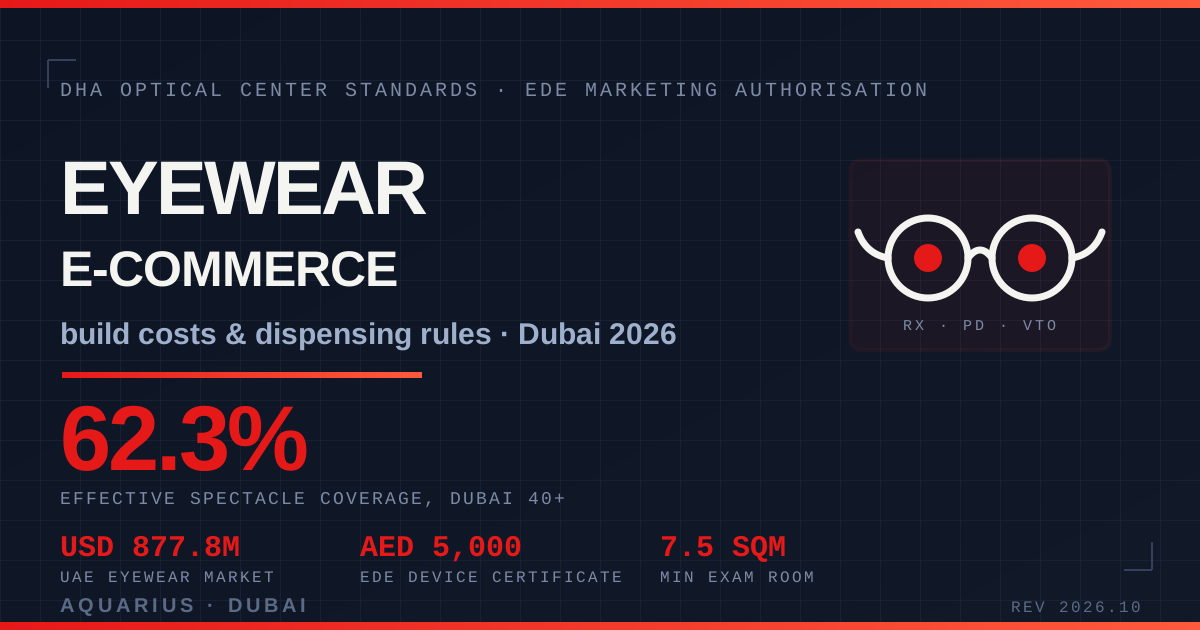
- The demand gap is measurable. The population-based Dubai Eye Health Survey (892 participants aged 40+) found effective spectacle coverage of just 62.3% in Emiratis and 69% in non-Emiratis — roughly one in three Dubai adults over 40 who need correction does not have an adequate pair.
- Prevalence is high and stacked: myopia 27.4% in Emiratis and 19.5% in non-Emiratis aged 40+, hypermetropia 20.4% and 20.6%, anisometropia 11.4% and 9.2%.
- The UAE eyewear market was USD 877.8 million in 2024 heading to USD 1.40 billion by 2030 at a 7.7% CAGR (Grand View Research), inside a UAE eye care market Ken Research puts at about USD 1.17 billion in 2026.
- Online is still the small shelf. Brick-and-mortar held 72.4% of global eyewear revenue in 2025, leaving e-commerce near 27.6% — against a UAE e-commerce market of USD 12.3 billion (about AED 45.1 billion) in 2026 and 11.04 million online shoppers. The category is under-indexed online, not saturated.
- Most Dubai optical retailers get this wrong: they treat the website as a sunglasses catalogue and leave the prescription business in the shop. Sunglasses are a fashion impulse with a thin margin and heavy brand competition. Prescription lenses are a recurring, high-margin, insurance-adjacent purchase — and in the UAE routine glasses and contact lenses are generally excluded from basic mandatory health plans, so the customer is paying cash and comparing prices online whether or not you are there.
- Virtual try-on is the single feature with the clearest published payback: a 2024 McKinsey study puts the average conversion lift at 18%, merchant data in eyewear reports returns down 20–35% (up to 35% when 3D visualisation is paired with PD measurement), and cart abandonment down about 22%.
- Regulation has moved. Under Federal Decree-Law 38 of 2024, effective 2 January 2025, the Emirates Drug Establishment (EDE) is the federal regulator for medical products, and it formally took over 44 services including all medical device marketing authorisations on 29 December 2025. Contact lenses and lens care solutions route through ede.gov.ae now, not the old portal.
The Dubai demand picture: a third of the market is walking around uncorrected
Most category guides open with market size. Start instead with the number that tells you whether there is a buyer: effective spectacle coverage. The Dubai Eye Health Survey, a population-based cross-sectional study of residents aged 40 or older conducted over three months from December 2019, measured it at 62.3% (95% CI 54.0–70.6) in Emiratis and 69% (95% CI 60.5–77.5) in non-Emiratis. That is the share of people needing correction who actually have adequate correction. The inverse — about 31–38% — is addressable demand sitting in the same city as your warehouse.
Underneath it, refractive error is broad rather than niche. The same survey put myopia at 27.4% in Emiratis and 19.5% in non-Emiratis, high myopia at 1.8% and 0.9%, hypermetropia at 20.4% and 20.6%, and anisometropia — a meaningful dispensing complication — at 11.4% and 9.2%. Among younger cohorts the trend is worse: UAE school and university studies report myopia from 15% to over 30% depending on age band, climbing sharply between 10 and 16, and research through late 2024 associated each additional hour of daily screen time with a 21% higher likelihood of developing myopia. In a country where outdoor hours collapse from May to September, that is a structural driver, not a fad.
Market sizing then confirms the commercial case rather than carrying it. Grand View Research puts the UAE eyewear market at USD 877.8 million in 2024 growing to USD 1.40 billion by 2030 at 7.7% CAGR; Ken Research sizes UAE eye care at about USD 1.17 billion in 2026; the UAE Optical Stores segment alone was estimated at USD 427 million in 2025. Channel share is the opportunity: globally, brick-and-mortar still took 72.4% of eyewear revenue in 2025, so roughly 27.6% is online — and the UAE's e-commerce base of 11.04 million shoppers and 45,000+ active stores means the infrastructure is there well ahead of the category's use of it.
The prescription wall: where a retail build becomes a regulated one
This is the line that decides your architecture, your licence and your launch date. Selling frames and non-prescription sunglasses is retail. Dispensing corrective lenses and fitting contact lenses is a clinical act performed against a prescription — and the UAE regulates it as one.
DHA: the facility and the person
A standalone Optical Center in Dubai needs a Dubai Health Authority facility licence to provide optometry services, under the DHA Standards for Optical Centers and Optometry Services. The standards are physical as well as procedural: the eye examination room must have a minimum floor area of 7.5 square metres (smaller only with accepted justification), and a staff member holding a DHA optician or optometrist professional licence must be available during operating hours. Licensing consultancies put an all-in Dubai optical store setup at AED 30,000–60,000 across DET trade licence, DHA facility approval, professional licence, municipality fit-out and device registration, typically 15–25 working days end to end. Those are advisory estimates, not a published tariff — get the figure in writing from DET and DHA before you budget it.
EDE: the product authorisation
Contact lenses and lens care solutions are medical devices. Federal Decree-Law 38 of 2024, in force from 2 January 2025, created the Emirates Drug Establishment as the federal authority for medical and pharmaceutical products, and on 29 December 2025 the EDE formally assumed 44 services — medical device marketing authorisations, import and export permits, GMP certification, facility licensing — from the previous regulator. New applications go through ede.gov.ae. Published fees are AED 100 for the application plus AED 5,000 for the registration certificate, payable before submission, with marketing authorisation valid five years from committee approval. The review target is 45 working days, but first-time registration including local authorised representative appointment and dossier review commonly runs 6 to 12 months end to end. Devices also require a UAE-based local authorised representative and post-market surveillance.
Read those two timelines together and the sequencing becomes obvious: if contact lenses are in your year-one plan, the EDE file opens on day one of the project, in parallel with the build, not after design sign-off.
What that means for the website
A compliant prescription flow needs things a stock theme does not have: a prescription capture step that stores sphere, cylinder, axis, addition, prism and PD per eye; an upload path plus a structured manual entry with validation ranges; an expiry rule so a stale prescription cannot be dispensed against; a reorder flow that reuses a verified prescription without re-collecting it; an audit trail showing which licensed professional verified which order; and a referral route that pushes a complex case to an in-practice eye exam rather than shipping it. The DHA standards govern the clinical record. Patient data also sits squarely inside UAE data-protection obligations, so storage location and retention are build decisions, not hosting afterthoughts.
What an optical store costs to build in Dubai
Three routes, before 5% VAT.
| Route | What you get | AED |
|---|---|---|
| Shopify, non-prescription | Bilingual sunglasses, frames and ready-made readers catalogue, cards plus Tabby and Tamara, reviews, basic try-on app. Fastest to revenue, no dispensing. | 26,000 – 55,000 |
| Custom prescription commerce | Rx capture and validation, lens configurator with index and coatings pricing, PD measurement, virtual try-on in the buy box, optician verification queue, contact lens subscriptions. | 70,000 – 160,000 |
| Headless multi-branch platform | Multi-emirate stock and pricing, practice management and lab integration, insurance and corporate vision schemes, click-and-collect across branches, full first-party data layer. | 180,000 – 420,000 |
The line items that actually move those totals:
| Feature | What it fixes | AED build cost |
|---|---|---|
| Prescription capture, validation and retention | Turns a cart into a dispensable order. Expiry rules, per-eye fields, upload plus structured entry, optician verification audit trail. | 18,000 – 45,000 |
| Lens configurator | Single vision, bifocal, progressive, index 1.5 to 1.74, photochromic, blue-filter, anti-reflective, tint — priced correctly per frame. This is where the margin is. | 22,000 – 60,000 |
| Virtual try-on in the buy box | About 18% average conversion lift (McKinsey 2024), returns down 20–35%, cart abandonment down 22%. Placement beats SDK choice. Licence fee is extra and recurring. | 25,000 – 70,000 |
| Pupillary distance measurement | The measurement that makes a remote dispense accurate. Paired with 3D visualisation it accounts for the top end of the returns reduction, up to 35%. | 12,000 – 32,000 |
| Contact lens subscription and reorder | Recurring revenue on a true consumable, against a verified prescription on file. | 16,000 – 42,000 |
| Bilingual Arabic / English storefront, RTL done properly | Not a translated theme. Arabic lens and clinical terminology, RTL layout, Arabic numerals in the Rx form. | 14,000 – 34,000 |
| Branch stock, click-and-collect, exam booking | Sends the complex prescriptions into a chair instead of losing them. Books eye tests from the product page. | 15,000 – 40,000 |
| Payments: cards, Tap or PayTabs, Apple Pay, Tabby and Tamara | Checkout completion on an AED 600–1,800 basket. See our Tabby and Tamara integration guide for the fee maths. | 7,000 – 18,000 |
| Lab and practice management integration | Order to lab without re-keying. Job status back to the customer. Kills the WhatsApp-and-spreadsheet workflow. | 20,000 – 65,000 |
| 5% VAT invoicing with TRN capture | Corporate vision schemes and insurance reimbursements need a proper tax invoice. | 6,000 – 14,000 |
| Care plan after launch | Hosting, patching, catalogue and lens price-matrix maintenance, CRO iterations. | 3,500 – 12,000 / month |
Licence and entity costs sit outside the build — our guide to the Dubai e-commerce licence cost covers the trading side, and an optical activity plus DHA facility approval is the shape you will need on top.
The maths that decides if the channel pays
Eyewear has an unusual economic shape: a considered, measured, high-ticket purchase that repeats every one to two years, plus a genuine consumable attached to it. Price it accordingly. A complete pair with a mid-index progressive and coatings in Dubai is routinely an AED 900–2,500 basket; contact lenses are a recurring AED 150–500 per cycle.
Run a store doing AED 500,000 a month at an AED 1,100 average order value — about 455 orders. Apply the conservative McKinsey virtual try-on figure of 18% conversion lift and that is roughly AED 90,000 a month of additional revenue from software that cost AED 37,000–102,000 once. Take returns from a typical remote-dispense rate down by the reported 20–35% and you also stop paying twice for freight, remakes and support time — the reverse-logistics maths is in our guide to e-commerce returns in Dubai.
Then the conversion stat that most optical retailers underuse: in the UAE, routine eye exams, prescription glasses and contact lenses are generally not covered by basic mandatory health plans — the DHA Essential Benefits Plan covers emergency eye care, not routine ophthalmology check-ups, lenses or frames, and comprehensive optical cover is sold as a priced rider. That means your customer is spending discretionary cash on a medical necessity. Price transparency, instalments via Tabby or Tamara, and a lens configurator that shows the trade-off between index and price convert that customer. An opaque "call for price" page does not.
Finally, the cost of inaction on the compliance side. Dubai Customs recorded 68 counterfeit-goods seizures worth about AED 42.195 million in the first three months of 2025, with eyewear named among the seized categories alongside watches, bags and electronics, and separately took more than 35 tonnes of counterfeit, smuggled and substandard goods out of Dubai's air cargo centres in a single three-month campaign. Trademark offences carry fines of AED 100,000 to AED 1 million. A catalogue that cannot evidence supplier authorisation, device registration and batch provenance per SKU is exposed at import, at marketplace onboarding and at inspection — the same lesson the cosmetics category learned, as we set out in our Dubai beauty and cosmetics e-commerce guide.
How Aquarius builds optical stores in Dubai
We start with the prescription data model and the lens price matrix, not the theme. Every Rx field, every validation range, every index and coating combination priced per frame family, the optician verification queue, the expiry rule, the referral path to a chair. Retrofitting that into a live catalogue after launch is the most expensive rework in this category, because it touches checkout, fulfilment and the clinical record at once.
Then the measurement layer — PD capture and virtual try-on placed inside the buy box, where the published lift actually comes from. Then subscriptions on contact lenses, because that is the recurring half of the book. Lab and practice-management integration lands last, once order volume justifies killing the manual handoff.
You get fixed-scope phases with a storefront live and selling at the end of phase one, AED ranges agreed before work starts, the EDE and DHA document sequence running in parallel with the build, and your code, clinical data and customer list in your own repository and your own cloud account from the first commit. Our pricing page shows how the phases are packaged, and our services cover the frame photography and 3D asset work as well as the commerce engineering.
Send us your SKU count, whether contact lenses are in scope, and whether you already hold a DHA facility licence. We will come back with a fixed AED scope, a regulatory sequence, and a launch date — usually within two working days. Start there.
FAQ
How much does an optical or eyewear e-commerce website cost in Dubai?
AED 26,000 to AED 55,000 for a bilingual non-prescription store selling sunglasses, frames and ready-made readers; AED 70,000 to AED 160,000 for a prescription-capable custom build with a lens configurator, PD capture, virtual try-on and an optician verification queue; and AED 180,000 to AED 420,000 for a headless multi-branch platform integrated with a practice management system and an optical lab. Running cost after launch is AED 3,500 to AED 12,000 a month, before 5% VAT.
Can I sell prescription glasses and contact lenses online in Dubai?
Yes, but not as plain retail. Dispensing corrective lenses and fitting contact lenses is a clinical act performed against a prescription, so it requires DHA facility approval for optical and optometry services and a DHA-licensed optician or optometrist in the process — the DHA Standards for Optical Centers and Optometry Services also set physical requirements such as a minimum 7.5 square metre examination room. Contact lenses and lens care solutions additionally need an EDE marketing authorisation. Confirm your exact product range and whether you intend to dispense, in writing, with DET and DHA before you trade.
What does it cost and how long does it take to register contact lenses with the EDE?
Published EDE fees are AED 100 for the application plus AED 5,000 for the registration certificate, paid before submission, and the marketing authorisation is valid five years from committee approval. The stated review target is 45 working days, but a first-time registration including appointing a UAE local authorised representative and completing the dossier commonly takes 6 to 12 months. Since 29 December 2025 all medical device marketing authorisations are handled by the EDE at ede.gov.ae, not the previous portal.
Is virtual try-on worth it for a Dubai eyewear store?
On frames, yes. A 2024 McKinsey study puts the average conversion lift from virtual try-on at 18%, eyewear merchant data reports returns down 20–35% — reaching the top of that range when 3D visualisation is paired with pupillary-distance measurement — and cart abandonment down about 22%. The variable that decides the outcome is placement: try-on inside the buy box performs; try-on three clicks deep does not. Build it on accurate 3D frame assets, because an overlay on poor geometry converts worse than a good photograph.
Do UAE health insurance plans cover glasses and contact lenses?
Generally no. Routine eye exams, prescription glasses and contact lenses are typically excluded from basic mandatory plans — the DHA Essential Benefits Plan covers emergency eye care but not routine ophthalmology check-ups, lenses or frames, and refractive surgery such as LASIK is excluded from most standard policies. Optical cover is usually sold as a capped rider at a higher premium. Practically, this means most of your customers are paying cash, comparing prices online, and respond strongly to transparent pricing and instalment options.