
LLMOps in Dubai 2026: The Real AED Cost of Keeping an AI Model in Production
72% of UAE firms now use AI but only 16% see revenue from it. The gap is not the model, it is MLOps. Real 2026 AED run-rates for evals, drift, tokens and UAE GPUs.
- PUBLISHED
- 23 OCT 2026
- READ TIME
- 13 MIN
- AUTHOR
- AQUARIUS · DUBAI
- UNIT
- REV 2026.09
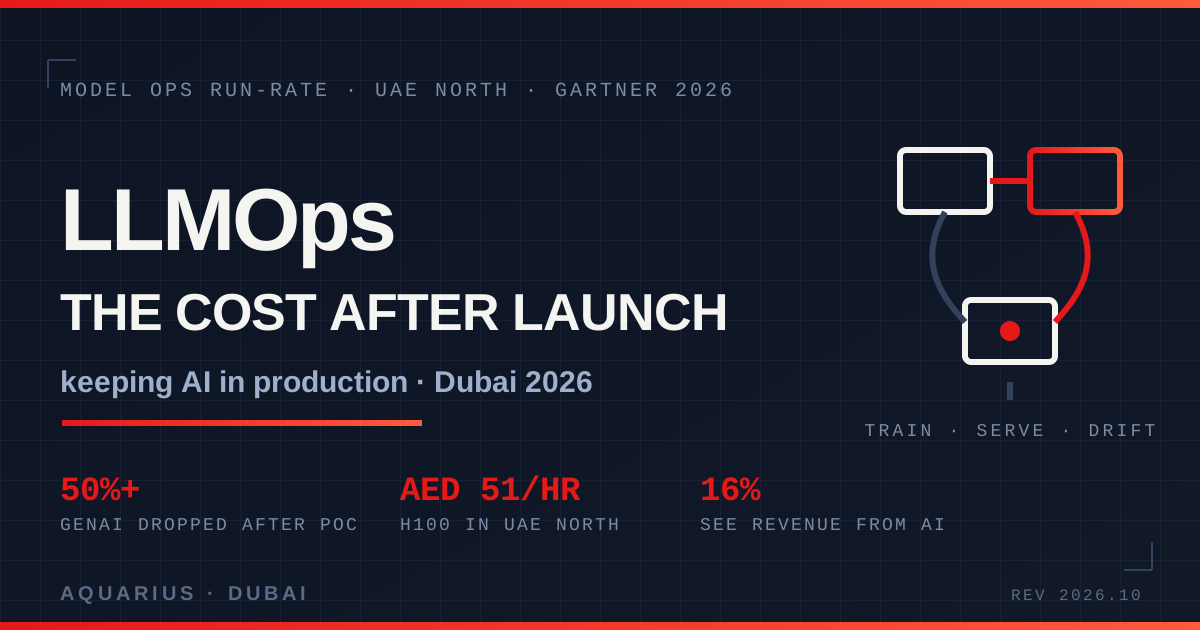
In Dubai in 2026, the expensive part of an AI project is not building the model, it is the 24 months after launch. A production LLM feature carries a permanent run-rate: evaluation harnesses, drift and token monitoring, prompt and model version control, retraining, and UAE-resident inference that costs roughly AED 45 to AED 51 per GPU-hour. Budget AED 73,000 to AED 184,000 a year for a single well-run API-based feature, and AED 900,000 or more for a private, UAE-hosted stack. That discipline is called MLOps, or LLMOps when the model is generative, and it is the single clearest reason some Dubai AI pilots turn into revenue while most quietly die.
The stakes: 72% adopted AI, 16% are getting paid for it
UAE AI adoption reached 72% of businesses in 2026, up from 53% a year earlier. The spending intent is just as strong: 90% of leaders are increasing AI budgets and 84% expect revenue growth from it. Only 16% are currently seeing that revenue impact. That is the whole story of Dubai AI in one line, and it is not a model-quality problem.
The structural evidence says the same thing. Across the GCC, nearly 80% of organisations have embedded AI into strategic plans, but only 34% have an enterprise-wide data strategy, fewer than one in three have the operating model and formal governance required to scale, and just 28% have a dedicated AI ethics or compliance board. Only 31% are using AI's more advanced applications at all. Meanwhile Gartner reports that more than 50% of generative AI projects are abandoned after the proof-of-concept stage, and forecasts that through 2026 organisations will drop 60% of AI projects that lack AI-ready data. The listed causes are never "the model was not clever enough": poor data quality, insufficient risk controls, rising costs, unclear business value.
The deadline pressure is local and real. On 4 May 2026 Sheikh Hamdan bin Mohammed launched an initiative to move Dubai's entire private sector toward agentic AI within two years, backed by Dubai Chamber training tracks, incubators and dedicated funds. It followed the federal directive to deliver 50% of government services through autonomous AI agents by 2028, with 80,000 federal employees in training. In June 2026 the UAE consolidated its AI Office, TDRA's digital-government arm and the Emirates Data Office into a single Federal Authority for Artificial Intelligence and Data. UAE firms are already further along than most: 15% run more than 500 AI agents in production, the highest of eight markets surveyed, against 9% globally.
Most Dubai businesses get this wrong in the same way: they approve a capital budget for building the model and no operating budget for running it. Six months later the pilot is "paused" and nobody can explain what broke.
LLMOps is not APM, and that is why it gets missed
Classic application monitoring tells you a request returned HTTP 200 in 180 ms. It cannot tell you the answer was wrong. A model degrades silently: the code never changes, the dashboards stay green, and quality decays as the world drifts away from the data the model saw. Four things make generative AI harder to operate than the software around it.
- Non-determinism. The same prompt can return different output, so "it works" has to be measured statistically against a scored evaluation set, not confirmed by one manual test.
- Variable unit cost. Every interaction bills. A single LLM inference can cost up to 100x a traditional ML prediction, so a feature that doubles in popularity doubles your bill, and a prompt-template change can quietly triple token volume.
- Drift without deploys. Pricing, regulations, catalogue, Arabic dialect usage and customer intent all move. The model does not.
- A live attack surface. Inputs are instructions. Prompt injection, data exfiltration through tools and over-broad agent permissions are operational risks, not launch-day checklist items. We cover the defences in detail in AI agent security in Dubai.
The global market has priced this in. MLOps tooling is tracking at USD 2.8 billion to 4.5 billion in 2026 on a verified 38 to 42% CAGR, while total AI infrastructure spending is forecast to pass USD 1 trillion by 2029 at roughly 31% annual growth. Nobody spends that on tooling for a solved problem.
The seven line items on a real Dubai AI run-rate
Here is what a production AI feature actually costs to keep alive in 2026, in AED, converted at AED 3.6725 to the dollar. These are operating costs after the build is paid for.
| Line item | What it buys | Monthly AED | Skippable? |
|---|---|---|---|
| Inference / tokens | Model API calls, or UAE-hosted GPU time for a private model | 1,500 to 40,000+ | No. This is the meter. |
| Model monitoring | Drift detection, quality scoring, hallucination and refusal rates, output regression alerts | 1,835 to 18,360 | No. This is how you learn you broke something. |
| Logging and tracing | Full prompt, response, tool-call and latency traces for AI workloads | 1,100 to 7,345 | No, and in Dubai it doubles as your audit trail. |
| Evaluation harness | A scored golden set run on every prompt or model change, in English and Arabic | 900 to 5,500 | No. Without it, every release is a guess. |
| Retraining and reindexing | Refreshing fine-tunes or rebuilding retrieval indexes as data changes | 1,200 to 12,000 | Quarterly at minimum for anything price or policy aware. |
| Human review loop | Sampled human grading of live output, plus an escalation path | 2,000 to 9,000 | No for regulated or customer-facing output. |
| Guardrails and access control | Injection filtering, PII redaction, tool permission boundaries, rate limits | 900 to 6,000 | No. |
Rolled up, the international benchmark maps cleanly onto Dubai. A small team running API-based features sits at roughly USD 20,000 to 50,000 a year, or AED 73,450 to AED 183,600. A full enterprise deployment with private infrastructure, data governance and monitoring reaches USD 250,000 plus, or AED 918,000 plus. The good news is that the same discipline is also the lever: FinOps practice on AI workloads, spot instances for training, model distillation and chargeback of AI spend to business units reliably cuts 40 to 60% off an undisciplined bill.
Two UAE multipliers that do not exist in the Western benchmarks
First, compute in the UAE is expensive. An NVIDIA H100 runs approximately USD 12.30 per GPU-hour in AWS me-central-1 (AED 45.2), USD 12.49 in GCP me-central1 (AED 45.9), and USD 14.00 in Azure UAE North (AED 51.4) — meaningfully above global averages. One always-on H100 is around AED 37,000 a month before storage or egress. That single number decides most build-versus-buy arguments in Dubai, and it is why a shared API endpoint beats a dedicated GPU until your volume is genuinely large. If data residency forces your hand, read our breakdown of private LLM options and AED costs in the UAE before you commit.
Second, residency and governance are not optional overhead. The UAE still has no horizontal AI statute, so an AI deployment sits simultaneously under PDPL, cybercrime rules, sector supervision, free-zone law and contractual assurance — the five rulebooks we map in AI compliance in Dubai. The cost of skipping that layer is now measured. IBM's 2026 report puts the average Middle East data breach at USD 8 million (about AED 29.4 million), with 26% of malicious breaches AI-enabled. Shadow AI — ungoverned tools adopted without review — was present in 43% of breached organisations in 2026, up from 20% a year earlier, and those breaches averaged USD 5.39 million against a global mean of USD 4.99 million. In 2025 IBM found 63% of breached organisations had no AI governance policy at all. Governance is the cheapest line on this page.
The three failure modes that actually kill Dubai AI pilots
1. No evaluation set, so no definition of "working". Teams demo ten prompts, everyone nods, and it ships. Three weeks later a prompt tweak degrades Arabic responses and nobody notices for a month. The fix is cheap: 100 to 300 graded examples per use case, in both languages, run automatically on every change. That one artefact separates projects that survive from the 50% Gartner counts as abandoned.
2. An unmetered token bill. As Core42's chief business officer put it, the biggest hidden cost is not the model, it is unmanaged consumption — every interaction carries a cost and organisations underestimate how fast it grows. Caching, routing cheap queries to small models, capping context length and setting per-tenant rate limits typically remove half the spend with no quality loss.
3. No named owner. The controls UAE regulators care about are mundane: a named human owner for every AI-supported function, permission boundaries so each agent acts only within its purpose, separation between what the AI prepares and what a human approves, and an audit trail for every action. Pilots with no owner get no budget at renewal.
What this costs to do properly with Aquarius
We treat the model as the easy half. A typical Dubai engagement looks like this:
| Engagement | What is included | AED |
|---|---|---|
| LLMOps readiness audit | Review of an existing AI feature: eval coverage, cost per interaction, drift exposure, guardrails, residency and audit-trail gaps, with a prioritised fix list | 9,500 to 18,000 one-off |
| Production hardening | Bilingual evaluation harness, tracing and cost dashboards, prompt and model versioning, CI gates, caching and routing, guardrail layer | 35,000 to 85,000 |
| Managed model operations | Monitoring, monthly eval runs, drift and cost reporting, retraining or reindexing, incident response | 6,500 to 22,000 per month |
Our commitment is simple and measurable: if the readiness audit does not identify cost or quality fixes worth more than its fee in the first year, you do not pay for it. The arithmetic is usually not close — a 40 to 60% reduction on even a modest AED 12,000 monthly inference bill returns the audit fee inside six months, before counting the revenue that the other 84% of UAE leaders are still waiting on. Full service ranges are on our pricing page.
FAQ
What is the difference between MLOps and LLMOps?
MLOps covers the lifecycle of any machine-learning model: data pipelines, training, versioning, deployment and monitoring. LLMOps is the generative subset, and it adds prompt versioning, token-cost control, retrieval index management, hallucination and refusal measurement, and injection defence. Most Dubai businesses in 2026 need LLMOps, because most are consuming a foundation model rather than training one.
Do I need MLOps if I only use an AI chatbot from a vendor?
You need a reduced version of it. You still own the prompts, the knowledge base, the escalation rules and the output your customers see. At minimum: a scored eval set, monthly sampling of real conversations, a token-spend alert and a named owner. That is a few thousand dirhams a month, not a platform project.
Can I keep AI data inside the UAE and still control costs?
Yes, but pick the right tier. UAE-resident API endpoints through sovereign cloud providers cost far less than a dedicated GPU, which runs around AED 37,000 per month for a single always-on H100. Reserve self-hosting for workloads where regulation or volume genuinely demands it.
How long does it take to get an AI feature production-ready in Dubai?
Hardening an existing feature typically takes three to six weeks: one week to build the bilingual evaluation set, one to two for tracing, cost dashboards and CI gates, and the rest for guardrails, caching and the governance paperwork. A readiness audit alone takes about five working days.
The short version
The UAE AI market is heading from roughly USD 7.93 billion in 2026 to AED 170 billion by 2030, with a national target of AED 335 billion contributed to the economy by 2031. The companies that capture a share of that will not be the ones with the best demo. They will be the ones whose AI still works, still costs what it should and still passes an audit in month 18.
If you have an AI feature in production, or one that stalled after the pilot, send us the use case and your current monthly spend. We will tell you honestly what it should cost to run and what is missing. Talk to the Aquarius team.