
Magento vs Adobe Commerce Dubai 2026: Real AED Costs
Magento Open Source licence is AED 0. Adobe Commerce runs AED 80,800-697,800 a year by GMV band. Dubai build costs, the 2.4.9 upgrade and the UAE hosting trap.
- PUBLISHED
- 17 OCT 2026
- READ TIME
- 12 MIN
- AUTHOR
- AQUARIUS · DUBAI
- UNIT
- REV 2026.09
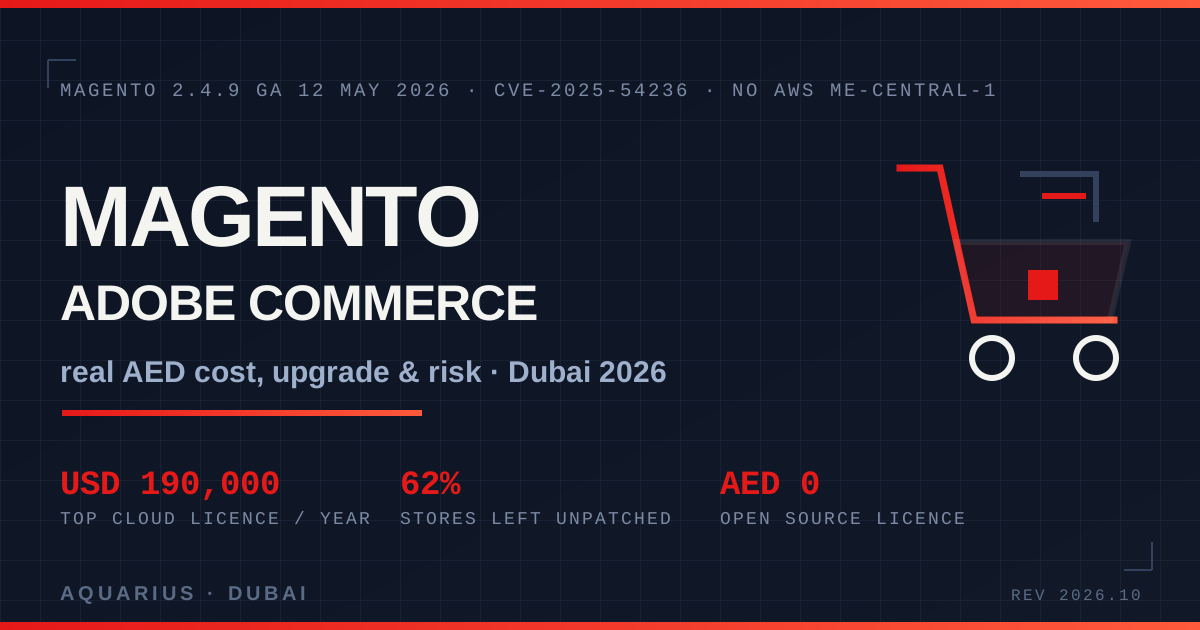
Short answer: Magento Open Source costs AED 0 in licence fees; Adobe Commerce is quote-only and typically lands between USD 22,000 and USD 125,000+ a year on-premises (≈ AED 80,800–459,100) or USD 40,000 to USD 190,000+ a year on Adobe’s cloud (≈ AED 146,900–697,800), priced off your gross merchandise value. Building or rebuilding a Magento store in Dubai realistically costs AED 20,000–45,000 for a basic catalogue, AED 40,000–90,000 for a custom build, and AED 120,000+ for enterprise work — before the two things most Dubai merchants miss: the Magento 2.4.9 upgrade is a rewrite in places, and Adobe’s managed cloud has no UAE region.
Key takeaways
- Licence is the small number. Development, hosting, extensions and support commonly cost two to three times the licence over a year.
- Only 38% of Magento stores were patched against SessionReaper (CVE-2025-54236) when mass exploitation started — 62% were sitting open.
- Magento 2.4.9 shipped 12 May 2026 and drops Laminas MVC, Zend_Cache, TinyMCE, PHP 8.2 and MySQL 8.0. Budget it as a project, not a patch.
- Adobe Commerce Cloud does not offer AWS
me-central-1(UAE). Your Dubai store serves from Europe or Asia-Pacific.- Dubai Magento rates sit around AED 136–213 per hour; maintenance is typically AED 100–150 per hour.
Why this matters for a UAE store right now
The UAE e-commerce market is worth roughly USD 12.30 billion in 2026 and is forecast to reach USD 21.01 billion by 2031 — an 11.29% compound annual growth rate. Dubai’s own logistics district EZDubai puts the national market on a 9.9% CAGR through 2030, reaching AED 67.2 billion. Wholesale and retail trade alone generated AED 50.9 billion of real gross value added in Dubai in Q1 2026, about 22% of the emirate’s GDP.
That growth is mobile-first: 78.67% of UAE online orders are placed on a phone, against 99% internet penetration and 11.3 million users. More than 40% of UAE consumers now use buy-now-pay-later at checkout. A platform decision in 2026 is really a decision about mobile performance, local payment coverage and compliance — not about feature checklists.
Magento is still a serious option here, but a shrinking one. StoreLeads counted 111,495 active Magento stores in Q1 2026, down about 10% year on year, giving Magento roughly 7–8% of global platform share — third behind WooCommerce (~33%) and Shopify (~26%). BuiltWith tracks a few hundred live Magento sites in the UAE and around 1,400 across the Middle East. Small numbers, but they skew heavily to big catalogues, B2B pricing and multi-store groups — exactly the work Shopify struggles with.
Magento Open Source vs Adobe Commerce vs ACCS: what you actually buy
There are now four products wearing roughly the same name, and Adobe publishes a price for none of them.
Magento Open Source is the free, self-hosted edition. No licence fee, no GMV reporting, no Adobe contract. You supply hosting, security patching, B2B features and everything Adobe keeps behind the paywall.
Adobe Commerce (on-premises) adds B2B modules, staging, Page Builder, Live Search, Product Recommendations and Adobe support. Licensing is annual and banded by GMV.
Adobe Commerce Cloud is the same software as a managed PaaS on AWS or Azure, with the infrastructure bundled into the licence — which is why the cloud bands run roughly 50–80% above on-premises.
Adobe Commerce as a Cloud Service (ACCS) launched in June 2025 as a true multi-tenant SaaS, sold in “per base package” tiers, usually paired with Adobe Commerce Optimizer for headless storefront and merchandising. Adobe has published no list pricing for it. Treat any ACCS number you see online as someone else’s negotiated deal.
| Edition | Annual licence (indicative) | In AED (peg 3.6725) | Who it fits in Dubai |
|---|---|---|---|
| Magento Open Source | USD 0 | AED 0 | Catalogues under ~5,000 SKUs with an in-house or retained dev team |
| Adobe Commerce on-prem — under USD 1m GMV | ≈ USD 22,000 | ≈ AED 80,800 | Growing retailer wanting B2B + support, own infrastructure |
| Adobe Commerce on-prem — USD 5–10m GMV | ≈ USD 49,000 | ≈ AED 180,000 | Established UAE brand, multi-store, Arabic + English |
| Adobe Commerce on-prem — USD 25m+ GMV | USD 125,000+ | AED 459,100+ | Regional group, GCC-wide distribution |
| Adobe Commerce Cloud — under USD 1m GMV | ≈ USD 40,000 | ≈ AED 146,900 | No ops team; accepts EU/APAC hosting |
| Adobe Commerce Cloud — USD 25m+ GMV | USD 190,000+ | AED 697,800+ | Enterprise with Adobe Experience Cloud already in place |
| ACCS (SaaS) | Quote only | Quote only | Greenfield builds willing to work inside Adobe’s SaaS limits |
Those bands are the industry-reported pattern, not an Adobe price list — every Adobe Commerce deal is negotiated against your reported GMV. Ask for the GMV definition in writing: whether it includes VAT, shipping, cancellations and returns changes which band you land in.
The Dubai build cost on top
Licence is the cheap half. UAE Magento agencies most commonly bill USD 25–49 per hour (roughly AED 92–180) — that band covers 48.78% of listed UAE firms, with a category median near USD 37 (AED 136) and a Dubai average around USD 58 (AED 213). Offshore Indian agencies sit at USD 15–45 per hour for individuals and USD 50–150+ for established shops; senior Indian agencies land around USD 35–65, roughly a quarter of US rates. Ongoing Magento maintenance in Dubai is typically AED 100–150 per hour.
Translated into projects: a basic Dubai Magento store runs AED 20,000–45,000, a genuinely custom build AED 40,000–90,000, and enterprise work with ERP integration, B2B pricing and Arabic RTL starts around AED 120,000. Add a realistic 15–25% a year for patching, extension renewals and version upgrades. If you want the comparison against a headless or bespoke stack, we broke that down in Shopify vs custom e-commerce in Dubai.
The myth-bust: “we’re on Magento, we’re enterprise-grade”
Magento’s biggest 2026 story is not pricing. It is SessionReaper — CVE-2025-54236, an improper-input-validation flaw in the Magento and Adobe Commerce Web API that allows unauthenticated session takeover, including administrator sessions, and chains to remote code execution. It affects Adobe Commerce, Commerce B2B and Magento Open Source alike.
Adobe shipped an emergency patch about six weeks early. Mass exploitation began on 22 October 2025, the same day a public technical analysis landed. Security firm Sansec blocked more than 250 exploitation attempts on day one, from attacker infrastructure uploading PHP webshells through the /customer/address_file/upload endpoint. The vulnerability was added to the CISA Known Exploited Vulnerabilities catalogue.
The number that should worry every Dubai merchant: only 38% of Magento stores had applied the patch when exploitation started. 62% were open. Fewer than one store in three was protected a month earlier. SessionReaper follows CosmicSting (2024), TrojanOrder (2022) and Shoplift (2015) — the pattern is a yearly mass-exploitation event that only patched stores survive. Self-hosting Magento without a named person responsible for patch Tuesdays is not a cost saving, it is deferred incident response. The cost of recovering a hacked Dubai site dwarfs a year of maintenance.
And 2.4.9 is not a patch
Magento 2.4.9 reached general availability on 12 May 2026 with standard support to 31 May 2029. From 2026 Adobe moved to one major release each May, aggregated security patches in May and November, and isolated security fixes monthly on the second Tuesday.
Upgrading is real work. 2.4.9 replaces Laminas MVC with native PHP MVC, swaps Zend_Cache for Symfony Cache, and drops TinyMCE for HugeRTE (an MIT fork, after TinyMCE 5 and 6 hit end of life and TinyMCE 7 became licence-incompatible). It requires MySQL 8.4 or MariaDB 11.8 as a minimum, adds PHP 8.5 support and drops PHP 8.2, and ships 560+ bug fixes. Most third-party extensions need vendor updates before they will run.
Meanwhile the clock on older versions has run out: 2.4.5 left standard support on 12 August 2025, 2.4.6 left standard support on 11 August 2026 (extended support to 31 August 2027), 2.4.7 runs to 31 May 2027 and 2.4.8 to 31 May 2028. If you are on 2.4.5 or 2.4.6 today, you are already in borrowed time.
The UAE trap nobody mentions in the sales call
Adobe Commerce on cloud infrastructure is available in AWS regions Adobe designates US, US-3, US-5, EU, EU-3, EU-5, EU-6 and AP-3; development and Reporting environments are limited to US or EU. AWS me-central-1 — the UAE region, three availability zones, AWS’s second in the Middle East after Bahrain — is not on that list.
So a Dubai store on Adobe Commerce Cloud serves customers from Europe or Asia-Pacific. Two consequences. First, latency: every uncached request crosses an ocean, which is exactly the wrong trade when 78.67% of your orders arrive on mobile and Core Web Vitals gate your rankings. Second, data residency: customer and order data lives outside the UAE, which forces a cross-border transfer assessment under the UAE Personal Data Protection Law.
Self-hosted Magento Open Source has no such limit — it runs fine in me-central-1 or Azure UAE North, with your database inside the country. That single fact flips the Open Source vs Adobe Commerce maths for any UAE business with residency requirements. We cover the detail in Dubai hosting and data residency.
What a Dubai Magento store must handle in 2026
Local payments and BNPL. Tap Payments ships a Magento gateway (composer require tappayments/module-payment-gateway) with 3DS2, saved cards, Apple Pay and Tabby. Tabby publishes tabby/m2-payments — note it requires the store currency to be AED, SAR or KWD, a configuration detail that quietly breaks multi-currency setups. Network International gives local acquiring and AED settlement for mid-market and enterprise; PayTabs and Telr both maintain Magento extensions with Apple Pay, Google Pay and BNPL. Our payment gateway integration cost guide has the fee comparison.
E-invoicing. Ministerial Decisions 243 and 244 of 2025, issued 29 September 2025, set the UAE’s phased e-invoicing rollout. Businesses with revenue of AED 50 million or more must appoint an Accredited Service Provider by 30 October 2026 and issue structured e-invoices from 1 January 2027. Below AED 50 million: ASP by 31 March 2027, issuing from 1 July 2027. Government entities issue from 1 October 2027. B2B and B2G invoices must be structured XML in PINT-AE format, routed through an ASP — which means your Magento order and credit-memo data has to reach that provider cleanly. A voluntary pilot has been open since 1 July 2026 with no penalty exposure, and it is the cheapest way to find your data-quality problems. See UAE e-invoicing and ERP integration.
Arabic and RTL. A second store view with a proper RTL theme, Arabic product data and Arabic payment and shipping labels — not a translation plugin bolted onto an English theme.
How Aquarius handles Magento work in Dubai
We take three kinds of Magento job, quoted fixed-price after a free audit:
| Engagement | Typical AED | Timeline | What you get |
|---|---|---|---|
| Security & health audit | AED 6,000–18,000 | 5–8 days | Patch gap report, extension debt list, hosting/PDPL review, prioritised fix plan |
| 2.4.9 upgrade | AED 25,000–75,000 | 4–9 weeks | Staging upgrade, extension re-certification, PHP/MySQL migration, UAT, cutover |
| New Magento Open Source store | AED 45,000–140,000 | 8–16 weeks | Custom theme, Arabic RTL, UAE payments, me-central-1 hosting, ERP hooks |
| Replatform off Magento | AED 35,000–120,000 | 6–14 weeks | Catalogue + customer migration, 301 map, SEO protection, new stack |
| Care plan | AED 3,500–12,000 / month | Ongoing | Patch Tuesdays applied, uptime + WAF, monthly performance report |
Risk reversal: fixed price, written scope, UAE-hosted staging you can click through before launch, and the audit is free. If the audit says your current build is fine, we tell you that and send no invoice.
The conversion argument is simple. A Dubai store doing AED 2 million a year that loses a week to an unpatched exploit loses roughly AED 38,000 in revenue plus cleanup — more than a year of the care plan above, and more than the audit and upgrade combined. With 62% of Magento stores unpatched at the last mass-exploitation event, that is not a hypothetical.
FAQ
Is Magento free?
Magento Open Source has no licence fee. It is not free to run: you pay for hosting, SSL, extensions, security patching and developer time. A realistic Dubai total cost of ownership for a self-hosted Open Source store is AED 20,000–45,000 to build plus AED 3,500–12,000 a month to keep safe and current.
How much does Adobe Commerce cost per year in AED?
Adobe does not publish prices. Industry-reported bands put on-premises licences at roughly AED 80,800 a year under USD 1m GMV, rising to AED 459,100+ above USD 25m GMV; Adobe-managed cloud runs roughly AED 146,900 to AED 697,800+ on the same bands. Development, extensions and support usually add two to three times the licence.
Should a Dubai store move from Magento to Shopify?
If your catalogue is simple, your integrations are few and you have no in-house developer, Shopify will cost less and break less. Stay on Magento when you need complex B2B pricing, multi-store with Arabic RTL, deep ERP integration, or UAE data residency — Shopify cannot host your database in the UAE either, but Magento Open Source can.
Is Magento 2.4.9 safe to upgrade to immediately?
It is the supported path — standard support runs to 31 May 2029 — but it is not a same-day job. Native PHP MVC replacing Laminas, Symfony Cache replacing Zend_Cache, HugeRTE replacing TinyMCE, plus MySQL 8.4 and MariaDB 11.8 minimums, means most third-party extensions need vendor updates first. Test on staging, budget four to nine weeks.
Can Adobe Commerce Cloud host in the UAE?
Not today. Adobe’s supported cloud regions are its US, EU and AP-3 designations; AWS me-central-1 in the UAE is not among them. If in-country data residency matters for your PDPL position, self-hosted Magento Open Source or a custom stack in me-central-1 is the route.
Get a straight answer on your Magento store
Tell us your version, your GMV band and whether residency matters, and we will tell you in one call whether to patch, upgrade, or replatform — with an AED number against each option. Start with the free Magento audit, or see fixed starting points on Aquarius pricing.