
Home Healthcare Software in Dubai (2026): DHA Standards, the 24-Hour Rule and Real AED Build Costs
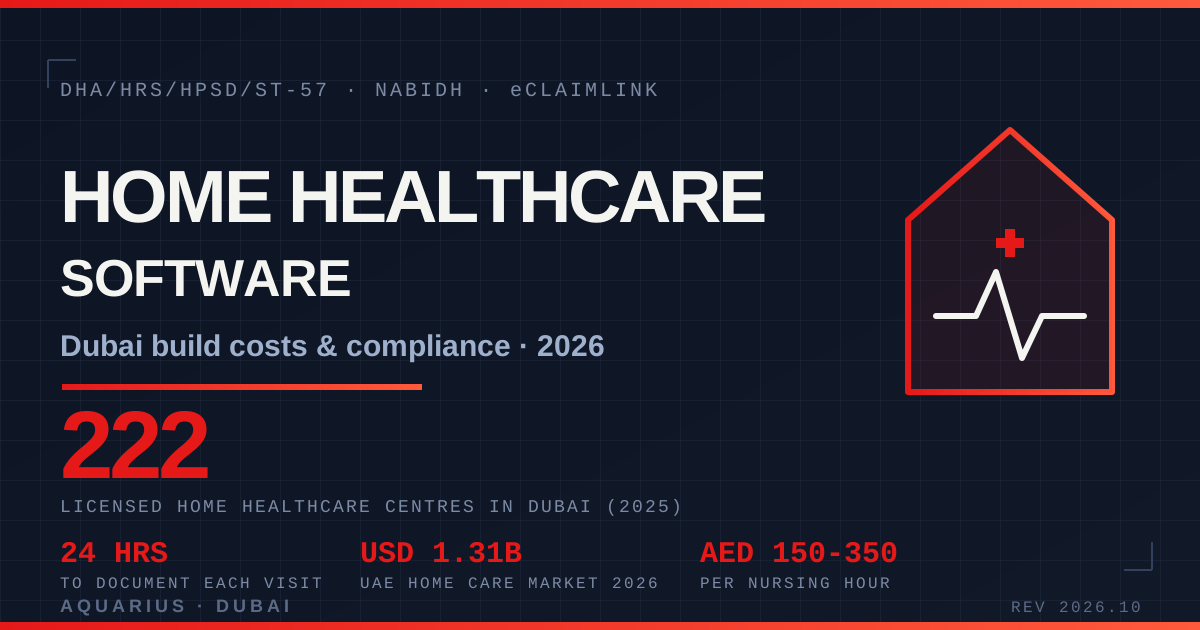
Dubai licensed 222 home healthcare centres in 2025, four times its hospital count. Real AED build costs for home care software, the DHA 24-hour documentation rule, NABIDH and visit verification.
- PUBLISHED
- 03 OCT 2026
- READ TIME
- 12 MIN
- AUTHOR
- AQUARIUS · DUBAI
- UNIT
- REV 2026.09
Short answer: a custom home healthcare and home nursing platform in Dubai costs roughly AED 70,000-320,000 to build and AED 2,500-9,000 a month to run. It is not an optional efficiency project. The DHA Standards for Home Healthcare Services require every patient visit to be documented electronically within 24 hours and authenticated with an electronic signature, and every DHA-licensed facility must maintain an active NABIDH connection to keep its licence. Paper visit sheets and a WhatsApp rota do not clear either bar.
Dubai now has 222 licensed home healthcare centres. That is four times the number of hospitals in the emirate. Almost all of them run their rosters on a spreadsheet.
Why home care became a real industry in Dubai (awareness)
Three numbers explain the rush. First, scale: Dubai’s licensed health facilities grew to approximately 5,800 in 2025, up from 5,340 in 2024 - growth of over 8 percent - and the breakdown is telling. Alongside 55 hospitals, 126 general medical clinics and 60 day-surgery centres, the emirate licensed 222 home healthcare centres. The private healthcare workforce passed 69,400 professionals, up from 64,100 the year before.
Second, money: the UAE home healthcare market is estimated at USD 1.18 billion in 2025, rising to USD 1.31 billion in 2026 and forecast to reach USD 2.19 billion by 2031 at a 10.84% CAGR. Third, the demand switch: health insurance became mandatory for private sector employees and domestic workers across all seven emirates from 1 January 2025, with a basic package priced at AED 320 a year covering claims up to AED 150,000, chronic and pre-existing conditions included with no waiting period. Newly insured residents plus post-acute discharge pressure on hospital beds equals home visits - and home visits are only billable if they are documented and verifiable.
Most Dubai home care operators get this wrong: they buy a generic field-service or CRM tool, then bolt clinical notes on afterwards. The DHA standard is not a scheduling standard. It is a clinical record standard with a hard clock on it. Build the record first and the roster around it, not the other way round.
What the DHA standard actually demands from your software (consideration)
The Standards for Home Healthcare Services (code DHA/HRS/HPSD/ST-57, issued 19 December 2024, effective 19 February 2025, revision date 2029) is the document your system is audited against. The clauses that translate directly into software requirements:
- Clause 8.2.1 - a qualified physician must assess the patient face-to-face before any home healthcare service takes place. Your intake workflow needs a gate: no visit can be scheduled against a patient with no recorded physician assessment.
- Clause 8.2.2 and 8.2.3 - care plans are developed in consultation with the treating physician, with documented medical history, physical examination, impairment level, medications, drug allergies and impact on activities of daily living (ADLs). That is a structured form, not a free-text note.
- Clause 9.1.3 - maintain an electronic medical record / NABIDH system covering patient identification, vital signs and assessments at each home visit, medical history, medication documentation with dose and route, the care plan with goals and documented rationale for every change, risk assessments (falls, pressure ulcers), signed physician orders, consent forms, communication records, referrals and a discharge summary on termination of service.
- Clause 9.1.4 - records shall be documented electronically within 24 hours of the patient’s visit and authenticated by electronic or computer-generated signature. This single clause kills paper. A nurse finishing a 7pm visit in Al Barsha has until 7pm tomorrow, and the signature has to be attributable.
- Clause 9.2 - general and informed consent signed before services begin, obtainable from a relative up to the fourth degree where the patient lacks capacity or is under 18, stored in the patient record and available for DHA inspectors at all times. Inspectors ask for it on the spot; a file cabinet in Deira is the wrong answer.
- Clause 9.1.2 - a list of all patients under home care, active and non-active, maintained at the facility office. A live census, not a reconstructed one.
- Standards Twelve and Thirteen - quality assurance and KPIs, measured and reported: clinical documentation accuracy, consent compliance, patient safety incidents and adverse events per 1,000 patient visits, infection rates, complaint resolution time, wound healing within the care-plan timeframe, new pressure ulcers, response time to service requests, unplanned re-visits, hospital readmissions at 30, 60 and 90 days, hospital-free days, ER visit rate and telehealth utilisation. Every one of those is a denominator your system must be able to produce on demand.
Staffing adds its own constraint. DHA guidance puts the assistant-nurse to registered-nurse ratio at 2:1 generally, but home care facilities are required to have 8 nurses in total at a 3:1 AN:RN ratio, with a registered or assistant nurse to physician ratio of 1:2. A roster engine that cannot encode skill mix will put you out of compliance on a Tuesday afternoon without anyone noticing.
On top of the clinical record sit the two Dubai integrations nobody can avoid: NABIDH, the mandatory health information exchange - a compliant EMR meeting the NABIDH Minimum Data Set is a prerequisite on the facility licence application and at renewal, and an inactive connection blocks renewal - and eClaimLink, the DHA portal through which all insurance claims must be submitted against the Unified Health Claims Data Set. We cover both in depth in our guides to EMR and NABIDH integration for Dubai clinics and medical billing and claims software on eClaimLink.
What it costs to build in Dubai
| Scope | What you get | Build cost (AED) | Timeline |
|---|---|---|---|
| Operations MVP | Patient census, physician assessment gate, care plans, nurse rostering with skill mix, mobile visit app with offline capture and e-signature, 24-hour documentation clock | 70,000 - 130,000 | 7 - 10 weeks |
| Clinical home care platform | MVP plus structured vitals and assessments, medication administration records, risk assessments, incident and adverse-event reporting, consent vault, discharge summaries, QA and KPI dashboards | 130,000 - 230,000 | 12 - 18 weeks |
| Full platform | Above plus family portal, telehealth follow-ups, route optimisation, inventory and equipment tracking, payroll-linked timesheets, multi-branch and Arabic/English throughout | 230,000 - 320,000 | 18 - 26 weeks |
| NABIDH integration | Minimum Data Set mapping, HL7 messaging, certification support | 45,000 - 110,000 | 6 - 12 weeks |
| eClaimLink / e-claims | Prior approval, claim submission, remittance reconciliation, denial workflow | 35,000 - 90,000 | 5 - 9 weeks |
| Run and support | UAE hosting, monitoring, backups, small changes, support SLA | 2,500 - 9,000 / month | ongoing |
The mobile visit app is where the compliance value concentrates. Electronic visit verification - timestamped, geo-stamped check-in and check-out at the patient’s address - exists precisely to prove a visit happened as billed, cutting phantom visits, billing errors and payroll disputes while giving coordinators real-time alerts on late and missed visits. In a Dubai context it also produces, as a by-product, the attributable evidence trail that satisfies clause 9.1.4 and the audit an insurer runs before paying.
The unit economics, in AED (decision)
Home nursing in Dubai bills at AED 150-350 per hour for most agencies, a 12-hour shift at AED 800-1,400, and live-in monthly packages at AED 18,000-35,000. Run the arithmetic on a mid-size operator: 30 nurses, each delivering 6 billable hours a day, 26 days a month, at a conservative AED 180 per hour. That is roughly AED 842,000 of monthly revenue, about AED 10.1 million a year.
Now the leakage. Two visits a week lost to scheduling collisions, traffic and no-shows across that roster is around 3% of capacity - call it AED 300,000 a year. Add claims rejected because documentation was late or incomplete, which on manual home care operations routinely runs into double-digit percentages of submitted value. A platform that enforces the 24-hour clock, verifies visits electronically and submits clean claims only has to recover a third of that leakage to pay for a AED 230,000 build inside the first year. The licence risk is the part with no price: an inactive NABIDH connection blocks renewal, and a facility that cannot renew does not bill at all.
Aquarius builds these as one system rather than four tools taped together: a React and Node stack, UAE hosting where data residency is required, an offline-first nurse app for buildings with no lift signal, Arabic and English from day one, the DHA clause set encoded as validation rather than training, and NABIDH and eClaimLink handled as first-class integrations instead of year-two promises. We scope in two-week discovery, ship the census, rostering and visit app first so operations feel it inside two months, then layer clinical documentation, QA dashboards and claims. Fixed-price phases, source code and data are yours, no per-nurse licence to leave behind. See pricing or the full services list, or look at how we approach healthcare app development in Dubai.
FAQ
How much does home healthcare software cost in Dubai?
A custom build runs AED 70,000-320,000 depending on whether you stop at rostering and a visit app or go through to full clinical documentation, QA dashboards and a family portal, plus AED 2,500-9,000 a month to run. NABIDH integration adds AED 45,000-110,000 and eClaimLink claims handling AED 35,000-90,000.
Is NABIDH integration mandatory for a Dubai home healthcare centre?
Yes. Every DHA-licensed facility must connect to NABIDH, and an EMR meeting the NABIDH Minimum Data Set is a prerequisite on both the new facility licence application and renewal. Failure to maintain an active, compliant connection blocks licence renewal. The DHA home healthcare standard separately requires an electronic medical record or NABIDH system for patient documentation.
How quickly must a home visit be documented under DHA rules?
Within 24 hours of the patient’s visit, electronically, authenticated by an electronic or computer-generated signature. That is clause 9.1.4 of the Standards for Home Healthcare Services. In practice it means the nurse documents on a mobile device at the point of care, because a batch of paper notes written up at the weekend fails both the clock and the attribution test.
Can we use an off-the-shelf home care system from the US or UK?
Partly. The clinical workflow translates; the compliance layer does not. Imported systems have no NABIDH interface, no eClaimLink claim format, no Arabic clinical and consent documents, no fourth-degree-relative consent rule, and no Dubai Drug Code mapping. Most Dubai operators end up paying for a licence plus a heavy localisation project - which is usually the point where a custom build becomes the cheaper of the two.
Does insurance in Dubai pay for home nursing?
Commonly yes for skilled home nursing and home physiotherapy where it is medically necessary and prescribed, with prior approval supported by a medical report and an itemised cost breakdown from a DHA-licensed provider. Long-term personal and elderly care is rarely covered. Your software should treat prior approval as a workflow stage with its own SLA, not an email someone remembers to send.
Thinking about building? Send us your current roster size, your NABIDH status and your biggest operational leak, and we will come back with a scoped AED range and a phase plan. Talk to Aquarius.