
Google Workspace vs Microsoft 365 for Dubai Businesses (2026): Real AED Cost, the 1 July Price Rise and UAE Data Residency
After the 1 July 2026 Microsoft increase both suites land at roughly AED 51-52 per user per month. The decision is no longer price - it is where your data sits and what AI costs on top.
- PUBLISHED
- 09 OCT 2026
- READ TIME
- 12 MIN
- AUTHOR
- AQUARIUS · DUBAI
- UNIT
- REV 2026.09
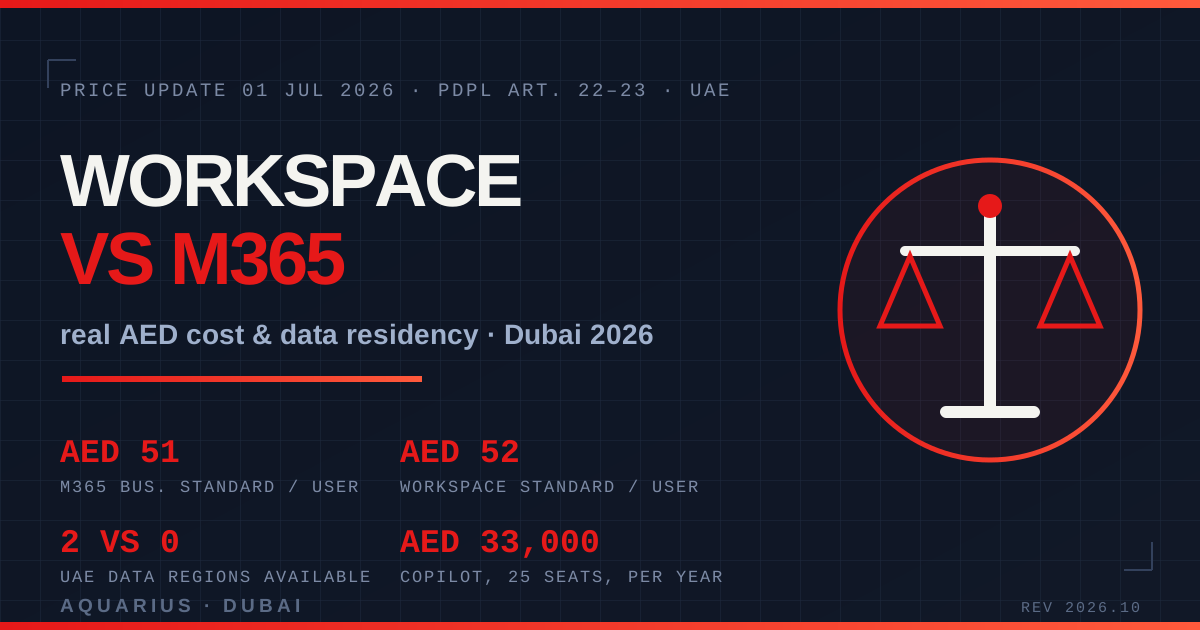
Short answer: After Microsoft's 1 July 2026 price update, the two mid-tier suites Dubai SMEs actually buy cost almost exactly the same: Microsoft 365 Business Standard at USD 14 per user per month (about AED 51 at the pegged rate, before 5% VAT) and Google Workspace Business Standard at USD 14 (UAE resellers list AED 52). On 25 users that is a difference of roughly AED 180 a year — noise. The two differences that are not noise: Microsoft can store your mail, files and Teams data at rest inside the UAE (Dubai and Abu Dhabi regions), while Google Workspace data regions offer only the United States, Europe or "no preference"; and Microsoft charges USD 30 per user per month extra for Copilot while Google bundles Gemini into every paid Workspace plan at no extra cost.
Key takeaways
- Price parity is now real. Microsoft 365 Business Standard moved from USD 12.50 to USD 14 on 1 July 2026 (+12%), Business Basic from USD 6 to USD 7 (+16%), Apps for business from USD 8.25 to USD 10 (+21%). Business Premium stayed at USD 22 — the same list price as Google Workspace Business Plus.
- The AI line item is the real budget decision. Microsoft 365 Copilot is USD 30 per user per month on top of a qualifying licence — about AED 33,000 a year for 25 seats. Google folded Gemini into all paid plans on 15 January 2025 for a USD 2 uplift and retired the old ~USD 20 standalone add-on.
- Data residency is the one-way door. A tenant provisioned with country = United Arab Emirates keeps Exchange, SharePoint, OneDrive and Teams content at rest in Microsoft's UAE North (Dubai) and UAE Central (Abu Dhabi) regions. Google has no UAE cloud region — its nearest regional presence is Doha.
- The PDPL clock is running with no map. The UAE Personal Data Protection Law has been in force since January 2022, yet the Executive Regulations remain unpublished — no adequacy list, no official standard contractual clauses — and practitioners are working to a 1 January 2027 full-compliance expectation.
- Most Dubai businesses get this wrong by choosing the brand first. The right order is workload, then residency, then AI, then price. Price is the last tie-breaker, and in 2026 it barely breaks a tie.
Why this decision suddenly matters in Dubai (and did not in 2023)
Three numbers set the stakes, and all three moved in the last eighteen months.
- The UAE cloud market is compounding at nearly 28% a year. It is valued at USD 16.43 billion in 2026 and forecast to reach USD 56.26 billion by 2031 at a 27.93% CAGR, with public cloud services alone accounting for USD 8.11 billion in 2025 — 63.2% of the market. A productivity suite is the first cloud contract almost every Dubai company signs, and the one that then dictates identity, storage and AI for a decade.
- Microsoft has put USD 15.2 billion behind the UAE specifically. Microsoft has confirmed a USD 15.2 billion UAE commitment through 2029 — USD 7.3 billion already deployed since 2023 and USD 7.9 billion to come for 2026–2029, of which USD 5.5 billion is AI and cloud infrastructure, plus a 200 MW Khazna datacentre expansion expected to begin operating before the end of 2026. That is the infrastructure behind the residency answer below.
- This is an SME decision, at scale. SMEs make up roughly 95% of all businesses in Dubai, around 42% of employment and 40–50% of GDP, and Dubai Chamber of Commerce membership has passed 292,486 companies. The typical buyer is a 10–60 seat firm with no in-house IT, signing an annual commitment off a reseller's one-page quote.
Here is what most Dubai businesses get wrong. They treat the suite as an email purchase and shop it on monthly price per mailbox. It is actually an identity, storage and compliance purchase — the thing your ERP logs into, the place every contract and Ejari document lands, and the system a PDPL enquiry will ask about. The AED 10 a month you save at signature is irrelevant against a migration you have to repeat in year three because the first choice could not evidence where the data lives.
What each suite actually costs in Dubai, in AED
These are list prices at the USD peg of AED 3.6725, per user per month on an annual commitment, excluding 5% UAE VAT. Reseller AED list prices in the UAE sit within a dirham or two of the converted figure; monthly, no-commitment billing typically runs 20–25% higher.
| Tier | Microsoft 365 | AED / user / mo | Google Workspace | AED / user / mo |
|---|---|---|---|---|
| Entry — web and mobile apps, no desktop Office | Business Basic — USD 7 | ~26 | Business Starter — USD 7 | ~26 |
| Mainstream — the tier most SMEs buy | Business Standard — USD 14 | ~51 | Business Standard — USD 14 | ~52 (reseller list) |
| Security and device management | Business Premium — USD 22 | ~81 | Business Plus — USD 22 | ~81 |
| Apps only | Apps for business — USD 10 | ~37 | n/a (web-native) | — |
| Storage at mainstream tier | 1 TB OneDrive + 50 GB mailbox (+50 GB added in 2026) | — | 2 TB pooled per user | — |
| AI assistant | Copilot add-on — USD 30 | ~110 | Gemini included | 0 |
The 1 July 2026 Microsoft update is worth reading as a trend, not a one-off. It was the largest commercial repricing since 2022: Business Basic USD 6 to 7, Business Standard USD 12.50 to 14, Apps for business USD 8.25 to 10, Office 365 E3 USD 23 to 26, Office 365 E5 USD 38 to 41, Microsoft 365 E3 USD 36 to 39 and E5 USD 57 to 60. Business Premium held at USD 22. Existing customers stay on old pricing until their first renewal after 1 July — which means a large share of Dubai SMEs will feel this on a 2026 or 2027 renewal date they have not diarised. Microsoft paired the increase with packaging: an extra 50 GB of mailbox storage, URL time-of-click protection and Copilot Chat enhancements across the Business plans, with Defender for Office P1 and Intune added at E3 and Security Copilot, Cloud PKI and Intune Endpoint Privilege Management at E5.
Google's increase already happened. On 15 January 2025 Google bundled Gemini into every paid Workspace plan and raised prices by about USD 2 per user per month — Business Standard from USD 12 to USD 14 — while retiring the standalone Gemini add-on that had cost roughly USD 20 per user per month. New customers paid immediately, monthly subscribers from 17 March 2025, annual plans at renewal. The 2026 lineup is unchanged: Business Starter USD 7 with 30 GB pooled, Business Standard USD 14 with 2 TB, Business Plus USD 22 with 5 TB, Enterprise on request.
The AI maths is where the real money is
Run it on a realistic Dubai office of 25 staff, annual commitment, before VAT:
- Microsoft 365 Business Standard: 25 × AED 51.4 × 12 = AED 15,420 a year.
- Google Workspace Business Standard: 25 × AED 52 × 12 = AED 15,600 a year.
- Add Copilot to the Microsoft stack: 25 × AED 110.2 × 12 = AED 33,052 a year — 2.1× the cost of the suite itself, and AED 33,052 more than the Gemini capability already sitting inside the Google quote.
That is the shareable number in this whole comparison: on a 25-seat Dubai office the suites differ by about AED 15 a month in total, while the AI decision differs by about AED 33,000 a year. Anyone arguing the licence price is arguing about the wrong line. Before you sign for Copilot seats, read our breakdown of what Microsoft 365 Copilot really costs in Dubai — including the cheaper tiers and the adoption data that should set your seat count.
Data residency: the one difference that is not a matter of taste
This is where the suites genuinely diverge, and it is the part reseller quotes never mention.
Microsoft. Microsoft has operated two in-country cloud regions since 2019 — UAE North in Dubai and UAE Central in Abu Dhabi. If a Microsoft 365 tenant is provisioned with its country set to the United Arab Emirates, customer data at rest for the core services — Exchange Online mailboxes, SharePoint Online site content, OneDrive for Business files, and Teams chats, channel conversations, images, voicemail and contacts — is stored in those UAE datacentres. You can put that in a compliance register and point an auditor at it.
Google. Workspace offers a data regions policy, not a UAE region. The location options are the United States, Europe, or no preference — there is no UAE option, and Google has not launched a dedicated UAE cloud region (sovereignty requirements route to Google Distributed Cloud instead). Which flavour of the control you get also depends on edition: Fundamental data regions — one policy, set at the root organisational unit — ships with Business Standard, Business Plus, Frontline, Enterprise Standard and Enterprise Essentials, while Enterprise data regions — multiple policies, per-OU and per-group control — requires Enterprise Plus, Enterprise Essentials Plus or Education Standard and Plus.
Does that make Google non-compliant in the UAE? No, and anyone who tells you otherwise is selling something. Under the PDPL (Federal Decree-Law 45/2021), cross-border transfer is permitted where the destination offers adequate protection (Article 22) or where one of the Article 23 fallbacks applies — most usefully, contractual obligations binding the recipient to PDPL-equivalent safeguards, or explicit consent. The practical problem is that the Executive Regulations have still not been published: there is no adequacy list and no official standard contractual clauses to rely on. So the burden lands on you to paper the transfer and document the assessment, then keep that file current until the regulations land. Our UAE PDPL compliance checklist sets out exactly what that file needs to contain, and website hosting and data residency in Dubai covers the same question for the rest of your stack.
Rule of thumb we use with clients: if you are a regulated entity, a government supplier, a healthcare or financial business, or you handle volumes of Emirates ID and customer records, in-country residency is worth paying for and Microsoft is the shorter path. If you are a trading company, agency, startup or professional-services firm, a documented Article 23 transfer is entirely workable and should not decide the purchase.
Pick by workload, not by brand
Four questions settle this faster than any feature matrix.
- How heavy is your Excel and your ERP? Finance, trading, logistics and construction teams in Dubai live in complex spreadsheets, pivot models and desktop add-ins, and most local ERP, POS and accounting packages assume desktop Office. That is a Microsoft 365 answer — Business Standard or Premium, desktop apps installed.
- Is your business web-first and collaborative? Agencies, startups, ecommerce and marketing teams that work in shared docs, browser tabs and real-time comments usually run faster on Workspace. Admin is simpler, onboarding is quicker, and 2 TB pooled per user removes the storage conversation entirely.
- Do you need device management and compliance tooling? At USD 22 both top tiers are priced identically, but they buy different things: Business Premium adds Intune device management, Defender and conditional access; Business Plus adds Vault retention, 5 TB and enhanced security controls. If you issue laptops to staff who travel, that tier is not optional.
- Who will actually administer it? This is the cost nobody quotes. A Microsoft tenant run properly — conditional access, enforced MFA, retention policies, Intune baselines — needs someone competent, in-house or retained. A Workspace tenant needs materially less.
The hidden costs Dubai buyers forget
- 5% VAT on top of every figure in this article, and your reseller invoice must carry a valid TRN for you to recover it.
- One-time onboarding fees. Local marketplaces bill setup separately — e& charges around AED 35 per user for configuration and migration plus AED 5 per user setup on top of the licence.
- Annual commitment lock. Annual pricing is 15–25% cheaper than monthly, but you cannot reduce seat count mid-term — painful in a business with seasonal or project hiring.
- Email authentication. Changing suites changes your sending infrastructure. Get SPF, DKIM and DMARC wrong during cutover and your invoices stop arriving — the single most common post-migration emergency we are called into. Our guide to email deliverability in Dubai covers the cutover order.
- Archiving and leavers. High staff turnover is a UAE norm; decide now whether ex-employee mailboxes get archived, converted to shared mailboxes, or paid for indefinitely.
What a clean migration costs in Dubai, and how we do it
Licences are the small number. These are realistic 2026 AED ranges for the project around them.
| Workstream | What it covers | Cost (AED) | Timeline |
|---|---|---|---|
| Suite selection and residency assessment | Workload audit, tier sizing, PDPL Article 22/23 transfer assessment, written recommendation with AED totals | 4,000–9,500 | 3–5 working days |
| Tenant build and hardening | Domain verification, tenant country and residency settings, enforced MFA, conditional or context-aware access, admin roles, backup policy | 7,500–22,000 | 1–2 weeks |
| Mail and file migration | Mailbox, calendar, contacts and drive migration with delta sync, shared mailboxes, aliases and distribution groups, user cutover support | 190–450 per user | 1–3 weeks |
| Email authentication cutover | SPF rebuilt under the 10-lookup limit, DKIM per sending source, DMARC held at p=none then ramped, reports monitored | 6,000–18,000 | 2–6 weeks |
| Identity and app integration | SSO to your ERP, CRM and internal apps, user provisioning and de-provisioning, UAE Pass where relevant | 12,000–45,000 | 2–5 weeks |
| Adoption and admin handover | Bilingual staff sessions, admin runbook, 30-day post-migration support | 5,000–15,000 | 2–4 weeks |
The cost of choosing wrong. A 25-seat migration done twice — because the first suite could not evidence residency, or because desktop Excel compatibility broke the finance team — costs roughly AED 12,000–20,000 in repeat project labour plus two cutover weekends, against annual licences of about AED 15,500. The selection work that prevents it costs under AED 10,000 and takes a week. That is the whole argument for doing step one properly.
How Aquarius does it. We start with the workload inventory, not the brand: every app that logs in with a company identity, every system that sends mail as your domain, every file store people actually use. Then we size tiers against that reality — mixed estates are normal, and a finance team on Business Standard alongside a creative team on Workspace is sometimes the correct answer rather than a compromise. Residency is configured at tenant creation, because the country setting is not something you casually change later. Mail moves with a delta sync so nobody loses a working day, DMARC stays at p=none through the cutover and ramps afterwards, and we hand over a runbook rather than a password list. Published ranges for the surrounding work sit on our pricing page.
If you have a renewal date between now and mid-2027, the useful first step is a 20-minute read of your current invoice: tier, commitment term, seat count, and whether you are still on pre-1-July-2026 Microsoft pricing. Send us those four facts and we will tell you what the renewal will actually cost and whether switching is worth the disruption — in a day, no obligation.
FAQ
Is Google Workspace cheaper than Microsoft 365 in the UAE in 2026?
No — not meaningfully. After the 1 July 2026 Microsoft increase, Business Standard and Workspace Business Standard both list at USD 14 per user per month on annual commitment, roughly AED 51–52 before 5% VAT. The entry tiers are both USD 7 and the top SME tiers are both USD 22. The one real cost gap is AI: Copilot is a USD 30 per user per month add-on, while Gemini is included in paid Workspace plans.
Does Microsoft 365 store UAE customer data inside the UAE?
Yes, for the core services, if the tenant is provisioned with country set to United Arab Emirates. Exchange Online mailboxes, SharePoint Online content, OneDrive files and Teams chats, channel conversations, images, voicemail and contacts are stored at rest in Microsoft's UAE North (Dubai) and UAE Central (Abu Dhabi) regions. Not every workload is covered, so confirm the specific services you depend on before you put it in writing.
Can I use Google Workspace and still comply with the UAE PDPL?
Yes, with documentation. Workspace data regions only offer the United States, Europe or no preference, so your data leaves the UAE — which the PDPL permits under Article 22 adequacy or an Article 23 fallback such as contractual PDPL-equivalent safeguards. Because the Executive Regulations are still unpublished, there is no adequacy list or official standard clauses to lean on, so you need your own transfer assessment and contractual file. Regulated and government-facing entities should take advice before assuming it is fine.
How much does migrating from one suite to the other cost in Dubai?
Budget AED 190–450 per user for mail and file migration, AED 7,500–22,000 for tenant build and hardening, and AED 6,000–18,000 for the SPF, DKIM and DMARC cutover. A typical 25-seat move lands around AED 20,000–40,000 all in over three to six weeks, depending on how much app integration and SSO is in scope.
I am on old Microsoft pricing. When do I start paying the new rates?
At your first renewal after 1 July 2026. Existing subscriptions ran on the previous rates until that renewal, so the increase arrives quietly on an anniversary date most SMEs have not diarised. Check your term now: if you are mid-way through an annual commitment you still have a window to re-sign on current pricing or re-plan the estate before the uplift applies.
Should a Dubai business run both suites?
Sometimes, and it is less exotic than it sounds. A finance or engineering team that needs desktop Excel and ERP add-ins on Microsoft 365, alongside a marketing or product team on Workspace, is a legitimate design — provided one directory is authoritative for identity and one policy governs email authentication for the domain. What fails is running two suites with two overlapping identity systems and no clear owner for either.