
Gift Card and E-Voucher Platform Development Dubai 2026: Costs and VAT
The UAE gift card market reaches USD 2.43bn in 2026, and most retailers charge VAT at the wrong moment. Real AED build costs, the closed-loop licence line, and what breaks at scale.
- PUBLISHED
- 13 OCT 2026
- READ TIME
- 11 MIN
- AUTHOR
- AQUARIUS · DUBAI
- UNIT
- REV 2026.09
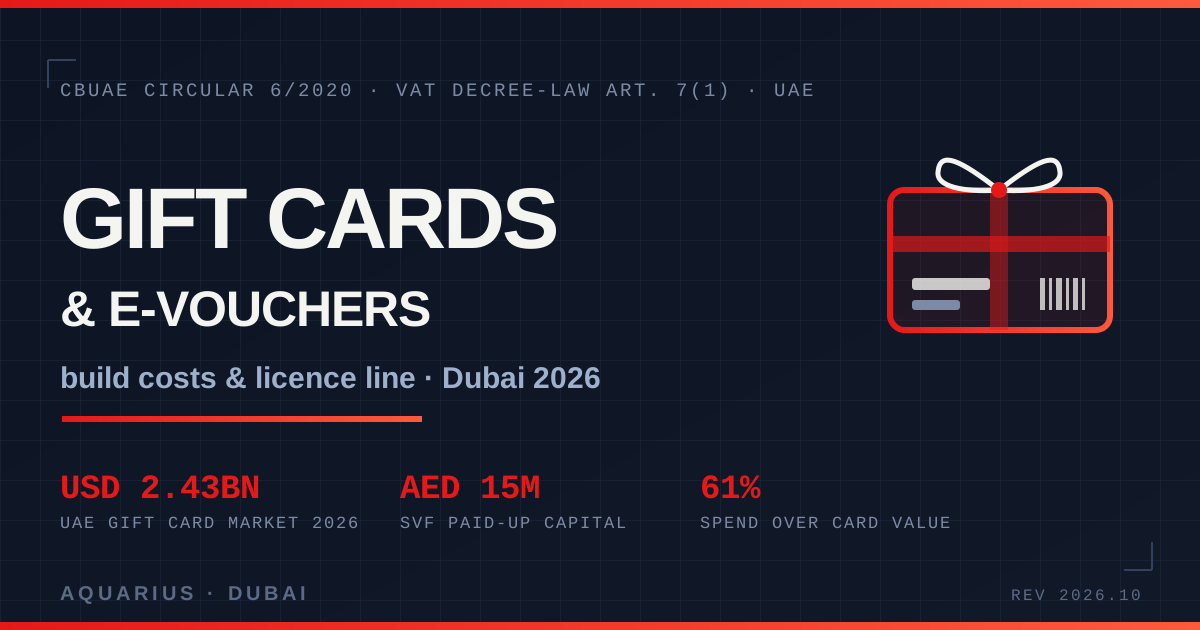
Short answer: A production gift card and e-voucher platform for a UAE retailer costs AED 55,000 to 180,000 to build and 8 to 16 weeks to ship, depending on whether you need corporate bulk ordering, POS redemption and multi-brand balances. The two decisions that actually matter are not technical: when you account for VAT (at redemption, not at sale) and whether your card can be spent outside your own legal entity — because that second one turns a marketing feature into a Central Bank–licensed stored value facility.
The UAE gift card market is a real revenue line now (awareness)
This stopped being a seasonal add-on. The UAE gift card and incentive card market is forecast at USD 2.43 billion in 2026, growing 10.5% year on year from USD 2.20 billion in 2025, and on track for USD 3.54 billion by 2030 (Research & Markets, February 2026). Across the wider region, the Middle East gift card business is tracking USD 8.7 billion in 2025 to USD 13.6 billion by 2030.
The shape of demand has changed too. Analysts describe a shift away from one-off plastic toward persistent digital balances tied to a customer account — a wallet, not a card. Amazon.ae, Majid Al Futtaim, Lulu, Spinneys, Sharaf DG, IKEA and Dubai Duty Free all run programmes; Emirates NBD and FAB push them through banking channels; Careem Pay and e& money distribute them inside wallets. If you are a mid-size UAE retailer or F&B group without a digital voucher rail in 2026, you are absent from a channel your competitors use for acquisition.
Seasonality is the forcing function. The UAE Ramadan economy is valued at USD 16.4 billion in 2026, with shopping activity rising roughly 46% during the holy month and 48% of consumers prioritising gifting and hospitality spend. Al-Futtaim reported UAE mall sales up 8% year on year across Ramadan and Eid. Add that 68% of UAE consumers now transact largely cash-free and a paper voucher looks like friction nobody asked for.
The VAT rule most Dubai retailers get wrong
Here is the mistake we see in almost every brief: a retailer charges 5% VAT when the customer buys the gift card, then charges VAT again when the card is redeemed against goods. That is double tax, and it is wrong.
Most Dubai businesses get this wrong: under Article 7(1) of Federal Decree-Law No. 8 of 2017, the issue or sale of a voucher is outside the scope of VAT provided it is not sold for more than its face value. The taxable supply happens at redemption, on the underlying goods or services. Selling an AED 500 card is not a sale for VAT purposes; it is a receipt against a future supply.
Two more clauses your build has to respect. Article 28(6) of the Executive Regulations requires that the monetary value a voucher can be redeemed for is identifiable at the point of issue — so your schema must store a stated face value, not a vague entitlement. And Article 40 deals with the case where consideration received differs from the declared cash value: the difference is itself a taxable supply. Sell an AED 500 card for AED 520 and you have created a taxable margin.
In practice this means your ledger needs two separate concepts that most off-the-shelf plugins conflate: a deferred-revenue liability created at sale (no output VAT), and a taxable supply created at redemption (output VAT on the goods, at their own rate). If your platform cannot produce a report of outstanding liability by issue date and redemption by tax period, your finance team will rebuild it in Excel every quarter. Get the data model right and the VAT treatment falls out of it for free.
The licence line: closed-loop versus multi-merchant (consideration)
This is the question that kills projects late. The CBUAE Stored Value Facilities Regulation (Circular No. 6/2020, issued 30 September 2020, effective 30 October 2020) governs stored value in the UAE. The distinction that decides your project scope:
- Single-purpose SVF — the balance is spendable only with the issuer or a closely affiliated network. A retailer’s own-brand gift card sits here and is excluded from the licensing prohibition. This is the lane 90% of our clients should stay in.
- Multi-purpose SVF — the balance is spendable across independent merchants. A multi-tenant mall card, a marketplace credit usable at third-party sellers, or a loyalty currency redeemable at partner brands lands here, and needs a CBUAE licence: minimum paid-up capital AED 15,000,000, aggregate capital funds of at least 5% of outstanding customer float, and 100% safeguarding of float in a segregated account, trust or insurance guarantee plus a bank guarantee. Expect 9 to 15 months for authorisation.
The practical route for multi-brand programmes is to issue through a licensed partner and keep your own build on the orchestration side — same user experience, no AED 15m capital requirement. Limited-network and pure loyalty or bonus schemes can also fall outside, but may still need to apply to CBUAE for confirmation of exemption, so confirm the structure before you write the first line of code. If you are genuinely heading toward a regulated balance, read our breakdown of e-wallet development and the CBUAE SVF licence first.
Consumer protection adds a lighter but non-optional layer: UAE gift cards are governed mainly by the issuer’s own terms, combined with the general duty that terms be clear, fair and disclosed before purchase. Expiry, where the card can be used and how unused balances are treated must all be stated plainly at checkout. There is no mandated refund of unused balances, but opaque expiry is the fastest way to a complaint to the Ministry of Economy or the local economic department.
What a gift card platform actually contains
Stripped down, there are six moving parts. Most briefs we receive ask for all six and only need four in phase one.
| Module | What it does | Timeline | Cost (AED) |
|---|---|---|---|
| Core issuance & ledger | Face-value cards, unique secured codes, balance ledger with deferred-revenue and redemption events, partial redemption, audit trail | 3-4 weeks | 22,000 - 40,000 |
| Storefront & delivery | Buy page, designs, custom amounts, personal message, scheduled email/WhatsApp delivery, PDF and Apple/Google Wallet pass | 2-3 weeks | 14,000 - 28,000 |
| Payment & VAT handling | Local gateway, 3DS, Apple Pay, refunds, FTA-correct tax points, TRN-ready invoicing | 1-2 weeks | 9,000 - 20,000 |
| POS & in-store redemption | Scan-to-redeem, offline tolerance, staff app, reconciliation against POS day-end | 2-4 weeks | 18,000 - 45,000 |
| Corporate bulk portal | Bulk upload, approval flow, PO/invoice billing, branded cards, delivery reports, LPO support | 2-3 weeks | 16,000 - 35,000 |
| Fraud, breakage & reporting | Velocity rules, code-enumeration defence, balance-check rate limits, liability dashboard, breakage forecasting | 1-2 weeks | 10,000 - 22,000 |
Two local cost realities to plan for. UAE payment gateway economics mean a card-not-present fee of roughly 2.5% to 2.9% plus AED 1 per transaction applies to the gift card purchase — on a programme doing AED 2m a year that is AED 50,000 to 58,000 of fees against revenue you have not recognised yet, so price your denominations accordingly. Our Dubai payment gateway integration cost guide has the current comparison. And corporate gifting season compresses hard: if the portal is not live by mid-November it misses the December and Eid cycles entirely.
On fraud, treat balance-check endpoints as hostile by default. Global data puts gift card fraud around USD 530 million a year in the US alone, with roughly one in four scam victims reporting a gift card as the payment method. Sequential or guessable codes and unthrottled balance lookups are how card-draining attacks work — a rate limit and a high-entropy code format cost you a day of engineering.
Breakage: the number your CFO will ask about
Breakage is the portion of issued value never redeemed. Global benchmarks — and they are global, not UAE-specific, so treat them as a planning range rather than a local figure — put overall redemption near 86%, implying roughly 14% unredeemed, with industry breakage typically cited at 5% to 15% of sales and about 6% of cards never used at all. In the US, unredeemed value runs around USD 4.7 billion a year.
Resist the temptation to build the business case on breakage. It is unreliable income, it attracts accounting scrutiny, and in the UAE your terms have to disclose expiry honestly anyway. The defensible model is the overspend effect, covered next.
What it returns, and what we charge (decision)
The conversion case for gift cards is unusually well documented. Around 61% of recipients spend more than the card’s balance, with average overspend near USD 73 — roughly AED 268 — and some studies put the share spending above face value as high as 75%. More useful for acquisition: 31% of recipients visit a business for the first time because of a gift card, and 72% of small businesses say gift cards bring in new customers. Gift card promotions are commonly reported at around 3.5x ROI.
Read that against the build cost. A programme that does AED 1m of issuance with a 61% overspend rate at AED 268 average is adding roughly AED 160,000 to 190,000 of incremental basket value on top of the float — which is the entire platform cost, in year one, from one effect.
| Package | Scope | Timeline | Price (AED) |
|---|---|---|---|
| Single-brand launch | Issuance & ledger, storefront, payment with correct VAT tax points, wallet pass, basic fraud controls | 5-7 weeks | 55,000 - 85,000 |
| Retail + POS | Above, plus in-store scan redemption, staff app, POS reconciliation, liability dashboard | 8-11 weeks | 95,000 - 135,000 |
| Corporate programme | Above, plus bulk corporate portal, approvals, PO billing, branded designs, API for partners | 12-16 weeks | 140,000 - 180,000 |
| Multi-merchant orchestration | Integration with a licensed SVF partner, merchant settlement, split redemption (licensing handled by the partner) | quoted | from 165,000 |
How Aquarius does it
We start with a two-page structure memo, not a wireframe: single-purpose or multi-purpose, where the tax point sits, and what the T&Cs must disclose. That document is what stops an AED 15m capital requirement appearing in month four. Then we build the ledger first and the storefront second, because the ledger is the thing you cannot retrofit — every balance bug is a money bug.
Codes are high-entropy and checked against enumeration from day one. Redemption is idempotent, so a double-tapped POS scan cannot spend a balance twice. Every balance movement is an append-only event, which means your auditor gets a straight answer and your finance team gets a liability report without a spreadsheet. We hand over the full codebase and the FTA-facing reporting, and we support the first gifting season with us on call — because the only load test that matters is the week before Eid.
If you already run a points programme, the voucher rail usually belongs next to it rather than inside it; we cover that split in our Dubai loyalty and rewards app guide.
FAQ
Do I charge 5% VAT when a customer buys a gift card in the UAE?
No. Under Article 7(1) of Federal Decree-Law No. 8 of 2017 the issue or sale of a voucher is outside the scope of VAT as long as it is not sold above face value. VAT applies at redemption, on the goods or services supplied. If you sell above face value, the excess is a taxable supply under Article 40. Confirm the treatment for your specific structure with your tax adviser.
Does my gift card need a CBUAE licence?
Not if it is single-purpose — redeemable only with you or a closely affiliated network. That is excluded from the SVF licensing prohibition under Circular No. 6/2020. The moment the balance can be spent at independent merchants it becomes multi-purpose, which requires a licence with AED 15,000,000 minimum paid-up capital and 100% float safeguarding. Most multi-brand programmes issue through an already-licensed partner instead.
Can I set an expiry date on a UAE gift card?
Yes, but it must be disclosed clearly before purchase, along with where the card can be used and how any unused balance is treated. UAE consumer protection rules require terms to be clear and fair and communicated up front. Hidden or aggressive expiry is the single most common source of gift card complaints.
How long does it take to launch before Ramadan or Eid?
Plan 8 to 11 weeks for a retail programme with in-store redemption, and add 3 weeks if you need a corporate bulk portal. Working backwards from a Ramadan launch, that means starting roughly in the third week of December. Corporate buyers commit their gifting budgets weeks before the season, so the portal has to be live early.
Should I use a plugin instead of building?
For a single store doing under about AED 300,000 a year of issuance, a hosted plugin is the right lazy answer — check it stores a stated face value and does not post output VAT at sale. Build when you need POS redemption, corporate bulk ordering, multi-outlet reconciliation or an auditable liability ledger, because that is where plugins stop and spreadsheets start.
Next step
If you are scoping a voucher programme for the 2026 gifting season, send us your structure — one brand or many, online only or POS too — and we will tell you in a day which lane you are in and what it costs. See our pricing for indicative bands, what we build for the full stack, or talk to us and we will start with the structure memo.