
Furniture and Home Decor E-commerce in Dubai (2026): AED Build Costs, 3D Room Planners and the Returns Maths
UAE home furniture is a USD 2.9bn market but only about USD 186m of it sells online. Real AED costs to build a Dubai furniture store, plus the 3D-and-returns maths that decides if it makes money.
- PUBLISHED
- 07 OCT 2026
- READ TIME
- 13 MIN
- AUTHOR
- AQUARIUS · DUBAI
- UNIT
- REV 2026.09
Short answer: a serious Dubai furniture and home decor store costs AED 55,000 to AED 240,000 to build in 2026 — the spread is almost entirely about whether you add 3D product visualisation, a room planner and delivery-slot logistics, or just put a catalogue online. Those three features are not decoration: 3D and AR cut furniture return rates by around 40% and lift conversion on the products that carry them, and in a category where UAE returns run 15% to 23% and a single bulky reverse pickup can wipe out the margin on the order, that is the whole business case. Budget AED 3,500 to AED 9,000 a month for care, hosting and catalogue operations after launch.
The gap is the opportunity. The UAE home furniture market is worth about USD 2.9 billion in 2026 and growing at a 4.15% CAGR, yet UAE furniture e-commerce generated only around USD 186 million in 2025. Offline still takes well over 60% of category revenue. Meanwhile overall UAE e-commerce hit roughly USD 12.3 billion in 2026 with 11 million-plus online shoppers and 45,000-plus active stores. Furniture is one of the last large retail categories in Dubai where the online channel is still under-built.
Key takeaways
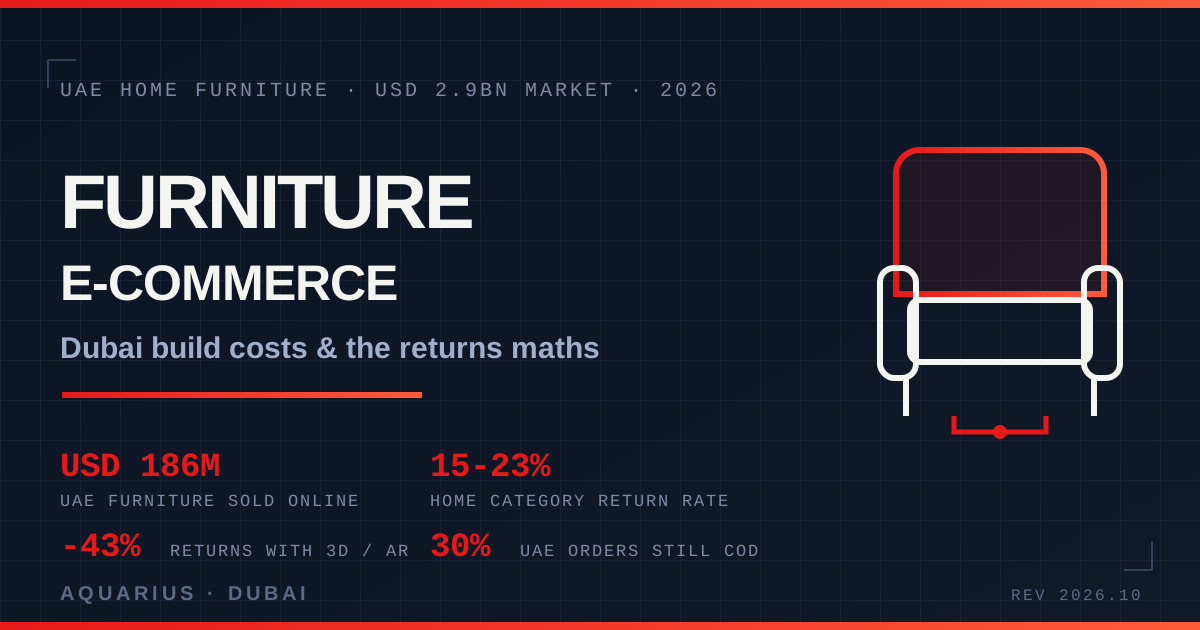
- UAE home furniture: USD 2.9bn in 2026 at 4.15% CAGR (Mordor Intelligence). Online furniture revenue: about USD 186m in 2025 (ECDB). Roughly 6% of the category sells online — against a national e-commerce market of USD 12.3bn.
- Online is the fastest-growing channel in the category, projected above 10% CAGR while the market overall grows at four. Furniture e-commerce in Abu Dhabi grew 41% between 2021 and 2023 versus 23% in Dubai.
- Most Dubai furniture retailers get this wrong: they treat the website as a showroom brochure and the showroom as the closer. The buyer has usually made the decision online and walks in to confirm dimensions. Without a 3D viewer and real dimension data, you pay showroom rent to do a job a product page should have done.
- Wayfair reported a 43% drop in returns and a 92% conversion lift on products viewed with its in-room 3D tool. Shopify merchant data shows an average 40% return reduction with AR, and size-related returns falling by as much as 71%.
- Home and furniture return rates in the UAE sit at 15% to 23%, against roughly 17% across all categories. 30% of UAE orders are still cash on delivery, and COD return-to-origin runs 28% to 35% versus 4% to 8% on prepaid.
- BNPL is now structural, not promotional: around 14% of checkout volume on major UAE stores entering 2026, with Tabby and Tamara together clearing over USD 6 billion in annualised UAE volume across 30,000 merchants. On the orders that use it, BNPL lifts average order value 30% to 80%.
Why furniture stayed offline in Dubai longer than everything else
Three honest reasons, and each one is a software problem rather than a shopper problem.
Fit uncertainty. Nobody wants to discover that a three-seater does not clear the lift lobby of a Dubai Marina tower. A flat product photo cannot answer "will this fit, and will it look right against my walls" — so the shopper defers, and a deferred furniture purchase usually ends in a showroom.
Delivery complexity. A sofa is not a parcel. It needs a two-man crew, a booked service lift, building access approval in many communities, an assembly window and packaging removal. Standard e-commerce checkout flows that promise "delivery in 2 to 4 days" collapse against that reality.
Return economics. UAE reverse logistics costs roughly AED 5 to AED 15 to process a normal returned item. For furniture and oversized goods, reverse logistics can exceed the product margin outright, and a rejected COD delivery alone costs about AED 25 to AED 50 in two-way shipping and handling before you touch the restocking question. We covered the mechanics in detail in our guide to e-commerce returns and reverse logistics in Dubai.
Which means the category is not waiting for more traffic. It is waiting for a store that removes the uncertainty before the order is placed, because every return here is expensive enough to decide the P&L.
The build, feature by feature — and what each one is actually for
Here is how we scope a Dubai furniture and home decor store. The point of the table is the middle column: every line item exists to kill a specific cost or objection, not to look modern.
| Feature | What it actually fixes | AED build cost |
|---|---|---|
| Catalogue, variants, Arabic and English | Fabric, finish and size variants with real dimensions, weight and care data per SKU. RTL done properly, not a translated theme. | 12,000 – 30,000 |
| 3D product viewer and AR view-in-room | The fit question. Drives the 40%-plus return reduction and the conversion lift. Cost is mostly 3D asset creation per SKU, not code. | 18,000 – 70,000 |
| Room planner / space configurator | Multi-item baskets. Turns a single chair sale into a living-room sale and lifts AOV far more than any discount. | 25,000 – 80,000 |
| Delivery slot and assembly booking | Service-lift windows, building access, two-man crew capacity, assembly add-on. Prevents failed deliveries, the most expensive event in the category. | 14,000 – 38,000 |
| Payments: cards, Tap or PayTabs, Apple Pay, Tabby and Tamara | High-ticket conversion. See our Tabby and Tamara integration guide for the fee maths. | 7,000 – 18,000 |
| Showroom stock visibility and click-and-collect | "In stock at Al Quoz" converts. It also stops you selling a floor model twice. | 10,000 – 32,000 |
| 5% VAT-compliant invoicing and TRN capture | B2B orders from fit-out contractors and hotels need a tax invoice with your TRN. Returns must refund the VAT element too. | 6,000 – 15,000 |
| Trade and project portal (B2B) | Interior designers, fit-out firms and holiday-home operators buying at tiered pricing against a quote, not a retail cart. | 20,000 – 60,000 |
Two of those lines deserve a warning. First, 3D assets are a per-SKU unit cost, so sequence them: build the viewer once, then model your top 40 revenue SKUs rather than a 2,000-line catalogue. Second, 3D and AR are heavy. A furniture store that ships uncompressed 3D models will fail Core Web Vitals and lose the organic traffic it built the store for — lazy-load the viewer behind a click, serve compressed Draco-encoded models, and check the result against our Core Web Vitals guide.
The returns maths, run properly
This is the calculation most Dubai furniture retailers never do, and it is the one that decides whether the channel is profitable.
Take a store doing AED 500,000 a month online at an average order value of AED 2,500 — 200 orders. At the category midpoint return rate of 19%, that is 38 returns a month. Bulky reverse pickup, inspection, repackaging and the write-down on a scuffed item realistically costs AED 250 to AED 600 per unit in Dubai once you include the crew, not the AED 5 to AED 15 that applies to a parcel. Call it AED 400. That is roughly AED 15,200 a month, or AED 182,000 a year, burned on reverse logistics.
Now apply the published AR effect. A 40% reduction takes 38 returns to 23 and saves about AED 6,000 a month — AED 72,000 a year — before counting a single extra sale from the conversion lift. A 3D viewer at the AED 18,000 to AED 70,000 band therefore pays for itself inside three to twelve months on returns alone. Macy's reported return rates under 2% on items shopped with its visualisation tools against a normal 5% to 7%; Wayfair's 43% and Shopify's 40% averages are the numbers to plan against.
Then fix the payment mix, because that is free money. COD is 30% of UAE orders and carries a 28% to 35% return-to-origin rate against 4% to 8% prepaid, plus AED 3 to AED 8 per shipment in collection handling. On a furniture basket a refused COD delivery is not a lost parcel, it is a truck and two men. The fix is not to ban COD on day one — it is to make prepaid better: Tabby or Tamara instalments on an AED 2,500 sofa remove the reason the customer wanted COD in the first place, and BNPL lifts AOV 30% to 80% on the orders that use it. Cap COD above a threshold, require a deposit on large items, and read our last-mile and COD integration guide before you wire the courier API.
Compliance: the two things furniture retailers get caught on
Product conformity. Regulated goods sold in the UAE need a valid certificate of conformity under the Emirates Conformity Assessment Scheme (ECAS) or the Emirates Quality Mark, held by the trader, importer or manufacturer. The ECAS mark itself was updated: new products entering the market had to meet the revised requirements by 15 March 2025, and products already in the local market by 14 September 2025. If you import mattresses, upholstered goods, children's furniture or anything electrical — lighting, motorised recliners, smart beds — get the certificate reference from your supplier and store it against the SKU in your catalogue, because that is the field a marketplace or an inspector will ask for and the one nobody has built a place for.
Returns and consumer terms. Under the UAE Consumer Protection Law (Federal Decree-Law No. 15 of 2020) and its executive regulation, Cabinet Decision No. 66 of 2023, an online seller must publish clear terms and honour the remedy ladder on defective goods — refund, replacement or repair at the consumer's election. Market practice in the UAE has converged on a 14-day return window for unused goods in original packaging, with customised and made-to-order items excluded. For furniture that exclusion is your most valuable clause: write it explicitly, and make the product page state clearly which SKUs are made to order. When you do refund, the 5% VAT element goes back with the price, which is why return handling belongs inside the invoicing system and not in a spreadsheet.
Platform choice: Shopify, headless, or custom
Honest version: for a catalogue under a few hundred SKUs with standard delivery, Shopify plus a 3D viewer app is the right answer and the fastest route to revenue. You outgrow it at a predictable point — when delivery slotting has to respect two-man crew capacity and building access rules, when showroom stock has to be live, or when the trade portal needs quote-based pricing. Those three requirements are where app stacking stops working and a custom or headless build starts being cheaper than the workarounds.
| Route | Best for | AED to launch | Running cost |
|---|---|---|---|
| Shopify plus 3D/AR app | Under ~300 SKUs, single warehouse, courier-handled delivery | 35,000 – 90,000 | Platform and app fees plus 2,500+ per month care |
| Headless (Next.js front end, commerce backend) | Content-heavy brands, strong SEO ambitions, Arabic and English, 3D-first product pages | 90,000 – 180,000 | 4,000 – 7,000 per month |
| Custom platform | Multi-showroom stock, crew and slot scheduling, trade portal, ERP integration | 140,000 – 240,000+ | 6,000 – 9,000 per month |
Timelines in our experience: a Shopify-based store with a 3D viewer on the top SKUs ships in 4 to 7 weeks. A headless bilingual store with a room planner runs 10 to 16 weeks. A custom platform with delivery slotting, showroom stock and a trade portal is 4 to 7 months, phased so the storefront earns while the operations layer is still being built.
How Aquarius builds these
We start with the SKUs, not the design. Phase one is a clean catalogue with real dimensions, weights, finish variants and ECAS references, a bilingual storefront, and 3D viewers on your top revenue products — because that combination is what moves the return rate. Phase two is the money layer: Tap or PayTabs with Apple Pay, Tabby and Tamara, VAT-correct invoicing with TRN capture, and delivery slot booking wired to your crew capacity. Phase three is the room planner, showroom stock visibility and the trade portal for designers and fit-out contractors. Fixed-scope phases, a storefront live and selling at the end of phase one, and your code, 3D assets and customer data in your own repository and your own cloud account from the first commit. Our pricing page shows how the phases are packaged, and our services cover both the commerce build and the photography and 3D asset production behind it.
FAQ
How much does a furniture e-commerce website cost in Dubai?
AED 35,000 to AED 90,000 for a Shopify-based store with 3D on your lead products, AED 90,000 to AED 180,000 for a bilingual headless build with a room planner, and AED 140,000 to AED 240,000-plus for a custom platform with delivery slotting, multi-showroom stock and a trade portal. Running cost after launch is AED 2,500 to AED 9,000 a month depending on route.
Is 3D or AR worth the cost for a Dubai furniture store?
On the published numbers, yes, and it pays back fast. Wayfair reported 43% fewer returns and a 92% conversion lift on products viewed in 3D; Shopify merchants average around a 40% return reduction. On a store doing AED 500,000 a month at AED 2,500 AOV, that is roughly AED 72,000 a year saved in reverse logistics alone. Model your top 40 revenue SKUs first rather than the whole catalogue.
What return rate should I plan for on furniture in the UAE?
Plan for 15% to 23% in home and furniture, against roughly 17% across all UAE categories. Keep prepaid and COD return rates in separate reports — COD return-to-origin runs 28% to 35% versus 4% to 8% prepaid, so a blended number will hide where your money is going.
Do I need ESMA or ECAS certificates to sell furniture online in the UAE?
The certificate obligation sits with the trader, importer or manufacturer for regulated products, not with your website. But you should store the ECAS or Emirates Quality Mark reference against each affected SKU — mattresses, upholstered and children's furniture, and anything electrical — because that is the evidence requested at import, at marketplace onboarding and at inspection. The revised ECAS mark deadlines were 15 March 2025 for new products and 14 September 2025 for products already in market.
Should I accept cash on delivery on furniture orders?
Selectively. COD is 30% of UAE orders so refusing it outright costs real volume, but on a bulky item a refused delivery means a truck and a two-man crew, not a lost parcel. The practical setup is a COD ceiling, a deposit requirement above it, and strong instalment options — Tabby and Tamara at around 14% of UAE checkout volume remove most of the reason a customer wanted COD, and lift order value 30% to 80% on the baskets that use them.
The short version
UAE home furniture is a USD 2.9 billion market with only about USD 186 million of it selling online, in a country doing USD 12.3 billion of e-commerce overall. The channel is under-built because the three hard problems — fit uncertainty, bulky delivery and return economics — are software problems that most furniture websites in Dubai never tried to solve. Solve them in order and the returns saving funds the build. If you run a furniture, home decor or fit-out business in Dubai and your website is still a PDF catalogue with a WhatsApp button, talk to us — we will price your top-SKU 3D set against your current return cost and show you which phase pays for itself first.