
How to Fund a Website, App or Software Build in Dubai (2026): Grants, Guarantees and Loans
Dubai has AED 18 billion of fresh tech financing on the table and most SMEs never touch it. The 2026 map of grants, guarantees and loans that pay for a build.
- PUBLISHED
- 01 OCT 2026
- READ TIME
- 11 MIN
- AUTHOR
- AQUARIUS · DUBAI
- UNIT
- REV 2026.09
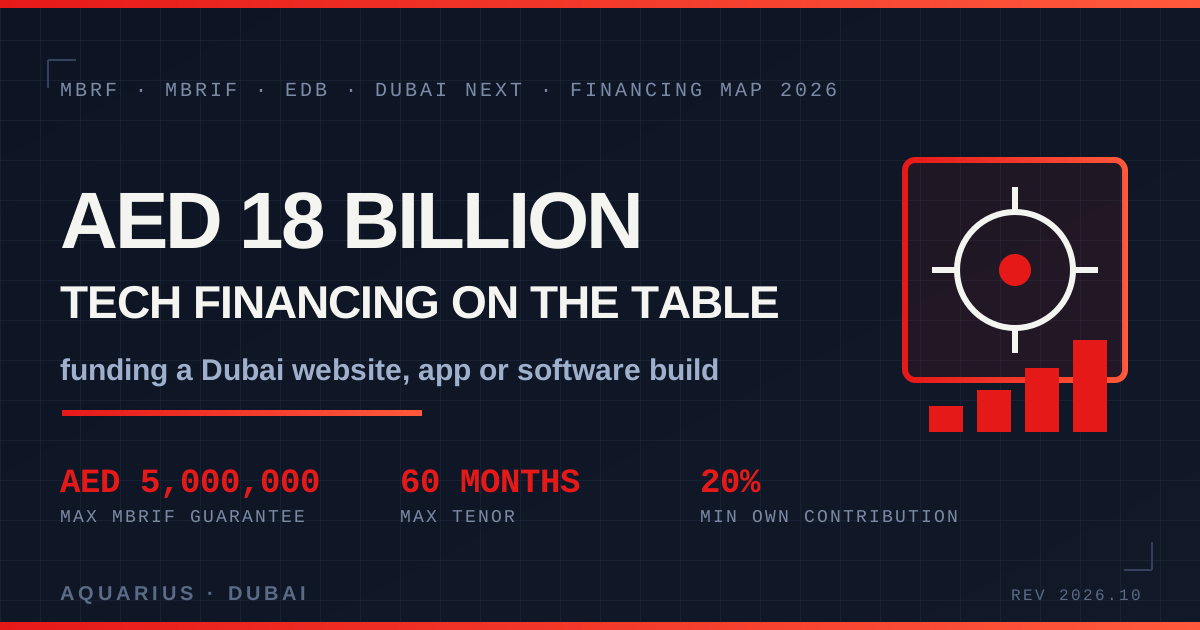
Short answer: A Dubai business does not have to pay for a website, app or software build out of cash flow. There are four realistic routes in 2026 — the Mohammed Bin Rashid Fund for SME (Emirati-owned Dubai projects, minimum 20% own contribution, up to 24 months’ grace and 5 years to repay), the MBRIF Guarantee Scheme (up to AED 5 million, up to a 60-month tenor, open to residents as well as nationals, no equity given up), Emirates Development Bank technology-adoption finance from AED 100,000 to AED 50 million, and ordinary commercial SME lending of AED 100,000 to AED 10 million. Most Dubai owners never check which one they already qualify for, and self-fund a smaller build than the business needed.
Key takeaways
- At Make it in the Emirates 2026, MoIAT unlocked AED 18 billion of industrial and technology financing — AED 10 billion from Mashreq over five years, AED 2 billion from Dubai Islamic Bank and AED 6 billion from Emirates Development Bank.
- The MBRIF Guarantee Scheme returns approval or feedback in roughly 5 days. A traditional bank facility takes 2 to 8 weeks.
- Only 22% of surveyed UAE SMEs sell online, and 32% run primarily on social media against just 25% on their own website. The funding is not the bottleneck — nobody applies.
- Most Dubai businesses get this wrong: they assume government money is Emirati-only. That is true of the Mohammed Bin Rashid Fund. It is not true of MBRIF or EDB.
Why 2026 is the year the money showed up
Three numbers set the stakes before you look at a single application form.
First, the supply of capital. At Make it in the Emirates 2026, the Ministry of Industry and Advanced Technology signed financing commitments worth AED 18 billion: AED 10 billion from Mashreq Bank over five years, AED 2 billion from Dubai Islamic Bank, and a separate AED 6 billion allocation from Emirates Development Bank. EDB was already reported in April 2026 to be deploying around USD 5.5 million a day into UAE businesses. That is not a pilot programme, it is a pipeline looking for borrowers.
Second, the demand side is moving without you. SME digital-transformation spending is the fastest-growing segment at 24.3% compound annual growth, as smaller UAE firms move onto modular SaaS stacks. 92% of UAE SMEs already accept digital payments and 83% name improving digital payments a priority. Your competitors are buying software this year.
Third, the gap. Only 22% of UAE SMEs surveyed sold products or services online. 32% of UAE small businesses run primarily on social media, against 25% on their own website and 27% mainly from a physical location, and 38% sell directly through social platforms. With SMEs making up over 94% of registered firms and more than 60% of national GDP, that is a very large share of the Dubai economy renting its storefront from an algorithm it does not control.
The constraint on most Dubai builds is not access to capital. It is that the owner priced the project against this month’s cash instead of against a five-year facility.
The myth: “government funding is only for Emiratis”
Half right, and the wrong half is the expensive one.
The Mohammed Bin Rashid Fund for SME (the lending arm associated with Dubai SME) is explicit: the project must be 100% owned and managed by UAE nationals, based in Dubai, the applicant must be 21 or older, the business must be less than 5 years old, and the applicant must not hold more than 5 Dubai trade licences for new-project funding (6 for existing-enterprise funding). If you are an expat-owned LLC, that door is closed.
The MBRIF Guarantee Scheme — a Ministry of Finance initiative — is a different instrument. It backs bank debt with a government guarantee to an MBRIF-listed bank for innovative companies in priority sectors, owned or managed by nationals or residents, with partial access for foreign-founder firms. Ceiling AED 5 million, tenor up to 60 months, approval or feedback in about 5 days, and no equity dilution. Recent guarantees are public: AED 1.5 million to Emirati startup 01Gov in May 2026, AED 2.5 million to Avani Eco Middle East.
Emirates Development Bank is the third door and the widest one for a software project. Its Advanced Technology Adoption Finance line is aimed squarely at AI, blockchain, IoT, robotics and clean-energy adoption, with facilities from AED 100,000 to AED 50 million. EDB also runs a credit-guarantee scheme covering up to 50% of loan value, which lets partner commercial banks cut 75 to 100 basis points off the rate; government backing is generally reported to land 2–5% below commercial pricing.
The 2026 Dubai funding map for a tech build
Read this table as a filter, not a menu. Most Dubai companies qualify for two or three rows and should apply to the fastest one that covers the scope.
| Route | Amount | Who qualifies | Equity given up | Speed |
|---|---|---|---|---|
| Mohammed Bin Rashid Fund for SME | Project-based, min 20% own contribution | 100% UAE-national owned & managed, Dubai-based, business under 5 years old | None — loan/guarantee | Committee cycle; 24-month grace, 5-year repayment |
| MBRIF Guarantee Scheme | Up to AED 5,000,000 | Innovative companies in priority sectors; nationals or residents; partial access for foreign founders | None | ~5 days to approval or feedback; up to 60-month tenor |
| Emirates Development Bank | AED 100,000 – 50,000,000 | UAE-registered businesses; advanced-technology adoption priority | None | Weeks; up to 50% credit guarantee to partner banks |
| Khalifa Fund (Abu Dhabi) | AED 50,000 – 3,000,000 | UAE nationals | None | Weeks |
| Commercial bank SME loan | RAKBANK AED 100K–4M · Emirates NBD up to 5M · ADCB up to 3M · FAB up to 10M | Typically 2+ years trading and AED 500,000+ annual turnover (RAKBANK) | None | 2–8 weeks |
| P2P / marketplace lending (e.g. Beehive) | AED 100,000 – 5,000,000 | Established UAE SMEs with filed financials | None | Days to weeks |
| Revenue / invoice finance (e.g. Comfi) | Working-capital sized | B2B, UAE-registered, 12+ months trading, ~AED 300,000 monthly revenue | None | As fast as 24 hours |
| Dubai Next crowdfunding (Dubai SME) | Campaign goal, all-or-nothing | Dubai projects with a public-facing product or story | None — rewards-based, you keep 100% | Campaign length; 5% admin + 2–3% gateway fees |
Two practical notes. Dubai Next is a real option that most owners dismiss: 1,570 campaigns have been registered on the platform to date with 62 approved and running, and because it is rewards-based you keep complete ownership — pre-selling a product on it is a legitimate way to fund the platform that sells it. And the Dubai RDI grant programme exists but is aimed at research: Dubai Future Foundation backed 26 research projects under it in January 2026. Do not write an R&D grant application for a booking website.
Match the facility to the build, not the other way round
Software scope should be set by what the business needs to earn, then financed. These are our own 2026 Dubai scoping ranges, mapped to the route that usually fits.
| What you are building | Typical AED | Sensible funding route |
|---|---|---|
| Landing page or one-page campaign site | AED 3,500–8,000 | Cash flow. Do not borrow for this. |
| Corporate bilingual (EN/AR) business site | AED 12,000–55,000 | Cash flow, or a small bank facility if it unblocks sales |
| Ecommerce store with UAE payments and VAT handling | AED 20,000–80,000+ | Bank SME loan, revenue finance, or a Dubai Next pre-sale |
| Mobile app, first production build (15–25 screens) | AED 25,000–90,000 | MBRIF guarantee, EDB, or MBRF if Emirati-owned |
| Custom platform or enterprise system | AED 275,000+ | EDB advanced-technology finance; phase it across the facility |
For the full cost side of this, our 2026 Dubai website and app cost breakdown prices every tier line by line, and the custom software cost guide covers enterprise scope. If you are still choosing a licence structure before you borrow, start with free zone versus mainland for a Dubai software company — lenders will ask.
How to actually get it approved
Lenders in the UAE do not fund “a website”. They fund a revenue mechanism with a repayment story. Four things change the answer.
- Write the application around throughput, not design. Orders per month, average basket in AED, gross margin, and the specific leak the software closes. A file that says “replace manual WhatsApp ordering, 400 orders/month at AED 180 average” reads as cash flow. “Modern responsive website” reads as an expense.
- Name the technology if you are going to EDB. The advanced-technology line is written around AI, IoT, robotics, blockchain and clean energy. An AI-assisted quoting engine or IoT-linked fleet dashboard sits inside the mandate; a brochure site does not.
- Bring a fixed-price, fixed-scope quote. Milestoned deliverables with dates let a credit committee model drawdown. Time-and-materials estimates get discounted or declined.
- Know your own contribution number. The Mohammed Bin Rashid Fund specifies a minimum 20% contribution from the applicant, set by its Investment Committee according to the nature and risk of the business. Assume every route wants skin in the game.
Sequence matters too. Apply to MBRIF first if you plausibly qualify — roughly 5 days to a yes or no costs you almost nothing, and a government guarantee makes the subsequent bank conversation cheaper. Run the commercial bank application in parallel, because 2 to 8 weeks is the norm and you do not want to discover the timeline after you have promised a launch date.
What it costs to wait
Here is the conversion-side number. 32% of UAE small businesses run primarily on social media and only 25% on a site they own, while 92% of UAE SMEs already take digital payments and only 22% sell online. That gap between “can take money digitally” and “actually sells digitally” is the margin your competitors are financing at 2–5% below commercial rates with EDB backing while you fund yours from retained profit.
Put it in AED. An ecommerce build at the middle of the range, say AED 50,000 financed over a 60-month MBRIF-guaranteed facility, is a low four-figure monthly line. One additional order a day at an AED 180 basket and 40% gross margin is roughly AED 2,160 of monthly gross profit. The facility is not the risk. Shipping a build too small to compete, because it had to fit this quarter’s cash, is the risk.
How Aquarius does it. We quote fixed price, fixed scope, with named milestones and dates — the format credit committees can actually read, and we will format the scope document for a funding application if you ask. We phase builds into gates so the first revenue-producing slice ships in weeks, not quarters, which is also what makes a repayment schedule believable. You own the code, the repository and the domain from day one; see our pricing and what we build. For funded MVPs specifically, our Dubai SaaS MVP guide covers the smallest scope that still raises money.
FAQ
Can an expat-owned Dubai company get government funding for a software project?
Not from the Mohammed Bin Rashid Fund for SME, which requires the project to be 100% owned and managed by UAE nationals and based in Dubai. But the MBRIF Guarantee Scheme covers companies owned or managed by nationals or residents, with partial access for foreign-founder firms in priority sectors, and Emirates Development Bank lends to UAE-registered businesses generally.
Will a bank actually lend money for a website or app?
Yes, as a business facility rather than a “website loan”. Commercial SME facilities run from AED 100,000 to AED 10 million depending on the bank, and typical thresholds are around 2 years trading and AED 500,000+ annual turnover. Present the build as a revenue mechanism with milestoned costs, not as an IT purchase.
How much of the project cost do I have to pay myself?
The Mohammed Bin Rashid Fund specifies a minimum 20% applicant contribution, set case by case by its Investment Committee based on the business and its risk. Guarantee schemes and bank facilities vary, but plan on funding a meaningful share yourself.
How fast can financing for a Dubai build be arranged?
The MBRIF Guarantee Scheme quotes approval or feedback in about 5 days. Traditional bank facilities take 2 to 8 weeks. Revenue-based and invoice finance providers can fund in as little as 24 hours if you clear their revenue threshold.
Is it better to borrow or to phase the build?
Do both. Phase the scope into revenue-producing gates so nothing is built on a guess, and finance the programme over a longer tenor — up to 60 months under an MBRIF guarantee, or 5 years with up to 24 months’ grace under the Mohammed Bin Rashid Fund. Phasing manages delivery risk; financing manages cash-flow risk. They are not substitutes.
Does crowdfunding work for a Dubai software project?
Dubai Next, the Dubai SME-backed platform, is rewards-based and all-or-nothing: you keep complete ownership, fees are around 5% admin plus 2–3% payment-gateway charges, and 1,570 campaigns have been registered with 62 approved and running. It suits a consumer product with a story. It rarely suits back-office software.
Working out how to pay for a build? Send us the scope you have in mind and your rough trading numbers — we will tell you which of these routes you plausibly qualify for and format the quote so a credit committee can read it. Talk to Aquarius.