
Fixed Price vs Time and Materials in Dubai (2026): What the New UAE Civil Code Changed
The new UAE Civil Code took effect on 1 June 2026 and rewrote the rules on fixed-price work. Which pricing model to sign for a Dubai software project, and the clauses that decide who pays.
- PUBLISHED
- 12 OCT 2026
- READ TIME
- 13 MIN
- AUTHOR
- AQUARIUS · DUBAI
- UNIT
- REV 2026.09
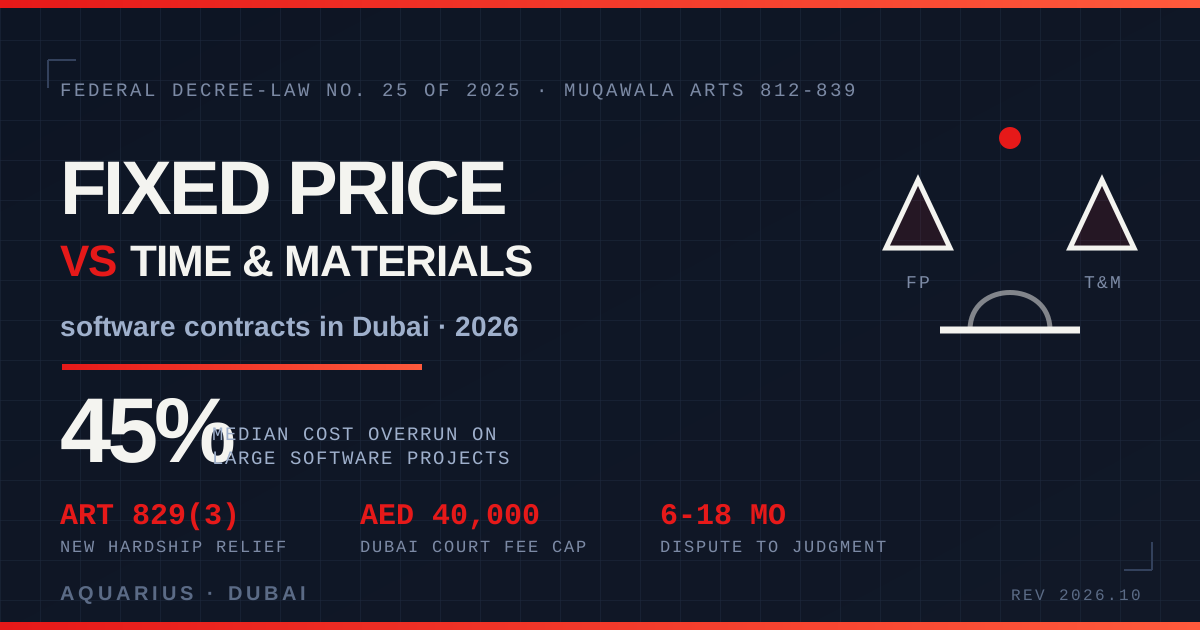
Short answer: fixed price is right when the scope is genuinely knowable and frozen; time and materials is right when it is not, and a capped time-and-materials sprint is usually the honest middle. What changed in 2026 is the law behind the choice — the new UAE Civil Transactions Law (Federal Decree-Law No. 25 of 2025) came into force on 1 June 2026, replacing the 1985 Civil Code in its entirety, and its contract-of-works articles now give a dispute forum an express power to reopen a lump-sum price when exceptional circumstances wreck its basis.
That single change flips a piece of received wisdom most Dubai businesses still repeat: that a signed fixed price is an absolute ceiling and the vendor’s problem alone. It is not. Below: what the new articles say, how the three pricing models really allocate risk, the AED numbers behind each, and the eight clauses that decide who pays when the scope moves.
Key takeaways
- Federal Decree-Law No. 25 of 2025 took effect 1 June 2026, has 1,422 articles, and governs contracts of works (muqawala) at Articles 812–839.
- Article 829(2): a lump-sum price can only increase by agreement. Article 829(3) is the new part — unforeseeable exceptional general circumstances now let a court extend time, raise or cut the price, or terminate.
- Large software projects run a median 45% over budget and deliver 56% less value than predicted (McKinsey / University of Oxford). 17% become overruns of 200–400%.
- Scope is the cause, not bad luck: unclear requirements (39%) and scope creep (33%) top the failure list.
- Getting it wrong is procedurally expensive in Dubai: court filing fees run 6% of claim value capped at AED 40,000, and six to 18 months to judgment once an expert is appointed.
Why 2026 is the year to re-paper your software contracts
The money is moving. Gartner puts MENA IT spending at US$169 billion in 2026, up 8.9% year on year, with software alone at US$20.45 billion — a 13.9% jump driven by generative-AI adoption. More projects are being signed in Dubai this year than in any year before it, and most of them are being signed on a one-page quote with a total at the bottom.
The failure data has not improved to match. The Standish Group’s long-running CHAOS research still finds roughly 29% of software projects succeed on time, on budget and with the features promised; 52% are challenged and 19% are cancelled outright. The McKinsey and University of Oxford study of large IT projects found an average 45% cost overrun, 7% schedule overrun, and 56% less value delivered than the business case claimed — with 17% turning into “black swans” that overrun by 200–400%.
And the legal floor under all of it moved on 1 June 2026. The new Civil Transactions Law was issued on 1 October 2025, published in Official Gazette No. 809 on 14 October 2025, and replaced Federal Law No. 5 of 1985 completely. If your master services agreement was drafted against the old articles 872–896, the cross-references in it are now pointing at a repealed law.
What UAE law actually does to a “fixed” price
A bespoke software build in the UAE is ordinarily characterised as muqawala — a contract under which one party undertakes to make something or perform work in exchange for consideration. That is Articles 812–839 of the new code, and it is the same body of law that governs construction. Five provisions matter to anyone signing a development contract in Dubai:
- Articles 812–813 — the contract has to describe the work. The code expects the subject matter, nature, quantity, method of performance, completion period and consideration to be specified. A fixed price attached to a vague scope is not a strong contract; it is an argument with a number on it.
- Article 829(2) — a lump sum rises only by agreement. If the scope changes, the contractor is entitled to more money by agreement of the parties, plus additional payment where the employer is at fault. No agreement, no increase: rising salaries, rising licence fees and a longer-than-expected integration are the vendor’s risk.
- Article 829(3) — the new hardship valve. Where exceptional general circumstances arise that could not have been foreseen and that upset the balance of the contract, the forum may extend the completion period, increase or reduce the remuneration, or terminate. This is the headline change for lump-sum work and it cuts both ways.
- Article 816(3) — notify immediately. If events or circumstances arise that may impede proper execution, the contractor must tell the client at once; failure makes the contractor liable for the consequences. In software terms: a dependency that blocks a sprint is an email you send the same week, not a surprise you reveal at delivery.
- Article 836 — the client can walk, but pays. The employer may be released from the contract and suspend execution at any time before completion, compensating the contractor for expenses incurred, work completed and lost profit; a court may reduce that where equitable, deducting what the contractor saved or earned elsewhere. Termination for convenience is not a free exit.
Two more provisions sit outside the muqawala chapter and routinely decide disputes. Liquidated damages are not sacred: Article 340 lets a court reduce an agreed sum where it is exaggerated or exceeds the actual loss, and lets a claimant go above it only by proving fraud or gross negligence. And on ownership, Article 28 of Federal Decree-Law No. 38 of 2021 on Copyrights gives the copyright in a commissioned work to the party who commissioned it unless otherwise agreed — helpful, but still worth an express assignment plus a source-code and repository handover clause, which is where most Dubai handover fights actually start.
The three models, honestly compared
There are only three ways to price a build, and the difference between them is not the total — it is who carries the uncertainty.
| Model | Who carries scope risk | Typical Dubai use | How change is handled | Failure mode |
|---|---|---|---|---|
| Fixed price (lump sum) | Vendor — priced in as a 15–30% contingency | Defined builds: marketing site, WordPress or Next.js rebuild, a known integration, phase 1 of an MVP | Change order at a published rate card; Art 829(2) means nothing moves without written agreement | Vendor protects margin by arguing scope; client gets the letter of the spec and not the product |
| Time and materials | Client | Discovery, platform work, AI and data projects, anything where requirements emerge | Backlog reprioritised in sprint planning — no commercial friction | No ceiling, no urgency; a project that never quite ends |
| Capped T&M / sprint retainer | Shared — client pays actuals up to a cap | Most real Dubai SME projects: 2–6 month builds with a firm budget and a soft scope | Fixed monthly capacity; scope traded in and out against a frozen budget | Weak prioritisation turns the cap into a ceiling you hit with half a product |
| Fixed-price discovery, then build | Vendor on discovery, either party on build | ERP, marketplace, fintech — anything where a wrong estimate is expensive | Discovery output is the scope the build is priced against | Discovery becomes a document nobody builds from |
A fair AED frame for 2026 Dubai work: a defined brochure or campaign site sits comfortably in a fixed price at AED 12,000–45,000; a custom web application or mobile app with integrations typically runs AED 90,000–400,000 and should be a staged or capped arrangement; an ERP or platform programme crosses AED 400,000 and belongs in fixed-price discovery first. Blended agency rates in Dubai run roughly AED 180–450 per hour depending on seniority and whether delivery is local or hybrid — our own breakdown is in the custom software development cost guide, and the ERP implementation cost guide covers why large programmes overrun hardest.
One warning against the obvious shortcut: insisting on a fixed price for an unknowable scope does not transfer the risk, it prices it twice. You pay the vendor’s contingency, and you still get the change orders — because Article 829(2) requires written agreement for every variation, so each new requirement becomes a negotiation instead of a sprint ticket.
The eight clauses that decide who pays
Model choice is maybe a third of the outcome. The rest is in the paperwork, and the same eight gaps appear in almost every contract we are asked to review.
1. A scope that can be tested, not admired
Articles 812–813 want the method and quantity of work described. Translate that into acceptance criteria per feature: inputs, expected output, the device and browser matrix, performance thresholds, and who signs. “Modern, responsive design” is not acceptance criteria; “Largest Contentful Paint under 2.5s on 4G for the ten listed templates” is.
2. A change-order process with a price list in it
Name the format, the approval authority, the turnaround, and the hourly or per-point rate for extra work. A change process without a rate card is a renegotiation; with one, it is administration.
3. IP assignment and a real handover
Article 28 of the Copyright Law gets you the copyright on a commissioned work, but not the repository, the CI secrets, the DNS, the app-store accounts or the cloud tenancy. Spell out handover artefacts and who owns each account from day one — the pattern of failure is laid out in our guide to website and domain ownership in Dubai.
4. PDPL processor terms
If the vendor touches personal data, Federal Decree-Law No. 45 of 2021 expects a processor acting only on documented instructions, deleting or returning data at the end of the engagement, and submitting to audit. Cross-border transfer needs an adequacy basis or appropriate safeguards. See the UAE PDPL compliance checklist.
5. A delay remedy that survives Article 340
Cap liquidated damages at a defensible percentage of the contract value and tie them to a milestone the client cannot block. A punitive figure invites reduction under Article 340(2); a reasonable one usually holds.
6. Payment terms built around VAT and e-invoicing reality
Milestone invoicing carries 5% VAT and the clock starts at the tax point, not at the client’s convenience. Add the UAE e-invoicing timeline: the pilot opens 1 July 2026, businesses above AED 50 million revenue had their accredited service provider deadline moved from 31 July to 30 October 2026 and must be live by 1 January 2027, and all remaining VAT-registered entities follow on 1 July 2027. Non-compliance penalties start at AED 5,000 per month, with AED 100 per non-conforming invoice capped at AED 5,000 monthly. If your build touches invoicing, it now has a regulatory deadline inside it.
7. Suspension rights, not just termination rights
Give yourself a graduated remedy: notice, a cure period, then suspension. Article 818(2) already lets a client require correction within a reasonable period and, if it is not done, rescind or bring in another contractor at the first contractor’s expense — Article 818(3) allows immediate rescission where correction is impossible or timely completion is absolutely unlikely. Mirror that ladder in the contract so nobody has to litigate to use it.
8. A dispute forum sized to the contract
Dubai Courts hear cases in Arabic and appoint technical experts, which suits documentary disputes and is procedurally cheap: filing fees are about 6% of claim value with a cap of AED 40,000, though simple matters still take three to six months and anything with an expert report runs six to 18. Arbitration under DIAC or litigation in the DIFC or ADGM courts gives you English-language proceedings and technical arbitrators, at materially higher cost. Context on scale: DIAC registered 355 cases in 2023, up 4.4%, with claims above AED 5.5 billion, and construction and real estate made up roughly 60% of the caseload — the same muqawala law your software contract sits under.
How Aquarius prices work — and what we will not fix a price on
We quote fixed prices for defined scope: websites, landing pages, a rebuild of a known system, a named integration, a phase we have scoped ourselves. We quote capped time and materials for everything exploratory: AI agents, data pipelines, marketplaces, anything whose requirements will be clearer in week six than on signature day. And we quote fixed-price discovery — typically AED 15,000–45,000, credited against the build — where the honest answer today is “nobody can price this yet.” Our standing bands are on the pricing page, and realistic durations are in the Dubai project timeline guide.
Three things come with every engagement, in writing: the repository and every account in your name from day one, acceptance criteria written before development starts, and a change-order rate card published up front so a new requirement costs a known number instead of a negotiation. If you want the comparison against hiring instead, read agency vs freelancer vs in-house in Dubai.
The arithmetic that should drive the decision is simple. On a AED 250,000 build, the industry-median 45% overrun is AED 112,500 — and the McKinsey finding that projects deliver 56% less value than the business case means the real loss is usually larger than the invoice gap. A two-week paid discovery that cuts the scope uncertainty is cheap insurance against both.
FAQ
Is a fixed-price software contract enforceable in Dubai?
Yes. A lump-sum muqawala contract binds both parties, and Article 829(2) of the new Civil Transactions Law means the price only increases by agreement of the parties, or where the client is at fault. The qualification is Article 829(3): unforeseeable exceptional general circumstances now allow a forum to extend time, adjust the remuneration or terminate.
Can a Dubai developer charge more than the agreed fixed price?
Not unilaterally. Rising salaries, licence costs or an integration that proved harder than estimated sit with the vendor on a lump sum. More money requires either a written variation, client fault, or a successful Article 829(3) argument — which is a high bar, not a renegotiation route.
What happens if we cancel the project halfway?
Article 836 lets a client withdraw before completion, but compensation covers expenses incurred, work completed and the contractor’s lost profit, with a court able to reduce it where the contractor saved costs or redeployed the team. Budget for it as a commercial exit, not a free one.
Who owns the source code by default?
Under Article 28 of Federal Decree-Law No. 38 of 2021, copyright in a commissioned work belongs to the party who commissioned it unless agreed otherwise. Still put an express assignment in the contract, and list the handover artefacts — repository, environments, DNS, cloud and store accounts — because ownership of the code is not the same as possession of the project.
Does the new Civil Code apply to a contract we signed in 2025?
Article 4 of the new law sets the general rule against retroactive application, so it applies from commencement on 1 June 2026 and not ordinarily to prior facts and acts unless legislation provides otherwise. Treat it as the law for everything you sign from now on — and check that your template does not still cite the repealed 1985 articles.
Which model should an SME in Dubai pick?
If you can write acceptance criteria for every screen today, take the fixed price. If you cannot, buy a short paid discovery, then run capped time and materials against the scope it produces. The expensive mistake is forcing a fixed price onto a scope nobody has defined yet: you pay the contingency and the change orders both.
Sign the model that matches your certainty
With MENA software spending up 13.9% this year and the legal baseline rewritten on 1 June 2026, the pricing model on your next statement of work is doing more work than the total at the bottom of it. Fixed price rewards clarity. Time and materials rewards discipline. Capped time and materials, with real acceptance criteria and a published change rate, is what most Dubai projects should actually be signing.
Want a second opinion on a quote you have been sent? Send us the proposal and we will tell you which model it really is, which of the eight clauses are missing, and the fixed AED price to deliver the same scope properly.