
Feature Flags and Canary Releases for Dubai Teams (2026): Ship Without Taking the Site Down
Elite teams fail 5% of changes, low performers 40%. Feature flags and gated canary releases are the difference. Real AED tool costs, kill-switch patterns and the UAE freeze-window calendar.
- PUBLISHED
- 25 OCT 2026
- READ TIME
- 12 MIN
- AUTHOR
- AQUARIUS · DUBAI
- UNIT
- REV 2026.09
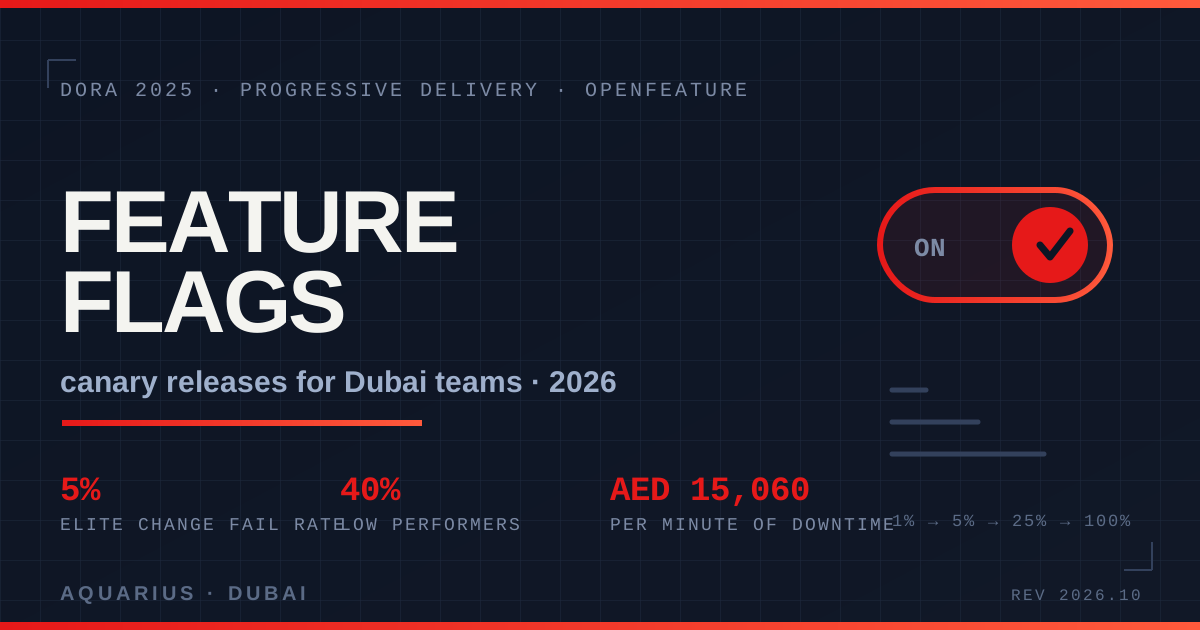
Short answer: a feature flag is a runtime switch that lets you ship code to production while keeping the feature off, and a canary release is turning that switch on for 1% of traffic before 100%. Together they are the single biggest reason elite delivery teams sit at a 5% change failure rate while low performers sit at 40%. For a Dubai e-commerce or SaaS business, that gap is money: online retail downtime costs roughly AED 15,060 per minute on an average day and up to AED 47,000 per minute during a peak like White Friday. Tooling to avoid it starts at AED 0 self-hosted and lands around AED 275–1,500 a month for a typical UAE SME.
Why Dubai teams stopped getting away with deploy-and-pray
The UAE is now a market where a bad release is measured in lost dirhams within the hour. B2C e-commerce in the UAE hit AED 42.2 billion in 2025 and is forecast by EZDubai to reach AED 67.2 billion by 2030 at a 9.9% CAGR. Internet penetration is effectively total: 99% of the population, around 11.1 million people, are online, and mobile internet penetration was forecast at 96% for 2025. Your customers are not forgiving a broken checkout because it was a Friday.
And the traffic is spiky in a very UAE-specific way. During White Friday 2025, UAE shopping app installs rose 38% year on year, total conversions rose 68% — 95% on iOS and 45% on Android — and remarketing activity grew 75%. Dubai Festivals and Retail Establishment then ran the 31st Dubai Shopping Festival from 5 December 2025 to 11 January 2026. That is a five-to-six week window where your release process is being stress-tested by the only traffic that pays the year.
Put a price on failure during it. ITIC’s 2025 downtime survey puts the median cost for enterprises with 1,000-plus employees at USD 9,000 a minute (USD 540,000 an hour), and 41% of enterprises say a single hour costs them between USD 1 million and over USD 5 million. Industry breakdowns put e-commerce at about USD 4,100 a minute on average and USD 12,800 a minute at peak — roughly AED 15,060 and AED 47,000 a minute at the pegged rate of USD 1 = AED 3.6725. Even a micro business under 25 staff is estimated at USD 1,670 a minute, about AED 6,135.
Most Dubai businesses get this wrong in exactly one way: they treat deploy and release as the same event. So every launch is a cliff — code goes live to 100% of customers at the same instant it reaches the server, and the only rollback plan is a panicked redeploy at 11pm.
Deploy is not release: the one idea that fixes the cliff
A deployment moves code onto infrastructure. A release exposes behaviour to users. Feature flags separate the two, so code can sit in production, dormant, for days before anyone sees it — and can be switched off in seconds by a product owner who has never opened a terminal.
In practice you will run four different kinds of flag, and conflating them is the most common implementation mistake we see in Dubai codebases:
- Release flags — temporary. Wrap unfinished work so it can merge to the main branch safely. Lifespan: days to weeks, then delete.
- Operational flags (kill switches) — long-lived. Turn off a heavy recommendation call, a third-party shipping-rate lookup or an AI summariser when it starts timing out. This is the flag that saves your DSF weekend.
- Experiment flags — measured. Serve variant A or B and compare conversion. Lifespan: the length of the test.
- Permission flags — permanent. Entitlements by plan tier, emirate, language or merchant. These are product configuration, not debt.
The non-negotiable technical rule: a flag evaluation must be fast and must never take your app down. That means an in-process SDK with a streaming or polled local cache and a hard-coded default value for every flag, so a flag-provider outage degrades to your default instead of a blank page. If your flag check is a blocking network call in the request path, you have added a dependency with none of the safety.
Canary, blue-green or ring: pick by blast radius
Flags give you the switch. Progressive delivery decides who it flips for, and in what order. The four patterns worth knowing, with the trade-offs that actually decide it for a UAE team:
| Pattern | How it works | Rollback speed | Infra cost | Best for |
|---|---|---|---|---|
| Canary | 1% → 5% → 25% → 100% of traffic over hours or days, watching error rate and latency at each step | Seconds (flag off) | Low — no extra environment | Most Dubai SME web apps and mobile backends |
| Blue-green | Two identical production stacks; shift the load balancer from blue to green in one move | Seconds (switch back) | High — roughly 2x compute during the window | Database-light systems, regulated workloads needing a clean cutover |
| Ring deployment | Internal staff → pilot merchants → one emirate → everyone | Minutes | Low | B2B platforms with named clients who will tell you what broke |
| Dark launch | New code runs on real traffic but its output is discarded and only logged | Instant (nothing was shown) | Medium — doubles some processing | Replacing a payment, pricing or VAT calculation engine |
For the majority of Dubai SMEs the answer is canary plus kill switches. Blue-green sounds safer and is often worse value: you pay for a second production stack and you still cannot roll back a schema migration, which is where most real incidents live. Canary at 1% catches the same class of failure at a fraction of the cost, provided you are watching the right numbers — which is a monitoring problem, covered in our note on observability and APM cost in Dubai.
The gate that makes a canary a canary
A rollout percentage with nobody watching it is just a slow outage. Define the abort rule before you start, in numbers: HTTP 5xx rate above baseline plus 0.5 percentage points, p95 latency more than 20% above the previous hour, checkout conversion for the flagged cohort below the control cohort by more than 10%, or any new error signature at all. Any one trips, the flag goes to 0%. Automate that and you have progressive delivery; do it by eye and you have a hobby.
What the 2025 DORA data actually says — including about AI
DORA’s 2025 State of DevOps report surveyed nearly 5,000 respondents, of whom 90% now use AI at work, and replaced the familiar four performance levels with seven team archetypes that mix delivery metrics with human factors such as burnout and friction. The headline for anyone shipping AI-assisted code is blunt: AI raises throughput, and it raises the change failure rate wherever feedback loops cannot keep pace.
That is the 2026 case for flags in one line. If your team is merging more code, faster, with AI assistance, then your safety net has to get faster too — or your failure rate climbs with your velocity. The benchmark spread is stark: elite performers run a change failure rate around 5% and deploy on demand, while low performers run about 40% and deploy somewhere between monthly and twice a year. The 2024 report also added deployment rework rate alongside change fail rate, precisely because unplanned work after a release is the cost everyone forgets to count.
Feature flag tooling cost in Dubai: real AED numbers
Vendors price in USD, per monthly active user, per request or per seat. Converted at USD 1 = AED 3.6725 and rounded, with 5% VAT excluded:
| Platform | List price | Approx. AED / month | What you get |
|---|---|---|---|
| LaunchDarkly Foundation — 10k MAU | USD 74.97/mo | ~AED 275 | Priced per service connection (first 5 included) plus ~USD 8.33 per 1,000 client-side MAU |
| LaunchDarkly Foundation — 50k MAU | USD 408.17/mo | ~AED 1,499 | Same model; the step a growing UAE app hits fastest |
| LaunchDarkly Foundation — 100k MAU | USD 824.67/mo | ~AED 3,029 | At 1M MAU the list figure is USD 8,321.67/mo (~AED 30,562) |
| Statsig Pro | Free tier, then USD 150/mo | AED 0, then ~AED 551 | Flag and config checks unlimited and free on every tier; charges for analytics and experiment events |
| Flagsmith Start-Up | USD 40/mo annual (USD 45 monthly) | ~AED 147–165 | 1M requests included; open-source core you can self-host later |
| Unleash Cloud Pro | ~USD 820/mo at 100k MAU | ~AED 3,011 | Enterprise controls; OSS edition is free to self-host |
| Self-hosted (Unleash, Flagsmith or GrowthBook OSS) | AED 0 licence | ~AED 100–400 hosting | Runs on a small UAE-region instance; you own uptime and upgrades |
| OpenFeature SDK layer | Free, CNCF project | AED 0 | Vendor-neutral API so you can swap provider without rewriting call sites |
Read that table against the downtime numbers above and the decision is not close. At an e-commerce average of AED 15,060 a minute, a single four-minute bad release costs more than a year of Flagsmith. The honest caveat: LaunchDarkly’s MAU model is the one that surprises people on the invoice, because a UAE consumer app that spikes during DSF pays for the spike. If your traffic is seasonal, price the December number, not the October one.
Dubai-specific rules for your rollout calendar
Four local constraints change how a UAE team should schedule releases, and none of them appear in imported DevOps playbooks:
- The weekend moved, and Friday is the trap. The UAE working week is Monday to Friday with Friday a half day for the federal sector and many private employers. A Friday afternoon deploy in Dubai is the local equivalent of the notorious Friday-night push: if it breaks, your responders are gone until Monday. Deploy Monday to Wednesday; use flags to release whenever you like.
- Freeze the code, not the product. Blanket code freezes through DSF (5 December to 11 January in the last edition) and White Friday are common and they quietly create a January backlog that fails harder. The better pattern is a deploy freeze with flags still live: no new code to production, but features already deployed dark can be enabled and disabled at will.
- Ramadan shifts your traffic curve, not just its volume. UAE consumption moves to late evening and post-iftar hours. Your canary analysis window must match the live traffic pattern — a 1% rollout judged at 10am during Ramadan is being judged on almost no data.
- Flag targeting is personal data. Targeting rules keyed on email, phone, Emirates ID fragments or precise location put identifiable data into a third-party flag service, which brings UAE Federal Decree-Law No. 45 of 2021 (PDPL) into scope. Target on hashed, non-reversible identifiers and coarse attributes such as plan tier or app version, keep a record of what the vendor stores, and check where the SDK terminates. Our note on hosting and data residency in Dubai covers the wider residency question.
Flag debt: the part that bites in month six
Every flag you add is a branch in production. Two hundred stale flags turn a codebase into a maze nobody can reason about, and that is how teams end up less safe than before they adopted flags. The discipline is boring and it is the whole game:
- One naming convention, with the type in the name:
release_,ops_,exp_,perm_. - An owner and an expiry date on every temporary flag, recorded in the platform, not in someone’s memory.
- A removal ticket created at the same time as the flag, not after launch.
- A monthly sweep that lists flags older than their expiry and either deletes the code path or converts the flag to permanent on purpose.
- Default values in code for every flag, so deleting the flag from the dashboard cannot change behaviour.
On lock-in: use OpenFeature, the vendor-neutral flagging API accepted into the CNCF in June 2022 and promoted to incubating in November 2023. By 2026 effectively every major vendor — LaunchDarkly, Split, ConfigCat, Flagsmith, Unleash, DevCycle, GrowthBook — ships an official OpenFeature provider. Write your call sites against the standard and switching provider becomes a configuration change rather than a rewrite. That single decision is worth more than any discount you will negotiate.
How Aquarius does it, and what it costs
We install progressive delivery as a day-one capability, not a rescue. A typical engagement: pick the flag platform against your real MAU curve including the December spike, wire OpenFeature so the choice is reversible, add kill switches around every third-party call (payment gateway, shipping rates, SMS, AI endpoints), define numeric canary abort thresholds with your team, automate the rollout steps in the existing pipeline, and run a live rollback drill before peak season so the first real use is not the first use.
Budget for that work the way you budget a pipeline: our DevOps and CI/CD setup cost guide puts a production-grade Dubai pipeline at AED 3,500–18,000 one-off plus AED 300–1,500 a month in tooling, and flag and canary instrumentation on top of an existing pipeline typically runs AED 6,000–18,000 one-off depending on how many services and third-party calls need wrapping. Compare that with one bad four-minute release during DSF. Quality gating before the canary is a separate discipline — see software testing and QA services in Dubai. Transparent ranges for everything sit on our pricing page.
Risk reversal, because this is infrastructure you should be able to audit: the flag platform account is created in your name, the OpenFeature wiring is yours in your repository, and the rollback drill is run with your engineers watching so the knowledge does not leave with us.
FAQ
Do I need a paid feature flag platform, or can I use environment variables?
Environment variables require a redeploy to change, which defeats the point: your kill switch is only as fast as your build. For one small app a self-hosted Unleash or Flagsmith instance at roughly AED 100–400 a month of hosting is enough. You want a managed platform once you need per-cohort targeting, an audit trail of who flipped what, or percentage rollouts that survive across multiple services.
How long should a canary stay at 1%?
Long enough to collect statistically meaningful traffic for your abort metrics, which in the UAE means covering at least one evening peak. For a consumer app, two to four hours spanning the post-work window is usually sufficient at 1%; for a low-volume B2B platform, 1% may be a single client, so use ring deployment instead and name the rings.
Can feature flags slow my site down?
Only if you implement them as blocking network calls. A correctly configured SDK evaluates flags in-process against a locally cached ruleset, so the cost is microseconds and a provider outage falls back to your in-code defaults. Client-side SDKs add a bootstrap payload, so keep the flag set small on the critical rendering path and server-render anything that would otherwise flicker.
Does PDPL stop me using a non-UAE flag provider?
Not by itself. The PDPL question is what personal data you send and where it is processed, not the vendor’s flag. Target on hashed identifiers and coarse attributes, avoid putting Emirates ID, phone numbers or precise location into targeting rules, document the transfer basis, and keep the vendor in your processor register. This is an engineering view, not legal advice — confirm the specifics with UAE counsel.
We already have blue-green. Do we still need flags?
Yes, and for a different failure. Blue-green rolls back a whole deployment; flags roll back a single feature while everything else shipped in the same release stays live. Blue-green also cannot help with a feature that is technically healthy but commercially wrong — a new checkout step that quietly drops conversion 12%. That is a flag-and-measure problem.
What is the first thing to implement if we only have a week?
Kill switches on every third-party dependency, with in-code defaults. One week spent making your payment gateway, shipping-rate lookup and AI calls individually switchable buys you more peak-season protection than a month of rollout automation.
The decision, in one line
If your team ships weekly or faster into UAE peak traffic, feature flags plus a gated canary are not an upgrade, they are the difference between a 5% and a 40% change failure rate — and at AED 15,060 a minute, the arithmetic does not survive a second opinion. Tooling is the cheap part; the discipline around naming, ownership and abort thresholds is what actually pays.
Shipping into DSF or White Friday this season and not sure you could turn a bad feature off in under a minute? Send us your repo and release process — we will tell you in one call where your kill switches are missing and what it costs to fit them.