
IAS 10 in the UAE: The Close Window That Decides Your Corporate Tax Base
UAE accounts are authorised for issue within four months of year end, but the Corporate Tax return is due at nine. Inside that five-month gap, IAS 10 decides which period a number lands in.
- PUBLISHED
- 14 NOV 2026
- READ TIME
- 13 MIN
- AUTHOR
- AQUARIUS · DUBAI
- UNIT
- REV 2026.09
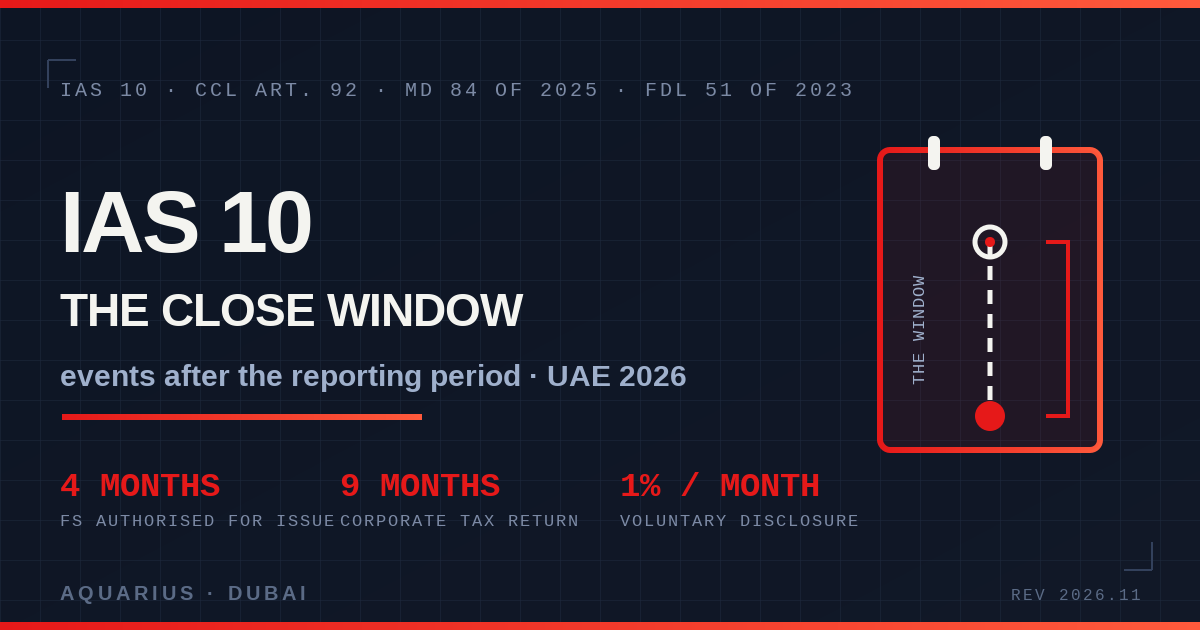
Short answer: Under IAS 10 the only events that can change a reported number are those occurring between the reporting date and the date the financial statements are authorised for issue — and in the UAE that date arrives early. The Commercial Companies Law requires the accounts and the auditor’s report to be put to the general assembly within four months of the financial year end, while the Corporate Tax return is not due until nine months. For a 31 December 2025 year end that is roughly 30 April 2026 against 30 September 2026: a five-month gap in which the tax file keeps moving and the accounting window is already shut.
Almost nothing in a typical Dubai ERP records that closing date. Journals are stamped with the date they were posted, not classified against the IAS 10 window, so a correction discovered in June gets quietly booked into the FY2025 ledger even though the audited statements were signed in April. The ledger then says one thing, the audited financial statements say another, and the Corporate Tax return reconciles to neither. That mismatch is the single most common avoidable finding in a UAE first- or second-cycle tax audit.
Why this became a 2026 problem in Dubai
The volume alone explains it. In the first half of 2026 the Dubai Business Registration and Licensing Corporation, part of the Department of Economy and Tourism, issued 58,337 new licences across mainland and free zones and renewed 173,652. Over the first nine months of 2026, 37,373 companies joined Dubai Chamber of Commerce, whose members recorded AED 252 billion of exports and re-exports between January and September. Corporate Tax registrations had already reached roughly 576,000 registrants by July 2025, including about 38,000 added after the Late Registration Waiver opened in April 2025.
That is an enormous population of entities filing a profit-based return for only the second or third time, most of them without a formal cut-off policy. Meanwhile the Federal Tax Authority is visibly on the ground: it conducted 103,680 field inspection visits in the first half of 2026, up 21% from about 86,000 in the same period of 2025. Enforcement capacity grew faster than finance-team maturity.
The audit perimeter widened at the same time. Ministerial Decision No. 84 of 2025, published on 25 March 2025 and effective for tax periods beginning on or after 1 January 2025, requires every Tax Group to prepare audited special-purpose financial statements — the old AED 50 million consolidated-revenue gate is gone. Ministerial Decision No. 82 of 2023, which set that AED 50 million threshold and caught Qualifying Free Zone Persons, is repealed but still governs tax periods that commenced before 1 January 2025. So for FY2025 and FY2026 a far larger set of Dubai groups now has a hard, audited, dated set of statements — which means a hard IAS 10 window, whether they manage it or not.
Most Dubai finance teams do not get IAS 10 wrong on the standard. They get it wrong because no system in the building knows what date the financial statements were authorised for issue.
Two dates, five months apart
IAS 10 defines events after the reporting period as those occurring between the end of the reporting period and the date the financial statements are authorised for issue. Everything turns on that second date, and UAE law sets it earlier than most finance directors assume.
Under Federal Decree-Law No. 32 of 2021 on Commercial Companies, the accounts must be approved by the managers or the board and presented to the general assembly together with the auditor’s report within four months of the end of the fiscal year (Articles 92 to 94 for limited liability companies, Article 173 for public joint stock companies). The general assembly itself must be convened within those same four months.
The Corporate Tax return, by contrast, is due within nine months of the end of the tax period. The FTA confirmed the practical consequence for the largest cohort: for a financial year ending 31 December 2025, the return and the payment were both due by 30 September 2026, filed through EmaraTax. Late filing runs at AED 500 per month for the first twelve months and AED 1,000 per month thereafter, on top of the AED 10,000 fixed penalty for late registration.
So a December-year-end Dubai company lives with this calendar:
| Date (FY2025 example) | Event | IAS 10 consequence |
|---|---|---|
| 31 Dec 2025 | Reporting date | Window opens |
| Jan–Apr 2026 | Audit fieldwork, adjustments, board approval | Adjusting events still change FY2025 figures |
| By 30 Apr 2026 | Accounts and auditor’s report to general assembly (CCL 4-month rule) | Window closes — authorised for issue |
| May–Sep 2026 | Tax computation, transfer pricing, group elimination work | No IAS 10 route into FY2025; corrections need a reissue or a disclosure |
| By 30 Sep 2026 | Corporate Tax return filed and paid | Must reconcile to the authorised statements |
Note what the middle row does. It is not a soft deadline. Once the statements are authorised for issue, the only ways to change a FY2025 number are to reissue the financial statements or to treat the item as a prior-period matter in FY2026 — and if the return has already been filed, to make a voluntary disclosure. None of those are quiet.
Adjusting or non-adjusting: the test that moves taxable income
IAS 10 splits events in the window into two classes, and the line between them is not about size or timing but about evidence.
- Adjusting events provide evidence of conditions that already existed at the reporting date. You change the reported amounts.
- Non-adjusting events are indicative of conditions that arose after the reporting date. You leave the numbers alone and disclose the nature and the financial effect.
Why a Dubai finance team should care more than a textbook reader: under Article 20 of the Corporate Tax Law, Taxable Income starts from Accounting Income — the net profit or loss shown in the financial statements. Classify an event as adjusting and FY2025 profit changes, so the tax paid on 30 September 2026 changes. Classify the same event as non-adjusting and FY2025 profit is untouched; the effect lands in FY2026. The classification decision is a tax-period allocation decision, made by an accountant who usually does not realise it.
The recurring Dubai cases, and how they actually fall:
| Event in the window | Classification | Why |
|---|---|---|
| A customer in administration in February; the receivable was already overdue at 31 December | Adjusting | Confirms the credit condition that existed at the reporting date — feeds the IFRS 9 expected credit loss |
| Court judgment in March on a dispute heard in November | Adjusting | Resolves the measurement of an existing IAS 37 obligation |
| Inventory sold in January below its 31 December carrying amount | Adjusting | Evidence of net realisable value at the reporting date |
| Final settlement of an employee end-of-service claim open at year end | Adjusting | Measures a liability that already existed |
| Warehouse fire in February | Non-adjusting | New condition; disclose nature and effect |
| Acquisition or disposal of a subsidiary in March | Non-adjusting | New transaction; disclose |
| Dividend declared in March for FY2025 | Non-adjusting | No present obligation existed at the reporting date, so no liability is recognised — disclosure only |
| Decision in April to liquidate or cease trading | Basis change | See the next section — this one is not a note |
The dividend row is the one that still catches UAE groups, because owner distributions are often decided informally after the year closes. A dividend declared after the reporting date is not a liability at that date. Accruing it anyway understates equity and misstates the balance sheet the FTA will compare against the return.
Going concern is not a disclosure note
Here is the part most Dubai finance teams get wrong, and it is the expensive part. IAS 10 paragraph 14 states that an entity shall not prepare its financial statements on a going concern basis if, after the reporting period, management determines that it intends to liquidate the entity or cease trading, or that it has no realistic alternative but to do so. That is not an adjustment to one line. It changes the measurement basis of the entire set of statements — typically to a liquidation or break-up basis — and it applies to any prior period whose statements have not yet been authorised for issue.
Going concern is also the one assessment that deliberately looks past the window: the horizon is at least twelve months from the end of the reporting period, which for a FY2025 set signed in April 2026 means forming a view that reaches into 2027.
In the UAE that assessment now sits next to a specific legal clock. Federal Decree-Law No. 51 of 2023 on Financial Restructuring and Bankruptcy came into force on 1 May 2024, replacing the 2016 law, and it is materially harsher on timing than its predecessor:
- The insolvency test is effectively a cash-flow test. The old balance-sheet route is gone, so a company with healthy net assets and no liquidity is squarely in scope.
- A debtor must file for preventive settlement or bankruptcy no later than 60 business days from the date payments were suspended, or from the date it became aware of facts confirming it will be unable to meet its debts as they fall due.
- The debt trigger is AED 500,000 for a legal entity and AED 300,000 for a natural person.
- Directors and managers can be held personally liable for conduct in the two years preceding proceedings — taking undue risks, disposing of assets at an undervalue, or granting a creditor a preference — and ordered to restore the company to the position it would have been in.
- Under Federal Judicial Council Decision No. 39 of 2025, a dedicated Federal Bankruptcy Court now sits at the Abu Dhabi Federal Court of First Instance, headed by a Court of Appeal judge.
Read those two frameworks together and the going-concern file stops being an audit formality. The date on which management “became aware” starts a 60-business-day statutory clock, and the two-year lookback means a board will later be judged on what it knew and when. A dated, evidenced going-concern assessment — cash flow forecast, facility letters, shareholder support, covenant headroom — is the primary contemporaneous record of that awareness. A forecast rebuilt from memory eighteen months later is not evidence; it is an argument.
What the data layer actually has to record
The fix is unglamorous and almost entirely about dates and provenance. Six fields and one register solve most of it:
- An authorised-for-issue date, stored once and visible everywhere. A single ledger-level attribute per entity per period. Every posting attempt after it is flagged, not silently accepted.
- Event date separate from posting date. Every post-year-end journal carries the date of the underlying event, so the adjusting test can be applied mechanically rather than argued.
- A subsequent-events register. One row per event: date identified, event date, description, amount, adjusting or non-adjusting, who decided, evidence link, disclosure wording. This is the document the auditor and the FTA both ask for.
- Period-lock with a reason code. Not a password shared with four people. A lock that records who reopened a closed period, when, and why.
- A tax-reconciliation bridge. Audited Accounting Income to Taxable Income, holding every Article 20 adjustment as a referenced line item — the same discipline the close and consolidation layer needs for Tax Group elimination.
- A dated going-concern pack. Twelve-month cash flow forecast, assumptions, sensitivities, support letters, versioned and immutable. Pulling the forecast from the same source as the cash flow statement removes the usual inconsistency between the two.
None of this requires a new ERP. In most Dubai implementations it is a thin layer over the general ledger the company already runs, plus discipline about who can post what, when.
What it costs in AED
Indicative Dubai build ranges for the close-window data layer, assuming an existing ERP or accounting system stays in place:
| Scope | What you get | AED range |
|---|---|---|
| Cut-off controls only | Authorised-for-issue field, period lock with reason codes, event-date capture on journals | 18,000 – 32,000 |
| Subsequent-events register | Register, classification workflow, evidence attachments, disclosure note export | 30,000 – 55,000 |
| Tax-reconciliation bridge | Accounting Income to Taxable Income with referenced Article 20 adjustments, locked to the audited set | 45,000 – 90,000 |
| Going-concern pack automation | Rolling 12-month forecast from ledger and treasury data, versioned assumptions, sensitivity runs | 55,000 – 120,000 |
| Tax Group close layer (MD 84 of 2025) | All of the above across group entities, with elimination and special-purpose statement support | 120,000 – 260,000 |
Now the cost of not doing it, which is where the arithmetic turns. If a misclassified subsequent event means a filed return understated tax, the correction route is a voluntary disclosure, and the penalty is 1% per month on the tax difference, running from the day after the original due date to the date of disclosure. Wait until the FTA has notified a tax audit and the penalty becomes 15% fixed plus 1% per month. Unpaid tax separately attracts 14% per annum, applied monthly.
Put numbers on it. A Dubai company that misallocated AED 2 million of profit between FY2025 and FY2026 carries roughly AED 180,000 of additional tax at the 9% rate. Self-disclosed eighteen months after the due date, the penalty is about AED 32,400. Found in an FTA audit instead, it is the 15% fixed charge of AED 27,000 plus the same monthly accrual — near AED 59,400, before any late-payment charge. Against that, the entire cut-off and register build sits in the AED 48,000 to 87,000 band, and it applies to every year that follows.
How Aquarius builds it
We treat the close window as a dated control, not a policy document. In a typical engagement we map your actual authorisation date against the CCL four-month rule and the nine-month Corporate Tax deadline, add the authorised-for-issue attribute and event-date field to your existing ledger, stand up the subsequent-events register with the classification test built in, and wire the Accounting Income to Taxable Income bridge so the return is generated from the audited set rather than typed alongside it. For Tax Groups caught by Ministerial Decision No. 84 of 2025, we extend the same controls across every member entity so the special-purpose statements and the single return agree by construction.
Delivery is six to ten weeks for a single entity and ten to sixteen for a group, on your current stack, with the register and bridge handed over as something your own finance team operates. See pricing for engagement structures, or talk to us about where your last close actually closed.
FAQ
What date are financial statements “authorised for issue” in the UAE?
In practice, the date the board or managers approve the accounts for presentation to the general assembly together with the auditor’s report. Federal Decree-Law No. 32 of 2021 requires that to happen within four months of the financial year end, so for a 31 December year end it is typically on or before 30 April. Record the actual date; do not assume it.
Can we still adjust FY2025 after the statements are signed?
Not through IAS 10. Once the statements are authorised for issue the window is closed. The options are reissuing the financial statements, or treating the item in the following period — as a prior-period correction if it is an error rather than a new event. If the Corporate Tax return has already been filed and tax was understated, a voluntary disclosure is required, carrying 1% per month on the tax difference.
Is a subsequent event always just a disclosure note?
No. Adjusting events change the reported amounts. And where events after the reporting date show that the going concern assumption is no longer appropriate, IAS 10 paragraph 14 requires the statements not to be prepared on a going concern basis at all — a change of measurement basis, not a note.
Does our Tax Group need audited statements now?
Yes. Ministerial Decision No. 84 of 2025, effective for tax periods starting on or after 1 January 2025, requires all Tax Groups to prepare audited special-purpose financial statements, with no revenue threshold. Member entities are relieved from preparing audited standalone statements. The AED 50 million revenue threshold now applies only to a taxable person that is not a Tax Group.
How long does the going concern assessment have to look forward?
At least twelve months from the end of the reporting period. For FY2025 statements signed in April 2026 that means the assessment reaches into 2027, and it should be dated and evidenced — under Federal Decree-Law No. 51 of 2023 a debtor has only 60 business days from becoming aware of an inability to pay debts as they fall due, and directors can be examined on the two years before proceedings.
Do we need to replace our ERP to fix this?
Usually not. The authorised-for-issue date, event-date capture, period lock with reason codes and the subsequent-events register can all be added as a layer on an existing general ledger. Replacement only makes sense if the ledger cannot support period locking or dated attributes at all.