
eSIM Apps in Dubai (2026): You Cannot Be a UAE eSIM Operator, So Build This Instead
The TDRA issues no MVNO licences, so a UAE eSIM brand is off the table. Here is the legal build: real e& and du visitor prices, 30-50% wholesale margins and AED build ranges for 2026.
- PUBLISHED
- 25 OCT 2026
- READ TIME
- 13 MIN
- AUTHOR
- AQUARIUS · DUBAI
- UNIT
- REV 2026.09
Short answer: You cannot launch your own UAE mobile network inside an app. The TDRA issues no individual MVNO licences — e& and du remain the only two licensed operators on public networks, and their licences were just renewed for 20 years to 8 August 2046. What you can build legally and profitably is the layer above: an outbound travel eSIM store or API integration for UAE residents and inbound tourists, where wholesale margins run 30–50% and the alternative your customer faces is AED 25 per day of carrier roaming.
Here is what most Dubai founders get wrong. They read “eSIM” as a telecom play, pitch a UAE network brand, and spend three months and a lawyer’s retainer discovering the licence does not exist. Meanwhile the actual opportunity is boring and open: a travel agency, tour operator, airline consolidator, hotel group or fintech app that sells connectivity as an attached product, through someone else’s licensed network, at a margin nobody is competing for in this market yet.
The 2026 numbers: a 5G-saturated country that is 41st at eSIM
The UAE should be an eSIM leader. On the readiness scoring it is not, and that gap is the whole commercial story.
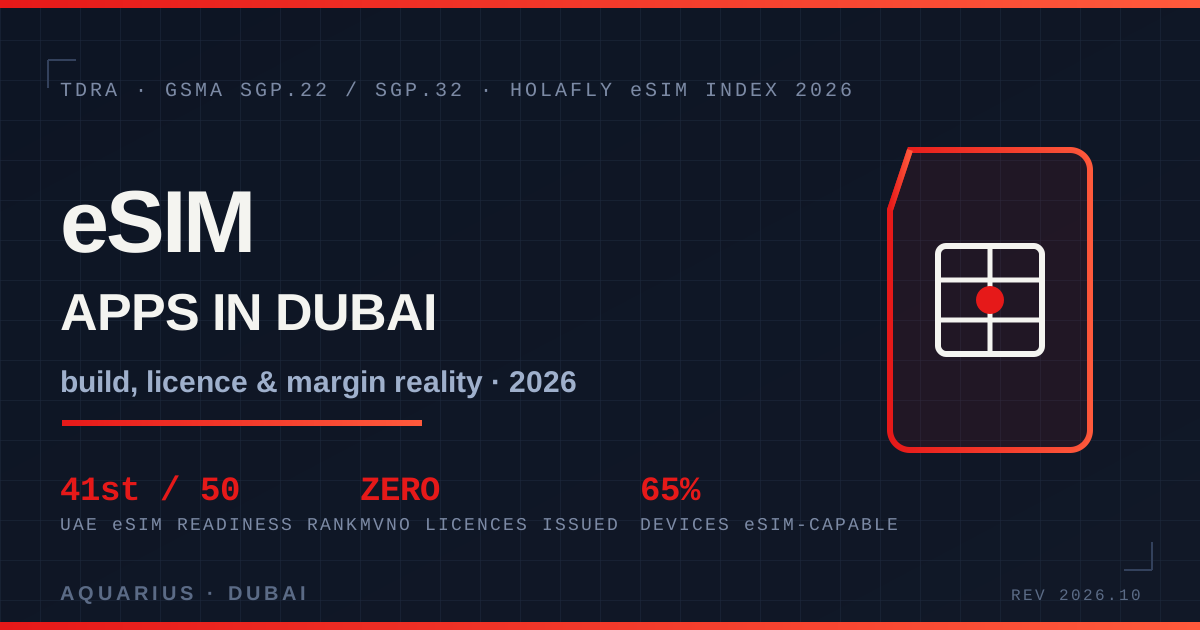
- Holafly’s inaugural Global eSIM Index 2026 (published 13 May 2026, covering 50 markets and 171 operators) ranks the UAE 41st with a score of 59.0 out of 100 — against Saudi Arabia 10th (79.7), Qatar 25th (75.8) and the United States top on 90.2.
- That is not a hardware problem. Roughly 65% of active devices in the UAE already support eSIM, on a premium-skewed Apple and Samsung install base, with mobile penetration at about 238% and 5G across the entire inhabited territory.
- Demand is real and travelling. Global eSIM adoption hit 28.1% for the 2026 summer travel season, up from 19.0% a year earlier, and the global travel eSIM market is put at about USD 1.75 billion in 2026 heading to USD 4.06 billion by 2035.
- Dubai supplies the footfall. DET recorded 19.59 million international overnight visitors in 2025, up 5% and a third consecutive record, with December 2025 the first month above 2 million (2.04 million) and hotel occupancy above 80%. DXB handled a record 95.2 million passengers in the same year.
- Yet the UAE eSIM market itself is valued at only around USD 144.6 million in 2026, forecast to reach USD 159.1 million by 2033 — a 1.7% CAGR. A flat domestic market sitting inside the busiest international air hub on earth is a distribution failure, not a demand failure.
Dubai sells 5G everywhere and ranks 41st of 50 on eSIM readiness. The constraint is not the network. It is that almost nobody here has built the buying experience.
The licence wall, stated plainly
Mobile Virtual Network Operation is a Regulated Activity under Federal Law by Decree No. 3 of 2003 on the Organisation of the Telecommunications Sector, as amended. In practice the TDRA does not issue individual MVNO licences: e& and du are the only licensed operators on public networks, and on 9 August 2026 the TDRA renewed both licences for a further 20 years, to 8 August 2046, with obligations attached covering resilience, interconnection and access, national roaming, quality of service and subscriber protection.
The sub-brands you see are not exceptions to that rule — they sit on the two licensed networks under commercial arrangements, which is why Virgin Mobile rides du infrastructure rather than its own. So three statements follow, and they should shape your product scope before a single screen is designed:
- You cannot issue UAE mobile numbers or UAE data profiles as a new brand without going through e& or du.
- You can sell outbound connectivity — eSIM profiles for the destination country — as a reseller or API partner of a global eSIM provider, which is the same product category Abu Dhabi-based MobiMatter has operated in since 2019.
- Your KYC and activation flow for anything touching a UAE profile is the operator’s process, not yours: local operator eSIMs require passport or Emirates ID registration, in-country verification and a TDRA type-approved device.
Four things you can actually build
1. Attached eSIM inside an existing travel product
The highest-return build, and the least technical. If you already run a booking flow, connectivity is one extra line item at checkout with no inventory and no fulfilment. Airalo’s Partner Platform charges no sign-up or subscription fee and supplies a Partner API, an SDK and a WooCommerce integration against 1,000+ packages across 200+ countries on net wholesale pricing with a minimum selling price. eSIM Go aggregates wholesale access from over 1,000 tier-1 operators in 190+ countries, with a Standard tier that asks an initial USD 1,000 across the first three months and no monthly commitment after that. If you run tours or transfers, pair this with the margin logic in our guide to cutting OTA commission.
2. A standalone travel eSIM brand for the UAE market
Own storefront, own pricing, own retention. This competes on local payment methods, Arabic and English parity, and distribution through UAE channels rather than on price against global incumbents. Entry resellers typically see 30–40% gross margin; partners clearing 10,000+ activations a month negotiate above 55%.
3. Corporate connectivity console
Dubai head offices with travelling staff currently expense roaming. A console that assigns destination profiles per trip, enforces a data cap and pushes the invoice into finance replaces an uncontrolled cost line. This is a B2B SaaS build, priced per seat, and it is stickier than any consumer eSIM app.
4. IoT fleet provisioning on SGP.32
For logistics, metering, cold chain and smart-building estates, the relevant standard is GSMA SGP.32 — published June 2024, now at v1.3, with commercial delivery from 17 April 2026. It adds two components, the IoT Profile Assistant on the device and the eSIM IoT Remote Manager in the backend, so headless devices can switch operator profiles without a user interface. If you are already running sensors, read it alongside our IoT platform build guide.
What UAE connectivity costs today
Price your product against these, not against your own guesswork. Visitor plans carry 28-day validity unless stated.
| Option | What you get | Price |
|---|---|---|
| e& instant visitor eSIM | 10 GB, 1 day, self-activated after immigration | Free |
| du free tourist eSIM | 10 GB, 24 hours | Free |
| e& visitor plan | 4 GB | AED 49 |
| e& visitor plan | 10 GB + 60 flexi minutes | AED 99 |
| e& visitor plan | 13 GB + 120 minutes | AED 125 |
| du value bundle | 10 GB / 15 GB / 20 GB | AED 99 / 139 / 189 |
| du unlimited tourist | Unlimited data, 7 / 14 / 28 days | AED 199 / 299 / 499 |
| Third-party travel eSIM, UAE destination | Entry data bundle | From about USD 3.49 |
| Carrier roaming for UAE residents abroad | Daily pack, 500 MB fair use then 64 kbps | From AED 25/day, weekly from AED 100 |
Read the last two rows together, because that is your entire pitch deck. A UAE resident on a seven-day trip pays roughly AED 175 in daily roaming packs, throttled to 64 kbps after 500 MB a day, when a destination eSIM covers the same week for a single-digit dollar figure. That delta is why attach rates on travel eSIM products hold up without discounting.
The device and activation traps nobody budgets for
Four implementation details decide whether your support inbox survives launch week.
- eSIM-only hardware is already here. The iPhone Air ships with no SIM tray in any market, and in the UAE the iPhone 17, 17 Pro and 17 Pro Max are eSIM-only. A flow that assumes a physical fallback is already broken for your highest-value customers.
- Install before arrival. The practical rule for inbound travellers is to install the eSIM profile before flying and activate on landing. Your onboarding emails, deep links and QR codes have to land while the customer still has connectivity — design for that, not for an airport install.
- QR versus in-app activation. In the UAE, Apple lists carriers for QR code or app activation, with e&, du and Virgin Mobile activating by app or QR. Supporting both doubles your QA matrix across iOS and Android.
- Device approval is non-negotiable. Every mobile device used in the UAE must be TDRA-approved and IMEI-registered, and pre-loaded non-UAE profiles designed to bypass local operators are not accepted. Build the unsupported-device message early; you will need it.
Delivery mechanics matter too. Profile QR codes, activation reminders and low-data alerts are transactional messages, and the UAE has its own rules and rate cards for those — our UAE messaging cost breakdown covers the TDRA sender ID requirements before you wire up notifications.
Build cost and timeline in Dubai
Aquarius ranges for 2026, assuming a wholesale partner rather than a telecom licence:
| Scope | What it includes | Build cost (AED) | Timeline |
|---|---|---|---|
| Attached eSIM at checkout | Partner API integration, catalogue sync, payment, email and QR delivery, on an existing site or app | 18,000 – 35,000 | 2 – 4 weeks |
| Standalone eSIM storefront | Web store, country and plan catalogue, wallet, AED payment gateway, Arabic and English, order dashboard | 45,000 – 85,000 | 5 – 8 weeks |
| Consumer app, iOS and Android | In-app purchase, profile install flows, usage polling, top-ups, push notifications, support handoff | 90,000 – 180,000 | 10 – 16 weeks |
| Corporate console or IoT fleet | Multi-tenant roles, per-trip assignment, policy caps, finance export, SGP.32 fleet provisioning | 160,000 – 320,000 | 14 – 22 weeks |
Run the margin model before you approve any of it. At a 35% gross margin on a mid-size travel eSIM bundle, a storefront build at AED 60,000 clears break-even in the low thousands of activations — a number a travel brand with existing booking volume reaches on attach alone, without buying a single click of paid traffic. Budget separately for the run rate: catalogues and partner APIs change, and our app maintenance cost guide has the realistic annual figure. Published ranges for the rest of our work sit on the pricing page.
How Aquarius ships this
We start with the boundary, not the build: a one-page written scope of what is legal for your entity, which wholesale partner fits your volume, and what the margin is at your realistic activation count. If the numbers do not work we say so in that first week, before design. Then we ship the thinnest version that can transact — usually attached eSIM on an existing checkout — and expand into app and console only once real attach data justifies it. Fixed scope, fixed price, source code yours.
If you already have UAE travel volume, the easiest attached revenue in your P&L is sitting untouched. Tell us your monthly booking volume and we will send the margin model back within two working days.
FAQ
Can I start my own eSIM network in Dubai?
Not as a new licensed operator. Mobile Virtual Network Operation is a Regulated Activity under Federal Law by Decree No. 3 of 2003, and in practice the TDRA issues no individual MVNO licences — e& and du are the only licensed operators on public networks, with licences renewed on 9 August 2026 for 20 years to 8 August 2046. You build above the network as a reseller or API partner, or you negotiate a commercial arrangement with one of the two operators.
Do I need a TDRA licence to resell travel eSIMs to UAE customers?
Selling destination eSIM profiles provisioned by a licensed foreign operator through a global partner is a retail and distribution activity, not operation of a UAE public network. That said, the licence boundary depends on your exact entity, your mainland or free zone activity codes and whether any UAE-issued profile or number is involved — get it confirmed in writing for your specific setup before launch.
What margin can an eSIM reseller realistically make?
Entry-level resellers typically run 30–40% gross margin on net wholesale pricing, and partners clearing 10,000+ activations a month negotiate above 55%. Platform fees are usually zero to start: Airalo charges no sign-up or subscription fee, and eSIM Go’s Standard tier asks an initial USD 1,000 spread across the first three months.
Can tourists install a UAE eSIM after they land?
Treat it as install-before-arrival. Both operators do offer an instant free visitor eSIM at the airport — 10 GB for one day on e&, 10 GB for 24 hours on du — but local operator profiles require passport or Emirates ID registration and in-country verification, and the reliable pattern for third-party profiles is to install before flying and activate on landing. Design your delivery around a customer who still has connectivity.
Which standard matters for IoT eSIM, and when?
GSMA SGP.32, published in June 2024 and now at v1.3, with commercial delivery from 17 April 2026. It introduces the IoT Profile Assistant on the device and the eSIM IoT Remote Manager in the backend so headless devices can be reprovisioned remotely. Consumer eSIM still runs on the SGP.22 consumer specification; do not mix the two architectures in one build.
How long does an eSIM app take to launch in Dubai?
Attached eSIM on an existing checkout is 2 to 4 weeks. A standalone storefront is 5 to 8 weeks, a consumer iOS and Android app 10 to 16 weeks, and a corporate or IoT fleet console 14 to 22 weeks. Partner onboarding and payment gateway approval run in parallel and are usually the critical path, not the code.