
Driving School Management Software in Dubai (2026): Build Cost, RTA Tadreeb & the Learning-Permit Clock
What a driving-institute platform costs to build in Dubai in 2026 - real AED tiers, the permit and allocation engine that protects revenue, and why RTA just opened five new training zones.
- PUBLISHED
- 30 SEPT 2026
- READ TIME
- 12 MIN
- AUTHOR
- AQUARIUS · DUBAI
- UNIT
- REV 2026.09
Short answer: custom driving school management software in Dubai costs roughly AED 90,000-180,000 for a core system (trainee records, learning-permit tracking, lesson scheduling, instructor and vehicle allocation, fee collection and an RTA-ready data layer), AED 180,000-350,000 for a full platform with native trainee and instructor apps, GPS route logging and automated assessments, and AED 350,000-600,000+ for a multi-branch group build with BI dashboards, fleet telematics and AI progress scoring - before 5% VAT. Off-the-shelf driving-school SaaS runs about USD 50-500 per month (roughly AED 185-1,835), but almost none of it is built for RTA's Tadreeb workflow, the three-month learning permit, or Arabic-first trainees.
This is the 2026 build guide for Dubai driving institutes, investors applying for the new RTA training zones, and operators still running 250-trainee cohorts on spreadsheets and WhatsApp groups. Updated September 2026.
Key takeaways
- Dubai issued 119,188 driving licences in the first half of 2026 alone - 96,400 of them brand new.
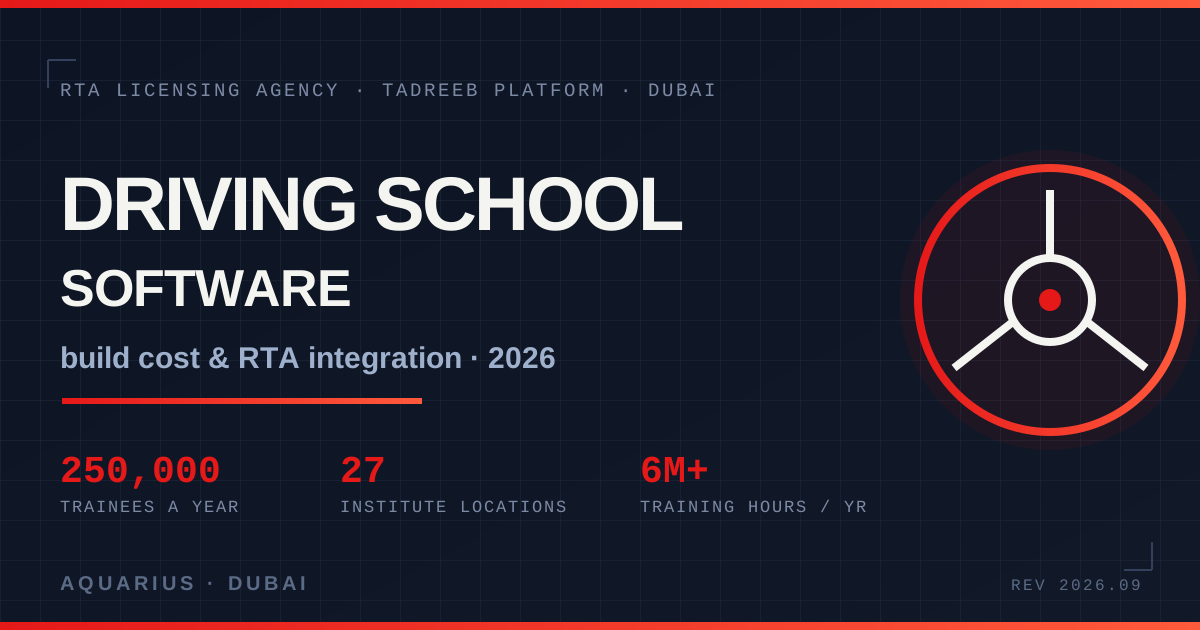
- RTA's Tadreeb platform spans 27 training institute locations, 3,400+ instructors, 3,000 vehicles, about 250,000 trainees and over 6 million training hours a year.
- RTA approved five new driver training zones in June 2026 and invited investors to apply - the first serious capacity expansion in years.
- Core custom build: AED 90K-180K. Full platform with apps: AED 180K-350K. Multi-branch group: AED 350K-600K+.
Dubai's driver-training market is bigger than most operators think
Most institutes underestimate the scale of what they are administering. RTA's Licensing Agency reports that the emirate issued 119,188 driving licences in H1 2026 - 96,400 new licences plus 22,788 issued through the foreign-licence exchange route. That is roughly 650 licences a day, every day, including weekends.
Behind those licences sits an industrial-scale training operation. RTA's unified Tadreeb platform - the first driver-training platform endorsed by the International Commission for Driver Testing (CIECA) and a Prince Michael International Road Safety Award winner - covers 27 training institute locations, more than 3,400 instructors and 3,000 training vehicles, serving around 250,000 trainees and more than 6 million training hours per year at a reported 97% trainer compliance rate.
Do the arithmetic and the operational problem becomes obvious: that averages about 9,250 trainees per institute location per year and roughly 24 training hours per trainee. A single mid-sized Dubai institute is scheduling tens of thousands of one-hour slots a year against a finite pool of instructors, vehicles, yard capacity and test dates.
And demand keeps climbing. Dubai's population grew by more than 208,000 people between June 2024 and June 2025 according to Dubai Statistics Centre, UAE active vehicle registrations hit 4.56 million by June 2025 (up 9.35% year on year, about 390,000 extra vehicles), and RTA says 3.5 million vehicles move on Dubai's roads during daytime hours, with registrations up 10% over two years against a 2-4% global average. In June 2026 RTA approved five new driver training zones - Wadi Al Safa, Jebel Ali, Mushrif, Al Maktoum City and Madinat Hind - and invited accredited institutes and new investors to apply for branches. New branches mean new systems, and they mean it this year.
What driving school software actually has to do in Dubai
Generic international driving-school software solves an American or European workflow. Dubai's is different in four specific ways, and each one is where off-the-shelf products break.
1. The learning permit clock
Before a trainee takes a single practical lesson they need an RTA learning permit, issued through the institute. It is valid for three months and must be renewed if lessons are not finished in time - AED 100 for light vehicles and motorcycles plus a AED 20 knowledge and innovation fee. That three-month window is the single most important number in your scheduling logic. Software that does not count down permit expiry per trainee, flag at-risk students at 60 and 80 days, and auto-prompt renewal will quietly cost your institute renewal fees, refunds and one-star reviews.
2. Instructor, vehicle and yard allocation as one constraint
A lesson is not just a calendar slot. It binds an instructor holding the right licence category, a vehicle with valid registration and insurance, a training zone with free capacity, and a trainee with a live permit at a compatible stage. That is a four-way constraint solver, not a booking form - and it is the difference between 70% and 95% fleet utilisation.
3. Bilingual, mobile-first trainees
Dubai trainees are overwhelmingly expat residents booking lessons from their phones between shifts. Arabic and English parity, right-to-left layout and a genuinely fast mobile experience are table stakes - the same discipline we cover in our Arabic website localisation guide.
4. Sensitive personal data, at volume
You are holding Emirates ID numbers, passport copies, eye-test results, medical notes and payment data for thousands of residents. That is regulated personal data under the UAE PDPL, and consent, retention and deletion need to be designed into the system rather than bolted on after launch. Start with our UAE PDPL compliance checklist.
Build tiers and what each one gets you
Here is how driving-institute platforms price out in Dubai for 2026. All figures exclude 5% VAT.
| Tier | AED (build) | What's included |
|---|---|---|
| Core system | 90,000-180,000 | Trainee CRM and enrolment, learning-permit tracking with expiry alerts, lesson scheduling with instructor and vehicle allocation, package and fee management with a UAE payment gateway, attendance and training-hours ledger, Arabic/English admin portal, structured export of trainee and training-hour data |
| Full platform + apps | 180,000-350,000 | Everything above plus native iOS/Android trainee and instructor apps, self-service rescheduling with cancellation rules, GPS route and hours logging from the vehicle, digital lesson assessments and progress sheets, a theory-test practice module, automated SMS/WhatsApp reminders, and instructor payroll and commission |
| Multi-branch group | 350,000-600,000+ | Everything above plus multi-branch consolidation and central fleet pooling, BI dashboards on pass rates, utilisation and revenue per instructor, vehicle telematics and maintenance scheduling, AI readiness scoring that predicts test-pass probability, role-based access across branches, and API endpoints for RTA and partner systems |
Two integrations pay for themselves fastest. Payments - packages of AED 5,000+ paid in instalments need proper reconciliation, instalment plans and automated dunning; see our payment gateway integration costs. And messaging - a no-show burns an hour of instructor time, an hour of vehicle time and a slot another trainee wanted, so automated reminders on the channel Dubai residents actually read are the cheapest ROI in the build; our WhatsApp Business API cost guide has the per-message numbers.
Build vs buy - the real numbers
Most international driving-school SaaS lands between USD 50 and USD 500 per month (about AED 185-1,835), with one-time licence options quoted at USD 600-2,000. That sounds cheap until you read the seat pricing. Drive Scout, a typical vertical product, charges USD 50 per user per month with a five-user minimum - a USD 250 floor before you add a single instructor. Apply that per-seat model to a Dubai institute running 120 instructors and you are paying about USD 6,000 a month, roughly AED 264,000 a year, forever, for software you do not own and cannot reshape around Tadreeb, the learning permit or Arabic RTL.
A custom platform is a one-time AED 90K-350K capital cost plus roughly 15-20% a year for hosting, support and enhancements. The crossover is straightforward: a single-branch institute with under about 25 instructors is usually better off renting. Above roughly 40-60 instructors, or across multiple branches, a custom build typically pays back inside 14-24 months - because the SaaS bill scales with every instructor you hire while an owned platform does not.
There is a second, larger lever. A Dubai learner's total spend runs AED 5,500-7,500 if they pass first time and AED 7,000-10,000 once one or two retakes are included, with driving-school fees making up 60-70% of that and RTA government fees around AED 1,000-1,050. Belhasa, one of the largest RTA-approved institutes, publishes a 20-hour package from AED 5,078. At that basket size, lifting fleet and instructor utilisation by even five percentage points across 9,000 trainees a year is a seven-figure AED swing - which is the actual business case for the software, not the admin hours it saves.
How Aquarius builds it: we scope the constraint engine first - permits, instructors, vehicles, zones - because every other module hangs off it, ship a working core in 10-14 weeks so you get a full intake cycle of value, then layer apps, telematics and analytics in phases. Bilingual by default, mobile-first, PDPL-designed, and your data stays yours and exportable. See our pricing or book a scoping call. If fleet visibility is your priority, our fleet tracking build guide covers the telematics layer in detail.
The cost of waiting: RTA opened five new training zones in June 2026 and invited new investors in. The institutes that win those branches will be the ones that can stand up a second, third and fourth location on the same system in weeks. If adding a branch means another spreadsheet, another WhatsApp group and another three admin hires, you are not bidding for that expansion - you are watching it.
Frequently asked questions
Does driving school software in Dubai have to integrate with RTA?
Licensed institutes operate inside RTA's Tadreeb platform for permits, training records and test scheduling, so your internal system is not a replacement - it is the operational layer around it. In practice your platform owns sales, packages, scheduling, allocation, payments, instructor payroll and trainee communication, and keeps its trainee and training-hour records structurally aligned with what RTA requires, with a clean export and API surface ready for whatever integration route RTA authorises for your institute.
How long does a custom driving-institute platform take to build?
A core system covering enrolment, permits, scheduling, allocation and payments takes about 10-14 weeks. Adding native trainee and instructor apps with GPS hour-logging and digital assessments typically pushes it to 18-24 weeks. Multi-branch consolidation with BI and telematics runs 6-9 months.
What does it cost to run per year after launch?
Budget 15-20% of the build cost annually for hosting, support, OS and app-store compliance updates, and enhancements. On an AED 180,000 build that is roughly AED 27,000-36,000 a year - materially less than per-seat SaaS at any meaningful instructor count.
Can we start with just the scheduling module?
Yes, and for most institutes that is the right first phase - but only if the trainee record and the learning-permit clock are built underneath it. Scheduling without permit-expiry awareness books lessons that cannot legally happen.
Is this only useful for driving schools?
The same engine - trainees, certified instructors, permits with expiry dates, vehicles or equipment, yards, assessments - fits any regulated training operator in Dubai, including heavy-vehicle, forklift, marine and safety-training institutes. The domain rules change; the constraint model does not.
Bottom line
Dubai is training a quarter of a million drivers a year across 27 locations, 3,400 instructors and 6 million training hours - and RTA just opened five more zones. Budget AED 90K-180K for a core platform and AED 180K-350K once trainee and instructor apps are in, and scope the permit clock and the allocation engine first, because those two are what protect revenue and pass rates. Talk to Aquarius about scoping your build.