
Digital Twin and BIM Platform Development in Dubai (2026): The Mandate, the Data Pipeline and Real AED Costs
Dubai now runs a city-scale twin covering 195,000 buildings. Real AED costs for a building or portfolio digital twin, the BIM mandate thresholds that apply, and the data pipeline behind it.
- PUBLISHED
- 03 OCT 2026
- READ TIME
- 12 MIN
- AUTHOR
- AQUARIUS · DUBAI
- UNIT
- REV 2026.09
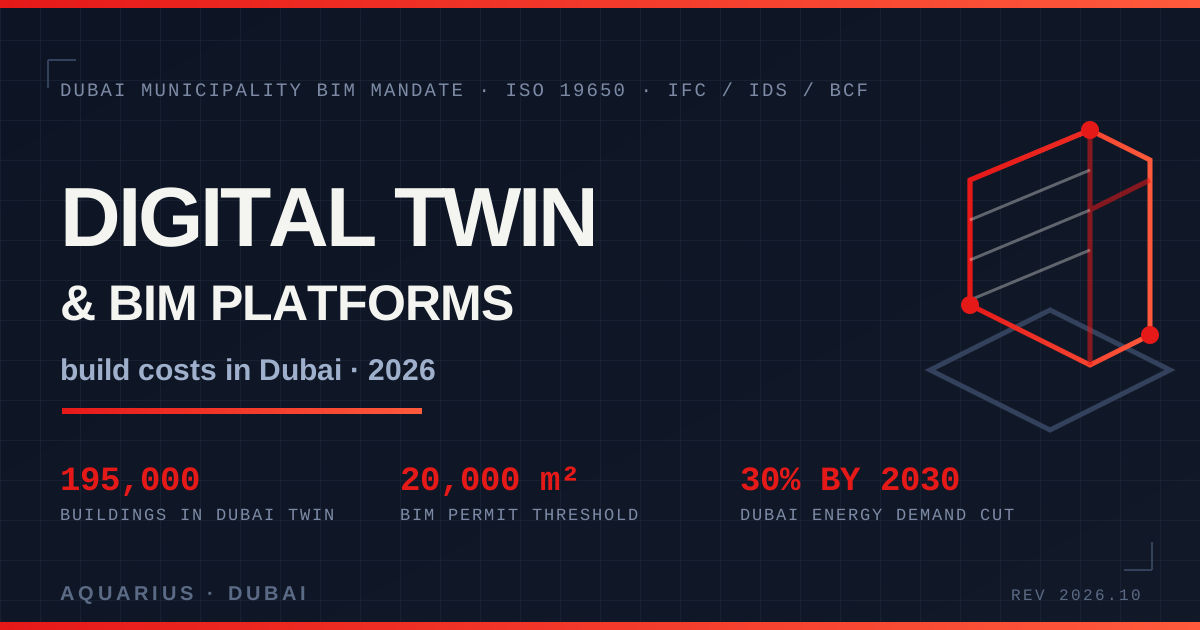
Short answer: a working digital twin for a single Dubai building or a small portfolio costs roughly AED 140,000-480,000 to build, plus AED 3,500-18,000 a month to run once telemetry, hosting and model updates are live. The BIM model is only the geometry layer underneath it, and since the start of 2024 Dubai Municipality has required an IFC model with building-permit submissions for projects over its size thresholds. Dubai itself now operates a city-scale twin covering 195,000 buildings, which is why owners and FM firms are suddenly being asked for asset data they never used to keep.
Most of the money in a twin does not go into the 3D view everybody demos. It goes into the boring plumbing: getting asset identity, BMS points and maintenance history into one place where a query actually returns the truth.
Dubai already built the biggest twin in the region
On 2 July 2026, Dubai Municipality launched the Dubai Digital Twin Platform - phase three of the project - integrating 3D models of more than 195,000 buildings, 330,000 public facilities and 280,000 infrastructure assets, layered with over 1,500 geospatial data layers and more than 100 two- and three-dimensional applications covering urban planning, asset management and rainfall simulation. Partnerships with Al-Futtaim Group and Huawei were signed to extend it, and the whole programme sits under the D33 economic agenda.
Three more numbers explain why private owners are following. The UAE digital twin market is estimated at around USD 560 million and growing. The UAE facility management market is put at about USD 23.6 billion in 2026, with Dubai holding roughly 52% of it and FM services in the emirate alone measured in the order of AED 12 billion. And more than 75% of new UAE real estate projects now ship with smart building technology - IoT HVAC, lighting and security - which means the data a twin needs is increasingly already on site, unused.
The regulatory pull is just as strong. Dubai's Demand Side Management Strategy 2030 targets a 30% cut in electricity and water demand by 2030 against a 2013 baseline - at least 19.2 TWh of electricity and 46.3 billion imperial gallons of water - and buildings account for over 70% of consumption. The strategy includes retrofitting around 30,000 buildings by 2030. You cannot evidence a retrofit saving you never instrumented.
Most Dubai owners get this wrong: they think the BIM model they already paid for is a digital twin. It is not. BIM is a design-time record of geometry and specification. A twin is a live, queryable model joined to real operational data - sensors, work orders, energy, occupancy - that keeps telling you something new after handover. A BIM file with no live data is an expensive drawing.
The mandate: what Dubai Municipality actually asks for
Dubai has had a BIM policy since Circular No. 196 of 2013, widened by Circular No. 207 of 2015. The change that matters commercially came with a circular issued in October 2023: BIM model submission for new building permits, in IFC format alongside native files, effective from the start of 2024. Dubai Municipality has aligned on open standards - ISO 19650 for information management, IFC for exchange, IDS for specifying what information must be present, and BCF for issue coordination.
| Project type | Discipline | Threshold that triggers BIM | What you submit |
|---|---|---|---|
| Buildings | Architectural | Over 20 floors or over 20,000 m² | IFC model plus native files |
| Buildings | Structural | Over 40 floors or over 30,000 m² | IFC model plus native files |
| Government projects | All | In scope regardless of size | IFC model plus native files |
| Specialised buildings (hospitals, universities) | All | In scope as a specialised use | IFC model plus native files |
Two forward-looking points. Dubai Municipality has signalled further expansion of the mandate, including COBie-style data for facility management handover on government projects - which is precisely the asset-register layer a twin needs. And IDS matters more than most teams realise: it turns "give us a good model" into a machine-checkable list of required properties, so your permit model either passes validation or it does not. Write the IDS check into your consultant's contract, not into a hope.
What a digital twin platform is actually made of
Strip the marketing away and a building twin is six layers. Underbuild any one of them and the demo looks fine while the value never arrives.
- Geometry. The IFC model, converted to a web-renderable tileset. Full-fidelity IFC in a browser is slow; you tile and simplify for the viewer and keep the authoritative model in storage.
- Asset register. Every chiller, AHU, FCU, pump, lift and meter with a stable unique ID, mapped to its geometry element. This is the layer that makes or breaks a twin, and it is mostly data cleaning rather than coding.
- Telemetry ingest. BMS over BACnet/IP or Modbus TCP, standalone sensors over MQTT, DEWA consumption, lift and access logs. Most Dubai towers already run a BMS - our guide to IoT and smart building software development in Dubai covers the gateway side in detail.
- Time-series store. Tens of thousands of points at one-to-five-minute intervals become billions of rows fast. Use a time-series database with downsampling and retention tiers from day one.
- Rules, analytics and alerts. Fault detection and diagnostics, setpoint drift, runtime-hour tracking, anomaly flags that open a work order rather than an email nobody reads.
- Interfaces. A 3D viewer for navigation, 2D dashboards for operators, and an API so the CAFM, the ERP and the tenant app all read the same truth.
One Dubai-specific decision deserves early attention: where the data lives. Building telemetry quickly becomes occupancy data, which drags in PDPL considerations, and government or semi-government clients commonly specify UAE-hosted infrastructure in the tender. Decide before you build - see our breakdown of Dubai hosting and data residency for the options and what each costs.
Real AED build costs in Dubai
These are the bands we quote in Dubai for 2026, assuming you already hold a usable design model. If you do not, add model production or scan-to-BIM before anything below.
| Scope | What you get | Build cost (AED) | Timeline | Monthly run (AED) |
|---|---|---|---|---|
| Twin pilot - one building | IFC viewer, asset register, 300-800 live BMS points, 3 dashboards | 140,000 - 220,000 | 8-12 weeks | 3,500 - 6,000 |
| Operational twin - one tower | Above plus FDD rules, work-order integration, energy baselining, tenant reporting | 230,000 - 350,000 | 14-20 weeks | 6,000 - 11,000 |
| Portfolio twin - 5 to 20 assets | Multi-asset rollup, benchmarking, DEWA consumption, role-based access, public API | 360,000 - 480,000 | 20-30 weeks | 11,000 - 18,000 |
| BIM-to-permit data layer | ISO 19650 information management, IDS validation, IFC export QA for submission | 45,000 - 110,000 | 4-8 weeks | Project-based |
| Scan-to-BIM for an existing asset | Laser scan, point cloud registration, LOD 300 model of MEP and structure | 35 - 90 per m² | 6-14 weeks | - |
The variable that moves these numbers most is not floor area - it is point count and protocol mess. One modern BMS with a clean BACnet point list is a two-week integration. Four legacy systems from three contractors, with point names in abbreviations nobody documented, is two months of forensic work. Ask for the point list before you ask for a price. Our pricing page sets out how we structure discovery so this gets priced on evidence rather than optimism.
The business case, in dirhams
Published studies of building digital twins report energy consumption reductions of roughly 20-30% and maintenance cost reductions of 15-25% for condition-based maintenance, with unplanned downtime down 20-50% through early fault detection. Documented cases include Jewel Changi Airport cutting unplanned downtime 45% in its first year with energy costs down 18%, and Microsoft's Redmond campus reducing emergency work orders 34%.
Apply the conservative end to a Dubai tower. Take an asset with an annual electricity bill of AED 1.8 million - unremarkable for a mid-size commercial building here, where cooling dominates the load. A 12% reduction, well below the published range, is AED 216,000 a year. Add the avoided cost of two emergency chiller call-outs and one deferred capital replacement, and an AED 280,000 operational twin pays back inside 18 months, then keeps paying. That arithmetic rests on the assumptions stated here - run it against your own DEWA bill before you commit to anything.
There is a second, less obvious return. Dubai's retrofit programme and green building rules make measured performance a reporting obligation rather than a nice-to-have. Owners who can produce verified consumption data per asset answer tenant ESG questionnaires, service-charge challenges and DSM programme requirements out of the same system. Owners who cannot pay a consultant to reconstruct it every year.
Where Dubai twin projects go wrong
- Buying the viewer first. Beautiful 3D navigation with no live data is a very expensive screensaver. Instrument first, visualise second.
- No unique asset IDs. If the BMS calls it AHU-03, the CAFM calls it AHU3-L4 and the model calls it a GUID, nothing joins. Fix identity before analytics.
- Treating handover data as the contractor's problem. Specify the information requirements in the contract under ISO 19650, with IDS validation, or you will buy that data twice.
- Ignoring the FM team. If the alert does not land in the system the technician already uses, it is ignored by week three.
- Underestimating retention cost. Raw one-minute data for 20,000 points, kept forever, is a storage bill with no owner. Define downsampling on day one.
How Aquarius builds these
We build twins as software products, not as visualisation projects: a short paid discovery that produces your point list, asset register gaps and an integration risk log, then a pilot on one building with a hard success metric, then rollout. UAE hosting where residency is required, PDPL-aware handling of occupancy data, and an API-first design so your CAFM and ERP become consumers rather than rivals. If your project is still in delivery rather than operation, our note on construction project management software in Dubai covers the upstream half.
FAQ
Is a digital twin mandatory in Dubai?
No. A digital twin is not mandatory. What is mandatory, since the start of 2024, is BIM model submission in IFC format with building-permit applications for projects over Dubai Municipality's thresholds - over 20 floors or 20,000 m² for architectural design, over 40 floors or 30,000 m² for structural, plus government and specialised buildings such as hospitals and universities. The twin is the commercial choice you make on top of that compliance work.
Can we build a twin for an older building with no BIM model?
Yes, and that is the common case in Dubai. You either scan-to-BIM the asset - roughly AED 35-90 per m² depending on MEP complexity and the level of detail you need - or start with a simplified floor-plate model plus a full asset register, which is cheaper and often sufficient for operations. Geometry is for navigation; the register and the telemetry carry the value.
How long before a twin shows a return?
Energy savings appear within the first full cooling season once baselining and fault detection are live, typically three to six months after go-live. Maintenance savings take longer because they depend on changing work-order practice. Plan on 12-24 months to clear the build cost on a single tower, faster across a portfolio where one integration serves many assets.
What standards should we insist on in the contract?
ISO 19650 for information management, IFC for model exchange, IDS to define the properties the model must carry, BCF for issue tracking, and an agreed naming and classification standard for assets. Add a clause requiring handover data to pass automated validation, not a human eyeball.
Who owns the data in a twin?
You should - explicitly, in writing, including the raw telemetry and the right to export it in an open format. Also check where it is hosted and who else can read it. Occupancy-derived data falls under UAE PDPL thinking, so treat tenant and movement data with the same care as customer records.
Next step
If you own, manage or are handing over a Dubai asset and somebody has asked you for performance data you cannot produce, start with the point list - not a platform demo. Send us the BMS export and the asset schedule and we will tell you in one call what is twin-ready, what needs cleaning and what a first phase actually costs. Talk to Aquarius, or see how we scope and price delivery on our services page.