
Digital Dirham 2026: What Dubai Businesses Must Fix Before the UAE CBDC Reaches Their Checkout
Dubai targets 90% cashless by 2026 and the Digital Dirham is rolling out through every licensed bank. The three integration jobs merchants must do, with real AED costs.
- PUBLISHED
- 29 SEPT 2026
- READ TIME
- 11 MIN
- AUTHOR
- AQUARIUS · DUBAI
- UNIT
- REV 2026.09
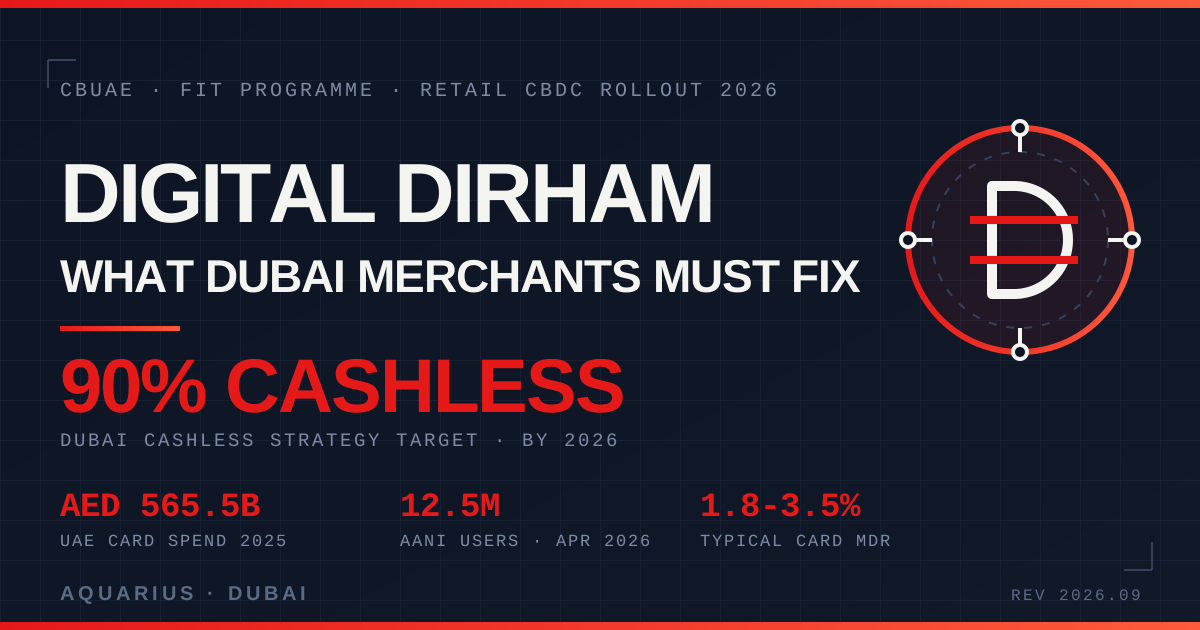
Short answer: the Digital Dirham is the UAE Central Bank’s own digital currency — legal tender, pegged 1:1 to the dirham, spendable in-store, online, peer-to-peer and even offline. Every licensed financial institution in the UAE is required to support it, which means it will arrive in your customers’ banking apps whether or not your checkout is ready. For most Dubai businesses the work is not blockchain engineering; it is three unglamorous jobs: a new payment method at checkout, a POS or QR update, and reconciliation logic that can handle instant, irreversible settlement.
Key takeaways
- Dubai’s Cashless Strategy, launched 9 October 2024 under the D33 agenda, targets 90% of all transactions cashless by 2026 and is projected to add over AED 8 billion a year to the economy.
- UAE card payment value hit AED 511.4 billion in 2024 (up 13.3%) and AED 565.5 billion in 2025, forecast to reach AED 814.7 billion by 2029 — a 9.6% compound growth rate.
- Aani, the national instant payments platform, passed 12.5 million registered users across 74 licensed financial institutions as of April 2026, settling transfers in seconds.
- The Digital Dirham is not the DDSC stablecoin. CBUAE approved that separately on 12 February 2026 — a dirham-backed stablecoin from IHC, FAB and Sirius International Holding on ADI Chain, aimed at institutional settlement, not your retail till.
- Card processing in the UAE typically costs 1.8% to 3.5% per transaction. Central-bank rails are built to undercut that, which is the real commercial story.
Dubai set a deadline for cash, and it has almost arrived
Most coverage of the Digital Dirham treats it as a futurist curiosity. It is not. It is the payments layer of a policy target with a date attached.
The Dubai Cashless Strategy was launched on 9 October 2024 under the directives of the Crown Prince of Dubai, as part of the Dubai Economic Agenda (D33). Its stated goal is blunt: 90% of all transactions in Dubai — government and private sector — conducted without cash by 2026. Officials estimate the efficiency gain at more than AED 8 billion annually. To enforce it, Dubai’s Department of Finance established a dedicated Digital Payment Systems Regulatory Division in December 2024. By that year, 97% of Dubai government services were already digital; the remaining work is in retail, mobility, utilities and private-sector payments — in other words, in your business.
The commercial momentum is already visible in the card numbers. UAE card payment value grew 13.3% in 2024 to AED 511.4 billion, then 10.6% in 2025 to AED 565.5 billion, and is forecast to reach AED 814.7 billion by 2029 at a 9.6% compound annual growth rate. Instant account-to-account payments are moving faster still: Aani, run by Al Etihad Payments under the Central Bank, announced in April 2026 that it had passed 12.5 million registered users connected through 74 licensed financial institutions, with transfers clearing in seconds rather than days.
Against that backdrop, the Digital Dirham is not an experiment competing for attention. It is the next rail on a network that UAE consumers have already adopted at scale.
What the Digital Dirham actually is
The Digital Dirham is a retail central bank digital currency (CBDC) issued by the Central Bank of the UAE under its Financial Infrastructure Transformation (FIT) Programme, launched in 2023. Four design facts matter to a business owner:
- It is central bank money, not a bank deposit. It is pegged one-to-one to the dirham and carries the direct backing of CBUAE. There is no issuer credit risk between you and the central bank.
- It is distributed through a two-tier model. CBUAE issues; licensed intermediaries — your bank, your wallet provider — handle wallets, onboarding and customer service. You will not integrate with the central bank directly. You will integrate through the institutions you already use.
- It works offline. Offline payment capability is explicitly in scope, which matters for events, delivery riders, remote sites and any till that loses connectivity.
- It is programmable. Smart contracts are part of the project scope, alongside cross-border functionality. Phase one of the CBDC strategy covered an mBridge soft launch for cross-border settlement and a bilateral bridge with India, plus a domestic retail and wholesale proof of concept.
CBUAE has already run a cross-border pilot and a real-value retail trial before opening the rollout, and the requirement that all UAE licensed financial institutions support the Digital Dirham means distribution is not left to market enthusiasm. Timing has moved — the original Q4 2025 retail target slipped, with the public retail rollout reported for March 2026 and expanding in phases — so treat specific dates as moving and the direction as fixed.
The myth most Dubai businesses are getting wrong
Here is the confusion we hear weekly: “so the UAE launched a stablecoin, right?” No. Two different things launched in the same window.
On 12 February 2026, CBUAE approved DDSC, a dirham-backed stablecoin from IHC, First Abu Dhabi Bank and Sirius International Holding, running on ADI Chain, a Layer-2 institutional blockchain from Abu Dhabi’s ADI Foundation. Its stated use cases are payments and collections, high-value settlement and treasury operations, trade and supply-chain flows, and programmable services for regulated entities — with executives openly describing machine-to-machine and AI-agent trade as a target.
DDSC is private-sector money on a blockchain, aimed at institutions. The Digital Dirham is central bank money, aimed at everyone. If your accountant or your developer is treating them as one project, your requirements document is already wrong.
What actually changes in your checkout, POS and back office
Strip away the terminology and a merchant faces four concrete pieces of work.
1. A new payment method at checkout. Whether you run Shopify, WooCommerce, Magento or a custom Next.js storefront, a Digital Dirham option is a new method object: an icon, a flow, a pending state, a webhook, a failure path. If your checkout hardcodes card logic instead of abstracting payment methods, this is where the cost lands. We covered the underlying economics in our Dubai payment gateway integration cost guide.
2. POS and QR acceptance. In-store acceptance runs over QR or NFC. That means terminal firmware updates from your acquirer, and a QR display path if you are doing table ordering, kiosks or delivery handover.
3. Reconciliation that assumes instant, final settlement. This is the part teams underestimate. Card money arrives in batches, days later, net of fees, and can be charged back. Central-bank rails settle in seconds and are final. If your ERP or accounting integration was built around T+2 batch files, instant settlement breaks your matching logic in a way that looks like missing revenue. The same lesson applied when merchants first wired up instant transfers — see our Aani and Jaywan integration guide.
4. Refunds, holds and disputes. There is no chargeback mechanism on final settlement. Deposits, pre-authorisations and returns all need to be redesigned as explicit refund transactions with their own audit trail — and, if you hold customer balances, you may cross into stored-value territory that requires its own CBUAE licence. We unpack that threshold in our e-wallet and SVF licence guide.
Rail comparison: what each one costs you
| Rail | Typical merchant cost | Settlement | Reversible? | Best for |
|---|---|---|---|---|
| Visa / Mastercard | 1.8%–3.5% MDR; new merchants often 2.2%–2.9% + ~AED 1 | T+1 to T+3, batched | Yes (chargebacks) | International cards, BNPL stacking, familiarity |
| Aani (instant A2A) | Low flat or near-zero per transfer, bank-dependent | Seconds, 24/7 | No | Invoices, deposits, high-ticket local sales |
| Digital Dirham (CBDC) | Designed as a low-cost public rail; pricing set via your intermediary | Instant, incl. offline capability | No (refund only) | Everyday retail, cash replacement, programmable payouts |
| DDSC stablecoin | Network and institutional fees | Near-instant on ADI Chain | No | B2B settlement, treasury, trade and supply-chain flows |
Run the arithmetic on your own volume. A Dubai store turning over AED 2 million a year online at a 2.6% blended rate pays roughly AED 52,000 annually in processing fees. Shifting even a third of that volume onto a cheaper domestic rail is a five-figure line item recovered — which is precisely why the low-cost public rails will not stay optional for long in competitive categories.
What it costs to get ready, in AED
Nothing here requires a blockchain team. These are the real engagement ranges we quote Dubai businesses for payment-rail work in 2026.
| Scope of work | Typical AED range | Timeline |
|---|---|---|
| Payment readiness audit (checkout, POS, reconciliation, licence exposure) | 4,000 – 9,000 | 3–5 days |
| Add a new payment method to an existing platform store (Shopify / WooCommerce) | 6,000 – 15,000 | 1–2 weeks |
| Custom checkout: payment-method abstraction layer + new rail | 18,000 – 45,000 | 3–6 weeks |
| Instant-settlement reconciliation and ERP/accounting sync rebuild | 15,000 – 40,000 | 3–5 weeks |
| POS / QR in-store acceptance integration | 12,000 – 35,000 | 2–5 weeks |
The cost of waiting is not a fine; it is margin and conversion. The UAE e-commerce market is estimated at around USD 12.3 billion in 2026, growing toward USD 21 billion by 2031 at roughly 11% a year. In a market growing that fast, the merchant who offers the payment method a customer already has open in their banking app wins the cart — and pays less to win it.
How Aquarius approaches it
We do not sell CBDC hype. We start with the audit, because in about half of the Dubai codebases we review the blocking problem is not the new rail at all — it is a checkout with card assumptions welded into it, or a reconciliation job that silently drops any transaction settling outside its expected batch window. Fix the abstraction once and every future rail, from Aani to the Digital Dirham to whatever CBUAE ships next, becomes a configuration change instead of a rebuild.
Our engagements are fixed-scope with a written integration spec before any code is written, and we hand over full source and credentials. No lock-in. See our pricing or the full services list.
Frequently asked questions
Is the Digital Dirham a cryptocurrency?
No. It is central bank money issued by CBUAE, pegged one-to-one to the dirham, with no market price volatility. Cryptocurrencies are privately issued and float in value. The Digital Dirham is the dirham, in digital form, with the central bank’s backing.
Do I have to accept it?
The obligation announced applies to licensed financial institutions supporting the currency, not to every merchant individually. But the Dubai Cashless Strategy’s 90% target applies across government and private sectors, and once a payment method sits in 12 million-plus banking apps, refusing it is a conversion decision, not a compliance one.
How is it different from Aani?
Aani moves commercial bank money instantly between accounts using a phone number. The Digital Dirham is a different form of money — a direct central bank liability — that can be held in a wallet, spent offline and programmed with smart contracts. Practically, both are instant, low-cost and final, and both break the same assumptions in a card-era reconciliation system.
What about VAT and invoicing?
The tax treatment does not change because the rail changed: a dirham is a dirham. What changes is your evidence trail. Instant, final settlement means your tax invoice and your payment record must match at the second, not at end-of-day batch — which matters as UAE e-invoicing requirements tighten.
Should I wait until the rollout is complete?
Do the audit now, build the abstraction now, ship the rail when your acquirer opens it. The audit and the checkout refactor are the long-lead items and they pay for themselves against card fees regardless of when the CBDC reaches your terminal. Waiting only compresses the same work into a deadline.
The practical next step
Dubai has committed to a cashless target with a date on it, the instant-payments network already has 12.5 million users, and a central bank digital currency is rolling out through every licensed institution in the country. The businesses that struggle in 2027 will not be the ones that picked the wrong rail — they will be the ones whose checkout and accounting could only ever handle one.
If you want to know where your stack breaks before a customer finds out, book a payment readiness audit. We will tell you plainly whether you need a refactor or a three-day change.