
Dealer Management Systems in Dubai (2026): The Back Office That Decides Your Margin
UAE new-car registrations fell 23.2% to August 2026 while Dubai logged 196,042 first-time registrations. What a dealer management system must hold in 2026, and real AED build costs.
- PUBLISHED
- 09 NOV 2026
- READ TIME
- 14 MIN
- AUTHOR
- AQUARIUS · DUBAI
- UNIT
- REV 2026.09
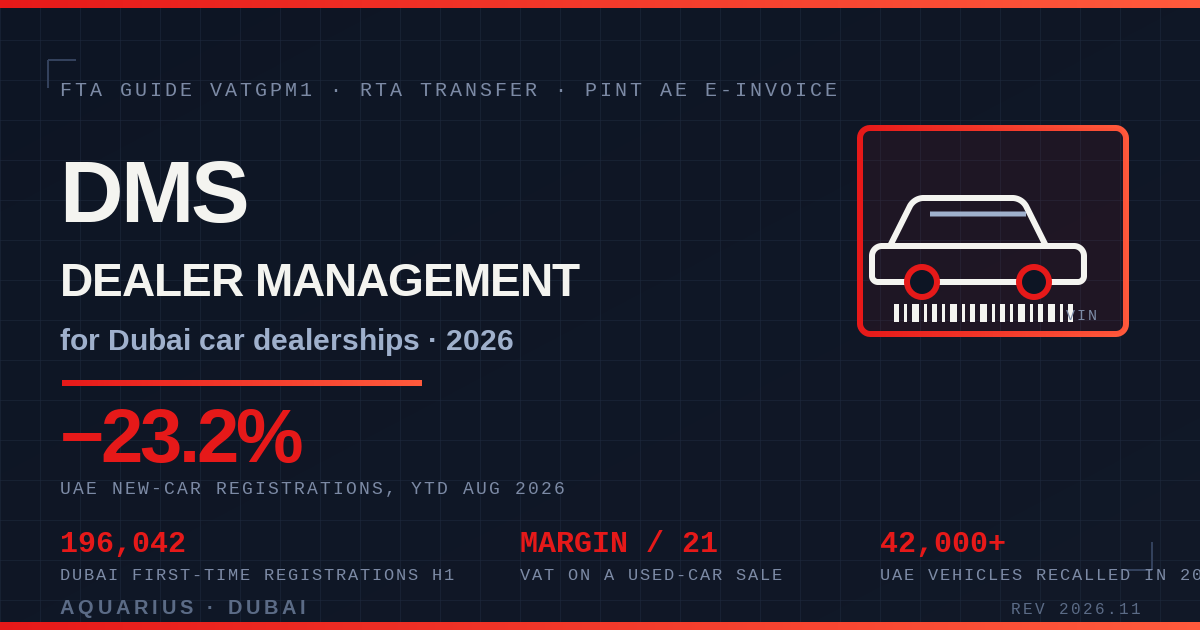
Short answer: A dealer management system is the single record that ties one vehicle’s whole life inside your business together — acquisition, stock ageing, test drive, deal file, registration transfer, service history, parts and warranty — so that every department reads the same VIN instead of its own spreadsheet. In Dubai in 2026 that record is also a tax document: FTA Guide VATGPM1, published in January 2026, requires a per-item stock book before you may charge VAT on the margin of a used car rather than on the full price. Expect AED 60,000–450,000 to build it properly on the systems you already own.
Most Dubai dealerships have bought the front of the funnel three times over — a website, a portal subscription, a CRM — and never bought the back of it. That worked while volume was rising. It stopped working this year.
The 2026 numbers that changed the maths
Three figures, all from this year, explain why the back office is suddenly where the money is.
- UAE new-car registrations are down 23.2% year to date through August 2026, at 160,210 units, with August alone off 15.1% to 23,066 units. Volume is not coming to rescue a thin gross.
- Dubai recorded 196,042 first-time vehicle registrations in the first half of 2026 — more than 32,000 a month, over 1,000 a day — according to Ahmed Mahboob, CEO of the RTA’s Licensing Agency. The transactions are still happening. They are simply moving between players faster.
- Dubai holds 56.84% of the UAE used-car market, a market worth USD 22.92 billion in 2026 and forecast to reach USD 39.58 billion by 2031 at an 11.52% CAGR. Pre-owned is where the growth is, and pre-owned is exactly where per-unit record-keeping gets hard.
Put those together and you get the shape of 2026: fewer new units, more used units, and a margin that now depends on how fast a car moves and how clean its paperwork is. Both of those are software problems.
Here is what most Dubai dealerships get wrong. They think the DMS is an accounting system that happens to know about cars. It is the opposite: it is a vehicle record that happens to produce accounting. Get that backwards and you will buy a general-purpose ERP, bolt a stock sheet onto it, and spend the next three years reconciling.
What a dealer management system actually holds
A DMS is not a CRM and not a website. A CRM tracks people; a DMS tracks units. Five records sit at its core, and a Dubai build has to get all five right because each one feeds a different regulator or a different profit centre.
- The stock ledger, per VIN. Acquisition date, acquisition source and party type, purchase price, reconditioning cost by line, transport, days in stock, current asking price, price-change history, and where the unit physically is. One row per chassis, not per listing.
- The deal file. Enquiry source, test drive, trade-in appraisal, finance or insurance product attached, discount approved and by whom, delivery date, and the final gross per unit split between vehicle, finance commission and accessories.
- The registration and transfer record. Mulkiya details, inspection status, fines cleared, insurance issued, and the RTA transfer event itself with its fees and date.
- The fixed-ops record. Job cards attached to the same VIN, labour hours, parts issued, technician, warranty versus customer-pay split, and the next-service due date.
- The parts record. Stock by part number with bin location, supersession chains, cost and landed cost, and the obsolescence clock.
The value is not in any single one. It is in the join. A car you bought at auction, reconditioned for AED 6,400, sat on for 71 days, discounted twice, delivered with an extended warranty and then serviced three times should be a single readable story. In most Dubai dealerships it is five stories in four systems, and nobody can tell you what that unit actually earned.
VATGPM1: your stock book is now a tax control
This is the part that moved in 2026 and the part most teams have not absorbed. In January 2026 the Federal Tax Authority published Guide VATGPM1, the first full official guidance on the Profit Margin Scheme under Article 29(2) of the VAT Executive Regulation. For a used-car dealer, the scheme is the difference between charging 5% VAT on a whole AED 90,000 selling price and charging it only on your margin.
The arithmetic is simple. VAT equals the margin multiplied by the VAT fraction of 5/105 — which the guide simplifies to dividing the margin by 21. On a car bought at AED 72,000 and sold at AED 90,000, that is AED 18,000 divided by 21, or roughly AED 857 of VAT instead of about AED 4,286. Per unit, at Dubai used-car volumes, that gap is the business.
The conditions are where software earns its fee:
| How you acquired the unit | Profit Margin Scheme available? | What the DMS must store |
|---|---|---|
| Bought from a non-registered person (private seller, trade-in from a consumer) | Yes | A self-issued purchase invoice carrying your name, address and TRN, the seller’s name and address, the purchase date and a description of the vehicle |
| Bought from a taxable person who themselves applied the margin scheme | Yes | Evidence that VAT was previously imposed, and that the supplier invoice shows no VAT amount |
| Bought from a taxable person on a normal tax invoice showing a VAT amount | No | Standard-rated treatment on the full selling price — flagged at acquisition, not at sale |
| Imported used vehicle where import VAT is recoverable | No | Import entry and recovered input tax; the unit must be locked out of margin treatment |
| Goods predating VAT introduction in 2018 | No | Age evidence; excluded because VAT was never previously imposed |
Two traps sit inside that table. First, eligibility is decided at acquisition, by a salesperson or a buyer at an auction, months before anybody raises a sales invoice — so the flag has to be captured at intake or it will never be reliable. Second, the invoicing rule is unforgiving: the invoice must state that VAT has been charged on the profit margin, and the VAT amount must not be shown. Print the VAT line out of habit and the FTA’s own guidance treats the transaction as disqualified from the scheme. That is a template branch in your DMS, not a note in a training manual.
There is a reporting consequence too. Margin-scheme supplies go into Box 1 of the VAT 201 return at selling price less the VAT on the margin, with the purchase price reported in Box 9 and no VAT shown, and the return carries a specific checkbox for scheme users. The FTA also expects a stock book or equivalent record showing each good purchased and sold under the scheme. A per-VIN stock ledger is the stock book. A spreadsheet of listings is not.
Days in stock: the cost nobody invoices you for
Ageing is the second half of the margin story, and it is the half a DMS makes visible. International retail benchmarks are blunt: franchise dealers turn used inventory in roughly 32 to 38 days, independents in 48 to 55 days, and once a unit passes 60 days the combined cost of floorplan interest, depreciation and reconditioning runs about USD 32–45 per vehicle per day — roughly AED 117–165 a day. Cumulatively, a 38-day turn absorbs around USD 1,400 per vehicle against about USD 2,600 at a 55-day turn.
Those are US figures and Dubai conditions differ — different funding costs, different seasonality around Dubai Shopping Festival, a heavy re-export trade. But the direction is not in dispute, and the conversion is useful: closing a 20-day gap in average turn is worth something like AED 2,300–3,300 per unit. At 40 used units a month that is AED 1.1 to 1.6 million a year, found entirely in a report your current setup cannot produce.
| Days in stock | What the system should do automatically |
|---|---|
| 0 – 15 | Hold price. Confirm reconditioning closed and photography complete; a unit not listed is not ageing, it is hiding |
| 16 – 30 | First price review against live market comparables, logged with a named approver |
| 31 – 45 | Escalate: mandatory second review, promotion flag, and a sales-manager task |
| 46 – 60 | Wholesale or export decision required, with the holding cost already accrued against the unit |
| 60+ | Report by exception to ownership, with cumulative holding cost per unit shown in AED |
Fixed operations is the profit centre your DMS protects
When new-vehicle volume falls 23%, service and parts carry the business. At the six largest listed US dealer groups, fixed operations produced between 48% and 59% of total gross profit in the fourth quarter of 2025 — 49.3% at AutoNation, 49.7% at Asbury, 44.7% of Penske’s retail automotive gross. The industry’s own absorption target is 115%, meaning service and parts gross covers every overhead plus a cushion, yet average service absorption measured just 68.1% in the first quarter of 2025.
That gap is largely a data gap. Absorption cannot be managed if labour hours, parts margin and overhead live in different systems, and service retention cannot be managed if the workshop does not know which VINs you sold. A DMS that shares one vehicle record between the showroom and the service bay turns every delivery into a 12-month service appointment pipeline. If the workshop side is your immediate bottleneck, our breakdown of garage and workshop management software in Dubai covers job cards and VAT invoicing in detail.
Recalls and warranty: the traceability test
2026 has been a heavy recall year in the UAE. Al-Futtaim and the Ministry of Economy and Tourism have run campaigns covering 29,774 Toyota Land Cruiser 300s built between 2021 and 2024, 6,933 Lexus LX500 and LX600 units, 5,612 Jeep Wrangler and Gladiator vehicles, and a further 892 Lexus and Toyota vehicles for a front-camera software fix — more than 42,000 vehicles between them.
A recall is a traceability exam with a deadline. You must be able to answer, per VIN: who owns it now, what contact details are current, which campaigns apply, which have been completed, and which parts were consumed. In a market where tens of thousands of used cars change hands in Dubai every month, the OEM’s original owner record goes stale quickly — and the dealer who transferred the car is the only party who knows. If your DMS cannot produce that list in one query, your recall completion rate is a phone-call campaign run from memory.
Buy a platform, or build on what you own?
The global DMS vendors are real software, and they are priced for North American franchise economics. Published and reported ranges give a sense of scale:
| Platform | Reported cost | Rough AED equivalent |
|---|---|---|
| CDK Drive, entry tier | USD 500 – 1,000 / month | AED 1,800 – 3,700 / month |
| CDK, enterprise per rooftop | USD 5,000 – 15,000+ / month | AED 18,000 – 55,000+ / month |
| CDK full suite (DMS, CRM, digital retail, F&I) | USD 15,000 – 30,000 / month | AED 55,000 – 110,000 / month |
| Tekion core DMS, per store | around USD 6,000 / month | around AED 22,000 / month |
| Tekion full stack, mid-volume franchise | USD 12,000 – 25,000 / month | AED 44,000 – 92,000 / month |
Pricing from all of these vendors is quoted per dealership rather than published, and year-one costs rise further with migration, training and OEM interface enablement. Keyloop, for instance, layers tiered annual API subscriptions with one-time certification fees and overage charges on top of the licence.
For a single-rooftop Dubai dealership, AED 22,000 a month is AED 264,000 a year, every year, for a product built around US tax, US finance products and US regulatory reporting — none of which includes a VATGPM1 stock book, an RTA transfer record or a PINT AE e-invoice. The honest decision rule is this: if you are a multi-brand OEM franchise with mandated vendor interfaces, licence the platform. If you are an independent, a used-car specialist or an export desk, build the five records on the ERP and CRM you already pay for. In almost every Dubai independent we have scoped, the second route costs less than two years of licence fees and ends up fitting the local process.
One more deadline: e-invoicing
Whatever you choose has to emit structured invoices. The UAE eInvoicing pilot went live on 1 July 2026 on the Peppol network using the PINT AE specification — a decentralised five-corner model where invoices move as XML through a Ministry of Finance Accredited Service Provider, not as a PDF on an email. Businesses with annual revenue of AED 50 million or more had until 30 October 2026 to appoint an ASP, with go-live from 1 January 2027; those under AED 50 million have until 31 March 2027 to appoint, going live 1 July 2027. Penalties under Cabinet Decision No. 173 of 2026 run to AED 5,000 initially plus AED 5,000 per month, capped at AED 50,000 over any 12 consecutive months, and apply to the recipient of an invoice as well as the issuer.
For a dealership this collides directly with the margin scheme. A standard tax e-invoice carries roughly 51 mandatory fields; a margin-scheme sale must not show a VAT amount. Reconciling those two facts inside one invoicing engine is a design decision best made before you pick an ASP, not after. Our walkthrough of UAE e-invoicing ERP integration covers the field mapping.
What it costs to build in Dubai
Indicative AED ranges for fixed-scope work, delivered on systems you already run:
| Scope | AED range | Typical timeline |
|---|---|---|
| Per-VIN stock ledger, acquisition-source capture and a VATGPM1-ready stock book with correct invoice templates | 30,000 – 70,000 | 4 – 6 weeks |
| Deal file: test drive, trade-in appraisal, approval routing, gross-per-unit reporting and the ageing escalation ladder | 60,000 – 150,000 | 7 – 11 weeks |
| Fixed-ops and parts module sharing the same VIN record, with warranty-versus-customer-pay split and recall campaign tracking | 75,000 – 180,000 | 8 – 14 weeks |
| Full custom DMS: stock, deals, registration, service, parts, ASP and Peppol e-invoicing, dashboards | 220,000 – 450,000 | 14 – 22 weeks |
| Ongoing care, monitoring and regulatory updates | 3,500 – 14,000 / month | Rolling |
Published ranges for related builds sit on our pricing page, and the full list of what we deliver is on services.
How we sequence it
We start with the stock ledger, because it is the cheapest phase and it carries the compliance win: one row per VIN, acquisition source captured at intake, margin-scheme eligibility decided on day one, invoice templates branched correctly, days-in-stock live. That alone usually pays for itself inside two quarters through the ageing discipline. The deal file comes second, because by then there is a unit to attach it to. Fixed ops and parts come third, and the e-invoicing integration last — by which point the fields the ASP needs already exist and the integration is a connector rather than a data-cleansing project.
If the lead-generation side is your real gap rather than the back office, read our guide to car dealership website development in Dubai, or the economics of building your own used-car marketplace instead of renting portal leads.
Frequently asked questions
Do I need a dealer management system if I only sell 20 cars a month?
You need the stock ledger. At 20 units a month the deal-file and parts modules are optional, but the per-VIN acquisition record is not — it is what makes the Profit Margin Scheme defensible, and the VAT difference on 240 cars a year dwarfs the build cost. Start there and add modules when the volume justifies them.
Can my accounting software be my DMS?
Not on its own. Accounting software records transactions; a DMS records units and their state over time. The two must integrate, but asking a general ledger to hold reconditioning cost by line, days in stock and recall campaign status per chassis is how dealerships end up with four spreadsheets and no single answer on what a car earned.
Does the Profit Margin Scheme apply to imported used cars?
No. The sale of used cars imported into the UAE is not eligible, and the scheme is also unavailable where import VAT is recoverable. Those units must be flagged for standard-rated treatment at intake. Confirm your own position with your tax adviser, because the acquisition-source rules are detailed.
What breaks most often when a Dubai dealership switches systems?
Historic stock and service data. Units in progress, open job cards, part supersessions and customer records with duplicate phone formats are the usual casualties. Budget a dedicated migration phase and insist on a reconciliation report that proves unit counts and open balances match on both sides before cutover.
How long before a DMS build pays back?
Two levers do the work: the VAT saved by correctly applying the margin scheme where it is available, and the holding cost avoided by cutting average days in stock. At international benchmark rates, each 20 days of average turn removed is worth roughly AED 2,300 to 3,300 per unit. For most Dubai independents the stock-ledger phase pays back inside two to three quarters; the full platform typically inside 18 months.
Where to start this week
Pull a list of every used unit on your lot and try to fill four columns for each one: acquisition date, acquisition source and party type, total reconditioning spend, and days in stock. If you cannot complete that table in an hour, you do not have a stock book — and both your margin-scheme position and your ageing discipline are running on trust. That is a small, fixable problem this quarter and an expensive one at audit.
Send us that list, however messy it is. We will come back with where your margin is leaking, whether licensing or building is cheaper at your unit volume, and a phased AED scope that gets the stock book VATGPM1-ready before your e-invoicing cohort date — talk to Aquarius.